Closed
6341 Stewart Rd #400, Galveston, TX 77551
Galveston's foundation landscape is unlike anywhere else in the Houston metro: a barrier island where pier-and-beam and raised-piling construction dominate the historic core and beachfront, while newer slab-on-grade homes on the island's interior sit in FEMA Zone AE coastal high-hazard territory subject to storm-surge saturation from events like Hurricane Harvey (2017) and Hurricane Beryl (2024). The City of Galveston Development Services Department — not the City of Houston Permitting Center — handles all permits here, and the combination of salt-air corrosion, long-duration flood saturation, and a housing stock ranging from 19th-century Victorians to post-Ike beach rebuilds makes foundation repair on this island a specialized undertaking that demands contractors with direct coastal experience.
Ranked by verified Google rating × review volume × verification tier. How we rank →
Some highly-rated pros serve Galveston from nearby and may not keep a Galveston street address. Those are listed under "Also serving Galveston" with their real city and distance, so you always know where each business is based.
6341 Stewart Rd #400, Galveston, TX 77551
2108 26th St, Galveston, TX 77550
4701 Ave N Ursuline St, Galveston, TX 77551
6511 Stewart Rd STE 5, Galveston, TX 77551
2215 The Strand, Galveston, TX 77550
620 37th St #120, Galveston, TX 77550
213 18th St B, Galveston, TX 77550
Highly-rated pros based nearby who cover Galveston. Distance shown from the Galveston area.
Serving Galveston Based in Texas City · 8.9 mi away
Why it matters to you
Much of Galveston's mid-century ranch and modern slab-on-grade housing sits in FEMA Zone AE, where events like Harvey and Beryl left neighborhoods under standing water for days. Prolonged saturation reconsolidates the sandy-clay fill common on the island's interior, stripping bearing capacity from beneath perimeter beams — and settlement often appears weeks after the water recedes, not during the event itself. Homeowners who repaired interior finishes quickly after Beryl (2024) may only now be noticing diagonal cracks at door corners or sticking exterior doors as delayed soil movement continues.
What a good pro does
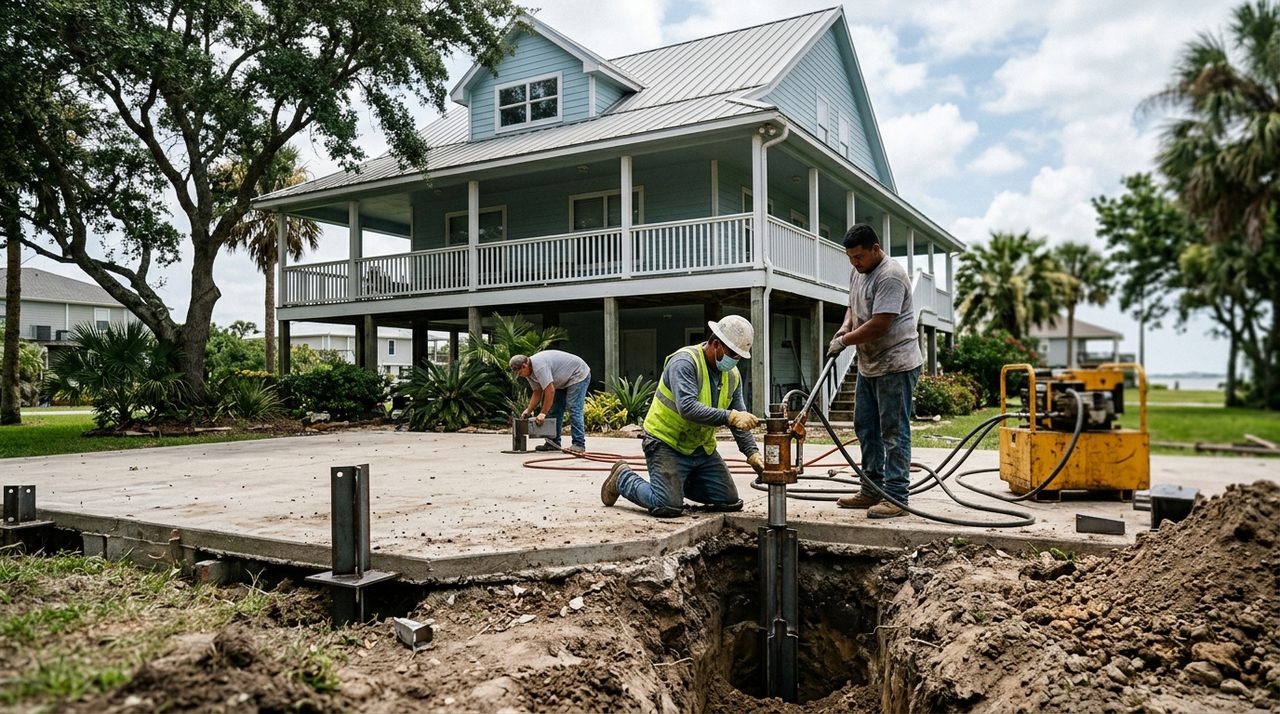
A qualified contractor should probe perimeter soil conditions and review any available flood depth records before diagnosing the cause of movement — do not assume soil shrinkage without confirming saturation history. For slab-on-grade homes that have settled post-surge, steel push piers driven to load-bearing strata (estimated $1,200–$1,800 per pier, 8–16 piers typical) are generally preferred over pressed concrete pilings in this coastal environment; helical piers are sometimes specified where soil stratification makes push-pier refusal unpredictable. All underpinning work on the island requires a permit through the City of Galveston Development Services Department — not Houston — and a site inspection is part of that process.
Sources: FEMA National Flood Hazard Layer (NFHL), Municipal permit office (see area profile)
Why it matters to you
Galveston's 19th- and early 20th-century Victorian homes — concentrated in the historic East End and Silk Stocking districts — commonly rest on wood pier-and-beam or original masonry pier foundations that have been exposed to decades of Gulf salt air and periodic flooding. Wood beam rot, corroded fasteners, and masonry pier spalling create differential movement that mimics the diagonal cracking patterns of slab failure but requires an entirely different repair approach. Because many of these properties fall within City of Galveston local historic districts, any visible exterior foundation work — including replacing wood piers or repointing masonry — may trigger preservation review under the city's own ordinances, which are entirely separate from Houston's HAHC process.
What a good pro does
Contractors should specify marine-grade, corrosion-resistant hardware and pressure-treated or composite replacement members rated for coastal exposure — standard interior-grade materials will fail prematurely in Galveston's salt-air environment. Before any pier replacement or perimeter trenching, verify with the City of Galveston Development Services Department whether the property is in a local historic district requiring separate preservation approval in addition to the standard structural permit. Homeowners should request written documentation of all replaced members and hardware specifications, as this record matters both for future permit inspections and for TREC seller-disclosure obligations at resale.
Sources: Municipal permit office (see area profile), Local HOA / deed restrictions (see area profile), International Residential Code (as adopted by City of Houston)
Why it matters to you
Winter Storm Uri (February 2021) ruptured cast-iron and older PVC under-slab drain lines in Galveston homes just as it did across the broader Houston metro. On an island where the water table is already elevated and flood exposure is routine, a slow under-slab plumbing leak is especially destructive: the saturated zone directly beneath the slab can cause localized heave followed by settlement as soil structure degrades, creating a pattern that looks like classic differential foundation movement but actually has a plumbing root cause. Galveston's census median year built is 1973, meaning a substantial share of the island's owner-occupied housing stock predates modern PVC and still has cast-iron drain lines at risk.
What a good pro does
Before signing any foundation repair contract — whether for slab lifting, pier installation, or void fill — insist that the contractor recommend a hydrostatic plumbing test performed by a plumber licensed by the Texas State Board of Plumbing Examiners (TSBPE). This test, which typically costs an estimated $250–$400, pressurizes the under-slab drain system to confirm or rule out active leaks. If a leak is confirmed, it must be repaired by a TSBPE-licensed plumber before any structural work proceeds; repairing the foundation over an ongoing leak will accelerate re-movement and void most contractor warranties.
Sources: Texas State Board of Plumbing Examiners, Municipal permit office (see area profile)
Why it matters to you
Because virtually all of Galveston Island sits in FEMA Zone AE, most homes with a mortgage or NFIP flood insurance policy require a current elevation certificate. Any foundation repair that alters the finished floor elevation — including slab lifting via mudjacking, polyurethane foam injection, or pier-based re-leveling — can invalidate an existing elevation certificate, potentially disrupting flood insurance rating at exactly the wrong moment. Texas TREC seller-disclosure forms require homeowners to disclose known foundation movement and prior repairs, so undocumented or unpermitted work surfaces as a legal and financial liability when the property changes hands. With Galveston's owner-occupancy rate at roughly 47 percent (ACS 2023), a large share of the island's housing stock turns over through the rental and resale market regularly.
What a good pro does
Before any repair that changes slab elevation, contact your flood insurance carrier to understand the rating impact and budget for an updated elevation certificate from a licensed surveyor after work is complete. Require your contractor to pull the appropriate permit through the City of Galveston Development Services Department and obtain a final inspection sign-off; this paper trail is your protection on the TREC disclosure form and demonstrates to a buyer's inspector that the work was done to code. Homeowners in subdivisions or condo associations should also check deed restrictions recorded with the Galveston County Clerk, as some developments require HOA or architectural review approval before exterior foundation work begins.
Sources: FEMA National Flood Hazard Layer (NFHL), Municipal permit office (see area profile), Local HOA / deed restrictions (see area profile)
Hiring foundation repair in Galveston? Galveston's housing stock spans from historic 19th-century Victorian homes to modern beach developments, creating an exceptionally diverse home service landscape. Homeowners must contend with persistent salt air corrosion, high flood risk across much of the island, and hurricane exposure that drives demand for wind-resistant roofing, elevated foundations, and robust moisture management. Permit jurisdiction falls under the City of Galveston Development Services Department or Galveston County, never the City of Houston Permitting Center.
Building era
Highly mixed — 1800s historic core through 21st-century beach and master-planned construction.
Typical style
Mix of Victorian, Gulf Coast vernacular, raised beach houses, mid-century ranch, and modern coastal developments; no single dominant style across the area.
Foundations
Mixed — many historic and coastal homes on pier-and-beam or raised pilings; newer mainland construction often slab-on-grade. Not confirmed at subdivision level — check property records.
Common systems
Older homes may have outdated electrical and galvanized plumbing requiring upgrades; coastal properties require corrosion-resistant HVAC equipment rated for salt air environments; newer builds typically feature modern central HVAC and PEX or copper plumbing.
What that means for repairs
Historic restoration is common in Galveston's core; coastal properties frequently undergo elevation projects, hurricane hardening, and replacement of salt-air-corroded exterior systems. Flood damage repair drives significant renovation activity across all housing types.
Permit jurisdiction
City of Galveston Development Services Department (within city limits); individual incorporated cities handle their own permitting elsewhere in Galveston County; unincorporated areas fall under Galveston County jurisdiction. Not the City of Houston Permitting Center.
HOA & deed restrictions
No county-wide mandatory HOA. HOAs exist at the subdivision, condo, and master-planned community level. Many single-family homes in Galveston have no HOA. Check deed restrictions recorded with the Galveston County Clerk for specific properties.
Historic districts
No City of Houston historic district designation — Galveston is outside Houston's jurisdiction. The City of Galveston maintains its own historic preservation program and local historic districts, governed by Galveston's ordinances separate from Houston's HAHC.
Contractor note
Contractors must verify whether work falls within City of Galveston, another incorporated Galveston County city, or unincorporated county jurisdiction, as permitting requirements and floodplain regulations differ significantly. Properties in local historic districts within the City of Galveston may require additional preservation review separate from any Houston process.
FEMA flood zone
FEMA Zone AE (high flood risk) — source: fema_nfhl. Galveston's island geography and coastal exposure create significant flood risk from both storm surge and rainfall. Proximity to the Gulf of Mexico and Galveston Bay compounds risk across most of the area.
Hurricane Harvey impact
Hurricane Harvey's flood impacts in Galveston County were highly localized and varied by precise location — bayfront vs. mainland interior, creek proximity, and elevation. Specific street-level flooding data for this area could not be confirmed without a more precise subdivision or address — check FEMA Harvey flood inundation maps and Galveston County floodplain administrator reports for property-specific history.
Heat & humidity load
Extreme humidity and salt air accelerate corrosion of HVAC condensers, metal roofing components, and exterior fasteners. Summer heat combined with coastal moisture drives high demand for dehumidification, mold remediation, and HVAC maintenance. Prolonged UV exposure degrades exterior paint and sealants faster than inland areas.
Working with contractors here
Contractors in Galveston most commonly work on flood damage repair, foundation elevation projects, hurricane-hardening (impact windows, fortified roofing), and replacement of salt-air-corroded exterior systems including HVAC condensers, metal railings, and fasteners. The wide range of housing eras means contractors must be prepared for both historic restoration requiring period-appropriate materials and modern coastal construction techniques. Job scoping should always include assessment of flood history, current elevation relative to base flood elevation, and whether the property falls within a City of Galveston historic district requiring preservation review. Corrosion-resistant materials and marine-grade hardware should be specified as standard for any exterior work.
Local Tip
Always ask for a written estimate before work begins. Texas contractors are required to provide one on jobs over $1,000.
Galveston's housing stock spans from historic 19th-century Victorian homes to modern beach developments, creating an exceptionally diverse home service landscape. Homeowners must contend with persistent salt air corrosion, high flood risk across much of the island, and hurricane exposure that drives demand for wind-resistant roofing, elevated foundations, and robust moisture management. Permit jurisdiction falls under the City of Galveston Development Services Department or Galveston County, never the City of Houston Permitting Center.
Source: U.S. Census Bureau, ACS 5-Year 2023
On Galveston Island, storm surge and Gulf wind are the defining hazards: much of Galveston sits in FEMA Zone AE coastal high-hazard territory, so wind-rated, elevation- and surge-aware work is the baseline, not an upgrade.
Source: FEMA National Flood Hazard Layer (NFHL). Flood zones vary by parcel — verify your individual FIRM panel.
Salt-laden surge water accelerates corrosion of steel pier shafts and any exposed rebar in concrete grade beams, so a post-hurricane inspection in Galveston, TX should explicitly include probing for rust jacking that can crack surrounding concrete from the inside. Beryl 2024's storm surge along Galveston Bay illustrates why coastal homeowners need a foundation assessment within two weeks of any surge event, well before cosmetic repairs obscure structural evidence. Much of the housing stock predates modern wind codes (median build year 1973), so retrofits matter more here. Confirm the current FEMA panel for your Galveston parcel — the area maps to Zone AE, but adjacent lots can differ.
Coastal Galveston, TX properties face combined salt-air corrosion and intense storm-cell winds that together degrade the steel components in both helical piers and push-pier systems faster than inland sites. After the May 2024 derecho-level events, inspect exposed pier hardware and any visible grade-beam connections for rust staining that indicates accelerated corrosion requiring sealing or protective coating. Confirm the current FEMA panel for your Galveston parcel — the area maps to Zone AE, but adjacent lots can differ.
Winter Storm Uri forced many Houston homeowners to run emergency heat sources that generated condensation, and in coastal Galveston, TX that added interior moisture combined with cold exterior temperatures can increase relative humidity under pier-and-beam structures enough to begin softening wood sill plates over the bearing points. Have your foundation repair contractor check wood components of any pier-and-beam system in the first warm-weather inspection window after a significant freeze. With a median build year of 1973, the older building stock here is more exposed to hard-freeze damage than newer construction. As a Galveston County community, Galveston may follow county rather than City of Houston storm rebuild rules.
Sources: FEMA National Flood Hazard Layer (NFHL), Ready.gov -- Hurricanes, CenterPoint Energy -- Storm Center, City of Houston -- Emergency Preparedness, Ready.gov -- Winter Weather, Harris County Flood Control District
Houston-specific estimators to plan your project before you call a pro. All results are planning estimates — a licensed local pro confirms the details on site.
Grouped by mature root aggression & water demand.
Trunk center to the nearest exterior wall.
The root zone likely reaches your foundation's soil during Houston's dry summers, when clay shrinks most. Watch for sticking doors and diagonal cracks, keep soil moisture even with a soaker hose during drought, and have a foundation pro evaluate if you see any movement.
Find a Houston foundation pro →This is a planning estimate only — actual requirements depend on an on-site assessment by a licensed Houston pro. Guidance is based on general species root behavior in expansive clay, not a soil test.
Disconnect & drain every outdoor hose bib
Remove hoses, drain the spigots, and cover each with an insulated faucet sock. Un-drained hose bibs are the #1 burst point in a Houston freeze.
Insulate exposed pipes in the attic & garage
Wrap any pipe in an unconditioned space (attic runs, garage walls) with foam sleeves. Houston homes rarely insulate these because they only matter a few nights a year — which is exactly why they burst.
Open cabinet doors & keep a pencil-width drip
On hard-freeze nights, open kitchen/bath cabinets so warm air reaches the pipes and let faucets on exterior walls drip to relieve pressure.
Protect the attic/garage water heater & its lines
An attic or garage tank sits in unconditioned space. Insulate the cold-inlet and hot-outlet lines and confirm the emergency drain pan is clear so a leak doesn't reach the ceiling.
This is a planning estimate only — actual requirements depend on an on-site assessment by a licensed Houston pro. If a pipe has already burst, shut off your main water supply and call a licensed Houston plumber immediately — freeze bursts flood fast.
Sources: Municipal permit office (see area profile)
Sources: Municipal permit office (see area profile)
Sources: FEMA National Flood Hazard Layer (NFHL)Municipal permit office (see area profile)