Closed
951 FM 646 Rd, League City, TX 77573
League City's slab-on-grade homes — the vast majority built between the 1990s and 2010s in master-planned subdivisions like Bay Colony, Tuscan Lakes, and Victory Lakes — sit atop Galveston County's expansive Beaumont and Houston Black clay formations, where the wet/dry swing between Gulf Coast rain events and La Niña drought years creates relentless seasonal movement. Coastal humidity, the Clear Creek watershed nearby, and a median year-built of 2002 (U.S. Census Bureau, ACS 5-Year 2023) make foundation behavior here meaningfully different from older inner-loop Houston neighborhoods. All underpinning work requires permits through the City of League City Building & Permits Division — not the Houston Permitting Center — and most newer subdivisions add an HOA architectural review step before exterior excavation can even begin.
Ranked by verified Google rating × review volume × verification tier. How we rank →
Some highly-rated pros serve League City from nearby and may not keep a League City street address. Those are listed under "Also serving League City" with their real city and distance, so you always know where each business is based.
951 FM 646 Rd, League City, TX 77573
1898 Louisiana Ave, League City, TX 77573
2925 Gulf Fwy S Suite B #456, League City, TX 77573
906 E Main St, League City, TX 77573
2640 E League City Pkwy Suite 104-981, League City, TX 77573
1220 E Main St, League City, TX 77573
Highly-rated pros based nearby who cover League City. Distance shown from the League City area.
Serving League City Based in Webster · 2.6 mi away
Serving League City Based in Dickinson · 2.9 mi away
Serving League City Based in Webster · 3.1 mi away
Serving League City Based in Clear Lake · 3.3 mi away
Why it matters to you
The majority of League City's housing stock — the suburban tracts in South Shore Harbour, Victory Lakes, Magnolia Creek, and similar communities — was built between 1995 and 2015 on Galveston County's expansive Beaumont clay. The La Niña-driven drought years of 2022–2023 baked the soil, pulling it away from slab edges and leaving perimeter voids that offer zero bearing support. When Gulf Coast rains return, water channels directly into those gaps rather than soaking in gradually, rapidly undercutting the beam. Homeowners in these subdivisions often notice sticking interior doors or diagonal drywall cracks before any visible exterior soil gap appears.
What a good pro does
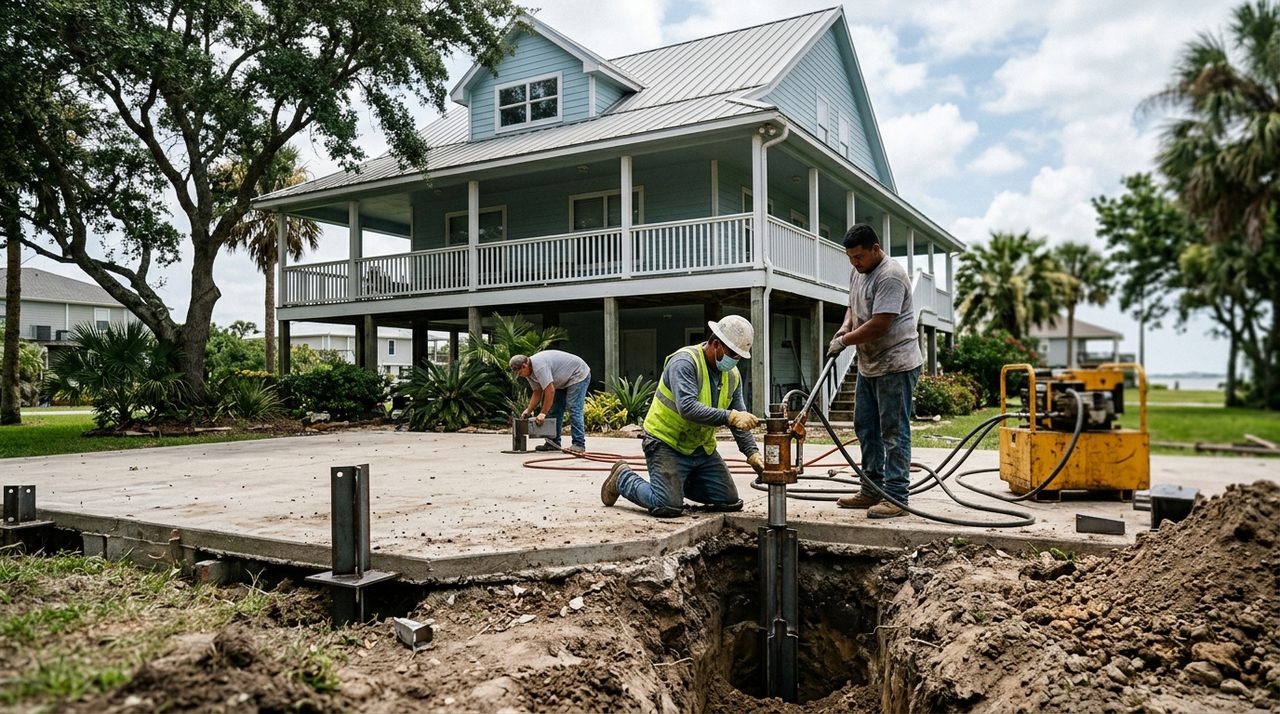
A qualified contractor will probe the perimeter with a moisture meter and examine beam exposure before recommending any lifting method. For a 2,000 sq ft slab with localized void issues, polyurethane foam injection ($2,000–$5,000 estimated) can fill voids without full pier underpinning — but only if differential movement is under half an inch. If movement is greater, steel push piers ($1,200–$1,800 per pier estimated, typically 8–16 piers) reaching load-bearing soil below the clay are the appropriate fix. The contractor must pull a permit through the City of League City Building & Permits Division before work begins.
Sources: Municipal permit office (see area profile), International Residential Code (as adopted by City of Houston)
Why it matters to you
Virtually every major League City subdivision built after 1990 — Bay Colony, Tuscan Lakes, Victory Lakes, South Shore Harbour, and others — operates under a mandatory HOA with an architectural review committee. Trenching around the slab perimeter to install steel push piers is an exterior modification that most of these HOAs require pre-approval to perform, separate from and in addition to the City of League City permit. Homeowners who allow contractors to begin without HOA sign-off risk stop-work orders and fines, and some HOAs also restrict the hours and staging areas for construction equipment — all details that affect project timelines and cost.
What a good pro does
Before signing any repair contract, submit the contractor's written scope of work and pier layout diagram to your subdivision's architectural review committee. Build a two-to-four week HOA approval window into the project schedule — most League City HOAs have defined review periods. Once HOA approval is in hand, the contractor files for the City of League City permit; inspections are scheduled through the city's Building & Permits Division, not Galveston County. Confirm both the HOA approval letter and the permit number in writing before excavation starts.
Sources: Local HOA / deed restrictions (see area profile), Municipal permit office (see area profile)
Why it matters to you
While most of League City is newer construction, the original 1960s–1980s ranch-style homes clustered near the historic Main Street corridor frequently have cast-iron under-slab drain lines that were stressed or cracked during Winter Storm Uri in February 2021. Many of those repairs addressed only visible interior pipe breaks; under-slab lines were left partially compromised. Ongoing slow leaks saturate the Beaumont clay directly beneath the slab, causing localized heave followed by settlement as the soil structure breaks down — a pattern that mimics classic drought-cycle movement and is easily misdiagnosed without a plumbing test. These older homes also sit closer to Clear Creek, where soil moisture levels fluctuate more than in the newer inland subdivisions.
What a good pro does
Any foundation contractor evaluating settlement in a League City home built before 1990 should require a hydrostatic plumbing test ($250–$400 estimated) before attributing movement to soil alone. The test is performed by a plumber licensed through the Texas State Board of Plumbing Examiners (TSBPE). If under-slab leaks are confirmed, the plumbing scope must be repaired by a TSBPE-licensed plumber and permitted separately through the City of League City before foundation underpinning begins — fixing the slab over a continuing leak accelerates future failure.
Sources: Texas State Board of Plumbing Examiners, Municipal permit office (see area profile), International Residential Code (as adopted by City of Houston)
Why it matters to you
League City homeowners receiving multiple foundation repair quotes often find wildly different recommendations — pressed concrete pilings, steel push piers, or helical piers — at price points ranging from roughly $3,500 to $25,000 or more (all estimates). The divergence is partly legitimate: Galveston County's clay profile is deep, and push piers must be driven until they reach refusal in load-bearing soil, which varies by block and proximity to Clear Creek's fill zones. Pressed concrete pilings, common in 1980s–1990s construction throughout the Houston metro, are now viewed skeptically by many structural engineers because they can't be driven to refusal depth in deep clay and have higher failure rates over time. Helical piers are sometimes recommended near the bayou edges where soil is softer and push pier refusal depth is unreliable.
What a good pro does
Request that every written proposal specify the pier type, the number of piers, the target installation depth or refusal criteria, and whether a third-party engineer will verify the work. Steel push piers at $1,200–$1,800 per pier (estimated) with engineer-verified depth documentation offer the most defensible long-term performance on League City's deep clay. Texas does not have a standalone state license for foundation repair contractors through TDLR, so insurance verification — general liability plus workers' compensation — and permit confirmation through the City of League City are the primary homeowner protections. Get at least three proposals with comparable pier counts before committing.
Sources: Texas Department of Licensing & Regulation, Municipal permit office (see area profile), International Residential Code (as adopted by City of Houston)
Hiring foundation repair in League City? League City is one of the largest and fastest-growing cities in Galveston County, with housing stock spanning from 1960s-era originals near the historic downtown to expansive master-planned communities built from the 1990s through today. Homeowners here contend with coastal humidity, salt air corrosion, and proximity to Clear Creek and Dickinson Bayou watersheds. The city manages its own permitting and code enforcement, making it distinct from unincorporated Galveston County areas.
Building era
1960s–2020s, with the majority of residential growth occurring from the 1990s onward in master-planned subdivisions.
Typical style
Single-story and two-story suburban tract homes in newer subdivisions (Bay Colony, South Shore Harbour, Tuscan Lakes, Victory Lakes); older ranch-style and traditional homes near historic League City downtown.
Foundations
Predominantly slab-on-grade across all eras.
Common systems
Newer homes (2000s+) feature high-efficiency central HVAC, PEX or CPVC plumbing, and 200-amp electrical panels. Older 1960s–1980s homes may have original copper or galvanized plumbing, R-22 refrigerant HVAC systems, and 100–150 amp panels.
What that means for repairs
Older homes near downtown League City commonly undergo full HVAC replacement, plumbing re-pipes, and kitchen/bath remodels. Newer master-planned communities see cosmetic upgrades, fence replacements, and outdoor living additions. Coastal proximity drives demand for exterior paint, siding repair, and roof maintenance due to salt air and wind.
Permit jurisdiction
City of League City Building & Permits Division (300 W. Walker St., League City, TX 77573). League City is a fully incorporated municipality with its own permitting, inspections, and code enforcement — not governed by Galveston County engineering or the Houston Permitting Center.
HOA & deed restrictions
Most newer subdivisions (Bay Colony, South Shore Harbour, Tuscan Lakes, Victory Lakes, Magnolia Creek, etc.) have mandatory HOAs with architectural review committees. The City of League City maintains an HOA Alliance program facilitating communication between the city and neighborhood HOAs. Older areas near downtown may lack mandatory HOAs and rely on deed restrictions or voluntary civic organizations. Specific HOA names vary by subdivision — not confirmed for all areas; check Galveston County Clerk records.
Historic districts
No City of Houston historic district designation confirmed. League City has its own local historic preservation efforts centered around the original townsite near Main Street, but these are governed by the City of League City, not HAHC.
Contractor note
Contractors must obtain permits through the City of League City and comply with local building codes, which incorporate wind-resistant construction standards due to coastal proximity. Many HOAs require architectural review committee approval before exterior modifications begin.
FEMA flood zone
FEMA Zone X (low flood risk) — source: fema_nfhl. However, portions of League City near Clear Creek, Dickinson Bayou, and their tributaries fall within higher-risk flood zones (A and AE). Homeowners should verify their specific parcel, as flood risk varies significantly across this geographically large city.
Hurricane Harvey impact
Hurricane Harvey (2017) brought significant flooding to portions of League City, particularly along Clear Creek and in low-lying areas near Dickinson Bayou. South Shore Harbour, parts of Bay Colony, and neighborhoods adjacent to waterways experienced notable flooding. The city saw widespread damage, though many newer elevated-pad subdivisions fared better. Specific impact varied block by block — homeowners should check individual property flood history through Galveston County and FEMA records.
Heat & humidity load
League City's coastal location brings extreme humidity, salt air exposure, and Gulf storm risk from June through November. HVAC systems run heavily from May to October, driving demand for annual maintenance, refrigerant checks, and ductwork inspections. Exterior materials — especially metal fixtures, fasteners, and painted surfaces — degrade faster due to salt air corrosion. Roofing inspections are critical given wind exposure from tropical weather systems.
Working with contractors here
Contractors in League City most commonly handle HVAC servicing and replacement, roof repair and replacement (especially after storm seasons), and plumbing work ranging from re-pipes in older homes to fixture upgrades in newer builds. The wide range of housing ages means contractors must be prepared for both modern systems in 2010s-era homes and aging infrastructure in 1960s–1980s properties near downtown. Exterior work — painting, siding repair, fence replacement, and window sealing — is in constant demand due to salt air and humidity. Many jobs in master-planned communities require HOA architectural approval before work begins, so contractors should build pre-approval timelines into project scoping. Wind-rated materials and proper hurricane strap installation are important selling points for roofing and structural contractors given the coastal wind exposure.
Local Tip
Always ask for a written estimate before work begins. Texas contractors are required to provide one on jobs over $1,000.
League City is one of the largest and fastest-growing cities in Galveston County, with housing stock spanning from 1960s-era originals near the historic downtown to expansive master-planned communities built from the 1990s through today. Homeowners here contend with coastal humidity, salt air corrosion, and proximity to Clear Creek and Dickinson Bayou watersheds. The city manages its own permitting and code enforcement, making it distinct from unincorporated Galveston County areas.
Source: U.S. Census Bureau, ACS 5-Year 2023
Most of League City maps to FEMA Zone X (low mapped flood risk), but Houston's flash-flood reality means even low-risk blocks benefit from smart drainage and storm-hardened installs; risk climbs sharply on blocks nearest Clear Creek and Galveston Bay, where it varies parcel to parcel.
Source: FEMA National Flood Hazard Layer (NFHL). Flood zones vary by parcel — verify your individual FIRM panel.
Houston's flash-flood reality means even low-mapped-risk areas like League City, TX can see sheet flow accumulate against a foundation during a slow-moving Gulf system, so verify that your perimeter drainage is clear and properly sloped before hurricane season opens. A TDLR-licensed foundation contractor can add or reposition surface drains to intercept runoff before it softens the clay bearing layer beneath your slab. Confirm the current FEMA panel for your League City parcel — the area maps to Zone X, but adjacent lots can differ.
Even with low mapped flood risk, League City, TX is not immune to the localized sheet flow that accompanies a Houston severe thunderstorm, and repeated minor inundation at the foundation perimeter sustains the clay moisture that drives slow heave cycles. A pre-storm season inspection confirming that soil grade, splash blocks, and downspout extensions all direct water away from the slab is the most cost-effective foundation repair step you can take. As a Galveston County community, League City may follow county rather than City of Houston storm rebuild rules.
Winter Storm Uri's multi-day freeze caused Houston clay soils to go through freeze-thaw cycling not common in the region, and even low-flood-risk neighborhoods in League City, TX saw new door-sticking and brick-step cracking appear in the spring following the storm. A post-winter Zip-Level survey establishes whether that movement is seasonal and self-correcting or progressive and in need of pier work before summer drying amplifies the differential. Because League City drains toward Clear Creek and Galveston Bay, block-level runoff can differ sharply from the mapped zone.
Sources: FEMA National Flood Hazard Layer (NFHL), Ready.gov -- Hurricanes, CenterPoint Energy -- Storm Center, City of Houston -- Emergency Preparedness, Ready.gov -- Winter Weather, Harris County Flood Control District
Houston-specific estimators to plan your project before you call a pro. All results are planning estimates — a licensed local pro confirms the details on site.
Grouped by mature root aggression & water demand.
Trunk center to the nearest exterior wall.
The root zone likely reaches your foundation's soil during Houston's dry summers, when clay shrinks most. Watch for sticking doors and diagonal cracks, keep soil moisture even with a soaker hose during drought, and have a foundation pro evaluate if you see any movement.
Find a Houston foundation pro →This is a planning estimate only — actual requirements depend on an on-site assessment by a licensed Houston pro. Guidance is based on general species root behavior in expansive clay, not a soil test.
Disconnect & drain every outdoor hose bib
Remove hoses, drain the spigots, and cover each with an insulated faucet sock. Un-drained hose bibs are the #1 burst point in a Houston freeze.
Insulate exposed pipes in the attic & garage
Wrap any pipe in an unconditioned space (attic runs, garage walls) with foam sleeves. Houston homes rarely insulate these because they only matter a few nights a year — which is exactly why they burst.
Open cabinet doors & keep a pencil-width drip
On hard-freeze nights, open kitchen/bath cabinets so warm air reaches the pipes and let faucets on exterior walls drip to relieve pressure.
Protect the attic/garage water heater & its lines
An attic or garage tank sits in unconditioned space. Insulate the cold-inlet and hot-outlet lines and confirm the emergency drain pan is clear so a leak doesn't reach the ceiling.
This is a planning estimate only — actual requirements depend on an on-site assessment by a licensed Houston pro. If a pipe has already burst, shut off your main water supply and call a licensed Houston plumber immediately — freeze bursts flood fast.
Sources: Municipal permit office (see area profile)
Sources: FEMA National Flood Hazard Layer (NFHL)Harris County Flood Control District
Sources: Local HOA / deed restrictions (see area profile)Municipal permit office (see area profile)
Sources: Texas Department of Licensing & RegulationTexas State Board of Plumbing ExaminersMunicipal permit office (see area profile)