Closed
2310 State Hwy 3 A, Dickinson, TX 77539
Dickinson sits squarely in FEMA Zone AE along Dickinson Bayou, meaning the city's 1950s–1970s pier-and-beam cottages and 1990s–2010s slab-on-grade subdivisions like Bay Colony and Centerfield Lakes face a foundation threat that almost no other Houston suburb combines so sharply: prolonged flood saturation from Harvey (2017) and Beryl (2024) layered on top of Beaumont-series expansive clay, with the added complication that 'substantial improvement' rules under FEMA can be triggered the moment a repair crosses 50 percent of the structure's pre-damage value. Understanding which repair method fits your home's era and flood-zone reality — and pulling the right permit through the City of Dickinson's own permit office, not Houston's — is what separates a lasting fix from a liability at resale.
Ranked by verified Google rating × review volume × verification tier. How we rank →
Some highly-rated pros serve Dickinson from nearby and may not keep a Dickinson street address. Those are listed under "Also serving Dickinson" with their real city and distance, so you always know where each business is based.
2310 State Hwy 3 A, Dickinson, TX 77539
3707 Fatta Dr #107, Dickinson, TX 77539
1202 Poston Rd, Dickinson, TX 77539
751 16th St, Dickinson, TX 77539
Highly-rated pros based nearby who cover Dickinson. Distance shown from the Dickinson area.
Serving Dickinson Based in EaDo · 1 mi away
Serving Dickinson Based in League City · 1.8 mi away
Serving Dickinson Based in League City · 2.5 mi away
Serving Dickinson Based in League City · 3.3 mi away
Serving Dickinson Based in League City · 4.2 mi away
Serving Dickinson Based in League City · 4.2 mi away
Why it matters to you
Much of Dickinson took on standing water for days during Harvey in 2017 and again during Beryl in 2024. Prolonged saturation reconsolidates the expansive Beaumont clay under and around slab-on-grade foundations, and the resulting settlement can appear weeks or even months after floodwater recedes — not immediately after the storm. Homeowners in the Bay Colony and Centerfield Lakes subdivisions whose 1990s-era slabs were already stressed by the 2022–2023 drought cycle are especially likely to see stair-step cracks at brick corners or doors that no longer latch, because the slab has dropped unevenly on the bayou-facing side.
What a good pro does
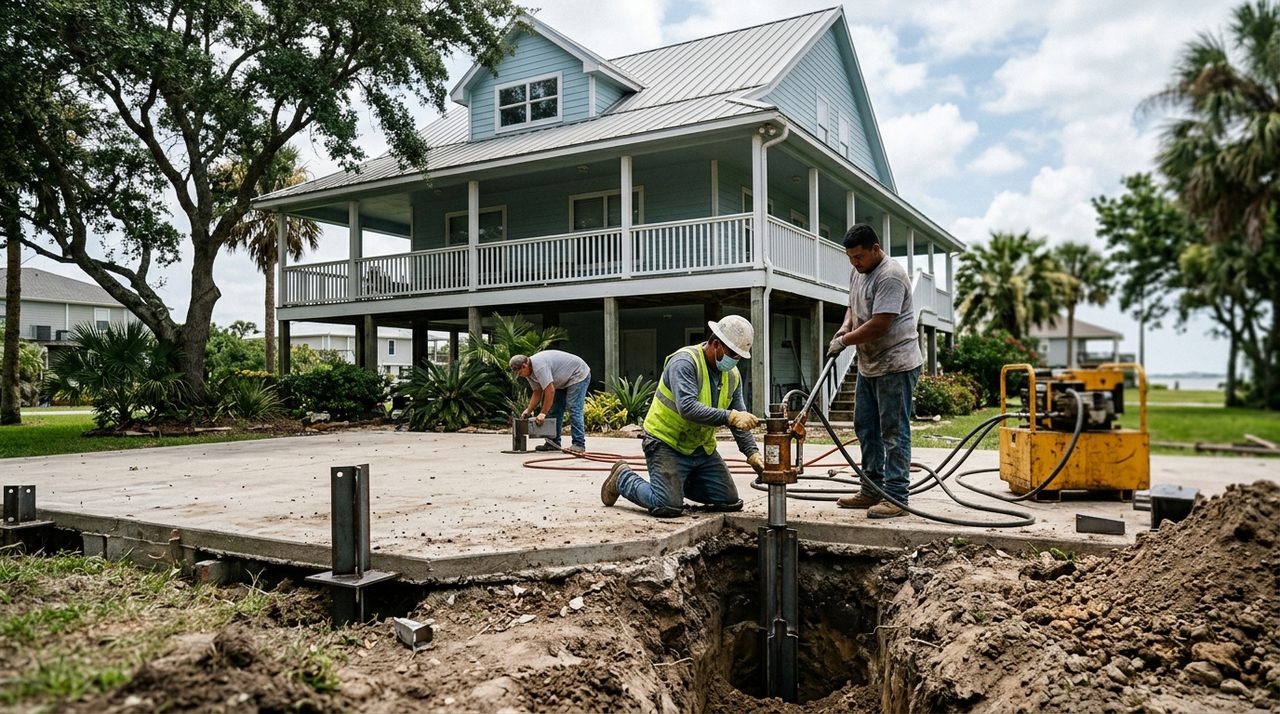
A qualified foundation contractor working in Dickinson should document the home's flood history before proposing any repair, compare floor-elevation readings taken at multiple slab corners, and recommend steel push piers (typically $1,200–$1,800 per pier installed, est.) anchored below the zone of seasonal clay movement rather than pressed concrete pilings, which have higher failure rates in repeatedly saturated soils. All underpinning work requires a permit through the City of Dickinson Permit Office — not the Houston Permitting Center — and the inspector's sign-off should be in hand before any trench is backfilled.
Sources: FEMA National Flood Hazard Layer (NFHL), Harris County Flood Control District, Municipal permit office (see area profile)
Why it matters to you
Dickinson's pre-1980 ranch and split-level homes near Dickinson Bayou were built with cast-iron under-slab or under-pier drain lines that have now endured not only 40-plus years of corrosion but the freeze-thaw shock of Winter Storm Uri in February 2021. Many post-Uri repairs in this part of Galveston County were cosmetic — walls patched, but cracked under-slab lines left in place. A slow drain leak under a slab or beneath a pier-and-beam crawl space saturates the clay locally, first causing heave and then settlement as the soil structure breaks down; a homeowner may be quoted a pier job when the real culprit is a $400 plumbing test away from being identified.
What a good pro does
Before signing any foundation repair contract on a Dickinson home built before 1985, insist on a hydrostatic plumbing test performed or supervised by a plumber licensed through the Texas State Board of Plumbing Examiners (TSBPE). If the test fails, the drain-line repair should be completed and allowed to dry out for at least 30–60 days before re-evaluating whether pier work is still necessary. This sequencing can save homeowners thousands of dollars in unnecessary underpinning.
Sources: Texas State Board of Plumbing Examiners, Municipal permit office (see area profile), International Residential Code (as adopted by City of Houston)
Why it matters to you
Unlike the production-builder slabs in Bay Colony or Bayou Maison, Dickinson's 1950s–1970s elevated pier-and-beam homes near the bayou were designed to flex and can tolerate moderate differential movement — but repeated flood saturation rots wood beam sills and undermine concrete piers that were set in loosely compacted fill adjacent to the bayou channel. Homeowners who assume that a pier-and-beam house 'can't have foundation problems the same way a slab can' often wait too long, arriving at a point where the center-beam sill has deteriorated and interior floors slope noticeably toward the water side of the lot.
What a good pro does
Repair on pier-and-beam structures in Dickinson typically involves replacing rotted wood sills with treated lumber or steel, re-leveling or adding concrete piers, and addressing any grade-beam erosion at the perimeter. Because this work involves structural modification, a permit from the City of Dickinson is required; the permit office also coordinates with Galveston County for properties in the FEMA AE flood zone where substantial-improvement thresholds apply. Get written proposals that specify materials, pier depths, and whether the contractor's scope includes repairing or sistering the center beam — not just shimming piers.
Sources: Municipal permit office (see area profile), FEMA National Flood Hazard Layer (NFHL), International Residential Code (as adopted by City of Houston)
Why it matters to you
Homes in Bay Colony (managed by Goodwin & Co.), Centerfield Lakes, Bayou Maison, and Bayou Park III are governed by mandatory HOA CC&Rs that require architectural committee approval before exterior work — including any trenching around the foundation perimeter or visible pier installation. Separately, because these subdivisions sit in FEMA Zone AE, any repair that alters the finished floor elevation can affect the validity of an existing elevation certificate, which is a required document at sale for flood-insurance rating purposes. Texas sellers must also disclose known foundation movement and all prior repairs on the TREC Seller's Disclosure form, so undocumented or unpermitted work becomes a direct financial and legal liability.
What a good pro does
Before excavating a single trench in an HOA-governed Dickinson subdivision, submit the repair scope to the relevant architectural review committee and get written approval. Simultaneously, confirm with your foundation contractor that they will pull a permit through the City of Dickinson Permit Office and provide you with a copy of the final inspection record. If your home has had any prior foundation work, obtain an updated elevation certificate from a licensed surveyor after repairs are complete — particularly if piers raised any portion of the slab — so your flood insurance rating and resale disclosure are both accurate.
Sources: Local HOA / deed restrictions (see area profile), FEMA National Flood Hazard Layer (NFHL), Municipal permit office (see area profile)
Hiring foundation repair in Dickinson? Dickinson is an incorporated Galveston County city with a wide mix of housing stock—from 1950s–1970s bayou-adjacent homes to 1990s–2010s master-planned subdivisions like Bay Colony and Centerfield Lakes. Situated along Dickinson Bayou in FEMA Zone AE, flood mitigation, foundation repair, and post-storm restoration are central to the home services landscape. Contractors must navigate a patchwork of HOA-governed subdivisions with strict CC&Rs alongside older, unrestricted lots with different structural and regulatory demands.
Building era
1950s–1970s in older bayou-adjacent areas; 1990s–2010s in master-planned subdivisions (Bay Colony, Centerfield Lakes, Bayou Maison, Bayou Park).
Typical style
Production-builder traditional brick veneer in HOA subdivisions (1- and 2-story); ranch-style, split-level, and elevated structures in older bayou-adjacent areas; some manufactured homes and cottages in non-HOA sections.
Foundations
Mixed — concrete slab-on-grade dominates in modern subdivisions; pier-and-beam and elevated pier foundations more common in older bayou-adjacent and lower-lying areas.
Common systems
Modern subdivisions: central A/C with gas or electric furnace, copper or PEX plumbing, 200-amp electrical panels. Older homes: may have original galvanized or cast-iron plumbing, window units or aging central HVAC, and 100- to 150-amp electrical service. Post-Harvey replacements are common across both eras.
What that means for repairs
Post-Harvey flood restoration drove massive renovation activity including full drywall replacement, mold remediation, HVAC replacement, and re-flooring. Ongoing renovation focuses on flood-proofing measures such as foundation elevation, installation of flood vents, and upgraded drainage systems. Older homes near the bayou frequently undergo full gut renovations or elevation projects.
Permit jurisdiction
City of Dickinson Permit Office (incorporated city in Galveston County; does not use Houston Permitting Center).
HOA & deed restrictions
No city-wide HOA. Many subdivisions have mandatory HOAs with recorded CC&Rs, including Bay Colony Community Association (managed by Goodwin & Co.), Centerfield Lakes HOA Inc. (mandatory POA), Bayou Maison HOA (mandatory), and Bayou Park III HOA. Hundreds of homes in Dickinson have no HOA at all, particularly in older areas and individual lots.
Historic districts
No historic district designation confirmed for Dickinson. The city does not have a Houston-style HAHC review process.
Contractor note
Contractors must pull permits through the City of Dickinson and should verify whether the property is in an HOA-governed subdivision with architectural review requirements before beginning exterior work. Flood zone AE designation triggers additional FEMA compliance requirements for substantial improvements or new construction.
FEMA flood zone
FEMA Zone AE (high flood risk) — source: fema_nfhl. Dickinson Bayou runs through the heart of the city, and extensive areas along the bayou and its tributaries are within the AE regulatory floodway and 100-year floodplain.
Hurricane Harvey impact
Dickinson was one of the hardest-hit communities in the entire Houston region during Hurricane Harvey (2017). Dickinson Bayou overflowed massively, inundating large portions of the city. Thousands of homes flooded and the city became a national example of Harvey's devastation. Both HOA subdivisions and older bayou-adjacent neighborhoods experienced severe damage. Many homes required full gut renovations, and some were demolished or elevated post-storm.
Heat & humidity load
High heat and extreme humidity accelerate mold growth in flood-damaged or poorly ventilated structures, a persistent concern given the neighborhood's flood history. Slab foundations in clay soils can shift during summer drought cycles, and aging HVAC systems in older homes are heavily stressed. Coastal proximity adds salt-air corrosion risk to outdoor HVAC condensers, metal roofing, and exterior fixtures.
Working with contractors here
Flood damage restoration and prevention dominate the contractor landscape in Dickinson—mold remediation, drywall replacement, foundation repair, and home elevation projects are consistently in demand due to the AE flood zone designation and Harvey's lasting impact. Plumbing contractors frequently encounter corroded galvanized lines in older bayou-adjacent homes and post-flood pipe replacement needs. HVAC replacement is common across both eras of housing, as many systems were destroyed in Harvey or are aging out in 1990s-era subdivisions. Contractors working in HOA communities like Bay Colony or Centerfield Lakes should obtain architectural approval before exterior modifications. Job scoping in Dickinson must always account for flood history—checking for prior water intrusion, assessing foundation elevation relative to base flood elevation, and confirming whether the property triggers FEMA substantial improvement thresholds.
Local Tip
Always ask for a written estimate before work begins. Texas contractors are required to provide one on jobs over $1,000.
Dickinson is an incorporated Galveston County city with a wide mix of housing stock—from 1950s–1970s bayou-adjacent homes to 1990s–2010s master-planned subdivisions like Bay Colony and Centerfield Lakes. Situated along Dickinson Bayou in FEMA Zone AE, flood mitigation, foundation repair, and post-storm restoration are central to the home services landscape. Contractors must navigate a patchwork of HOA-governed subdivisions with strict CC&Rs alongside older, unrestricted lots with different structural and regulatory demands.
Source: U.S. Census Bureau, ACS 5-Year 2023
Much of Dickinson maps to FEMA Zone AE (high flood risk), so flood-resilient detailing -- elevated equipment, water-tolerant materials, and drainage-first thinking -- is essential here, not optional; risk climbs sharply on blocks nearest Dickinson Bayou, where it varies parcel to parcel.
Source: FEMA National Flood Hazard Layer (NFHL). Flood zones vary by parcel — verify your individual FIRM panel.
Wind-uplift forces transferred through a coastal structure's framing to its foundation connections are as damaging as surge inundation in Dickinson, TX, and a licensed foundation repair contractor should verify that anchor bolts and mudsill connections to the foundation remain tight and uncorroded each season. Surge scour around exterior piers should be evaluated immediately after a hurricane, since even partial undermining of a bell-bottom footing can cause progressive settlement once the soil dries and reconsolidates. Confirm the current FEMA panel for your Dickinson parcel — the area maps to Zone AE, but adjacent lots can differ.
Wind-driven rain infiltration beneath a coastal elevated slab or through a compromised mudsill in Dickinson, TX can saturate the bearing soil between piles rapidly, and that moisture fluctuation compresses and loosens pile-to-grade connections over time. Have your foundation repair specialist confirm that any open crawl-space vents are protected against wind-driven rain entry before severe storm season peaks in late spring and summer. Confirm the current FEMA panel for your Dickinson parcel — the area maps to Zone AE, but adjacent lots can differ.
Hard freezes in Dickinson, TX rarely involve the prolonged clay saturation of inland floodplain areas, but burst pipes in coastal homes often discharge into sandy or shell-fill subgrade that drains poorly and holds water near concrete grade beams longer than expected. Confirm with a TDLR-licensed foundation specialist that your post-freeze pipe repair included soil-moisture monitoring near any grade beam, and schedule an elevation survey at 60 days if significant water was released under or around the foundation. With a median build year of 1984, the older building stock here is more exposed to hard-freeze damage than newer construction. Because Dickinson drains toward Dickinson Bayou, block-level runoff can differ sharply from the mapped zone.
Sources: FEMA National Flood Hazard Layer (NFHL), Ready.gov -- Hurricanes, CenterPoint Energy -- Storm Center, City of Houston -- Emergency Preparedness, Ready.gov -- Winter Weather, Harris County Flood Control District
Houston-specific estimators to plan your project before you call a pro. All results are planning estimates — a licensed local pro confirms the details on site.
Grouped by mature root aggression & water demand.
Trunk center to the nearest exterior wall.
The root zone likely reaches your foundation's soil during Houston's dry summers, when clay shrinks most. Watch for sticking doors and diagonal cracks, keep soil moisture even with a soaker hose during drought, and have a foundation pro evaluate if you see any movement.
Find a Houston foundation pro →This is a planning estimate only — actual requirements depend on an on-site assessment by a licensed Houston pro. Guidance is based on general species root behavior in expansive clay, not a soil test.
Disconnect & drain every outdoor hose bib
Remove hoses, drain the spigots, and cover each with an insulated faucet sock. Un-drained hose bibs are the #1 burst point in a Houston freeze.
Insulate exposed pipes in the attic & garage
Wrap any pipe in an unconditioned space (attic runs, garage walls) with foam sleeves. Houston homes rarely insulate these because they only matter a few nights a year — which is exactly why they burst.
Open cabinet doors & keep a pencil-width drip
On hard-freeze nights, open kitchen/bath cabinets so warm air reaches the pipes and let faucets on exterior walls drip to relieve pressure.
Protect the attic/garage water heater & its lines
An attic or garage tank sits in unconditioned space. Insulate the cold-inlet and hot-outlet lines and confirm the emergency drain pan is clear so a leak doesn't reach the ceiling.
This is a planning estimate only — actual requirements depend on an on-site assessment by a licensed Houston pro. If a pipe has already burst, shut off your main water supply and call a licensed Houston plumber immediately — freeze bursts flood fast.
Sources: Municipal permit office (see area profile)
Sources: FEMA National Flood Hazard Layer (NFHL)Municipal permit office (see area profile)
Sources: Local HOA / deed restrictions (see area profile)
Sources: Harris County Flood Control District
Sources: Texas Department of Licensing & RegulationTexas State Board of Plumbing Examiners