Closed
1306 State Hwy 3, League City, TX 77573
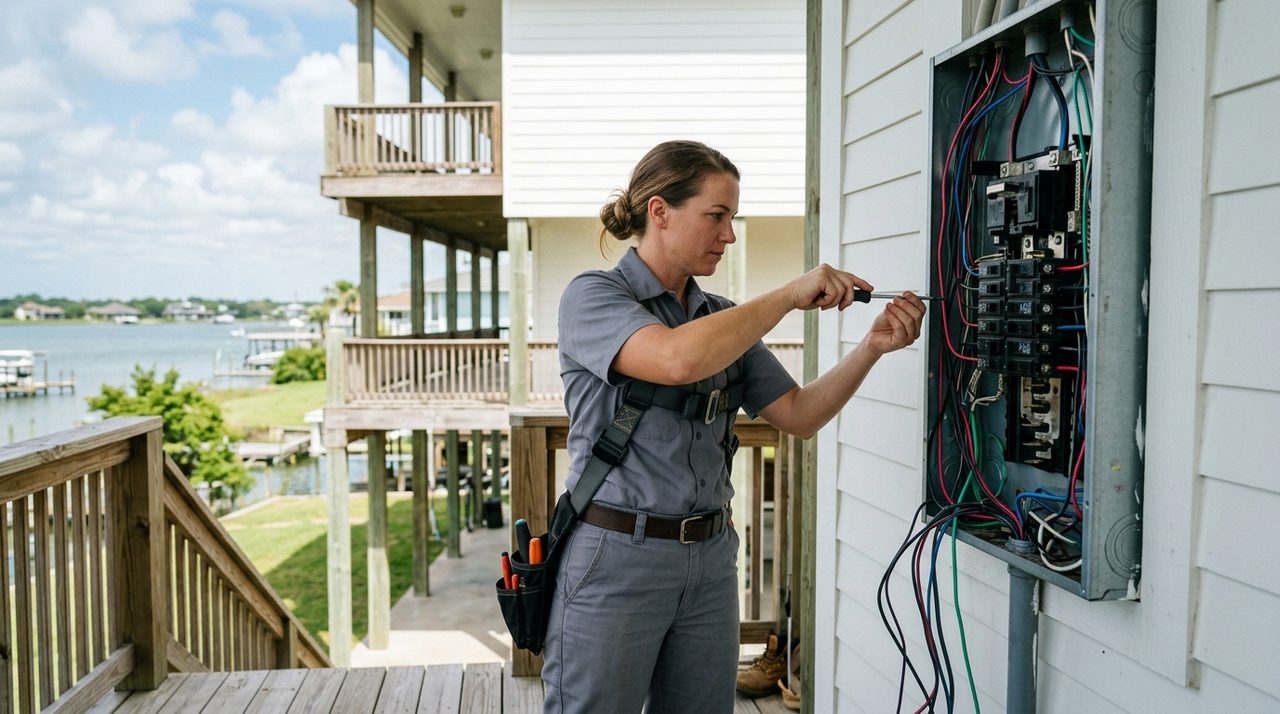
League City's housing stock spans six decades—from 1960s ranch homes near Main Street to 2020s builds in Tuscan Lakes and Victory Lakes—meaning electrical systems here range from aging 100-amp services with outdated wiring to modern 200-amp panels already straining under EV chargers and heat-pump additions. Coastal Galveston County location amplifies every electrical challenge: salt-laden Gulf air accelerates corrosion on weatherheads, meter bases, and attic junction boxes, while the May 2024 derecho and Hurricane Beryl's 80-mph-plus winds caused widespread service-entrance damage that homeowners—not CenterPoint—are responsible for repairing. All electrical permit work routes through the City of League City Building & Permits Division at 300 W. Walker St., not the Houston Permitting Center, and most master-planned subdivisions add an HOA architectural review layer on top of city permits.
Ranked by verified Google rating × review volume × verification tier. How we rank →
Some highly-rated pros serve League City from nearby and may not keep a League City street address. Those are listed under "Also serving League City" with their real city and distance, so you always know where each business is based.
1306 State Hwy 3, League City, TX 77573
610 Clear Creek Ave Ste A, League City, TX 77573
305 Houston Ave, League City, TX 77573
4807 FM 646 Rd # F, League City, TX 77573
2297 Ashley Falls Ln, League City, TX 77573
420 Dickinson Ave, League City, TX 77573
1135 Butler Rd, League City, TX 77573
1495 Gulf Fwy S, League City, TX 77573
Highly-rated pros based nearby who cover League City. Distance shown from the League City area.
Serving League City Based in Dickinson · 3.4 mi away
Serving League City Based in Kemah · 4.2 mi away
Why it matters to you
Hurricane Beryl (2024) and the May 2024 derecho delivered sustained winds above 80 mph across Galveston County, physically tearing service drops from weatherheads and pulling meter cans off masonry walls on homes throughout League City. Salt air from Galveston Bay and Clear Lake accelerates corrosion on the mast riser, weatherhead, and meter base year-round, so damage that looks superficial after a storm often masks internal oxidation that compromises the entire service entrance. CenterPoint Energy restores power only to the utility side of the meter; everything from the weatherhead through the meter base is the homeowner's responsibility and requires both a licensed electrician and a CenterPoint reconnect appointment before power is restored.
What a good pro does
A qualified Master Electrician—licensed through TDLR and permitted through the City of League City—should inspect the full service entrance after any storm event, not just visible mast damage. The repair scope typically includes replacing the weatherhead, galvanized or PVC mast riser, and meter base with corrosion-resistant materials rated for coastal exposure, then scheduling a city inspection before calling CenterPoint for reconnection. Estimated repair cost for weatherhead and mast replacement runs $600–$1,400, though a corroded meter base replacement can add $400–$800 to that estimate.
Sources: Texas Department of Licensing & Regulation, Municipal permit office (see area profile)
Why it matters to you
League City's proximity to Galveston Bay means average relative humidity routinely exceeds 75%, and attic temperatures in unshaded coastal-area homes reach 140°F-plus in summer—a combination that aggressively oxidizes wire nuts, corrodes aluminum neutral conductors, and degrades THHN insulation in attic wiring runs. Homes built in the 1990s and 2000s—the dominant era in Bay Colony, South Shore Harbour, and Victory Lakes—typically have attic-routed branch circuits without conduit protection, leaving wire connections exposed to this thermal-humidity cycling for decades. Homeowners usually discover the problem only after a nuisance breaker trip or, worse, a hot spot found during a pre-sale thermal-imaging inspection.
What a good pro does
A licensed electrician should perform a thermal-imaging scan of attic junction boxes, especially in homes more than 15 years old, replacing corroded wire nuts with rated gel-filled connectors or re-terminating circuits inside sealed, gasketted junction boxes. Conduit-sleeving exposed attic runs is the long-term fix for chronic corrosion. All junction box work in League City requires a permit from the City of League City Building & Permits Division and inspection before the boxes are covered.
Sources: Texas Department of Licensing & Regulation, Municipal permit office (see area profile), International Residential Code (as adopted by City of Houston)
Why it matters to you
The older ranch-style and traditional homes clustered near historic League City's Main Street corridor were built with 100-amp or 150-amp services sized for all-gas households with minimal air conditioning load—a reality that changed dramatically after Winter Storm Uri (2021) drove many owners to add electric space heaters or heat-pump water heaters as gas-supply backups. Adding even one 240V heat-pump water heater to a 100-amp service that already carries a central AC unit, two refrigerators, and a washer/dryer pushes the service to nuisance-tripping territory and risks overheating conductors at the main panel. Homes in this age bracket may also carry Federal Pacific Stab-Lok breakers, which have well-documented failure-to-trip histories.
What a good pro does
Upgrading to a 200-amp service—estimated at $1,800–$3,200 installed including the City of League City permit fee—is the correct fix, not just swapping breakers. A TDLR-licensed Master Electrician must pull the permit, and the city inspection must be completed before CenterPoint sets the new meter. Homeowners adding an EV charger at the same time should discuss going directly to 400-amp service ($3,500–$6,000 estimated), since a second trip to upgrade service later costs more than doing it once.
Sources: Texas Department of Licensing & Regulation, Municipal permit office (see area profile), International Residential Code (as adopted by City of Houston)
Why it matters to you
League City's master-planned subdivisions—Bay Colony, Tuscan Lakes, Magnolia Creek, Victory Lakes—have high rates of owner-occupancy (74.4% metro-wide per ACS 2023 data) and rising EV adoption, but installing a Level 2 EVSE here means navigating both the City of League City's electrical permit process and the subdivision HOA's architectural review committee, which may restrict exterior conduit routing, charger mounting height, or equipment color. Homeowners who skip the HOA approval step before the permit inspection can face mandatory removal orders from their ARC even after passing city inspection. Many 2000s-era homes in these subdivisions were built with 200-amp panels that technically have capacity, but the available space for a dedicated 50-amp breaker must be confirmed—not assumed.
What a good pro does
Start with the HOA architectural review application—get written ARC approval specifying conduit routing and equipment placement before scheduling the city permit. The electrician then pulls an electrical permit from the City of League City Building & Permits Division, performs a load calculation to confirm the existing 200-amp panel can support a dedicated 40- or 50-amp EVSE circuit, and schedules the required city inspection. A Level 2 charger supply circuit (assuming panel capacity exists) runs an estimated $400–$900 installed; if the panel needs upgrading concurrently, budget $1,800–$3,200 additional.
Sources: Municipal permit office (see area profile), Local HOA / deed restrictions (see area profile), Texas Department of Licensing & Regulation
Hiring electricians in League City? League City is one of the largest and fastest-growing cities in Galveston County, with housing stock spanning from 1960s-era originals near the historic downtown to expansive master-planned communities built from the 1990s through today. Homeowners here contend with coastal humidity, salt air corrosion, and proximity to Clear Creek and Dickinson Bayou watersheds. The city manages its own permitting and code enforcement, making it distinct from unincorporated Galveston County areas.
Building era
1960s–2020s, with the majority of residential growth occurring from the 1990s onward in master-planned subdivisions.
Typical style
Single-story and two-story suburban tract homes in newer subdivisions (Bay Colony, South Shore Harbour, Tuscan Lakes, Victory Lakes); older ranch-style and traditional homes near historic League City downtown.
Foundations
Predominantly slab-on-grade across all eras.
Common systems
Newer homes (2000s+) feature high-efficiency central HVAC, PEX or CPVC plumbing, and 200-amp electrical panels. Older 1960s–1980s homes may have original copper or galvanized plumbing, R-22 refrigerant HVAC systems, and 100–150 amp panels.
What that means for repairs
Older homes near downtown League City commonly undergo full HVAC replacement, plumbing re-pipes, and kitchen/bath remodels. Newer master-planned communities see cosmetic upgrades, fence replacements, and outdoor living additions. Coastal proximity drives demand for exterior paint, siding repair, and roof maintenance due to salt air and wind.
Permit jurisdiction
City of League City Building & Permits Division (300 W. Walker St., League City, TX 77573). League City is a fully incorporated municipality with its own permitting, inspections, and code enforcement — not governed by Galveston County engineering or the Houston Permitting Center.
HOA & deed restrictions
Most newer subdivisions (Bay Colony, South Shore Harbour, Tuscan Lakes, Victory Lakes, Magnolia Creek, etc.) have mandatory HOAs with architectural review committees. The City of League City maintains an HOA Alliance program facilitating communication between the city and neighborhood HOAs. Older areas near downtown may lack mandatory HOAs and rely on deed restrictions or voluntary civic organizations. Specific HOA names vary by subdivision — not confirmed for all areas; check Galveston County Clerk records.
Historic districts
No City of Houston historic district designation confirmed. League City has its own local historic preservation efforts centered around the original townsite near Main Street, but these are governed by the City of League City, not HAHC.
Contractor note
Contractors must obtain permits through the City of League City and comply with local building codes, which incorporate wind-resistant construction standards due to coastal proximity. Many HOAs require architectural review committee approval before exterior modifications begin.
FEMA flood zone
FEMA Zone X (low flood risk) — source: fema_nfhl. However, portions of League City near Clear Creek, Dickinson Bayou, and their tributaries fall within higher-risk flood zones (A and AE). Homeowners should verify their specific parcel, as flood risk varies significantly across this geographically large city.
Hurricane Harvey impact
Hurricane Harvey (2017) brought significant flooding to portions of League City, particularly along Clear Creek and in low-lying areas near Dickinson Bayou. South Shore Harbour, parts of Bay Colony, and neighborhoods adjacent to waterways experienced notable flooding. The city saw widespread damage, though many newer elevated-pad subdivisions fared better. Specific impact varied block by block — homeowners should check individual property flood history through Galveston County and FEMA records.
Heat & humidity load
League City's coastal location brings extreme humidity, salt air exposure, and Gulf storm risk from June through November. HVAC systems run heavily from May to October, driving demand for annual maintenance, refrigerant checks, and ductwork inspections. Exterior materials — especially metal fixtures, fasteners, and painted surfaces — degrade faster due to salt air corrosion. Roofing inspections are critical given wind exposure from tropical weather systems.
Working with contractors here
Contractors in League City most commonly handle HVAC servicing and replacement, roof repair and replacement (especially after storm seasons), and plumbing work ranging from re-pipes in older homes to fixture upgrades in newer builds. The wide range of housing ages means contractors must be prepared for both modern systems in 2010s-era homes and aging infrastructure in 1960s–1980s properties near downtown. Exterior work — painting, siding repair, fence replacement, and window sealing — is in constant demand due to salt air and humidity. Many jobs in master-planned communities require HOA architectural approval before work begins, so contractors should build pre-approval timelines into project scoping. Wind-rated materials and proper hurricane strap installation are important selling points for roofing and structural contractors given the coastal wind exposure.
Local Tip
Always ask for a written estimate before work begins. Texas contractors are required to provide one on jobs over $1,000.
League City is one of the largest and fastest-growing cities in Galveston County, with housing stock spanning from 1960s-era originals near the historic downtown to expansive master-planned communities built from the 1990s through today. Homeowners here contend with coastal humidity, salt air corrosion, and proximity to Clear Creek and Dickinson Bayou watersheds. The city manages its own permitting and code enforcement, making it distinct from unincorporated Galveston County areas.
Source: U.S. Census Bureau, ACS 5-Year 2023
Most of League City maps to FEMA Zone X (low mapped flood risk), but Houston's flash-flood reality means even low-risk blocks benefit from smart drainage and storm-hardened installs; risk climbs sharply on blocks nearest Clear Creek and Galveston Bay, where it varies parcel to parcel.
Source: FEMA National Flood Hazard Layer (NFHL). Flood zones vary by parcel — verify your individual FIRM panel.
In League City, TX, your primary hurricane electrical risk is extended outage and surge damage rather than panel flooding, so have a licensed electrician install a transfer switch and whole-house surge arrester before the season peaks in August. When Beryl 2024 knocked out power to 900,000 CenterPoint customers in July heat, homes with interlock kits and generators were the ones that stayed livable. Confirm the current FEMA panel for your League City parcel — the area maps to Zone X, but adjacent lots can differ.
Whole-house surge protection is the critical electrician upgrade for League City, TX residents whose primary storm risk is power-quality damage rather than flooding; a surge arrester at the meter base absorbs the voltage spikes that destroy HVAC control boards, smart-home hubs, and refrigerator compressors every time CenterPoint restores a faulted circuit after a derecho. A licensed electrician can add this protection to virtually any modern meter base in under two hours. As a Galveston County community, League City may follow county rather than City of Houston storm rebuild rules.
Frozen tree limbs brought down distribution lines across League City, TX during Uri 2021, and when power was restored in stages the resulting surges destroyed control boards in variable-speed HVAC systems, refrigerators, and smart panels. A whole-house surge arrester installed by a licensed electrician at the meter base is the most cost-effective way to protect those components before the next hard freeze. Because League City drains toward Clear Creek and Galveston Bay, block-level runoff can differ sharply from the mapped zone.
Sources: FEMA National Flood Hazard Layer (NFHL), Ready.gov -- Hurricanes, CenterPoint Energy -- Storm Center, City of Houston -- Emergency Preparedness, Ready.gov -- Winter Weather, Harris County Flood Control District
Houston-specific estimators to plan your project before you call a pro. All results are planning estimates — a licensed local pro confirms the details on site.
Disconnect & drain every outdoor hose bib
Remove hoses, drain the spigots, and cover each with an insulated faucet sock. Un-drained hose bibs are the #1 burst point in a Houston freeze.
Insulate exposed pipes in the attic & garage
Wrap any pipe in an unconditioned space (attic runs, garage walls) with foam sleeves. Houston homes rarely insulate these because they only matter a few nights a year — which is exactly why they burst.
Open cabinet doors & keep a pencil-width drip
On hard-freeze nights, open kitchen/bath cabinets so warm air reaches the pipes and let faucets on exterior walls drip to relieve pressure.
Protect the attic/garage water heater & its lines
An attic or garage tank sits in unconditioned space. Insulate the cold-inlet and hot-outlet lines and confirm the emergency drain pan is clear so a leak doesn't reach the ceiling.
This is a planning estimate only — actual requirements depend on an on-site assessment by a licensed Houston pro. If a pipe has already burst, shut off your main water supply and call a licensed Houston plumber immediately — freeze bursts flood fast.
Sources: Municipal permit office (see area profile)Texas Department of Licensing & Regulation
Sources: FEMA National Flood Hazard Layer (NFHL)Municipal permit office (see area profile)
Sources: Municipal permit office (see area profile)
Sources: Local HOA / deed restrictions (see area profile)Municipal permit office (see area profile)