Open Now
2007 Louisiana Ave, League City, TX 77573
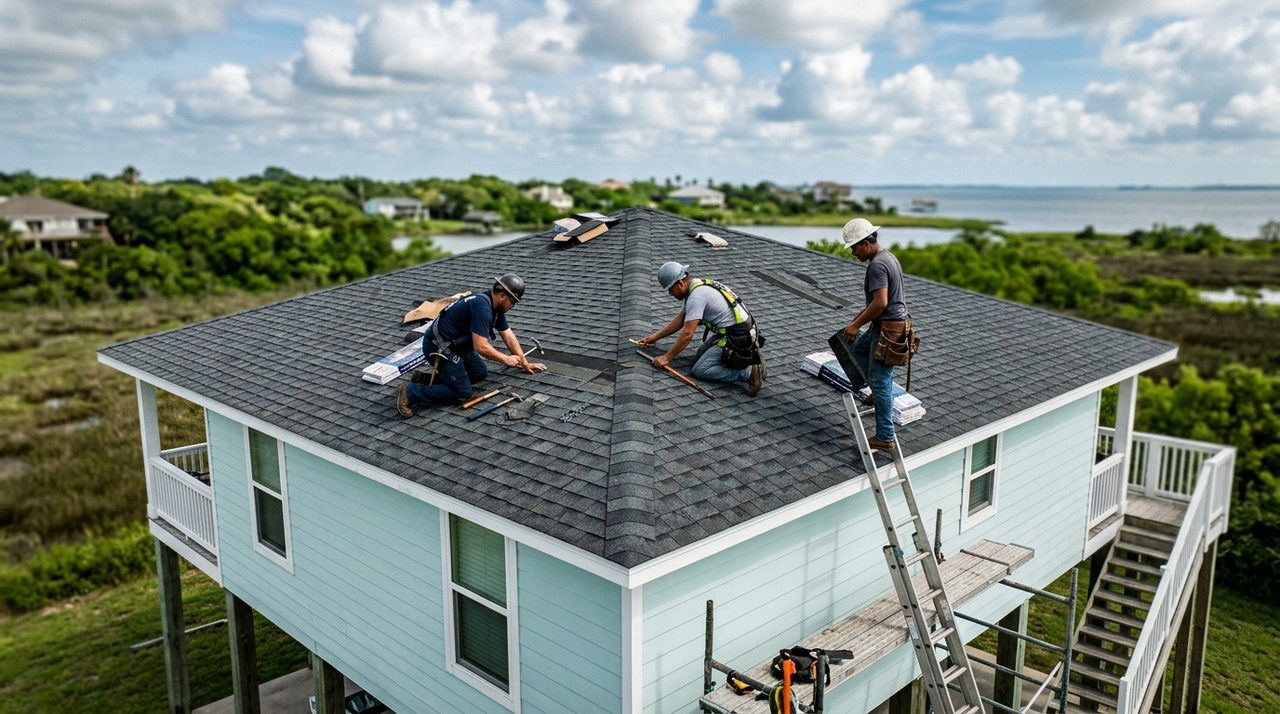
League City sits in Galveston County's coastal wind zone, where roughly 70% of the housing stock was built after 1990 in sprawling master-planned subdivisions — meaning tens of thousands of architectural shingle roofs are now entering their highest-risk decade for storm damage and heat-related degradation simultaneously. All roofing permits must be pulled through the City of League City Building & Permits Division (300 W. Walker St.), a fully independent office separate from both the Houston Permitting Center and Galveston County, and most subdivisions from Bay Colony to Victory Lakes layer mandatory HOA architectural review on top of that municipal process. This page covers the four roofing challenges that matter most for League City homeowners given the area's coastal exposure, 1990s–2010s tract-home construction, and TWIA wind-pool territory.
Ranked by verified Google rating × review volume × verification tier. How we rank →
2007 Louisiana Ave, League City, TX 77573
1640 E Main St, League City, TX 77573
2280 E Main St b2, League City, TX 77573
507 1/2, Houston Ave, League City, TX 77573
4890 W Main St, League City, TX 77573
2560 E League City Pkwy, League City, TX 77573
1109 Gulf Fwy S Suite B, League City, TX 77573
303 E Main St #180, League City, TX 77573
238 S Egret Bay Blvd Ste. 154, League City, TX 77573
2125 Boden St, League City, TX 77573
Why it matters to you
League City's large master-planned communities — Bay Colony, Tuscan Lakes, South Shore Harbour — were built largely between the mid-1990s and 2010s on flat, minimally treed lots that offer almost no natural wind break. The May 2024 derecho pushed 100+ mph straight-line winds across Galveston County, and League City's location within TWIA's designated catastrophe area means every roof here is underwritten as a high-wind-risk asset. Homes built before the 2006 IRC wind-resistance nailing pattern updates — covering much of the subdivision housing from the late 1990s — are particularly vulnerable to ridge cap loss and field-section tab lifting.
What a good pro does
A qualified roofer in League City should verify whether existing decking fasteners meet current IRC H3 or better hurricane-strap requirements and install starter strips with 6-nail patterns rather than the original 4-nail standard. Because Texas has no state roofing license, homeowners should confirm the contractor is registered with the City of League City to pull the required building permit and carries general liability plus workers' comp — TWIA policy compliance for installed materials depends on documented workmanship standards. Post-derecho demand routinely inflates bids 15–25% above baseline estimates, so collecting at least two written scopes before signing is especially important in a storm recovery window.
Sources: Texas Windstorm Insurance Association (TWIA), International Residential Code (as adopted by City of Houston), Municipal permit office (see area profile)
Why it matters to you
The majority of League City's post-1990 subdivisions — including Bay Colony, Victory Lakes, Magnolia Creek, and others — carry mandatory HOAs with Architectural Review Committees that must approve any roofing material change, including upgrades from 3-tab to dimensional shingles or a color shift, before work begins. ARC reviews typically take 10–30 days, a painful window when a storm-stripped roof is covered only by a tarp. The City of League City maintains an HOA Alliance program specifically because this coordination challenge is common across the municipality; ignoring ARC approval can result in forced re-roofing at the homeowner's expense even after a valid insurance settlement.
What a good pro does
Start the ARC submission in parallel with — not after — the insurance adjuster visit, using the contractor's material spec sheet and color sample. Many League City HOAs have pre-approved shingle lines (often Owens Corning or GAF dimensional products in specified earth tones); selecting from that list can cut review time from 30 days to under two weeks. Your roofer should build the ARC approval window into the project schedule and hold permit application to the City of League City's Building & Permits Division until ARC written approval is in hand, since the permit record will be public and ARC non-compliance is easily flagged.
Sources: Local HOA / deed restrictions (see area profile), Municipal permit office (see area profile)
Why it matters to you
League City's coastal proximity introduces a corrosion factor that inland Houston suburbs don't face: salt-laden Gulf air degrades asphalt binder and corrodes metal flashings — ridge vents, pipe boots, step flashing at dormers — faster than manufacturers' test conditions anticipate. Combined with 2,700+ annual cooling degree days, attic deck temperatures that can exceed 160°F, and the region's intense UV, a standard 30-year architectural shingle on a south- or west-facing League City roof realistically performs for 15–18 years before granule loss voids warranty protection. The median League City home was built around 2002, meaning a large share of roofs are now in exactly this accelerated degradation window.
What a good pro does
When replacing, specify Class 4 impact-resistant shingles with a manufacturer's wind warranty rated to 130 mph or better — the premium over standard architectural shingles is estimated at $1,500–$3,500 for a typical League City single-story home but can produce measurable TWIA premium discounts. Ask for stainless steel or aluminum step flashings rather than galvanized at all penetrations; the upgrade cost is modest but lifespan in salt-air conditions is dramatically longer. Energy Star-rated cool-roof shingles (lighter granule blends) can also reduce attic heat load, and some Texas utility programs offer rebates for qualifying products.
Sources: Texas Windstorm Insurance Association (TWIA), ENERGY STAR / U.S. Dept. of Energy, International Residential Code (as adopted by City of Houston)
Why it matters to you
Many League City ranch-style homes built in the 1960s–1980s near the original downtown, and a notable share of 1990s tract homes with enclosed patio additions, incorporate flat or low-slope (under 2:12 pitch) roof sections covered in modified bitumen or built-up membranes. League City's high rainfall intensity — Harvey's 40–50 inch totals in southeastern Harris and northern Galveston counties overwhelmed drainage systems throughout the area — causes prolonged ponding on these sections when interior drains or scuppers are even partially clogged, accelerating membrane delamination. Slab-on-grade construction means moisture that infiltrates a flat-roof deck section goes directly into living-space framing with no crawl-space buffer.
What a good pro does
Modified bitumen and TPO replacement on a flat addition typically costs $4.50–$7.50 per square foot installed in the current League City market (estimate), and the scope should always include clearing and upsizing scuppers or adding an overflow drain to meet current IRC R903 drainage requirements. A competent roofer will also probe the wood nailer and perimeter blocking for rot before applying new membrane — replacing decayed blocking at the time of membrane work costs a fraction of what it costs after a new roof is already installed. The City of League City requires a building permit for this work; confirm the contractor pulls it before membrane removal begins.
Sources: International Residential Code (as adopted by City of Houston), Municipal permit office (see area profile), FEMA National Flood Hazard Layer (NFHL)
Hiring roofers in League City? League City is one of the largest and fastest-growing cities in Galveston County, with housing stock spanning from 1960s-era originals near the historic downtown to expansive master-planned communities built from the 1990s through today. Homeowners here contend with coastal humidity, salt air corrosion, and proximity to Clear Creek and Dickinson Bayou watersheds. The city manages its own permitting and code enforcement, making it distinct from unincorporated Galveston County areas.
Building era
1960s–2020s, with the majority of residential growth occurring from the 1990s onward in master-planned subdivisions.
Typical style
Single-story and two-story suburban tract homes in newer subdivisions (Bay Colony, South Shore Harbour, Tuscan Lakes, Victory Lakes); older ranch-style and traditional homes near historic League City downtown.
Foundations
Predominantly slab-on-grade across all eras.
Common systems
Newer homes (2000s+) feature high-efficiency central HVAC, PEX or CPVC plumbing, and 200-amp electrical panels. Older 1960s–1980s homes may have original copper or galvanized plumbing, R-22 refrigerant HVAC systems, and 100–150 amp panels.
What that means for repairs
Older homes near downtown League City commonly undergo full HVAC replacement, plumbing re-pipes, and kitchen/bath remodels. Newer master-planned communities see cosmetic upgrades, fence replacements, and outdoor living additions. Coastal proximity drives demand for exterior paint, siding repair, and roof maintenance due to salt air and wind.
Permit jurisdiction
City of League City Building & Permits Division (300 W. Walker St., League City, TX 77573). League City is a fully incorporated municipality with its own permitting, inspections, and code enforcement — not governed by Galveston County engineering or the Houston Permitting Center.
HOA & deed restrictions
Most newer subdivisions (Bay Colony, South Shore Harbour, Tuscan Lakes, Victory Lakes, Magnolia Creek, etc.) have mandatory HOAs with architectural review committees. The City of League City maintains an HOA Alliance program facilitating communication between the city and neighborhood HOAs. Older areas near downtown may lack mandatory HOAs and rely on deed restrictions or voluntary civic organizations. Specific HOA names vary by subdivision — not confirmed for all areas; check Galveston County Clerk records.
Historic districts
No City of Houston historic district designation confirmed. League City has its own local historic preservation efforts centered around the original townsite near Main Street, but these are governed by the City of League City, not HAHC.
Contractor note
Contractors must obtain permits through the City of League City and comply with local building codes, which incorporate wind-resistant construction standards due to coastal proximity. Many HOAs require architectural review committee approval before exterior modifications begin.
FEMA flood zone
FEMA Zone X (low flood risk) — source: fema_nfhl. However, portions of League City near Clear Creek, Dickinson Bayou, and their tributaries fall within higher-risk flood zones (A and AE). Homeowners should verify their specific parcel, as flood risk varies significantly across this geographically large city.
Hurricane Harvey impact
Hurricane Harvey (2017) brought significant flooding to portions of League City, particularly along Clear Creek and in low-lying areas near Dickinson Bayou. South Shore Harbour, parts of Bay Colony, and neighborhoods adjacent to waterways experienced notable flooding. The city saw widespread damage, though many newer elevated-pad subdivisions fared better. Specific impact varied block by block — homeowners should check individual property flood history through Galveston County and FEMA records.
Heat & humidity load
League City's coastal location brings extreme humidity, salt air exposure, and Gulf storm risk from June through November. HVAC systems run heavily from May to October, driving demand for annual maintenance, refrigerant checks, and ductwork inspections. Exterior materials — especially metal fixtures, fasteners, and painted surfaces — degrade faster due to salt air corrosion. Roofing inspections are critical given wind exposure from tropical weather systems.
Working with contractors here
Contractors in League City most commonly handle HVAC servicing and replacement, roof repair and replacement (especially after storm seasons), and plumbing work ranging from re-pipes in older homes to fixture upgrades in newer builds. The wide range of housing ages means contractors must be prepared for both modern systems in 2010s-era homes and aging infrastructure in 1960s–1980s properties near downtown. Exterior work — painting, siding repair, fence replacement, and window sealing — is in constant demand due to salt air and humidity. Many jobs in master-planned communities require HOA architectural approval before work begins, so contractors should build pre-approval timelines into project scoping. Wind-rated materials and proper hurricane strap installation are important selling points for roofing and structural contractors given the coastal wind exposure.
Local Tip
Always ask for a written estimate before work begins. Texas contractors are required to provide one on jobs over $1,000.
League City is one of the largest and fastest-growing cities in Galveston County, with housing stock spanning from 1960s-era originals near the historic downtown to expansive master-planned communities built from the 1990s through today. Homeowners here contend with coastal humidity, salt air corrosion, and proximity to Clear Creek and Dickinson Bayou watersheds. The city manages its own permitting and code enforcement, making it distinct from unincorporated Galveston County areas.
Source: U.S. Census Bureau, ACS 5-Year 2023
Most of League City maps to FEMA Zone X (low mapped flood risk), but Houston's flash-flood reality means even low-risk blocks benefit from smart drainage and storm-hardened installs; risk climbs sharply on blocks nearest Clear Creek and Galveston Bay, where it varies parcel to parcel.
Source: FEMA National Flood Hazard Layer (NFHL). Flood zones vary by parcel — verify your individual FIRM panel.
For homeowners in League City, TX: beryl 2024 stripped unsealed ridge vents and attic ventilators off roofs across low-flood-risk Houston neighborhoods, creating interior soaking before homeowners even knew there was an opening. Have a roofer install hurricane-rated ridge vent covers or temporarily cap off-ridge ventilators if a storm is within 72 hours of landfall. Confirm the current FEMA panel for your League City parcel — the area maps to Zone X, but adjacent lots can differ.
The May 2024 derecho showed that 80-mph straight-line winds can strip improperly fastened ridge caps from roofs across the Houston metro regardless of flood zone, so have a licensed roofer inspect and hand-nail any ridge shingles that feel loose or show lifted leading edges in League City, TX. A secure ridge cap also prevents the attic air-pressure equalization that accelerates uplift on field shingles during a pressure drop. As a Galveston County community, League City may follow county rather than City of Houston storm rebuild rules.
Even in lower-flood-risk League City, TX, a hard freeze following a rainstorm can trap water under lifted perimeter shingles and expand it into cracks in the decking, a failure mode that became widespread during Uri 2021. Ask a roofer to hand-seal any perimeter shingles showing daylight beneath them before December so freeze-water expansion does not open your deck to spring rains. Because League City drains toward Clear Creek and Galveston Bay, block-level runoff can differ sharply from the mapped zone.
Sources: FEMA National Flood Hazard Layer (NFHL), Ready.gov -- Hurricanes, CenterPoint Energy -- Storm Center, City of Houston -- Emergency Preparedness, Ready.gov -- Winter Weather, Harris County Flood Control District
Houston-specific estimators to plan your project before you call a pro. All results are planning estimates — a licensed local pro confirms the details on site.
Estimated design wind speed for your zone
Outside the TDI catastrophe area, so a WPI-8 is generally not mandated — but Houston still sees hurricane-force gusts (Beryl, 2024). Insist on properly rated shingles installed to the manufacturer's high-wind nailing pattern (6 nails) and starter strips, or a wind claim can be denied for improper installation.
Find a Houston roofer →This is a planning estimate only — actual requirements depend on an on-site assessment by a licensed Houston pro. Wind-speed zones are approximate; your exact TDI/WPI-8 obligation depends on your address's designation. Verify with the Texas Department of Insurance before contracting.
Disconnect & drain every outdoor hose bib
Remove hoses, drain the spigots, and cover each with an insulated faucet sock. Un-drained hose bibs are the #1 burst point in a Houston freeze.
Insulate exposed pipes in the attic & garage
Wrap any pipe in an unconditioned space (attic runs, garage walls) with foam sleeves. Houston homes rarely insulate these because they only matter a few nights a year — which is exactly why they burst.
Open cabinet doors & keep a pencil-width drip
On hard-freeze nights, open kitchen/bath cabinets so warm air reaches the pipes and let faucets on exterior walls drip to relieve pressure.
Protect the attic/garage water heater & its lines
An attic or garage tank sits in unconditioned space. Insulate the cold-inlet and hot-outlet lines and confirm the emergency drain pan is clear so a leak doesn't reach the ceiling.
This is a planning estimate only — actual requirements depend on an on-site assessment by a licensed Houston pro. If a pipe has already burst, shut off your main water supply and call a licensed Houston plumber immediately — freeze bursts flood fast.
Sources: Municipal permit office (see area profile)
Sources: Texas Windstorm Insurance Association (TWIA)International Residential Code (as adopted by City of Houston)
Sources: Local HOA / deed restrictions (see area profile)
Sources: Texas Windstorm Insurance Association (TWIA)FEMA National Flood Hazard Layer (NFHL)
Sources: Municipal permit office (see area profile)