Open Now
900 Apollo St, Houston, TX 77058
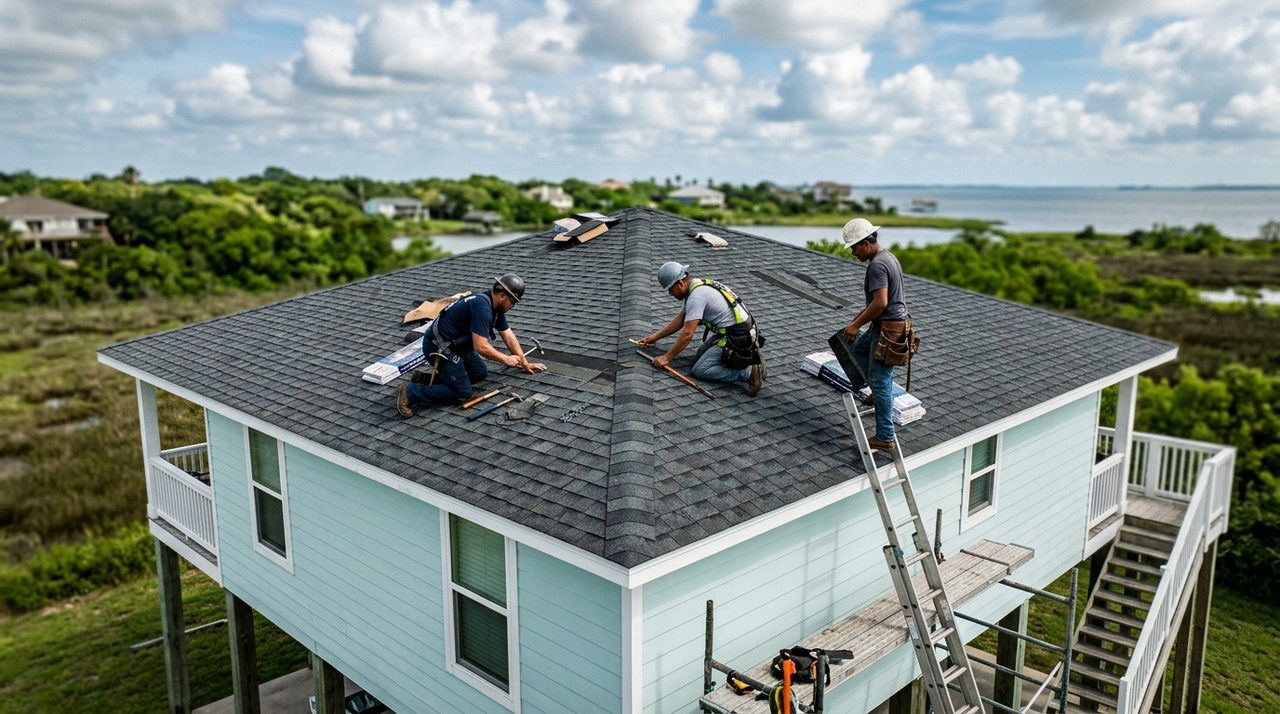
Clear Lake's NASA-era subdivisions — built primarily between 1960 and 1985 — are now home to aging asphalt shingle roofs that have endured decades of Gulf Coast heat, the May 2024 derecho's straight-line winds, and intense spring hail seasons without the benefit of modern impact-resistant materials. Most properties fall under City of Houston permit jurisdiction, but roofing work here adds a complicating layer: multiple mandatory subdivision HOAs — CLCCA, CLFCA, Reserve at Clear Lake, and others — each run their own Architectural Review Committee and can require pre-approval before a single shingle is swapped. This page explains the four roofing challenges that specifically define the Clear Lake ownership experience, with concrete guidance on costs, permits, and HOA timing.
Ranked by verified Google rating × review volume × verification tier. How we rank →
900 Apollo St, Houston, TX 77058
17214 Mercury Dr, Houston, TX 77058
1322 Space Park Dr A215, Houston, TX 77058
1827 El Dorado Blvd, Houston, TX 77062
1350 E NASA Pkwy STE 250-H, Houston, TX 77058
957 E NASA Pkwy Suite 519, Houston, TX 77058
17301 El Camino Real Suite A1, Houston, TX 77058
18333 Egret Bay Blvd Suite 421, Houston, TX 77058
2323 Clear Lake City Blvd #180-129, Houston, TX 77062
Why it matters to you
The bulk of Clear Lake's housing stock was built during the Johnson Space Center boom of the 1960s through the 1980s, meaning original or first-replacement roofs are now 20–40 years old — well past the practical 15–18-year lifespan standard architectural shingles achieve under Houston's sustained 95–105°F ambient temperatures and 160°F attic deck conditions. South- and west-facing roof planes on Clear Lake's one-story ranch homes absorb the most punishment, with asphalt binder oxidation and granule loss accelerating UV damage that is invisible from the driveway but voids manufacturer warranties.
What a good pro does
A thorough roofer should perform a close-up (ladder-level) inspection of granule density and fiberglass mat condition before recommending patch-versus-replace. For a full tear-off re-roof on a typical 1,800–2,400 sq ft Clear Lake ranch, budget an estimated $9,000–$16,000 for 30-year dimensional shingles with new underlayment; upgrading to Class 4 impact-resistant shingles adds an estimated $1,500–$3,500 but can qualify for insurer discounts. Because Texas has no state roofing contractor license, homeowners should independently verify the contractor holds general liability and workers' compensation coverage before work begins.
Sources: ENERGY STAR / U.S. Dept. of Energy, Texas Windstorm Insurance Association (TWIA)
Why it matters to you
Clear Lake's master-planned subdivisions feature wide arterials and open-canopy street layouts — there is minimal tree windbreak compared with heavily wooded areas like Memorial or The Woodlands. The May 2024 derecho produced 100+ mph straight-line winds across Harris County, and pre-2006 homes throughout Clear Lake were built before IRC wind-resistance nail-pattern requirements tightened. Shingle tabs on these older roofs are particularly vulnerable to uplift along ridge caps and field sections, and Clear Lake's location on the northwest shore of Galveston Bay places it squarely in TWIA's designated catastrophe area.
What a good pro does
Roofers replacing storm-damaged sections on pre-2006 Clear Lake homes should apply a six-nail fastening pattern (rather than the older four-nail standard) and install a self-adhering ice-and-water shield at all eaves and rakes as an enhanced wind-driven rain barrier — both measures are consistent with current IRC wind-resistance provisions. Homeowners near Clear Lake or Galveston Bay should confirm their property's TWIA eligibility and verify that installed materials and fastening schedules meet TWIA requirements before signing off on the job, as a non-compliant installation can jeopardize a wind-pool claim.
Sources: Texas Windstorm Insurance Association (TWIA), International Residential Code (as adopted by City of Houston), FEMA National Flood Hazard Layer (NFHL)
Why it matters to you
Unlike most of Houston's unzoned core — where HOAs are sparser — virtually every Clear Lake subdivision carries a mandatory HOA with an active Architectural Review Committee. The Clear Lake City Community Association, Clear Lake Forest Community Association, and Reserve at Clear Lake Community Association each publish their own ARC guidelines, and a roofing material change (including a color shift, an upgrade to metal, or switching shingle product lines) can require a written ARC application with a 10–30-day review window. Starting work without ARC approval can trigger stop-work orders and fines, and in dispute cases, the HOA can require the homeowner to re-roof at their own expense to match the approved specification.
What a good pro does
Before pulling a City of Houston building permit through the Houston Permitting Center, confirm which subdivision HOA governs the specific address and request the current ARC roofing guidelines in writing. Submit the contractor's product data sheet and color sample simultaneously with your insurance claim documentation to minimize the delay between adjuster approval and construction start. If storm damage is severe, document the damage thoroughly for the ARC submission — most Clear Lake HOA guidelines include expedited review provisions for emergency repairs, though homeowners must formally invoke them.
Sources: Local HOA / deed restrictions (see area profile), City of Houston Permitting Center, Municipal permit office (see area profile)
Why it matters to you
Many of Clear Lake's original 1960s–1970s ranch homes were built with box vents or gable vents only — no continuous ridge-and-soffit ventilation system meeting the balanced 1:150 net-free-area ratio required by current IRC R806 provisions. Houston's annual average relative humidity exceeds 75%, and on slab-on-grade construction there is no crawl space to buffer ground moisture. Without proper airflow, OSB and plywood decking in these attic spaces accumulates condensation year-round, leading to delamination that can rot a new deck within five to eight years of a re-roof if the underlying ventilation problem is not corrected simultaneously.
What a good pro does
Any roofer bidding a full replacement on a 1960s–1980s Clear Lake home should include an attic ventilation audit as part of the scope, calculating existing net-free area against IRC R806 minimums for the home's square footage. If deficient, adding continuous ridge venting and increasing soffit vent area is typically an incremental cost of $400–$900 on a standard Clear Lake ranch but substantially extends deck and shingle life. Ask the contractor to document the before-and-after vent calculation in writing so you have evidence of code-compliant installation for resale and insurance purposes.
Sources: International Residential Code (as adopted by City of Houston), ENERGY STAR / U.S. Dept. of Energy
Hiring roofers in Clear Lake? Clear Lake is a sprawling collection of master-planned subdivisions built primarily from the 1960s through the 1980s during the Johnson Space Center boom. Homeowners face the maintenance demands of aging slab-on-grade ranch and traditional homes—original HVAC, cast-iron drain lines, and galvanized plumbing are common upgrade targets. Multiple mandatory HOAs enforce deed restrictions and architectural review, so contractors and homeowners must account for approval processes before exterior work.
Building era
1960s–1980s (core buildout), with newer infill subdivisions into the 2000s.
Typical style
One- and two-story ranch and traditional brick homes; some Colonial Revival facades in older sections; suburban traditional in 1980s–2000s additions.
Foundations
Predominantly concrete slab-on-grade, consistent with post-1960 Houston suburban construction.
Common systems
Original homes typically have copper or galvanized supply lines, cast-iron drain waste vent, R-22 refrigerant HVAC systems, and older 150–200 amp electrical panels. Homes from the 2000s subdivisions like Reserve at Clear Lake have modern PEX/PVC plumbing and R-410A systems.
What that means for repairs
Kitchen and bathroom remodels are frequent in 1960s–1970s homes. HVAC replacements are common as original systems exceed useful life. Many owners are re-piping from galvanized to PEX and upgrading electrical panels to support modern loads. Slab foundation repair is a recurring need due to expansive clay soils in the coastal plain.
Permit jurisdiction
Houston Permitting Center (City of Houston jurisdiction for most Clear Lake subdivisions within city limits). Some adjacent areas may fall under Harris County Engineering for unincorporated pockets—verify by address.
HOA & deed restrictions
No single area-wide HOA; multiple subdivision-level mandatory HOAs govern most properties. Key associations include Clear Lake City Community Association (CLCCA), Clear Lake Forest Community Association (CLFCA), and Reserve at Clear Lake Community Association. Membership is mandatory within each association's boundaries, with deed-restriction enforcement and architectural review committees.
Historic districts
No City of Houston historic district designation confirmed.
Contractor note
Exterior modifications—roofing materials, fencing, paint colors, and additions—typically require Architectural Review Committee (ARC) approval from the applicable subdivision HOA before permits are pulled. Contractors should confirm which association governs the property and obtain written ARC approval to avoid stop-work orders and violation fines.
FEMA flood zone
FEMA Zone X (low flood risk) per official NFHL data. However, Clear Lake's proximity to Clear Lake (the body of water), Galveston Bay, and local bayou tributaries means localized street-level flooding can occur during extreme rainfall events despite the overall Zone X designation.
Hurricane Harvey impact
Research sources did not document specific Harvey flood impacts for Clear Lake. Broader public reporting indicates parts of Clear Lake experienced significant flooding during Harvey, particularly near bayous and low-lying areas close to the lake and bay, but impact varied street by street. For property-specific Harvey inundation data, check Harris County Flood Control District historical maps and FEMA Harvey inundation records.
Heat & humidity load
Houston's extreme summer heat and humidity stress aging HVAC systems in 1960s–1980s homes, often pushing original or under-capacity units to failure. High humidity also promotes mold in poorly ventilated attics and crawl spaces. The coastal-plain location adds salt air exposure that accelerates corrosion on outdoor HVAC condensers, metal roofing components, and exterior fixtures.
Working with contractors here
The dominant work in Clear Lake involves updating systems in 1960s–1980s slab-on-grade homes: whole-house re-pipes replacing galvanized and cast-iron with PEX and PVC, HVAC changeouts from legacy R-22 systems to modern high-efficiency units, and electrical panel upgrades from 150-amp to 200-amp service. Foundation leveling and mudjacking are steady demand items given the expansive clay soils beneath slabs in this coastal-plain environment. Contractors should expect HOA architectural review requirements on any exterior-facing work—roofing, siding, fencing, and even driveway resurfacing may need pre-approval from the applicable subdivision association. Job scoping should include verifying the specific HOA (CLCCA, CLFCA, Reserve at Clear Lake, etc.) and its current ARC guidelines, as requirements vary by subdivision.
Local Tip
Always ask for a written estimate before work begins. Texas contractors are required to provide one on jobs over $1,000.
Clear Lake is a sprawling collection of master-planned subdivisions built primarily from the 1960s through the 1980s during the Johnson Space Center boom. Homeowners face the maintenance demands of aging slab-on-grade ranch and traditional homes—original HVAC, cast-iron drain lines, and galvanized plumbing are common upgrade targets. Multiple mandatory HOAs enforce deed restrictions and architectural review, so contractors and homeowners must account for approval processes before exterior work.
Source: U.S. Census Bureau, ACS 5-Year 2023
Most of Clear Lake maps to FEMA Zone X (low mapped flood risk), but Houston's flash-flood reality means even low-risk blocks benefit from smart drainage and storm-hardened installs; risk climbs sharply on blocks nearest Clear Lake and Galveston Bay, where it varies parcel to parcel.
Source: FEMA National Flood Hazard Layer (NFHL). Flood zones vary by parcel — verify your individual FIRM panel.
Wind uplift at the roof-to-wall connection is the structural failure mode that matters most in Clear Lake, TX since flooding is not the primary risk here. Ask your roofer to inspect the starter-course fastening pattern and, if your home was built before the 2009 IRC updates, discuss installing supplemental ring-shank nails along all perimeter rows before the next major storm. Confirm the current FEMA panel for your Clear Lake parcel — the area maps to Zone X, but adjacent lots can differ.
Hail damage to roofs in Clear Lake, TX is often invisible from the ground but destroys the granule layer that blocks UV degradation, cutting shingle life by half without a single active leak. Ask a TDLR-licensed roofer to inspect after any storm that produced hail an inch or larger in diameter and document findings for your insurer before the one-year claim deadline passes. Because Clear Lake drains toward Clear Lake and Galveston Bay, block-level runoff can differ sharply from the mapped zone.
Even in lower-flood-risk Clear Lake, TX, a hard freeze following a rainstorm can trap water under lifted perimeter shingles and expand it into cracks in the decking, a failure mode that became widespread during Uri 2021. Ask a roofer to hand-seal any perimeter shingles showing daylight beneath them before December so freeze-water expansion does not open your deck to spring rains. With a median build year of 1984, the older building stock here is more exposed to hard-freeze damage than newer construction. Because Clear Lake drains toward Clear Lake and Galveston Bay, block-level runoff can differ sharply from the mapped zone.
Sources: FEMA National Flood Hazard Layer (NFHL), Ready.gov -- Hurricanes, CenterPoint Energy -- Storm Center, City of Houston -- Emergency Preparedness, Ready.gov -- Winter Weather, Harris County Flood Control District
Houston-specific estimators to plan your project before you call a pro. All results are planning estimates — a licensed local pro confirms the details on site.
Estimated design wind speed for your zone
Outside the TDI catastrophe area, so a WPI-8 is generally not mandated — but Houston still sees hurricane-force gusts (Beryl, 2024). Insist on properly rated shingles installed to the manufacturer's high-wind nailing pattern (6 nails) and starter strips, or a wind claim can be denied for improper installation.
Find a Houston roofer →This is a planning estimate only — actual requirements depend on an on-site assessment by a licensed Houston pro. Wind-speed zones are approximate; your exact TDI/WPI-8 obligation depends on your address's designation. Verify with the Texas Department of Insurance before contracting.
Disconnect & drain every outdoor hose bib
Remove hoses, drain the spigots, and cover each with an insulated faucet sock. Un-drained hose bibs are the #1 burst point in a Houston freeze.
Insulate exposed pipes in the attic & garage
Wrap any pipe in an unconditioned space (attic runs, garage walls) with foam sleeves. Houston homes rarely insulate these because they only matter a few nights a year — which is exactly why they burst.
Open cabinet doors & keep a pencil-width drip
On hard-freeze nights, open kitchen/bath cabinets so warm air reaches the pipes and let faucets on exterior walls drip to relieve pressure.
Protect the attic/garage water heater & its lines
An attic or garage tank sits in unconditioned space. Insulate the cold-inlet and hot-outlet lines and confirm the emergency drain pan is clear so a leak doesn't reach the ceiling.
This is a planning estimate only — actual requirements depend on an on-site assessment by a licensed Houston pro. If a pipe has already burst, shut off your main water supply and call a licensed Houston plumber immediately — freeze bursts flood fast.
Sources: City of Houston Permitting CenterLocal HOA / deed restrictions (see area profile)
Sources: EPA Lead Renovation, Repair and Painting (RRP) Rule
Sources: Local HOA / deed restrictions (see area profile)
Sources: FEMA National Flood Hazard Layer (NFHL)Texas Windstorm Insurance Association (TWIA)International Residential Code (as adopted by City of Houston)
Sources: Texas Windstorm Insurance Association (TWIA)Local HOA / deed restrictions (see area profile)