4311 FM 2351, Friendswood, TX 77546
Best Roofers in Friendswood, TX
Friendswood's housing stock runs from early-1960s ranches near Clear Creek to 2000s-era brick-veneer production homes in West Ranch, meaning roofs across the city span four decades of shingle technology, underlayment standards, and ventilation design — often within the same subdivision. Because Friendswood is an independent Galveston County city, every re-roof or structural repair goes through the City of Friendswood Building Inspections Department, not Houston's system, and many subdivisions layer HOA architectural review on top of that permit step. This page covers the roofing challenges that actually show up here: wind-uplift exposure in open subdivisions, aging shingle stock on 1990s production homes, HOA approval timing, and the ventilation failures that silently rot decking in the Gulf Coast humidity.
Verified against Google Business data
Updated 2026
See the 10 Roofers Serving Friendswood 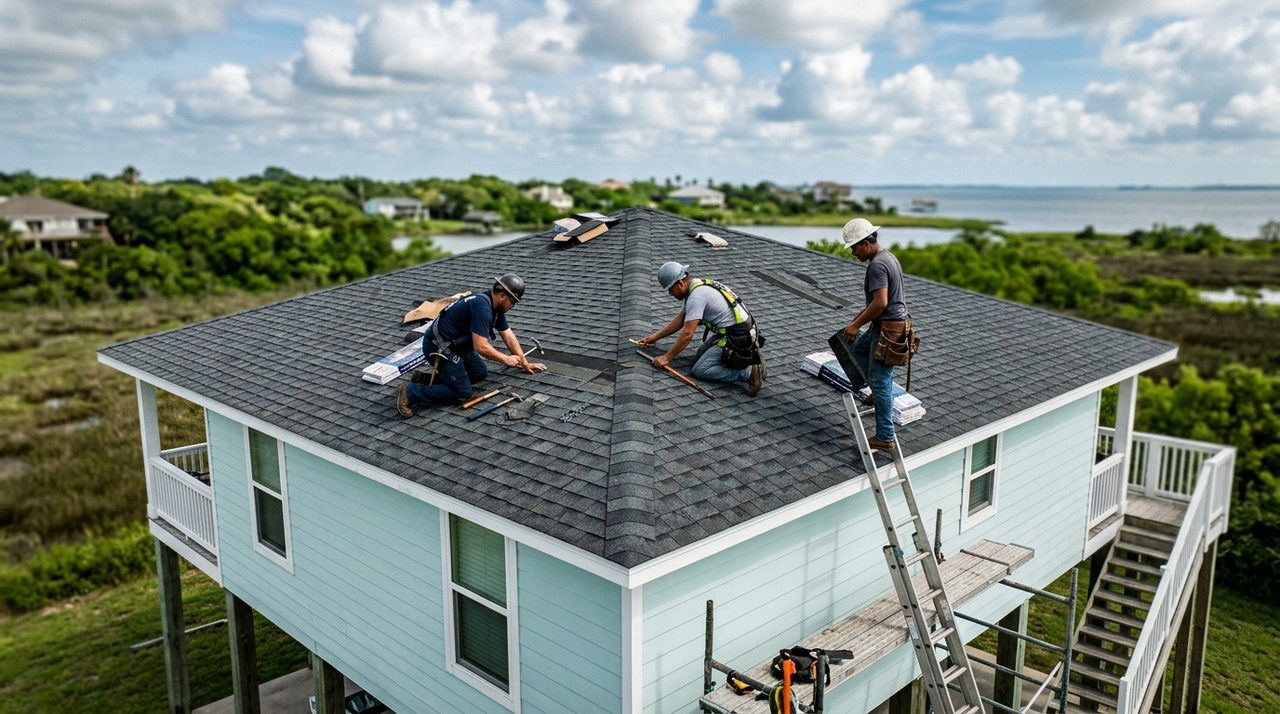
- Median home built
- 1990
- Median home value
- $399,500
- FEMA flood zone
- X (low)
- Typical re-roof cost (est.)
- $9,000–$16,000
- Most common local issue
- Aging 1990s architectural shingles past effective service life on slab-on-grade production homes
Ranked by verified Google rating × review volume × verification tier. How we rank →
Some highly-rated pros serve Friendswood from nearby and may not keep a Friendswood street address. Those are listed under "Also serving Friendswood" with their real city and distance, so you always know where each business is based.
Min rating:
10 resultsBased in Friendswood
700 S Friendswood Dr Ste G, Friendswood, TX 77546
Closed
107 S Friendswood Dr suite a, Friendswood, TX 77546
Open Now
402 Overlook Dr, Friendswood, TX 77546
105 S Friendswood Dr, Friendswood, TX 77546
Closed
4815 FM 2351 Suite 205, Friendswood, TX 77546
102 W Edgewood Dr, Friendswood, TX 77546
Open Now
907 S Friendswood Dr, Friendswood, TX 77546
Open Now
5406 Abercreek Ave, Friendswood, TX 77546
Also serving Friendswood
Highly-rated pros based nearby who cover Friendswood. Distance shown from the Friendswood area.
Closed
Serving Friendswood Based in Pearland · 1.7 mi away
Roofers in Friendswood: What You Should Know
1990s Production-Home Shingles Are at or Past Their Real-World Expiration Date
Why it matters to you
Friendswood's largest growth phase ran through the 1990s, and the U.S. Census Bureau puts the city's median year-built at 1990 — meaning a huge share of local roofs carry original 3-tab or early architectural shingles that are 25–35 years old. Houston's combination of 2,700-plus cooling degree days annually and sustained attic deck temperatures that can exceed 160°F during summer accelerates asphalt binder oxidation, cutting the practical life of a nominally 30-year shingle to 15–18 years in this climate. Many of these roofs look acceptable from the street but have granule loss and micro-cracking that voids manufacturer warranties and leaves the OSB decking exposed to Gulf Coast humidity.
What a good pro does
A qualified roofer should perform an on-deck inspection — not just a drive-by estimate — checking granule loss in downspout strainers, tab lifting along the west and south planes, and the condition of valley and pipe-boot flashings. For a full tear-off and replacement on a typical Friendswood 1,800–2,400 sq ft single-story home, budget $9,000–$16,000 as an estimate for 30-year dimensional shingles; upgrading to Class 4 impact-resistant shingles adds roughly $1,500–$3,500 but can unlock insurance premium credits under TWIA wind pool rules applicable to Galveston County properties. The contractor must pull a permit through the City of Friendswood Building Inspections Department for a full re-roof — not through any Harris County or Houston office.
Sources: Texas Windstorm Insurance Association (TWIA), Municipal permit office (see area profile), International Residential Code (as adopted by City of Houston)
Hurricane and Derecho Wind Uplift on Open-Canopy Subdivisions
Why it matters to you
Friendswood sits in Galveston County within TWIA's catastrophe zone, and newer subdivisions like West Ranch were built in the 2000s on open lots that provide little tree-break against Gulf wind events. The May 2024 derecho produced 100-plus mph straight-line winds across SE Houston, and Harvey (2017) moved directly through this corridor. Homes built before the 2006 IRC wind-resistance code upgrades — which covers virtually all of Friendswood's 1960s through late-1990s stock — were nailed to older standards with fewer fasteners per shingle, making ridge caps, hip ends, and perimeter rows the first sections to lift.
What a good pro does
After any named storm or derecho, have an on-roof inspection done before filing an insurance claim so you understand the actual damage scope rather than relying solely on an adjuster's ground-level assessment. A roofer working in Friendswood should be familiar with TWIA's product eligibility requirements — specific shingles and installation nail patterns must meet TWIA standards for a replacement roof to maintain wind pool coverage. Texas has no state roofing license through TDLR, so verify the contractor carries general liability and workers' compensation insurance and can register with the City of Friendswood to pull the required permit; storm-chaser fraud risk is elevated in Galveston County after major events.
Sources: Texas Windstorm Insurance Association (TWIA), International Residential Code (as adopted by City of Houston), Municipal permit office (see area profile)
HOA Architectural Review Delays Before Re-Roofing Work Can Start
Why it matters to you
Friendswood has no city-wide HOA, but dozens of active subdivision-level associations — West Ranch (managed by RealManage), Wilderness Trails, Forest of Friendswood, and others — require homeowners to submit an Architectural Review Committee (ARC) application before changing roofing materials, including color shifts or upgrades from standard architectural shingles to metal. ARC review windows commonly run 10–30 days, which can create serious problems if you are trying to address storm damage quickly or if a roofer schedules a job before approval is in hand. Non-compliance can result in fines or a forced re-roof at the homeowner's expense.
What a good pro does
Before signing any roofing contract, confirm whether your specific Friendswood subdivision has an active HOA and obtain the current ARC submission requirements — shingle brand, color palette, and profile restrictions vary by association. Coordinate with your roofer to submit the ARC application and the City of Friendswood permit application in parallel so approvals align as closely as possible. If your subdivision's HOA appears inactive (the city's HOA list flags several with 'no current contact'), pull the recorded deed restrictions at the Galveston County Clerk's office to verify whether material covenants still apply, because recorded restrictions run with the land regardless of HOA operational status.
Sources: Local HOA / deed restrictions (see area profile), Municipal permit office (see area profile)
Attic Ventilation Failure and Silent Deck Rot in Gulf Coast Humidity
Why it matters to you
Friendswood's slab-on-grade construction — standard on every production home built after the 1970s here — means there is no crawl space to act as a moisture buffer, and all attic humidity load is managed entirely by roof ventilation. Homes from the 1970s through mid-1990s, which make up a large portion of Friendswood's older subdivisions like Wilderness Trails, were commonly built with box or gable vents only and no continuous ridge vent system. Houston's annual average relative humidity exceeds 75%, and without balanced ridge-to-soffit airflow meeting IRC R806 ratios, moisture condenses on OSB and plywood decking year-round — not just during winter — causing delamination that a new shingle layer will simply cover and accelerate.
What a good pro does
Any Friendswood roofer scoping a full replacement on a 1970s–1990s home should probe the decking at eaves and in valleys before pricing the job; replacing rotten decking typically adds $75–$150 per sheet as an estimate and is far cheaper to address during tear-off than after new shingles are down. The replacement design should include a continuous ridge vent paired with unobstructed soffit vents to meet the IRC 1:150 net free area ventilation ratio. Confirm the City of Friendswood's inspection includes a ventilation check — their Building Inspections Department operates independently and has its own inspection schedule and checklist separate from any Houston process.
Sources: International Residential Code (as adopted by City of Houston), Municipal permit office (see area profile), FEMA National Flood Hazard Layer (NFHL)
Roofers in Friendswood: What You Should Know
Hiring roofers in Friendswood? Friendswood is an incorporated city with housing stock spanning from the 1960s through the 2010s, meaning contractors encounter everything from aging pier-and-beam foundations near Clear Creek to modern slab-on-grade production homes in master-planned communities like West Ranch. The city manages its own permitting, and the patchwork of active HOAs across dozens of subdivisions means architectural review requirements vary block by block. Proximity to Clear Creek creates recurring flood concerns in lower-lying sections despite many parcels mapping outside high-risk FEMA zones.
- Housing era
- 1960s–2010s, with major growth phases in the 1970s, 1990s, and 2000s
- Foundation
- Predominantly slab-on-grade (post-1970s production housing)
- Flood zone
- FEMA Zone X (low flood risk) per official NFHL API
- Permits
- City of Friendswood Building Inspections Department (independent city — does not use Houston or…
Housing stock & systems
Building era
1960s–2010s, with major growth phases in the 1970s, 1990s, and 2000s.
Typical style
Suburban traditional brick veneer single-family homes, 1- and 2-story plans with attached garages on moderate to large lots.
Foundations
Predominantly slab-on-grade (post-1970s production housing); some older 1960s-era homes may have pier-and-beam — confirm via Galveston CAD records.
Common systems
Older 1960s–1970s homes: original galvanized or copper plumbing, R-22 HVAC units nearing or past end of life, fuse panels or early breaker panels. 1990s–2010s homes: PVC/PEX plumbing, R-410A HVAC, 200-amp electrical panels. Attic-mounted air handlers are standard across eras.
What that means for repairs
Older subdivisions like Wilderness Trails see frequent HVAC replacements, re-piping from galvanized to PEX, and electrical panel upgrades. Newer master-planned communities like West Ranch focus on cosmetic remodels and outdoor living additions, often requiring HOA architectural review.
Permits & restrictions
Permit jurisdiction
City of Friendswood Building Inspections Department (independent city — does not use Houston or county permitting).
HOA & deed restrictions
No city-wide mandatory HOA. Dozens of subdivision-level HOAs exist, many actively managed (e.g., West Ranch managed by RealManage, Wilderness Trails with its own HOA website, Forest of Friendswood as a formal Texas nonprofit). Some older subdivisions show 'no current contact' on the city's HOA list, indicating defunct or inactive associations. Deed restrictions are common and recorded at the county level.
Historic districts
No historic district designation confirmed. Friendswood is an independent city and not subject to Houston's HAHC jurisdiction.
Contractor note
Contractors must pull permits through the City of Friendswood, not Harris or Galveston County. Many subdivisions require HOA architectural review before exterior work begins — always confirm the specific subdivision's requirements before scheduling.
Flood & weather
FEMA flood zone
FEMA Zone X (low flood risk) per official NFHL API. However, areas near Clear Creek and its tributaries carry significantly higher flood exposure. Property-level risk varies widely — always verify individual parcels, especially in older subdivisions closer to the creek.
Hurricane Harvey impact
Friendswood experienced significant flooding during Hurricane Harvey (2017), particularly in neighborhoods near Clear Creek and low-lying drainage channels. Older subdivisions closer to the creek were hit hardest, while newer elevated master-planned sections fared better. Specific repeatedly flooded streets are not confirmed in available sources — check Galveston County flood control mapping and past seller disclosures for property-level history.
Heat & humidity load
Coastal humidity and extended 95°F+ heat stress HVAC systems heavily, especially attic-mounted air handlers in older homes with inadequate insulation. Slab foundations on expansive clay soils experience seasonal movement during summer drought cycles, potentially affecting door frames and drywall. Roofing materials degrade faster due to UV exposure and Gulf moisture.
Working with contractors here
Friendswood's multi-decade housing stock creates a wide range of service demands. In 1960s–1970s subdivisions, contractors frequently handle whole-house re-piping, HVAC system replacements transitioning from R-22, and electrical panel upgrades from 100-amp to 200-amp service. Post-Harvey, flood remediation, foundation repair, and mold mitigation remain ongoing concerns in creek-adjacent areas. In newer master-planned communities like West Ranch, work tends toward kitchen and bath remodels, outdoor living additions, and fence replacements — all of which typically require HOA architectural approval before starting. Contractors should scope jobs with awareness that the City of Friendswood enforces its own building codes and inspection schedules, which differ from Houston's process.
Local Tip
Always ask for a written estimate before work begins. Texas contractors are required to provide one on jobs over $1,000.
About Friendswood
Friendswood is an incorporated city with housing stock spanning from the 1960s through the 2010s, meaning contractors encounter everything from aging pier-and-beam foundations near Clear Creek to modern slab-on-grade production homes in master-planned communities like West Ranch. The city manages its own permitting, and the patchwork of active HOAs across dozens of subdivisions means architectural review requirements vary block by block. Proximity to Clear Creek creates recurring flood concerns in lower-lying sections despite many parcels mapping outside high-risk FEMA zones.
- Median year built
- 1990
- Median home value
- $399,500
- Owner-occupied
- 76.9%
- Population
- 40,827
- Housing units
- 14,985
- Median income
- $125,052
Source: U.S. Census Bureau, ACS 5-Year 2023
Flood & storm risk
FEMA Zone XLow flood riskMost of Friendswood maps to FEMA Zone X (low mapped flood risk), but Houston's flash-flood reality means even low-risk blocks benefit from smart drainage and storm-hardened installs; risk climbs sharply on blocks nearest Clear Creek, where it varies parcel to parcel.
Source: FEMA National Flood Hazard Layer (NFHL). Flood zones vary by parcel — verify your individual FIRM panel.
Houston Storm Readiness in Friendswood
Hurricane & flooding
Wind uplift at the roof-to-wall connection is the structural failure mode that matters most in Friendswood, TX since flooding is not the primary risk here. Ask your roofer to inspect the starter-course fastening pattern and, if your home was built before the 2009 IRC updates, discuss installing supplemental ring-shank nails along all perimeter rows before the next major storm. Confirm the current FEMA panel for your Friendswood parcel — the area maps to Zone X, but adjacent lots can differ.
Severe storms & hail
The May 2024 derecho showed that 80-mph straight-line winds can strip improperly fastened ridge caps from roofs across the Houston metro regardless of flood zone, so have a licensed roofer inspect and hand-nail any ridge shingles that feel loose or show lifted leading edges in Friendswood, TX. A secure ridge cap also prevents the attic air-pressure equalization that accelerates uplift on field shingles during a pressure drop. Because Friendswood drains toward Clear Creek, block-level runoff can differ sharply from the mapped zone.
Ice storms & freezes
Ice loading in Friendswood, TX is infrequent but disproportionately damaging because Houston roofs and their fastening systems are designed for wind, not sustained dead weight. Ask a licensed roofer to inspect your ridge board connections and confirm that collar ties or rafter ties are present in the attic, since Uri 2021 produced several ridge-sag failures in well-maintained Houston homes where the framing had no freeze-load margin. As a Galveston County community, Friendswood may follow county rather than City of Houston storm rebuild rules.
Sources: FEMA National Flood Hazard Layer (NFHL), Ready.gov -- Hurricanes, CenterPoint Energy -- Storm Center, City of Houston -- Emergency Preparedness, Ready.gov -- Winter Weather, Harris County Flood Control District
Free Friendswood Tools & Calculators
Houston-specific estimators to plan your project before you call a pro. All results are planning estimates — a licensed local pro confirms the details on site.
Hurricane Roof Wind-Load & TDI/WPI-8 Estimator
Open full tool & FAQ →115–120 mph
Estimated design wind speed for your zone
Outside the TDI catastrophe area, so a WPI-8 is generally not mandated — but Houston still sees hurricane-force gusts (Beryl, 2024). Insist on properly rated shingles installed to the manufacturer's high-wind nailing pattern (6 nails) and starter strips, or a wind claim can be denied for improper installation.
Find a Houston roofer →This is a planning estimate only — actual requirements depend on an on-site assessment by a licensed Houston pro. Wind-speed zones are approximate; your exact TDI/WPI-8 obligation depends on your address's designation. Verify with the Texas Department of Insurance before contracting.
Houston Freeze Prep & Pipe Insulation Checklist
Open full tool & FAQ →Your freeze checklist — 4 tasks
- 1
Disconnect & drain every outdoor hose bib
Remove hoses, drain the spigots, and cover each with an insulated faucet sock. Un-drained hose bibs are the #1 burst point in a Houston freeze.
- 2
Insulate exposed pipes in the attic & garage
Wrap any pipe in an unconditioned space (attic runs, garage walls) with foam sleeves. Houston homes rarely insulate these because they only matter a few nights a year — which is exactly why they burst.
- 3
Open cabinet doors & keep a pencil-width drip
On hard-freeze nights, open kitchen/bath cabinets so warm air reaches the pipes and let faucets on exterior walls drip to relieve pressure.
- 4
Protect the attic/garage water heater & its lines
An attic or garage tank sits in unconditioned space. Insulate the cold-inlet and hot-outlet lines and confirm the emergency drain pan is clear so a leak doesn't reach the ceiling.
This is a planning estimate only — actual requirements depend on an on-site assessment by a licensed Houston pro. If a pipe has already burst, shut off your main water supply and call a licensed Houston plumber immediately — freeze bursts flood fast.
Frequently Asked Questions
Do I need a permit from the City of Friendswood to replace my roof, and how is that different from pulling a permit in Houston?
Yes — Friendswood is an independent incorporated city in Galveston County, so all re-roof and structural repair permits go through the City of Friendswood Building Inspections Department, not the City of Houston Permitting Center and not Galveston County. Houston's rules (where a like-for-like shingle swap sometimes skips a permit) do not apply here; call Friendswood Building Inspections directly to confirm whether your specific scope requires a permit and inspection before work starts. Contractors unfamiliar with the distinction sometimes pull no permit at all, which can create a title problem when you sell.
Sources: Municipal permit office (see area profile)
My home in Wilderness Trails was built in the mid-1970s — does it have a pier-and-beam foundation, and does that affect how roofers work on it?
Some 1960s–1970s Friendswood homes near Clear Creek, including parts of older subdivisions, were built on pier-and-beam rather than slab-on-grade — you can confirm your foundation type at no cost through Galveston County Appraisal District records. Foundation type doesn't change the roofing work itself, but it does mean the structure can shift differently than a slab home, which occasionally causes fascia and soffit gaps that allow attic moisture intrusion and accelerate deck rot — ask your roofer to inspect those transitions during the estimate. If the home also has its original box or gable vents with no ridge system, that's a ventilation configuration worth addressing during any re-roof on a home of that era.
Sources: International Residential Code (as adopted by City of Houston)
My West Ranch subdivision requires HOA approval before exterior changes — how long does the Architectural Review Committee process take, and can roofers start while the application is pending?
West Ranch's HOA (managed by RealManage) uses an Architectural Review Committee process that typically runs 10–30 days from submission, and in most cases contractors cannot begin visible exterior work — including tear-off — until written ARC approval is in hand. Submitting your proposed shingle brand, color, and product data sheet at the same time as you finalize your roofer's contract is the best way to avoid delays, since the ARC may reject a color that doesn't match community standards even if the municipal permit is already approved. After the May 2024 derecho, ARC queues in several Friendswood subdivisions backed up significantly, so factor in that buffer if you're scheduling storm-damage repairs.
Sources: Local HOA / deed restrictions (see area profile)
Friendswood is FEMA Zone X, so do I still need to worry about my roof's ability to handle the rainfall volumes Houston gets?
Zone X means your parcel carries a low mapped flood risk for ground-level flooding, but that designation says nothing about a roof's ability to handle Houston's extreme rainfall intensity — Harvey deposited 60 inches over four days, and even Zone X homes in Friendswood experienced interior leaks from overwhelmed gutters, clogged scuppers, and failed flashing joints during that event. For flat or low-slope roof sections on any Friendswood home, confirm that interior drains and scuppers are properly sized and unobstructed, and that the membrane system being installed is rated for prolonged ponding. The flood-risk label is about your yard, not your roof plane.
Is there a best time of year to schedule a re-roof in Friendswood, and how far out should I expect to book after a major storm?
The practical scheduling window in Friendswood is October through April — temperatures are lower, humidity is slightly reduced, and adhesives and sealants cure more reliably than during the 100°F-plus summer peak. After the May 2024 derecho hit Harris and Galveston County roofing demand simultaneously, local contractors were booking 6–10 weeks out and material costs were running an estimated 15–25% above baseline; similar surges followed Harvey in 2017. If your roof is not actively leaking and you're approaching a normal end-of-life replacement, scheduling in late fall typically gets you better crew availability, more consistent inspection scheduling with the City of Friendswood, and baseline pricing.
Texas has no state roofing license — how should I vet a roofer in Friendswood to avoid storm-chaser fraud?
Because Texas does not license roofers through TDLR or any state agency, the minimum verification steps in Friendswood are: confirm the contractor is registered to pull permits with the City of Friendswood Building Inspections Department, ask for a current certificate of general liability and workers' compensation insurance naming you as a certificate holder, and check whether they carry product certifications relevant to TWIA wind coverage if you have a TWIA policy. Avoid any contractor who asks you to sign over your insurance claim or who offers to waive your deductible — both are red flags under Texas Insurance Code. A Friendswood-area roofer who knows the city's inspection schedule and the specific ARC requirements for your subdivision is a concrete sign of genuine local experience.
Sources: Texas Windstorm Insurance Association (TWIA)Municipal permit office (see area profile)