2881 Palmer Dr, Friendswood, TX 77546
Best Pest Control in Friendswood, TX
Friendswood's housing stock ranges from 1960s pier-and-beam homes near Clear Creek to 2000s slab-on-grade production houses in master-planned communities like West Ranch, and that span of construction eras creates meaningfully different pest entry points on the same street. Galveston County sits squarely in USDA's highest termite-pressure zone, and the city's proximity to Clear Creek means even Zone X parcels can hold standing water on clay-heavy soil long enough to sustain mosquito breeding after Gulf rain events. Understanding which pest threats actually apply to your subdivision's era and foundation type — and which HOA rules govern exterior treatment — is what separates an effective program from one that treats symptoms.
Verified against Google Business data
Updated 2026
See the 10 Pest Control Serving Friendswood 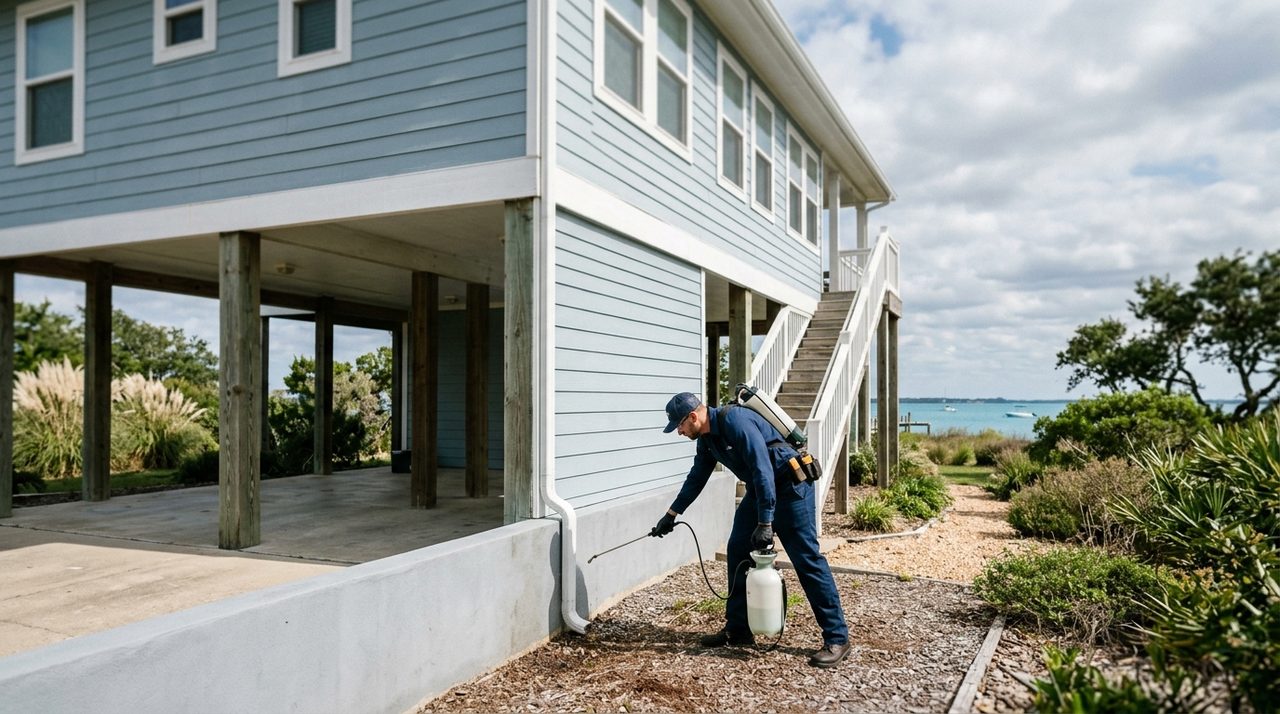
- Median home built
- 1990
- Median home value
- $399,500
- FEMA flood zone
- X (low)
- Typical pest control cost (est.)
- $150–$1,800 depending on service type
- Most common local issue
- Formosan termite pressure on aging slabs near Clear Creek
Ranked by verified Google rating × review volume × verification tier. How we rank →
Some highly-rated pros serve Friendswood from nearby and may not keep a Friendswood street address. Those are listed under "Also serving Friendswood" with their real city and distance, so you always know where each business is based.
Min rating:
10 resultsBased in Friendswood
Also serving Friendswood
Highly-rated pros based nearby who cover Friendswood. Distance shown from the Friendswood area.
Open Now
Serving Friendswood Based in Pearland · 1.8 mi away
Closed
Serving Friendswood Based in South Houston · 4.4 mi away
Open Now
Serving Friendswood Based in South Houston · 4.4 mi away
Closed
Serving Friendswood Based in Pearland · 4.6 mi away
Closed
Serving Friendswood Based in Webster · 4.7 mi away
Closed
Serving Friendswood Based in Clear Lake · 5 mi away
Closed
Serving Friendswood Based in Webster · 5 mi away
Open Now
Serving Friendswood Based in Webster · 5.1 mi away
Serving Friendswood Based in Pearland · 5.1 mi away
Pest Control in Friendswood: What You Should Know
Subterranean Termite Risk Across Friendswood's Multi-Era Foundations
Why it matters to you
Friendswood's oldest neighborhoods — including subdivisions like Wilderness Trails built in the 1960s and 1970s — contain homes that predate modern termiticide pre-treatment requirements for slab-on-grade pours. On those properties, expansion joints, original galvanized plumbing penetrations, and any remaining pier-and-beam sections near Clear Creek provide direct soil-to-wood contact that Formosan and Reticulitermes termites exploit year-round in Galveston County's Zone 5 pressure environment. Even 1990s and 2000s homes in West Ranch can lose termiticide barrier effectiveness after 10–15 years, leaving slab penetrations and weep holes in brick veneer vulnerable during spring swarm season.
What a good pro does
A TDLR-licensed Structural Pest Control operator with a termite category endorsement should probe all slab penetrations, brick weep holes, and any wood-to-soil contact points before recommending either a liquid barrier retreat (Termidor-type, estimated $800–$1,800 based on linear footage) or a bait station program (Sentricon-type, estimated $1,200–$2,000 installed plus $300–$500/year monitoring). For Wilderness Trails-era homes with original plumbing chases, a liquid barrier is typically the stronger first line given the number of legacy penetration points. City of Friendswood does not require a separate municipal permit for routine termite treatment, but the licensed operator's TDLR credentials should be verified before any work begins.
Standing Water and Mosquito Breeding on Clay Soil After Clear Creek Overflow Events
Why it matters to you
Although most of Friendswood maps to FEMA Zone X, blocks closest to Clear Creek see parcel-level flood risk that rises sharply after Gulf rain events, and even Zone X lots on Friendswood's clay-dominant soil can retain standing water for 72 hours or more after a heavy storm — exactly the window Aedes aegypti needs to complete an egg cycle. Harris County Mosquito Control District aerial spraying covers public rights-of-way, but private yard larval sources on low-drainage Friendswood lots are outside that program's scope, leaving homeowners responsible for their own property.
What a good pro does
A licensed pest control operator should conduct a source-reduction walk of the property — inspecting low spots near the foundation, any ornamental water features, downspout splash zones, and areas where clay soil creates persistent puddles — and apply larvicide (Bti-based granules or dunks) to standing water that cannot be eliminated. Monthly barrier spray programs during May through October typically run an estimated $75–$150 per application in the Houston metro. Operators working in Friendswood must hold a TDLR license with the appropriate pest category and should document treatment locations given the proximity to the Clear Creek corridor.
Sources: Texas Department of Licensing & Regulation, Harris County Flood Control District, FEMA National Flood Hazard Layer (NFHL)
American Cockroach Sewer Intrusion in Pre-1980 Friendswood Homes
Why it matters to you
Friendswood's 1960s and 1970s subdivisions commonly feature original cast-iron drain lines and early slab plumbing layouts that have developed gaps at joints and slab penetrations over decades of Galveston County clay-soil movement. After heavy rainfall displaces Periplaneta americana from storm and sanitary sewers, these gaps in aging cast-iron systems become direct migration routes into finished living spaces — a problem that interior spray treatments alone will not resolve if the exterior and drain harborage points remain open. Homeowners in older sections of Friendswood near Whispering Pines or Quaker Estates who report surge events after major rains are almost certainly dealing with this infrastructure-driven pattern rather than a sanitation issue.
What a good pro does
An effective approach requires a licensed TDLR operator to treat exterior perimeter weep holes and foundation gaps with residual product, apply gel bait or flush-and-treat at floor drains, and assess whether slab plumbing penetrations need physical exclusion material in addition to chemical treatment. A one-time general treatment for an average Friendswood home runs an estimated $150–$300, but recurrent post-rain pressure in pre-1980 homes typically warrants a quarterly service plan at an estimated $40–$70 per visit to maintain the exterior barrier. Homeowners should also consult a licensed plumber about video inspection of cast-iron drain condition, since persistent roach pressure often correlates with cracked lines creating sub-slab harborage that no surface treatment can fully address.
HOA Exterior Treatment Coordination in West Ranch and Other Active Friendswood Subdivisions
Why it matters to you
Friendswood has no city-wide mandatory HOA, but newer master-planned communities like West Ranch — managed by RealManage — and established associations like Forest of Friendswood maintain active architectural control processes that can affect when and how exterior pest control work is performed. Visible bait station installations, broadcast fire ant treatments on shared greenspace borders, and any structures associated with wildlife exclusion (vent covers, fascia sealing) may require HOA review before work begins, and treatment timing near community amenities can be restricted. Homeowners who skip this step risk fines or required removal of recently installed equipment.
What a good pro does
Before scheduling any perimeter bait station installation or exterior exclusion work in an HOA-governed Friendswood subdivision, homeowners should submit a written request to their association's architectural control committee and confirm in writing what treatments are permissible on the property line and shared-turf buffer. A pest control operator familiar with Friendswood subdivision rules can help document treatment types and station placements in a format most HOA reviewers accept. City of Friendswood permitting is not required for routine pest control service, but keeping HOA approval documentation on file protects homeowners if a neighbor or ACC inspector raises a complaint.
Sources: Local HOA / deed restrictions (see area profile), Texas Department of Licensing & Regulation
Pest Control in Friendswood: What You Should Know
Hiring pest control in Friendswood? Friendswood is an incorporated city with housing stock spanning from the 1960s through the 2010s, meaning contractors encounter everything from aging pier-and-beam foundations near Clear Creek to modern slab-on-grade production homes in master-planned communities like West Ranch. The city manages its own permitting, and the patchwork of active HOAs across dozens of subdivisions means architectural review requirements vary block by block. Proximity to Clear Creek creates recurring flood concerns in lower-lying sections despite many parcels mapping outside high-risk FEMA zones.
- Housing era
- 1960s–2010s, with major growth phases in the 1970s, 1990s, and 2000s
- Foundation
- Predominantly slab-on-grade (post-1970s production housing)
- Flood zone
- FEMA Zone X (low flood risk) per official NFHL API
- Permits
- City of Friendswood Building Inspections Department (independent city — does not use Houston or…
Housing stock & systems
Building era
1960s–2010s, with major growth phases in the 1970s, 1990s, and 2000s.
Typical style
Suburban traditional brick veneer single-family homes, 1- and 2-story plans with attached garages on moderate to large lots.
Foundations
Predominantly slab-on-grade (post-1970s production housing); some older 1960s-era homes may have pier-and-beam — confirm via Galveston CAD records.
Common systems
Older 1960s–1970s homes: original galvanized or copper plumbing, R-22 HVAC units nearing or past end of life, fuse panels or early breaker panels. 1990s–2010s homes: PVC/PEX plumbing, R-410A HVAC, 200-amp electrical panels. Attic-mounted air handlers are standard across eras.
What that means for repairs
Older subdivisions like Wilderness Trails see frequent HVAC replacements, re-piping from galvanized to PEX, and electrical panel upgrades. Newer master-planned communities like West Ranch focus on cosmetic remodels and outdoor living additions, often requiring HOA architectural review.
Permits & restrictions
Permit jurisdiction
City of Friendswood Building Inspections Department (independent city — does not use Houston or county permitting).
HOA & deed restrictions
No city-wide mandatory HOA. Dozens of subdivision-level HOAs exist, many actively managed (e.g., West Ranch managed by RealManage, Wilderness Trails with its own HOA website, Forest of Friendswood as a formal Texas nonprofit). Some older subdivisions show 'no current contact' on the city's HOA list, indicating defunct or inactive associations. Deed restrictions are common and recorded at the county level.
Historic districts
No historic district designation confirmed. Friendswood is an independent city and not subject to Houston's HAHC jurisdiction.
Contractor note
Contractors must pull permits through the City of Friendswood, not Harris or Galveston County. Many subdivisions require HOA architectural review before exterior work begins — always confirm the specific subdivision's requirements before scheduling.
Flood & weather
FEMA flood zone
FEMA Zone X (low flood risk) per official NFHL API. However, areas near Clear Creek and its tributaries carry significantly higher flood exposure. Property-level risk varies widely — always verify individual parcels, especially in older subdivisions closer to the creek.
Hurricane Harvey impact
Friendswood experienced significant flooding during Hurricane Harvey (2017), particularly in neighborhoods near Clear Creek and low-lying drainage channels. Older subdivisions closer to the creek were hit hardest, while newer elevated master-planned sections fared better. Specific repeatedly flooded streets are not confirmed in available sources — check Galveston County flood control mapping and past seller disclosures for property-level history.
Heat & humidity load
Coastal humidity and extended 95°F+ heat stress HVAC systems heavily, especially attic-mounted air handlers in older homes with inadequate insulation. Slab foundations on expansive clay soils experience seasonal movement during summer drought cycles, potentially affecting door frames and drywall. Roofing materials degrade faster due to UV exposure and Gulf moisture.
Working with contractors here
Friendswood's multi-decade housing stock creates a wide range of service demands. In 1960s–1970s subdivisions, contractors frequently handle whole-house re-piping, HVAC system replacements transitioning from R-22, and electrical panel upgrades from 100-amp to 200-amp service. Post-Harvey, flood remediation, foundation repair, and mold mitigation remain ongoing concerns in creek-adjacent areas. In newer master-planned communities like West Ranch, work tends toward kitchen and bath remodels, outdoor living additions, and fence replacements — all of which typically require HOA architectural approval before starting. Contractors should scope jobs with awareness that the City of Friendswood enforces its own building codes and inspection schedules, which differ from Houston's process.
Local Tip
Always ask for a written estimate before work begins. Texas contractors are required to provide one on jobs over $1,000.
About Friendswood
Friendswood is an incorporated city with housing stock spanning from the 1960s through the 2010s, meaning contractors encounter everything from aging pier-and-beam foundations near Clear Creek to modern slab-on-grade production homes in master-planned communities like West Ranch. The city manages its own permitting, and the patchwork of active HOAs across dozens of subdivisions means architectural review requirements vary block by block. Proximity to Clear Creek creates recurring flood concerns in lower-lying sections despite many parcels mapping outside high-risk FEMA zones.
- Median year built
- 1990
- Median home value
- $399,500
- Owner-occupied
- 76.9%
- Population
- 40,827
- Housing units
- 14,985
- Median income
- $125,052
Source: U.S. Census Bureau, ACS 5-Year 2023
Flood & storm risk
FEMA Zone XLow flood riskMost of Friendswood maps to FEMA Zone X (low mapped flood risk), but Houston's flash-flood reality means even low-risk blocks benefit from smart drainage and storm-hardened installs; risk climbs sharply on blocks nearest Clear Creek, where it varies parcel to parcel.
Source: FEMA National Flood Hazard Layer (NFHL). Flood zones vary by parcel — verify your individual FIRM panel.
Free Friendswood Tools & Calculators
Houston-specific estimators to plan your project before you call a pro. All results are planning estimates — a licensed local pro confirms the details on site.
Houston Subtropical Pest Treatment Planner
Open full tool & FAQ →Your Houston treatment schedule
| Pest | Cadence | Active window |
|---|---|---|
Mosquito control A standard 4-week barrier treatment holds a typical suburban lot through Houston's core mosquito season. | Every 28 days | April – October |
Termite (subterranean) A once-a-year spring inspection is the baseline for a drier, sunnier Houston lot — catch mud tubes and swarmer wings before damage compounds. | Annual inspection | Spring |
General pest guard (roaches, ants, spiders) Houston's year-round warmth means general pests never fully die off — a quarterly perimeter treatment is the standard maintenance rhythm. | Quarterly | Mar · Jun · Sep · Dec |
This is a planning estimate only — actual requirements depend on an on-site assessment by a licensed Houston pro. Texas requires an SPCB-licensed applicator for chemical treatment — ask for the technician's license number.
Frequently Asked Questions
Does the City of Friendswood require any permit or notification before a pest control company tents or fumigates my home?
Routine pest control treatments — sprays, bait stations, liquid termiticide barriers — do not require a City of Friendswood permit. If your operator recommends full structural fumigation (tenting), they are required under Texas law to notify the local fire marshal, and your pest company should coordinate that directly with the City of Friendswood rather than Harris or Galveston County offices, since Friendswood runs its own independent building and inspection department. Always confirm your operator holds a current TDLR Structural Pest Control license with the appropriate fumigation category endorsement before work begins.
My home in Wilderness Trails was built in the early 1970s with pier-and-beam construction — are termite risks different than in the newer slab homes in West Ranch?
Yes, meaningfully so. A 1970s pier-and-beam home near Clear Creek gives subterranean termites direct wood-to-soil contact under the crawl space, which is a more straightforward highway than the expansion joints and plumbing penetrations termites exploit in slab-on-grade homes. That older framing is also more likely to have untreated lumber, since pre-treatment with termiticide wasn't standard practice in that era. A licensed TDLR operator should perform a wood-destroying insect report (WDIR) inspection and assess whether liquid soil treatment around the perimeter or crawl-space bait stations are the better fit for that foundation type.
Even though my Friendswood parcel is in FEMA Zone X, I had standing water in my backyard for four days after the last heavy rain — does that create a real mosquito problem?
A Zone X designation means your parcel has low mapped flood risk for insurance purposes, but it does not mean your clay-heavy soil drains quickly — and Aedes aegypti mosquitoes can complete a breeding cycle in standing water in as little as seven to ten days. Harris County Mosquito Control District (and Galveston County's equivalent program) handles aerial and roadside spraying on public rights-of-way, but that coverage does not extend into your private yard. If your backyard routinely holds water for 72 hours or more after rain events, a professional larviciding treatment combined with a source-reduction assessment is the most effective private-property response.
Sources: Harris County Flood Control DistrictFEMA National Flood Hazard Layer (NFHL)
What is the realistic cost and timeline to get a Sentricon-style termite bait station system installed around a 2,200-square-foot slab home in West Ranch?
As an estimate, bait station installation for a home that size in the Friendswood market typically runs $1,200–$2,000 for the initial setup, with a required annual monitoring contract adding roughly $300–$500 per year. Installation itself usually takes one to two days once you have confirmed your West Ranch HOA architectural control requirements — West Ranch is managed by RealManage and may require advance approval before visible exterior equipment is placed in your yard or along the foundation line. Factor in the HOA review window, which can add one to three weeks to the start date, when scheduling.
Sources: Local HOA / deed restrictions (see area profile)
After Hurricane Beryl came through in July 2024, I noticed roof damage on my soffit — how quickly can wildlife get into my attic, and does my homeowner's insurance cover pest exclusion work that follows storm entry?
Roof rats and opossums can exploit a damaged soffit or fascia gap within days of a storm, and Beryl's winds caused widespread soffit and ridge cap damage across SE Houston suburbs including Friendswood. Texas law under TPWD requires specific handling protocols for bats, which are a protected species and a real possibility in attic spaces with new openings. Most standard homeowner policies cover the structural repair that follows storm damage but typically exclude pest exclusion or wildlife removal costs as a separate line item — review your policy and, if your home is TWIA-covered, confirm that exclusion labor is itemized before any work begins.
Red fire ant mounds keep reappearing near my irrigation heads and along the fence line — is there a time of year in Friendswood when treatment is most effective, and how often do I realistically need to retreat?
In the Friendswood area, fire ant colonies are most active and mounds most visible in spring (March–May) and again in early fall (September–October) when soil temperatures are moderate — treating during those windows with a broadcast granule or perimeter bait gives you the best colony-wide kill before queens relocate. Because Galveston and Harris County soil is classified high-density red imported fire ant territory by TAMU Extension, re-infestation from neighboring lots and shared greenspace is nearly guaranteed without a quarterly maintenance schedule. Individual mound treatments alone rarely provide lasting results on suburban lots with irrigated turf, which is why recurring perimeter broadcast programs are the standard recommendation for Friendswood yards.