Closed
1001 Sue Dr, Kemah, TX 77565
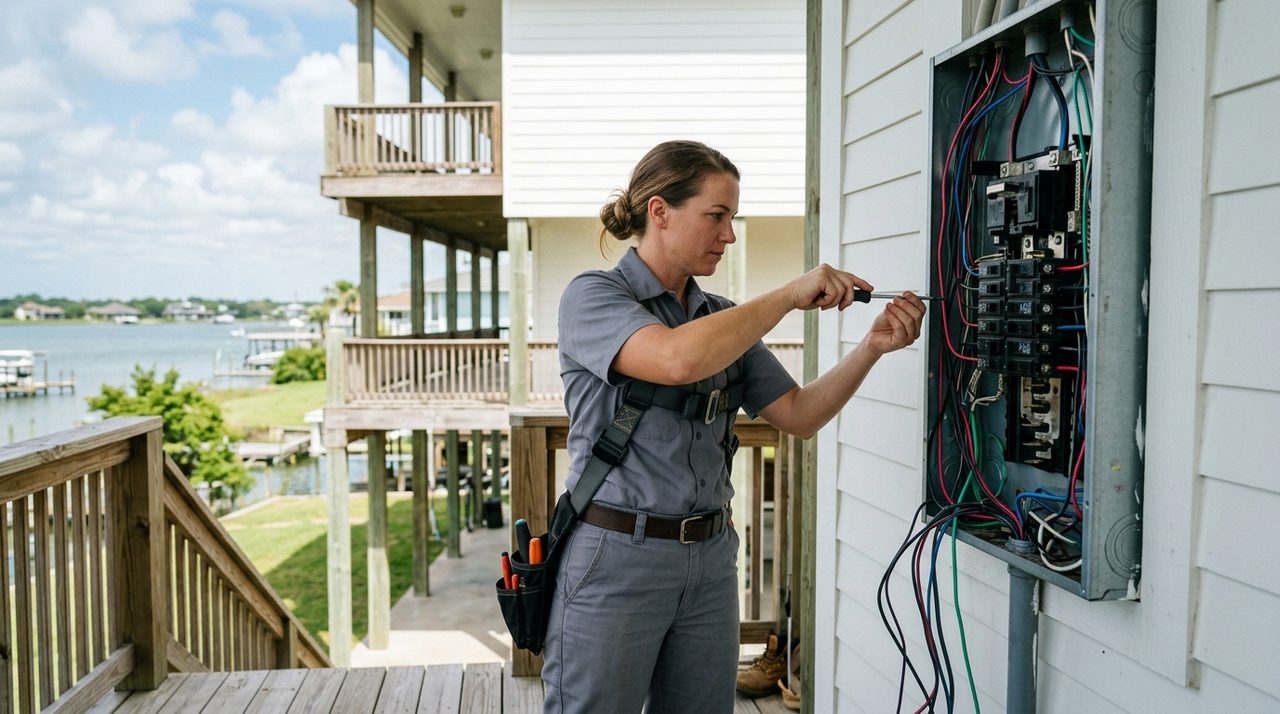
Kemah's bayfront location on Galveston Bay places virtually every home in FEMA Zone AE, meaning electrical work here carries flood-compliance obligations that simply don't exist in most Houston suburbs — panels, subpanels, and meter bases must meet elevation requirements, and any renovation crossing the 50% substantial-improvement threshold triggers full floodplain upgrade of the entire electrical system. From pre-1960s bay cottages with outdated service to post-2008 elevated townhomes in marina developments, Kemah homeowners deal with salt-air corrosion, hurricane-force wind exposure, and the City of Kemah's independent permit office — not Houston Permitting Center, not Galveston County. This page explains the four electrical challenges that actually matter in this community and what competent, locally experienced electricians do about them.
Ranked by verified Google rating × review volume × verification tier. How we rank →
Some highly-rated pros serve Kemah from nearby and may not keep a Kemah street address. Those are listed under "Also serving Kemah" with their real city and distance, so you always know where each business is based.
1001 Sue Dr, Kemah, TX 77565
921 Lawrence Rd, Kemah, TX 77565
Highly-rated pros based nearby who cover Kemah. Distance shown from the Kemah area.
Serving Kemah Based in League City · 3.6 mi away
Serving Kemah Based in Dickinson · 4.7 mi away
Serving Kemah Based in League City · 4.8 mi away
Serving Kemah Based in League City · 5 mi away
Serving Kemah Based in League City · 5.1 mi away
Serving Kemah Based in League City · 5.1 mi away
Serving Kemah Based in Dickinson · 5.5 mi away
Serving Kemah Based in Dickinson · 6.2 mi away
Why it matters to you
Virtually all of Kemah falls inside FEMA Zone AE, and the bayfront and canal-adjacent blocks saw surge inundation during both Harvey (2017) and Beryl (2024). A submerged main panel or meter base doesn't simply dry out — internal corrosion compromises breaker ratings and voids UL listings even when the box looks intact from the outside. Critically, any permitted electrical repair or replacement on a Kemah property in the AE zone that constitutes a substantial improvement must bring electrical equipment above the Base Flood Elevation, which on pier-supported bayfront homes can mean relocating the meter can and subpanel from a ground-level storage area to the elevated living-floor level.
What a good pro does
A qualified master electrician working in Kemah should pull all permits through the City of Kemah's building department — not Harris County or Houston Permitting Center — and submit an elevation certificate confirming where new equipment will land relative to BFE before work begins. TDLR requires a licensed Master Electrician to pull permits and supervise; ask to see that credential. Replacement panels and meter cans in flood-exposed locations should use NEMA 4X-rated enclosures and flood-resistant wiring methods below BFE per FEMA floodplain management guidelines.
Sources: FEMA National Flood Hazard Layer (NFHL), Texas Department of Licensing & Regulation, Municipal permit office (see area profile)
Why it matters to you
Kemah's position directly on Galveston Bay means salt-laden air contacts every exterior electrical component — weatherheads, meter cans, disconnect switches, HVAC disconnect boxes, and outdoor receptacles — year-round. The area's 1990s–2000s waterfront redevelopment wave left many homes with standard steel or aluminum outdoor enclosures that were never rated for a marine environment; by the time homeowners notice a breaker tripping or a GFCI refusing to reset, the enclosure internals and conductor terminations may already be heavily oxidized. This is not a cosmetic problem: corroded terminations increase resistance, generate heat, and can ignite adjacent materials.
What a good pro does
An electrician experienced with Kemah's coastal conditions should inspect all exterior enclosures with a thermal camera and replace corroded meter cans, disconnect switches, and outdoor sub-panels with marine-grade or NEMA 4X stainless-steel enclosures rated for salt-air exposure. All exterior receptacles within the living area and any ground-level storage should be GFCI-protected and installed in in-use, weatherproof covers per IRC electrical provisions. Permits for this replacement work go through the City of Kemah's building department, and the electrician must hold a current TDLR Master Electrician license to pull them.
Sources: International Residential Code (as adopted by City of Houston), Texas Department of Licensing & Regulation, Municipal permit office (see area profile)
Why it matters to you
Hurricane Beryl (July 2024) delivered sustained winds exceeding 80 mph across the Galveston Bay shoreline, and Kemah's elevated pier-supported homes — some with mast risers climbing 10–14 feet above grade to reach the service drop — present a longer lever arm for wind to shear conduit fittings and pull the service entrance from the structure. CenterPoint Energy will restore the utility-side service drop, but the weatherhead, mast, conduit, and meter base are the homeowner's responsibility and require both a City of Kemah electrical permit and a CenterPoint reconnect appointment before power is restored. Pre-1990s cottages in Kemah that still have overhead service rather than underground laterals are disproportionately exposed to this failure mode.
What a good pro does
After any major wind event, have a TDLR-licensed electrician inspect the full service entrance assembly — weatherhead cap, mast conduit, straps, and meter socket — before requesting CenterPoint reconnection. Mast repairs or replacements on elevated homes must be permitted through the City of Kemah; the permit triggers an inspection that confirms the new assembly is properly strapped to the structure at intervals that meet current code for coastal wind exposure. Homeowners on older cottages with overhead service should ask their electrician to quote the cost comparison for converting to an underground lateral during the same mobilization — it eliminates future mast exposure entirely.
Sources: Municipal permit office (see area profile), Texas Department of Licensing & Regulation, International Residential Code (as adopted by City of Houston)
Why it matters to you
Kemah's proximity to Galveston Bay keeps relative humidity chronically elevated — often above 80% — and attic temperatures in Kemah's wood-framed beach-house-style homes routinely exceed 130–140°F during summer. This combination attacks wire-nut connections and aluminum neutral conductors in attic junction boxes faster than in inland Houston neighborhoods; homes from the 1970s–1980s infill period are especially vulnerable because many were built with minimal attic ventilation and no conduit protection on attic wiring runs. A nuisance breaker trip or a warm outlet cover is often the first sign that insulation on THHN conductors has begun to crack or that a junction-box connection has oxidized to the point of arcing.
What a good pro does
A thorough electrician will add thermal-imaging inspection of attic wiring runs to any service call on a Kemah home built before 2000, not just the specific circuit reported as problematic. Hot spots in attic junction boxes should be remediated by replacing wire nuts with listed lever-nut connectors rated for the conductor size and, where practical, enclosing exposed attic runs in conduit to reduce humidity intrusion. Any rewiring or junction-box work requires a permit from the City of Kemah building department; confirm the electrician holds a current TDLR Master Electrician license before work begins.
Sources: Texas Department of Licensing & Regulation, Municipal permit office (see area profile), International Residential Code (as adopted by City of Houston)
Hiring electricians in Kemah? Kemah is a small incorporated city on Galveston Bay with a mix of original bay cottages, 1990s–2000s waterfront redevelopment, and newer elevated townhome/marina communities. Homeowners here face persistent challenges from storm surge exposure, salt-air corrosion, and FEMA floodplain compliance requirements. Contractors working in Kemah must be familiar with elevated foundation systems, coastal building codes, and the City of Kemah's own permitting process.
Building era
Mixed: pre-1960s original cottages, 1970s–1980s infill, significant 1990s–2000s waterfront redevelopment, and post-2008 elevated infill.
Typical style
Coastal raised beach-house style (pier-supported with elevated living areas), traditional suburban SFRs (brick veneer or siding), and townhome/condo marina-oriented developments with stucco or fiber-cement siding.
Foundations
Mixed — pier-and-beam/elevated pile foundations dominate along the bayfront and canal-adjacent properties; slab-on-grade more common in interior and newer suburban pockets.
Common systems
Older cottages may have original copper or galvanized plumbing and outdated electrical panels; 1990s–2000s homes typically feature central HVAC, PVC/CPVC plumbing, and 200-amp electrical service. Salt-air exposure accelerates corrosion on HVAC condensers, metal roofing components, and exterior electrical fixtures across all eras.
What that means for repairs
Most common renovation activity includes elevating older homes to meet current FEMA BFE requirements, replacing storm-damaged structures with new elevated construction, upgrading HVAC and exterior materials to salt-air-resistant alternatives, and converting or remodeling ground-level areas beneath raised homes for parking or storage.
Permit jurisdiction
City of Kemah (independent incorporated city with its own municipal government and building department).
HOA & deed restrictions
No city-wide mandatory HOA or master association. HOAs are present in specific newer townhome, condo, and marina developments on a project-by-project basis. Older platted areas (e.g., original Kemah Townsite) generally have no organized HOA. Voluntary civic clubs may exist in some pockets but are not confirmed. Deed restrictions vary by subdivision — check Galveston County Clerk records for specific parcels.
Historic districts
No City of Houston historic district designation confirmed. Kemah is an independent incorporated city; no HAHC jurisdiction applies. No locally designated historic districts confirmed in current city records.
Contractor note
Contractors must pull permits through the City of Kemah, not Houston or Galveston County. Coastal AE zone requirements often mandate elevation certificates, flood-resistant materials below BFE, and compliance with FEMA substantial improvement/damage rules for renovations exceeding 50% of the structure's market value.
FEMA flood zone
FEMA Zone AE (high flood risk) — source: fema_nfhl. Kemah sits directly on Galveston Bay and is exposed to both storm surge and tidal flooding. Much of the city falls within AE and potentially VE (velocity) zones along the immediate shoreline. Proximity to Clear Creek and Galveston Bay amplifies flood risk during tropical weather events.
Hurricane Harvey impact
Kemah experienced flooding during Hurricane Harvey (2017) from a combination of extreme rainfall and storm surge/tidal influence from Galveston Bay. Specific damage data for Kemah was not itemized separately from broader Galveston County FEMA reports, but the bayfront location and low elevation made the area vulnerable to both surge-driven and rain-driven flooding. Many older, non-elevated homes in the area sustained water damage. Post-Harvey, elevated construction and stricter floodplain compliance have become more prevalent.
Heat & humidity load
Extreme humidity and sustained heat along Galveston Bay push HVAC systems hard from May through October. Salt-laden coastal air accelerates corrosion on condenser coils, ductwork fasteners, and exterior metal components. Pier-and-beam homes benefit from under-house ventilation but require regular inspection for moisture damage, mold, and pest intrusion during the humid season.
Working with contractors here
Contractors in Kemah most frequently handle foundation elevation projects, HVAC replacement with salt-air-resistant units, and exterior envelope repairs caused by coastal weather exposure. Roof replacements are common after storm events, with wind-rated materials and proper tie-downs critical given the bayfront exposure. Plumbing work in older cottages often involves full re-pipes from galvanized to modern materials. Job scoping must account for FEMA elevation requirements — any substantial improvement to a structure in the AE zone requires bringing the entire building into current floodplain compliance, which can dramatically expand project scope and cost. Access can be tight on narrow waterfront lots, and contractors should verify whether the specific property falls under a project-level HOA with architectural review requirements before beginning exterior work.
Local Tip
Always ask for a written estimate before work begins. Texas contractors are required to provide one on jobs over $1,000.
Kemah is a small incorporated city on Galveston Bay with a mix of original bay cottages, 1990s–2000s waterfront redevelopment, and newer elevated townhome/marina communities. Homeowners here face persistent challenges from storm surge exposure, salt-air corrosion, and FEMA floodplain compliance requirements. Contractors working in Kemah must be familiar with elevated foundation systems, coastal building codes, and the City of Kemah's own permitting process.
Source: U.S. Census Bureau, ACS 5-Year 2023
Much of Kemah maps to FEMA Zone AE (high flood risk), so flood-resilient detailing -- elevated equipment, water-tolerant materials, and drainage-first thinking -- is essential here, not optional; risk climbs sharply on blocks nearest Galveston Bay, where it varies parcel to parcel.
Source: FEMA National Flood Hazard Layer (NFHL). Flood zones vary by parcel — verify your individual FIRM panel.
Before a named storm threatens Kemah, TX, a TDLR-licensed electrician should confirm your generator interlock, transfer switch, and any elevated panel connections are torqued and weatherproof, because salt-air corrosion accelerates terminal failure in coastal environments. Harvey 2017 left parts of Bolivar Peninsula without grid power for months, making a properly wired standby or portable generator system the most important electrical investment a coastal homeowner can make. Confirm the current FEMA panel for your Kemah parcel — the area maps to Zone AE, but adjacent lots can differ.
A generator interlock installed by a TDLR-licensed electrician is especially valuable in Kemah, TX because coastal CenterPoint feeders are among the first to lose power in any severe storm and among the last to be restored. Before the next derecho-level event, confirm with a licensed electrician that your transfer switch or interlock is rated for the wattage of your generator and that all connections are torqued to prevent the arc faults that humid, salt-laden coastal air accelerates. As a Galveston County community, Kemah may follow county rather than City of Houston storm rebuild rules.
In Kemah, TX, a generator interlock installed by a licensed electrician is the difference between safely powering a space heater during a multi-day coastal freeze outage and risking carbon monoxide poisoning by running a generator in an attached garage. Coastal CenterPoint feeders serving Galveston Bay communities were among the last restored after Uri 2021, making self-sufficient backup power not a luxury but a safety necessity. Because Kemah drains toward Galveston Bay, block-level runoff can differ sharply from the mapped zone.
Sources: FEMA National Flood Hazard Layer (NFHL), Ready.gov -- Hurricanes, CenterPoint Energy -- Storm Center, City of Houston -- Emergency Preparedness, Ready.gov -- Winter Weather, Harris County Flood Control District
Houston-specific estimators to plan your project before you call a pro. All results are planning estimates — a licensed local pro confirms the details on site.
Disconnect & drain every outdoor hose bib
Remove hoses, drain the spigots, and cover each with an insulated faucet sock. Un-drained hose bibs are the #1 burst point in a Houston freeze.
Insulate exposed pipes in the attic & garage
Wrap any pipe in an unconditioned space (attic runs, garage walls) with foam sleeves. Houston homes rarely insulate these because they only matter a few nights a year — which is exactly why they burst.
Open cabinet doors & keep a pencil-width drip
On hard-freeze nights, open kitchen/bath cabinets so warm air reaches the pipes and let faucets on exterior walls drip to relieve pressure.
Protect the attic/garage water heater & its lines
An attic or garage tank sits in unconditioned space. Insulate the cold-inlet and hot-outlet lines and confirm the emergency drain pan is clear so a leak doesn't reach the ceiling.
This is a planning estimate only — actual requirements depend on an on-site assessment by a licensed Houston pro. If a pipe has already burst, shut off your main water supply and call a licensed Houston plumber immediately — freeze bursts flood fast.
Sources: Municipal permit office (see area profile)Texas Department of Licensing & RegulationFEMA National Flood Hazard Layer (NFHL)
Sources: Municipal permit office (see area profile)
Sources: FEMA National Flood Hazard Layer (NFHL)Municipal permit office (see area profile)
Sources: Municipal permit office (see area profile)Texas Department of Licensing & Regulation