Closed
1401 Marina Bay Dr, Kemah, TX 77565
Kemah's position on Galveston Bay — FEMA Zone AE, repeatedly hammered by Harvey (2017), Imelda (2019), and Beryl's July 2024 landfall — creates a pest environment unlike anywhere else in the Houston metro. The mix of pre-1960s bay cottages on pier-and-beam foundations, 1990s waterfront redevelopment, and newer elevated pile-supported townhomes means every flood event leaves standing water trapped beneath raised structures and inside low-lying slab pockets for days at a time, turbocharging mosquito breeding and driving cockroaches out of saturated Galveston County sewer corridors. Understanding which pests Kemah's coastal hydrology and housing stock actually produce — and how City of Kemah permit rules and TDLR licensing requirements shape what a pest control operator can legally do here — is the difference between a one-call fix and a revolving door of re-infestations.
Ranked by verified Google rating × review volume × verification tier. How we rank →
Some highly-rated pros serve Kemah from nearby and may not keep a Kemah street address. Those are listed under "Also serving Kemah" with their real city and distance, so you always know where each business is based.
1401 Marina Bay Dr, Kemah, TX 77565
Highly-rated pros based nearby who cover Kemah. Distance shown from the Kemah area.
Serving Kemah Based in League City · 2.7 mi away
Serving Kemah Based in Dickinson · 4.3 mi away
Serving Kemah Based in Clear Lake · 5 mi away
Serving Kemah Based in League City · 5.1 mi away
Serving Kemah Based in Dickinson · 5.1 mi away
Serving Kemah Based in League City · 5.2 mi away
Serving Kemah Based in League City · 5.6 mi away
Serving Kemah Based in Webster · 5.9 mi away
Serving Kemah Based in League City · 6.1 mi away
Why it matters to you
Kemah's bayfront and canal-adjacent properties sit in FEMA Zone AE, meaning every named storm — including Beryl's 2024 landfall just miles away — pushes flood water into the crawl space beneath pier-and-beam cottages and into low spots along drainage swales that Galveston County's clay-influenced soils hold for 72 hours or more. Harris County Mosquito Control District aerial runs cover public rights-of-way, but the standing water pooled under your raised home or along your bulkhead line is private property — entirely your responsibility to address. Aedes aegypti breeding in as little as a tablespoon of water means the void space beneath a 1970s-era cottage can produce thousands of mosquitoes within a week of a surge event.
What a good pro does
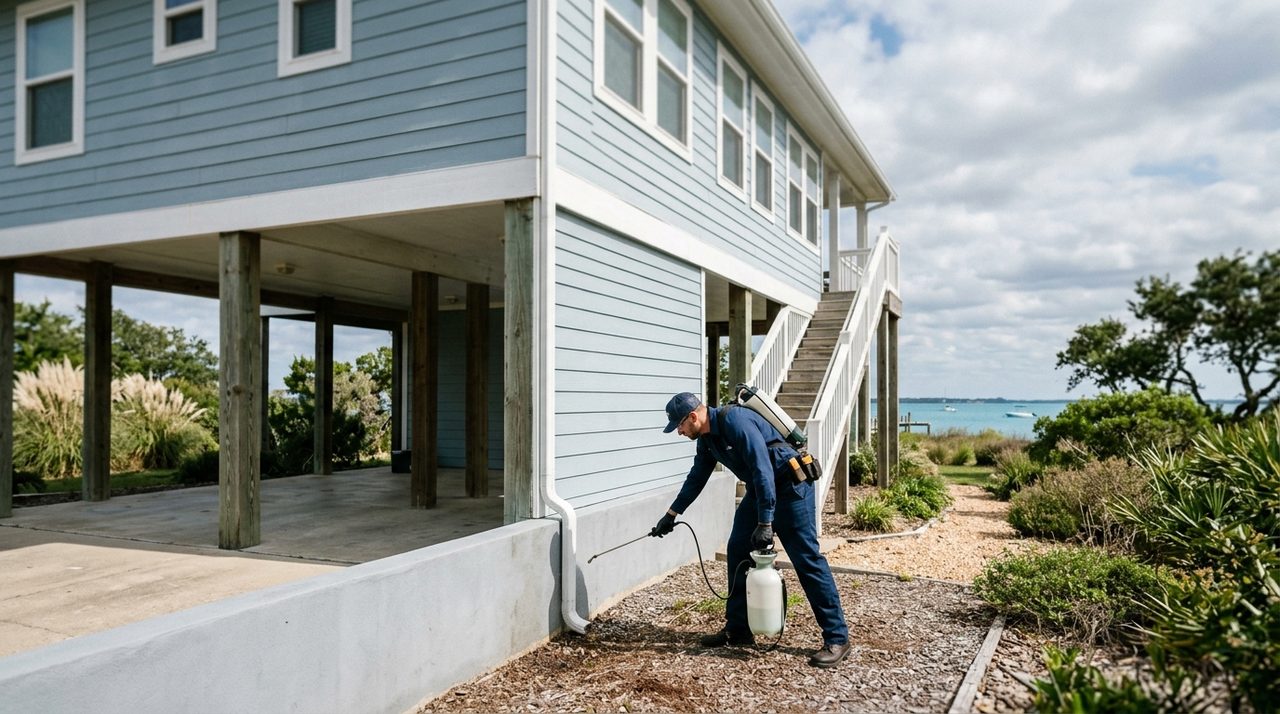
A TDLR-licensed pest control operator with a Category E (mosquito/vector) endorsement should conduct a source-reduction walkthrough beneath the elevated structure, apply EPA-registered Bti or spinosad larvicide to any trapped standing water, and follow up with a perimeter barrier spray using a residual pyrethroid on the underside of floor joists and surrounding vegetation. Monthly barrier spray programs during Kemah's April–October mosquito season typically run $75–$150 per application (est.). Ask your operator for documentation of their TDLR license number and specific category endorsements before scheduling — operators are required by law to provide this on request.
Sources: Texas Department of Licensing & Regulation, Harris County Flood Control District, FEMA National Flood Hazard Layer (NFHL)
Why it matters to you
Kemah's older bay cottages — many built pre-1980 with galvanized or cast-iron drain lines and minimal slab or foundation sealing — sit directly atop or adjacent to Galveston County sewer infrastructure that Periplaneta americana (the so-called 'waterbug') colonizes year-round. Heavy rain and storm surge events physically displace roaches from saturated sewer lines, pushing them upward through floor drains, weep holes in brick veneer, and the improperly resealed plumbing chases left behind after post-Harvey and post-Beryl re-pipes. Homes in Kemah's 1990s–2000s redevelopment pockets with slab-on-grade construction face the same penetration risk at every PVC stub-out that wasn't properly foam-sealed at the time of construction.
What a good pro does
Effective treatment requires a two-step approach: exterior perimeter gel bait and residual spray along the foundation line and weep holes, combined with a drain treatment (boric acid-based foam or an EPA-registered insect growth regulator flushed into floor drains) to break the sewer-to-interior pipeline. A qualified TDLR-licensed operator should inspect and chemically treat all accessible slab penetrations — not just spray the baseboards. No City of Kemah permit is required for routine pest control service, but if the operator's scope involves opening walls to seal utility chases, that remediation work falls under the City of Kemah building department's jurisdiction and may require a permit.
Sources: Texas Department of Licensing & Regulation, FEMA National Flood Hazard Layer (NFHL)
Why it matters to you
While Kemah's bayfront pier-and-beam homes lack a soil-to-wood slab interface, the interior and newer suburban pockets of Kemah — particularly 1990s–2000s slab-on-grade construction — sit in USDA Termite Pressure Zone 5, the highest-rated zone in the continental United States, and Galveston County's moist post-flood soils accelerate Formosan subterranean termite (Coptotermes formosanus) colony activity from February through June. FEMA Zone AE flood saturation events are documented to increase soil moisture around slab perimeters for weeks, and termites exploit expansion joints, post-tension cable sleeves, and plumbing penetrations as direct soil-to-framing highways. A 1995-built slab home (close to Kemah's Census median year built) likely received a pre-construction termiticide treatment that has long since degraded.
What a good pro does
A TDLR-licensed operator holding the Termite (Category B) endorsement should perform a full slab perimeter inspection and recommend either a liquid barrier treatment (Termidor-type, $800–$1,800 est. depending on linear footage) or a bait station monitoring system (Sentricon-type, $1,200–$2,000 est. installation plus $300–$500/year monitoring contract). In Kemah's AE flood zone, bait station placements should be documented with GPS coordinates and elevation references so that post-flood inspections can quickly identify stations that were inundated and need replacement — a step many operators skip unless the homeowner specifically requests it.
Sources: Texas Department of Licensing & Regulation, FEMA National Flood Hazard Layer (NFHL), Texas Commission on Environmental Quality
Why it matters to you
Beryl's July 2024 landfall and the May 2024 derecho both produced wind speeds capable of stripping the fiber-cement soffit panels and wood fascia common on Kemah's 1990s–2000s elevated townhomes and marina-oriented developments. Within days of that kind of damage, roof rats and Virginia opossums — both abundant in Galveston Bay's wooded coastal strips — exploit open soffit voids to nest in attic spaces that are already elevated 8–12 feet off grade and difficult to inspect from the ground. Texas law (TPWD) governs handling of certain wildlife, and Mexican free-tailed bats, which roost in coastal structures throughout Galveston County, require specific exclusion protocols that a general pest control technician cannot perform without proper coordination. TWIA wind coverage may apply to the structural damage that enabled the intrusion, but pest-related remediation (exclusion, trapping, decontamination) is typically a separate out-of-pocket cost.
What a good pro does
Engage a TDLR-licensed pest control operator with a wildlife control endorsement immediately after any storm event — not weeks later when an infestation is established. The operator should conduct a drone-assisted or ladder inspection of all soffit, fascia, and ridge-cap damage, perform one-way exclusion device installation, and seal all confirmed entry points with materials rated for coastal salt-air exposure (stainless steel mesh, not standard galvanized hardware cloth, which corrodes within one season in Kemah's environment). Coordinate your TWIA claim for the structural damage first so that exclusion and repair scopes don't overlap in ways that create coverage disputes. Post-exclusion decontamination of attic insulation contaminated by wildlife waste runs $500–$1,500+ (est.) and is a separate line item from the exclusion itself.
Sources: Texas Windstorm Insurance Association (TWIA), Texas Department of Licensing & Regulation, FEMA National Flood Hazard Layer (NFHL)
Hiring pest control in Kemah? Kemah is a small incorporated city on Galveston Bay with a mix of original bay cottages, 1990s–2000s waterfront redevelopment, and newer elevated townhome/marina communities. Homeowners here face persistent challenges from storm surge exposure, salt-air corrosion, and FEMA floodplain compliance requirements. Contractors working in Kemah must be familiar with elevated foundation systems, coastal building codes, and the City of Kemah's own permitting process.
Building era
Mixed: pre-1960s original cottages, 1970s–1980s infill, significant 1990s–2000s waterfront redevelopment, and post-2008 elevated infill.
Typical style
Coastal raised beach-house style (pier-supported with elevated living areas), traditional suburban SFRs (brick veneer or siding), and townhome/condo marina-oriented developments with stucco or fiber-cement siding.
Foundations
Mixed — pier-and-beam/elevated pile foundations dominate along the bayfront and canal-adjacent properties; slab-on-grade more common in interior and newer suburban pockets.
Common systems
Older cottages may have original copper or galvanized plumbing and outdated electrical panels; 1990s–2000s homes typically feature central HVAC, PVC/CPVC plumbing, and 200-amp electrical service. Salt-air exposure accelerates corrosion on HVAC condensers, metal roofing components, and exterior electrical fixtures across all eras.
What that means for repairs
Most common renovation activity includes elevating older homes to meet current FEMA BFE requirements, replacing storm-damaged structures with new elevated construction, upgrading HVAC and exterior materials to salt-air-resistant alternatives, and converting or remodeling ground-level areas beneath raised homes for parking or storage.
Permit jurisdiction
City of Kemah (independent incorporated city with its own municipal government and building department).
HOA & deed restrictions
No city-wide mandatory HOA or master association. HOAs are present in specific newer townhome, condo, and marina developments on a project-by-project basis. Older platted areas (e.g., original Kemah Townsite) generally have no organized HOA. Voluntary civic clubs may exist in some pockets but are not confirmed. Deed restrictions vary by subdivision — check Galveston County Clerk records for specific parcels.
Historic districts
No City of Houston historic district designation confirmed. Kemah is an independent incorporated city; no HAHC jurisdiction applies. No locally designated historic districts confirmed in current city records.
Contractor note
Contractors must pull permits through the City of Kemah, not Houston or Galveston County. Coastal AE zone requirements often mandate elevation certificates, flood-resistant materials below BFE, and compliance with FEMA substantial improvement/damage rules for renovations exceeding 50% of the structure's market value.
FEMA flood zone
FEMA Zone AE (high flood risk) — source: fema_nfhl. Kemah sits directly on Galveston Bay and is exposed to both storm surge and tidal flooding. Much of the city falls within AE and potentially VE (velocity) zones along the immediate shoreline. Proximity to Clear Creek and Galveston Bay amplifies flood risk during tropical weather events.
Hurricane Harvey impact
Kemah experienced flooding during Hurricane Harvey (2017) from a combination of extreme rainfall and storm surge/tidal influence from Galveston Bay. Specific damage data for Kemah was not itemized separately from broader Galveston County FEMA reports, but the bayfront location and low elevation made the area vulnerable to both surge-driven and rain-driven flooding. Many older, non-elevated homes in the area sustained water damage. Post-Harvey, elevated construction and stricter floodplain compliance have become more prevalent.
Heat & humidity load
Extreme humidity and sustained heat along Galveston Bay push HVAC systems hard from May through October. Salt-laden coastal air accelerates corrosion on condenser coils, ductwork fasteners, and exterior metal components. Pier-and-beam homes benefit from under-house ventilation but require regular inspection for moisture damage, mold, and pest intrusion during the humid season.
Working with contractors here
Contractors in Kemah most frequently handle foundation elevation projects, HVAC replacement with salt-air-resistant units, and exterior envelope repairs caused by coastal weather exposure. Roof replacements are common after storm events, with wind-rated materials and proper tie-downs critical given the bayfront exposure. Plumbing work in older cottages often involves full re-pipes from galvanized to modern materials. Job scoping must account for FEMA elevation requirements — any substantial improvement to a structure in the AE zone requires bringing the entire building into current floodplain compliance, which can dramatically expand project scope and cost. Access can be tight on narrow waterfront lots, and contractors should verify whether the specific property falls under a project-level HOA with architectural review requirements before beginning exterior work.
Local Tip
Always ask for a written estimate before work begins. Texas contractors are required to provide one on jobs over $1,000.
Kemah is a small incorporated city on Galveston Bay with a mix of original bay cottages, 1990s–2000s waterfront redevelopment, and newer elevated townhome/marina communities. Homeowners here face persistent challenges from storm surge exposure, salt-air corrosion, and FEMA floodplain compliance requirements. Contractors working in Kemah must be familiar with elevated foundation systems, coastal building codes, and the City of Kemah's own permitting process.
Source: U.S. Census Bureau, ACS 5-Year 2023
Much of Kemah maps to FEMA Zone AE (high flood risk), so flood-resilient detailing -- elevated equipment, water-tolerant materials, and drainage-first thinking -- is essential here, not optional; risk climbs sharply on blocks nearest Galveston Bay, where it varies parcel to parcel.
Source: FEMA National Flood Hazard Layer (NFHL). Flood zones vary by parcel — verify your individual FIRM panel.
Houston-specific estimators to plan your project before you call a pro. All results are planning estimates — a licensed local pro confirms the details on site.
| Pest | Cadence | Active window |
|---|---|---|
Mosquito control A standard 4-week barrier treatment holds a typical suburban lot through Houston's core mosquito season. | Every 28 days | April – October |
Termite (subterranean) A once-a-year spring inspection is the baseline for a drier, sunnier Houston lot — catch mud tubes and swarmer wings before damage compounds. | Annual inspection | Spring |
General pest guard (roaches, ants, spiders) Houston's year-round warmth means general pests never fully die off — a quarterly perimeter treatment is the standard maintenance rhythm. | Quarterly | Mar · Jun · Sep · Dec |
This is a planning estimate only — actual requirements depend on an on-site assessment by a licensed Houston pro. Texas requires an SPCB-licensed applicator for chemical treatment — ask for the technician's license number.
Sources: Harris County Flood Control DistrictFEMA National Flood Hazard Layer (NFHL)
Sources: Local HOA / deed restrictions (see area profile)