Closed
Serving Seabrook Based in Kemah · 1.9 mi away
Seabrook's position on Galveston Bay puts it at the intersection of two relentless pest pressures: FEMA AE flood-zone soils that stay saturated for days after storms, feeding mosquito and cockroach surges, and a Gulf-coast climate that keeps Formosan termite colonies active nearly year-round in the area's 1960s–1990s slab and pier-and-beam housing stock. Understanding how bay-adjacent conditions and mixed-era construction amplify pest risk helps Seabrook homeowners ask the right questions before writing a check.
Ranked by verified Google rating × review volume × verification tier. How we rank →
Some highly-rated pros serve Seabrook from nearby and may not keep a Seabrook street address. Those are listed under "Also serving Seabrook" with their real city and distance, so you always know where each business is based.
Highly-rated pros based nearby who cover Seabrook. Distance shown from the Seabrook area.
Serving Seabrook Based in Kemah · 1.9 mi away
Serving Seabrook Based in League City · 2.8 mi away
Serving Seabrook Based in Clear Lake · 4.9 mi away
Serving Seabrook Based in La Porte · 5.5 mi away
Serving Seabrook Based in Dickinson · 5.6 mi away
Serving Seabrook Based in League City · 5.8 mi away
Serving Seabrook Based in Webster · 5.9 mi away
Serving Seabrook Based in Webster · 5.9 mi away
Serving Seabrook Based in League City · 6 mi away
Serving Seabrook Based in Clear Lake · 6 mi away
Why it matters to you
Seabrook's FEMA AE designation means a significant share of residential lots flood — sometimes repeatedly in a single hurricane season — leaving standing water pooled in yard depressions, slab voids under pier-and-beam waterfront homes, and along the canal-front edges that characterize many neighborhoods near Galveston Bay. Houston's Black clay soil drains so slowly that standing water can persist 72-plus hours after a storm event, giving Aedes aegypti and Culex quinquefasciatus mosquitoes ample time to complete a breeding cycle. Harvey (2017) and Beryl's July 2024 landfall both left broad standing-water footprints across this immediate coastline.
What a good pro does
A licensed Texas Structural Pest Control operator (TDLR-credentialed, with a general household pest category endorsement) should conduct a yard-wide source-reduction assessment to identify cryptic breeding sites — under deck framing, in corrugated drainage pipes, and along bulkhead margins — then apply EPA-registered larvicide (Bacillus thuringiensis israelensis or spinosad) to water that cannot be eliminated. Harris County Mosquito Control District aerial spraying covers public right-of-way only, so private-yard barrier sprays on a monthly schedule during the April–October season are the homeowner's responsibility; budget $75–$150 per application as an estimate.
Sources: FEMA National Flood Hazard Layer (NFHL), Harris County Flood Control District, Texas Department of Licensing & Regulation
Why it matters to you
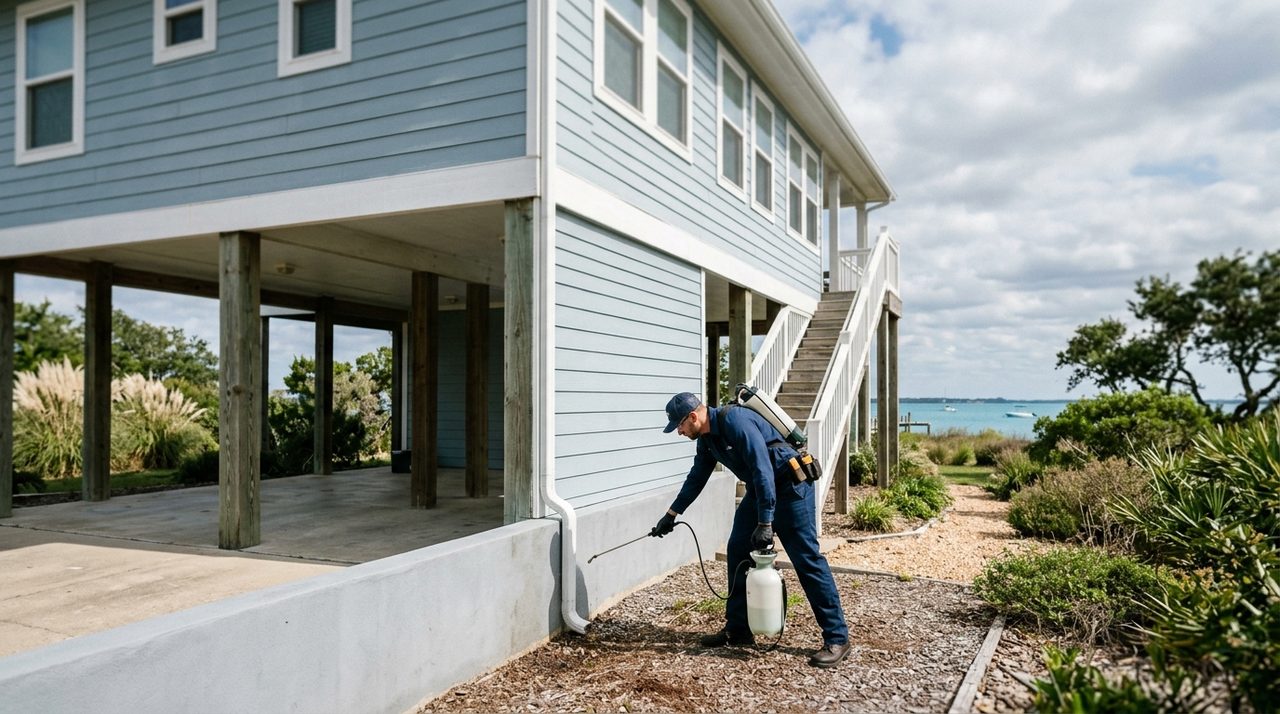
Seabrook's 1960s and 1970s waterfront and canal-front homes built on pier-and-beam foundations — elevated to meet historic floodplain requirements — leave wood floor framing, sill plates, and joists directly accessible from the soil below without a concrete slab barrier. Houston sits in USDA termite pressure Zone 5, and Coptotermes formosanus (Formosan subterranean termite) swarms most aggressively February through June, coinciding with the late-winter to spring period when Seabrook's saturated bayfront soils are at peak moisture from rain and tidal influence. Flood-saturated wood from storm events further accelerates colony establishment.
What a good pro does
A TDLR-licensed pest control operator with a Termite (Wood-Destroying Insects) category endorsement should perform a full Wood-Destroying Insect report before any treatment, mapping active mud tubes, frass, and damaged joists accessible through the crawlspace. For pier-and-beam structures, a soil-applied liquid termiticide barrier (Termidor-type) around the perimeter and beneath the structure, combined with bait monitoring stations at the foundation line, provides layered protection; liquid treatment for a pier-and-beam home in this linear-footage range typically runs $800–$1,800 as an estimate. No City of Seabrook permit is required for routine termite treatment, but contractors should document treatment zones for any future elevation-certificate or TWIA insurance review.
Sources: Texas Department of Licensing & Regulation, Texas Windstorm Insurance Association (TWIA), FEMA National Flood Hazard Layer (NFHL)
Why it matters to you
Seabrook's production-suburban 1970s–1990s slab-on-grade homes in neighborhoods like Lake Cove and Searidge frequently have original cast-iron or early-CPVC drain lines whose slab penetrations have shifted over decades due to Houston's expansive Beaumont/Houston Black clay soil. Heavy Gulf Coast rain events — including the repeated flooding episodes tracked by HCFCD — displace Periplaneta americana (American cockroach, locally called 'waterbugs') from storm sewers and crawlways into those slab gaps and weep holes within hours of a downpour. Interior spray treatments alone cannot break this cycle when the entry pathway is a displaced plumbing sleeve under the slab.
What a good pro does
Effective control requires a two-phase approach: a TDLR-licensed applicator should apply residual insecticide and bait gel to the exterior foundation perimeter, weep holes, and interior drain access points, combined with a physical exclusion audit to identify and foam-seal any plumbing penetrations accessible from under kitchen and bathroom cabinetry. Homeowners in Seabrook's older subdivisions should also have a plumber camera-inspect cast-iron drain lines for offset joints that create interior harborage — pest control and plumbing scopes overlap here. No municipal permit is needed for pest control treatment itself through the City of Seabrook, but any plumbing repair associated with exclusion will require a City of Seabrook plumbing permit.
Sources: Texas Department of Licensing & Regulation, Harris County Flood Control District
Why it matters to you
Beryl's Category 1 landfall in July 2024 and the May 2024 derecho with sustained gusts above 80 mph stripped soffit panels, ridge caps, and fascia boards across Seabrook's mixed-age housing stock — especially the wood-soffit construction common in 1970s–1980s homes. Within days of a storm, Rattus rattus (roof rats) and Virginia opossums exploit those openings, with mature coastal live oaks providing direct canopy-to-roofline access on many waterfront lots. Homeowners filing TWIA wind claims for roof repairs should be aware that unaddressed wildlife intrusion discovered during remediation can complicate the claim scope and timeline.
What a good pro does
A TDLR-licensed pest control operator with a Wildlife (vertebrate) category endorsement should inspect attic space before roof repairs begin, document any active rodent or wildlife presence with photos for insurance purposes, and perform exclusion sealing of all secondary entry points once the primary storm damage is repaired. Texas Parks and Wildlife Department (TPWD) protocols apply to bats and certain bird species, so the operator must verify species before any eviction work. Post-exclusion rodent trapping and attic sanitation (removal of contaminated insulation) are separate line items; full post-storm attic remediation in a Seabrook home of typical size typically runs $500–$1,500-plus as an estimate depending on scope.
Sources: Texas Department of Licensing & Regulation, Texas Windstorm Insurance Association (TWIA), Local HOA / deed restrictions (see area profile)
Hiring pest control in Seabrook? Seabrook is an incorporated city on Galveston Bay with housing ranging from 1960s waterfront homes to 2000s subdivision development, creating a wide spectrum of home service needs. The coastal location and FEMA AE flood zone designation mean that flood mitigation, elevation considerations, and storm-hardening are central to nearly every major home project. Homeowners should expect subdivision-level HOA requirements that vary block by block and plan for salt-air corrosion on exterior systems.
Building era
1970s–2000s, with some 1960s waterfront homes and ongoing infill.
Typical style
Production suburban traditional (one- and two-story brick or brick-and-siding) with coastal/contemporary elevated homes along waterfront and canal-front areas.
Foundations
Mixed — predominantly slab-on-grade in newer subdivisions; pier-and-beam or pier-and-pile construction common in older waterfront and canal-front homes due to floodplain and storm-surge requirements.
Common systems
Central HVAC systems typical of 1980s–2000s construction (aging units in older homes); copper and CPVC plumbing in newer builds, galvanized possible in 1960s–1970s stock; standard 200-amp electrical panels in newer homes, potential 100-amp in older homes.
What that means for repairs
Flood damage repair and mitigation retrofits are common drivers of renovation activity. Waterfront homes frequently undergo elevation projects, foundation reinforcement, and storm-resistant window/door upgrades. Older homes often need full plumbing repipes and HVAC replacements due to age and salt-air corrosion.
Permit jurisdiction
City of Seabrook Building/Permits Department (incorporated city — not Houston Permitting Center or Harris County).
HOA & deed restrictions
Subdivision-by-subdivision. Many subdivisions have mandatory HOAs/POAs including Seabrook Island HOA, Lake Cove Community Association (managed by Goodwin & Company), Seascape POA, and Searidge. Approximately 16 HOA/condo communities are registered in Seabrook. Some older or fringe areas may have no active HOA but may still have recorded deed restrictions.
Historic districts
No City of Houston historic district designation confirmed. Seabrook is an independent incorporated city and not subject to HAHC oversight.
Contractor note
Contractors must pull permits through the City of Seabrook and should verify subdivision-specific HOA architectural review requirements before starting exterior work. Coastal building codes and floodplain management regulations apply and may require elevation certificates.
FEMA flood zone
FEMA Zone AE (high flood risk) — source: fema_nfhl. Seabrook sits directly on Galveston Bay and is subject to both riverine flooding and coastal storm surge, contributing to its very high hazard risk rating.
Hurricane Harvey impact
The Clear Lake/Bay area of southeast Harris County experienced significant flooding during Hurricane Harvey. Seabrook-specific community hazard data rates overall risk as 'Very High.' However, no publicly available subdivision-level or street-level Harvey flood-extent map for Seabrook was identified. Exact street-by-street impact should be verified through Harris County Flood Control District records and individual property seller's disclosures.
Heat & humidity load
Extreme humidity and salt-air proximity accelerate corrosion on HVAC condensers, metal roofing components, and exterior hardware. HVAC systems run at near-continuous capacity May through September, shortening equipment lifespan. Mold and moisture intrusion in slab-on-grade and pier-and-beam homes require proactive dehumidification and ventilation strategies.
Working with contractors here
Contractors working in Seabrook most commonly handle flood damage restoration, foundation repairs (especially on older pier-and-beam waterfront homes), and HVAC replacements accelerated by salt-air corrosion and heavy summer usage. Roofing and exterior siding projects require wind-rated materials compliant with coastal building codes, and many jobs trigger City of Seabrook floodplain management requirements including elevation certificates. The wide range of housing ages — from 1960s waterfront cottages to 2000s subdivision homes — means scoping should always begin with a thorough assessment of existing systems, as plumbing and electrical standards vary significantly across eras. HOA architectural review adds a layer of approval in many subdivisions, so contractors should confirm HOA requirements before beginning visible exterior modifications.
Local Tip
Always ask for a written estimate before work begins. Texas contractors are required to provide one on jobs over $1,000.
Seabrook is an incorporated city on Galveston Bay with housing ranging from 1960s waterfront homes to 2000s subdivision development, creating a wide spectrum of home service needs. The coastal location and FEMA AE flood zone designation mean that flood mitigation, elevation considerations, and storm-hardening are central to nearly every major home project. Homeowners should expect subdivision-level HOA requirements that vary block by block and plan for salt-air corrosion on exterior systems.
Source: U.S. Census Bureau, ACS 5-Year 2023
Much of Seabrook maps to FEMA Zone AE (high flood risk), so flood-resilient detailing -- elevated equipment, water-tolerant materials, and drainage-first thinking -- is essential here, not optional; risk climbs sharply on blocks nearest Galveston Bay, where it varies parcel to parcel.
Source: FEMA National Flood Hazard Layer (NFHL). Flood zones vary by parcel — verify your individual FIRM panel.
Houston-specific estimators to plan your project before you call a pro. All results are planning estimates — a licensed local pro confirms the details on site.
| Pest | Cadence | Active window |
|---|---|---|
Mosquito control A standard 4-week barrier treatment holds a typical suburban lot through Houston's core mosquito season. | Every 28 days | April – October |
Termite (subterranean) A once-a-year spring inspection is the baseline for a drier, sunnier Houston lot — catch mud tubes and swarmer wings before damage compounds. | Annual inspection | Spring |
General pest guard (roaches, ants, spiders) Houston's year-round warmth means general pests never fully die off — a quarterly perimeter treatment is the standard maintenance rhythm. | Quarterly | Mar · Jun · Sep · Dec |
This is a planning estimate only — actual requirements depend on an on-site assessment by a licensed Houston pro. Texas requires an SPCB-licensed applicator for chemical treatment — ask for the technician's license number.
Sources: FEMA National Flood Hazard Layer (NFHL)Texas Department of Licensing & Regulation
Sources: Texas Windstorm Insurance Association (TWIA)Texas Department of Licensing & Regulation
Sources: Local HOA / deed restrictions (see area profile)
Sources: Harris County Flood Control DistrictFEMA National Flood Hazard Layer (NFHL)