Closed
1018 Hercules Ave, Houston, TX 77058
Clear Lake's NASA-era slab homes—most built between 1960 and 1985 on Houston's coastal-plain clay—are at the age where expansive soil movement, aging cast-iron drain lines, and decades of wet/dry cycles converge into visible foundation distress. Most of the area falls within City of Houston permit jurisdiction, meaning foundation underpinning work requires a permit through the Houston Permitting Center, and the subdivision-level HOAs (CLCCA, CLFCA, and others) add a layer of ARC approval before exterior trenching can begin. This page explains the specific mechanisms damaging Clear Lake slabs, what repair options actually make sense here, and what you need to do before signing a contract.
Ranked by verified Google rating × review volume × verification tier. How we rank →
Some highly-rated pros serve Clear Lake from nearby and may not keep a Clear Lake street address. Those are listed under "Also serving Clear Lake" with their real city and distance, so you always know where each business is based.
1018 Hercules Ave, Houston, TX 77058
1300 Bay Area Blvd #6, Houston, TX 77058
15314 St Cloud Dr, Houston, TX 77062
17300 Saturn Ln, Houston, TX 77058
Highly-rated pros based nearby who cover Clear Lake. Distance shown from the Clear Lake area.
Serving Clear Lake Based in Webster · 2.2 mi away
Serving Clear Lake Based in Seabrook · 2.5 mi away
Serving Clear Lake Based in Seabrook · 2.5 mi away
Serving Clear Lake Based in Webster · 2.8 mi away
Serving Clear Lake Based in Webster · 3 mi away
Serving Clear Lake Based in Kemah · 3.4 mi away
Why it matters to you
Clear Lake's 1960s and 1970s ranch homes were built with cast-iron drain-waste-vent systems that are now 50–60 years old. Winter Storm Uri (2021) cracked thousands of these lines across the Houston metro, and many Clear Lake homeowners patched interior walls without confirming the under-slab pipes were intact. A slow leak beneath a slab saturates the expansive clay directly, causing it to soften and reconsolidate—producing a localized depression that mimics drought-related settlement but won't respond correctly to pier underpinning if the leak is still active.
What a good pro does
Before any foundation contractor finalizes a repair scope, insist on a hydrostatic plumbing pressure test—a procedure that runs roughly $250–$400 (est.) and is performed by a plumber licensed by the Texas State Board of Plumbing Examiners (TSBPE). If a line fails, a licensed plumber must scope and repair or reroute the damaged section before underpinning begins; pier installation into saturated, compromised clay will not hold long-term. Confirm the plumbing work is permitted separately through the Houston Permitting Center.
Sources: Texas State Board of Plumbing Examiners, City of Houston Permitting Center
Why it matters to you
Clear Lake sits on coastal-plain Houston Black clay—among the most expansive soils in North America. The La Niña drought cycles of 2022–2023 baked these soils, pulling the clay away from slab edges and leaving the perimeter beam unsupported. When Gulf-driven rains return, water channels into those gaps rather than infiltrating gradually, washing fine particles out from under the beam. In a neighborhood where the median home was built in 1984 (ACS 2023), these slabs have endured four or more major drought-rebound cycles with no soil moisture management, making perimeter void formation one of the most widespread and underdiagnosed problems in Clear Lake.
What a good pro does
A qualified contractor will probe around the full perimeter to locate voids before recommending piers—mudjacking or polyurethane foam injection ($800–$2,500 per section, est.) can re-support a beam where the soil has pulled away without the cost of full steel pier underpinning. Ongoing prevention requires a soaker-hose irrigation program run 2–3 times per week at the foundation perimeter during dry months, placed 18 inches from the slab edge to maintain consistent soil moisture year-round.
Sources: Harris County Flood Control District
Why it matters to you
Clear Lake has no single area-wide HOA—instead, multiple mandatory subdivision associations (Clear Lake City Community Association, Clear Lake Forest Community Association, Reserve at Clear Lake, and others) govern properties street by street. Each association's Architectural Review Committee controls approval of exterior modifications, and foundation repair that involves perimeter trenching, pier-access excavation, or soil injection ports visible from the street or neighboring lots qualifies as exterior work in most ARC guidelines. Skipping this step has resulted in stop-work orders and violation fines for homeowners who assumed foundation work was exempt.
What a good pro does
Identify which specific HOA governs your parcel before signing any repair contract—your deed or a call to the Houston Permitting Center can confirm this. Submit a written scope-of-work description and site diagram to the relevant ARC and obtain written approval before the contractor mobilizes. After HOA approval, the foundation permit itself is pulled through the Houston Permitting Center; the City of Houston requires a permit for underpinning and structural repair work on residential slabs. A reputable contractor will walk you through both steps and not begin work until both approvals are in hand.
Sources: Local HOA / deed restrictions (see area profile), City of Houston Permitting Center, Municipal permit office (see area profile)
Why it matters to you
Many Clear Lake homes that showed settlement symptoms in the 1990s were repaired with pressed concrete pilings—the dominant and now-controversial method of that era. Pressed pilings have a documented failure rate on Houston's clay because they can't be driven to deep load-bearing strata; they simply push into whatever soil accepts them. A 1970s or 1980s home in Clear Lake that is showing new cracks and sticking doors may not need its first repair—it may need to address a pressed-piling repair that has itself failed, which completely changes the scope and cost of the job. Contractors proposing another round of pressed pilings on a home that already has them deserve particular scrutiny.
What a good pro does
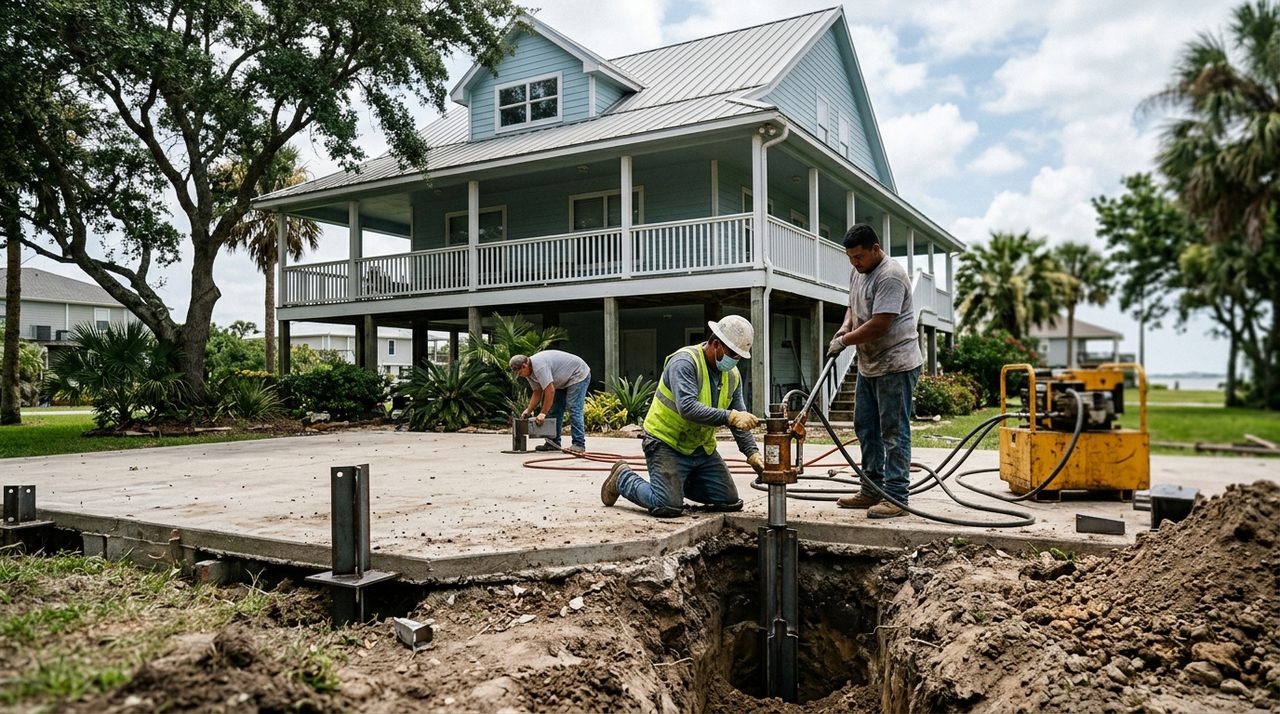
Request written documentation of any prior foundation work from the seller disclosure or your own records before soliciting bids—Texas TREC disclosure forms require sellers to report known foundation movement and repairs. Steel push piers ($1,200–$1,800 per pier installed, est.) or helical piers ($1,500–$2,200 per pier, est.) can be driven to deeper load-bearing soil where pressed pilings cannot reach, providing a more durable correction on Clear Lake's coastal-plain clay. Obtain at least three written proposals specifying pier type, count, and target depth so you can compare apples to apples rather than accept the first bid.
Sources: City of Houston Permitting Center, Texas Department of Licensing & Regulation
Hiring foundation repair in Clear Lake? Clear Lake is a sprawling collection of master-planned subdivisions built primarily from the 1960s through the 1980s during the Johnson Space Center boom. Homeowners face the maintenance demands of aging slab-on-grade ranch and traditional homes—original HVAC, cast-iron drain lines, and galvanized plumbing are common upgrade targets. Multiple mandatory HOAs enforce deed restrictions and architectural review, so contractors and homeowners must account for approval processes before exterior work.
Building era
1960s–1980s (core buildout), with newer infill subdivisions into the 2000s.
Typical style
One- and two-story ranch and traditional brick homes; some Colonial Revival facades in older sections; suburban traditional in 1980s–2000s additions.
Foundations
Predominantly concrete slab-on-grade, consistent with post-1960 Houston suburban construction.
Common systems
Original homes typically have copper or galvanized supply lines, cast-iron drain waste vent, R-22 refrigerant HVAC systems, and older 150–200 amp electrical panels. Homes from the 2000s subdivisions like Reserve at Clear Lake have modern PEX/PVC plumbing and R-410A systems.
What that means for repairs
Kitchen and bathroom remodels are frequent in 1960s–1970s homes. HVAC replacements are common as original systems exceed useful life. Many owners are re-piping from galvanized to PEX and upgrading electrical panels to support modern loads. Slab foundation repair is a recurring need due to expansive clay soils in the coastal plain.
Permit jurisdiction
Houston Permitting Center (City of Houston jurisdiction for most Clear Lake subdivisions within city limits). Some adjacent areas may fall under Harris County Engineering for unincorporated pockets—verify by address.
HOA & deed restrictions
No single area-wide HOA; multiple subdivision-level mandatory HOAs govern most properties. Key associations include Clear Lake City Community Association (CLCCA), Clear Lake Forest Community Association (CLFCA), and Reserve at Clear Lake Community Association. Membership is mandatory within each association's boundaries, with deed-restriction enforcement and architectural review committees.
Historic districts
No City of Houston historic district designation confirmed.
Contractor note
Exterior modifications—roofing materials, fencing, paint colors, and additions—typically require Architectural Review Committee (ARC) approval from the applicable subdivision HOA before permits are pulled. Contractors should confirm which association governs the property and obtain written ARC approval to avoid stop-work orders and violation fines.
FEMA flood zone
FEMA Zone X (low flood risk) per official NFHL data. However, Clear Lake's proximity to Clear Lake (the body of water), Galveston Bay, and local bayou tributaries means localized street-level flooding can occur during extreme rainfall events despite the overall Zone X designation.
Hurricane Harvey impact
Research sources did not document specific Harvey flood impacts for Clear Lake. Broader public reporting indicates parts of Clear Lake experienced significant flooding during Harvey, particularly near bayous and low-lying areas close to the lake and bay, but impact varied street by street. For property-specific Harvey inundation data, check Harris County Flood Control District historical maps and FEMA Harvey inundation records.
Heat & humidity load
Houston's extreme summer heat and humidity stress aging HVAC systems in 1960s–1980s homes, often pushing original or under-capacity units to failure. High humidity also promotes mold in poorly ventilated attics and crawl spaces. The coastal-plain location adds salt air exposure that accelerates corrosion on outdoor HVAC condensers, metal roofing components, and exterior fixtures.
Working with contractors here
The dominant work in Clear Lake involves updating systems in 1960s–1980s slab-on-grade homes: whole-house re-pipes replacing galvanized and cast-iron with PEX and PVC, HVAC changeouts from legacy R-22 systems to modern high-efficiency units, and electrical panel upgrades from 150-amp to 200-amp service. Foundation leveling and mudjacking are steady demand items given the expansive clay soils beneath slabs in this coastal-plain environment. Contractors should expect HOA architectural review requirements on any exterior-facing work—roofing, siding, fencing, and even driveway resurfacing may need pre-approval from the applicable subdivision association. Job scoping should include verifying the specific HOA (CLCCA, CLFCA, Reserve at Clear Lake, etc.) and its current ARC guidelines, as requirements vary by subdivision.
Local Tip
Always ask for a written estimate before work begins. Texas contractors are required to provide one on jobs over $1,000.
Clear Lake is a sprawling collection of master-planned subdivisions built primarily from the 1960s through the 1980s during the Johnson Space Center boom. Homeowners face the maintenance demands of aging slab-on-grade ranch and traditional homes—original HVAC, cast-iron drain lines, and galvanized plumbing are common upgrade targets. Multiple mandatory HOAs enforce deed restrictions and architectural review, so contractors and homeowners must account for approval processes before exterior work.
Source: U.S. Census Bureau, ACS 5-Year 2023
Most of Clear Lake maps to FEMA Zone X (low mapped flood risk), but Houston's flash-flood reality means even low-risk blocks benefit from smart drainage and storm-hardened installs; risk climbs sharply on blocks nearest Clear Lake and Galveston Bay, where it varies parcel to parcel.
Source: FEMA National Flood Hazard Layer (NFHL). Flood zones vary by parcel — verify your individual FIRM panel.
Beryl 2024 reminded Houston homeowners that even neighborhoods with low FEMA flood designations experience localized ponding when storm-sewer inlets back up, and that standing water against a foundation for even 12 hours can trigger clay heave in Clear Lake, TX. Before the season, confirm your gutters discharge at least five feet from the foundation and that splash blocks direct water toward the street, keeping clay moisture content consistent beneath the slab. Confirm the current FEMA panel for your Clear Lake parcel — the area maps to Zone X, but adjacent lots can differ.
Even with low mapped flood risk, Clear Lake, TX is not immune to the localized sheet flow that accompanies a Houston severe thunderstorm, and repeated minor inundation at the foundation perimeter sustains the clay moisture that drives slow heave cycles. A pre-storm season inspection confirming that soil grade, splash blocks, and downspout extensions all direct water away from the slab is the most cost-effective foundation repair step you can take. Because Clear Lake drains toward Clear Lake and Galveston Bay, block-level runoff can differ sharply from the mapped zone.
Ice loading from roof accumulation during a hard freeze transfers compressive stress to your foundation corners, and in Clear Lake, TX that added load on clay subgrade that has stiffened from cold can create corner settlement that persists after the thaw. A TDLR-licensed foundation contractor should inspect visible brick-to-foundation transitions and interior door frames after any multi-day freeze event, even if no pipe damage occurred. With a median build year of 1984, the older building stock here is more exposed to hard-freeze damage than newer construction. Because Clear Lake drains toward Clear Lake and Galveston Bay, block-level runoff can differ sharply from the mapped zone.
Sources: FEMA National Flood Hazard Layer (NFHL), Ready.gov -- Hurricanes, CenterPoint Energy -- Storm Center, City of Houston -- Emergency Preparedness, Ready.gov -- Winter Weather, Harris County Flood Control District
Houston-specific estimators to plan your project before you call a pro. All results are planning estimates — a licensed local pro confirms the details on site.
Grouped by mature root aggression & water demand.
Trunk center to the nearest exterior wall.
The root zone likely reaches your foundation's soil during Houston's dry summers, when clay shrinks most. Watch for sticking doors and diagonal cracks, keep soil moisture even with a soaker hose during drought, and have a foundation pro evaluate if you see any movement.
Find a Houston foundation pro →This is a planning estimate only — actual requirements depend on an on-site assessment by a licensed Houston pro. Guidance is based on general species root behavior in expansive clay, not a soil test.
Disconnect & drain every outdoor hose bib
Remove hoses, drain the spigots, and cover each with an insulated faucet sock. Un-drained hose bibs are the #1 burst point in a Houston freeze.
Insulate exposed pipes in the attic & garage
Wrap any pipe in an unconditioned space (attic runs, garage walls) with foam sleeves. Houston homes rarely insulate these because they only matter a few nights a year — which is exactly why they burst.
Open cabinet doors & keep a pencil-width drip
On hard-freeze nights, open kitchen/bath cabinets so warm air reaches the pipes and let faucets on exterior walls drip to relieve pressure.
Protect the attic/garage water heater & its lines
An attic or garage tank sits in unconditioned space. Insulate the cold-inlet and hot-outlet lines and confirm the emergency drain pan is clear so a leak doesn't reach the ceiling.
This is a planning estimate only — actual requirements depend on an on-site assessment by a licensed Houston pro. If a pipe has already burst, shut off your main water supply and call a licensed Houston plumber immediately — freeze bursts flood fast.
Sources: City of Houston Permitting CenterMunicipal permit office (see area profile)
Sources: FEMA National Flood Hazard Layer (NFHL)Harris County Flood Control District
Sources: City of Houston Permitting CenterLocal HOA / deed restrictions (see area profile)
Sources: City of Houston Permitting CenterLocal HOA / deed restrictions (see area profile)Texas State Board of Plumbing Examiners