1212 Winding Way Dr, Friendswood, TX 77546
Best Foundation Repair in Friendswood, TX
Friendswood's housing stock spans six decades — from 1960s pier-and-beam homes near Clear Creek to 2000s slab-on-grade production houses in West Ranch — and every era brings its own foundation vulnerability on Galveston County's expansive clay soils. Seasonal shrink-swell cycles, drought-then-deluge patterns, and the lingering effects of post-Harvey saturation create a real and ongoing repair market here. All foundation work requiring permits runs through the City of Friendswood Building Inspections Department, not Houston or the county, and dozens of subdivision HOAs add a second approval layer that can delay your repair start date if you don't plan ahead.
Verified against Google Business data
Updated 2026
See the 10 Foundation Repair Serving Friendswood 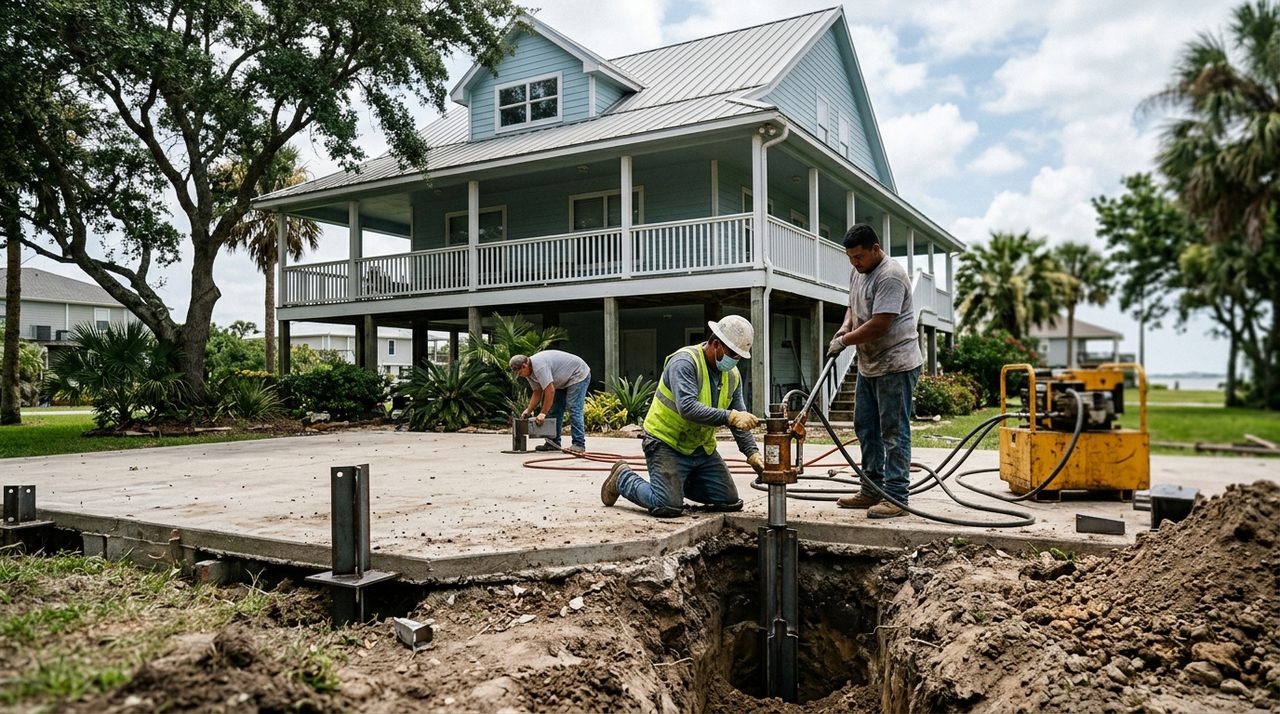
- Median home built
- 1990
- Median home value
- $399,500
- FEMA flood zone
- X (low)
- Typical repair cost (est.)
- $3,500–$25,000 depending on method and pier count
- Most common local issue
- Perimeter void formation on 1990s–2000s slabs after back-to-back drought cycles
Ranked by verified Google rating × review volume × verification tier. How we rank →
Some highly-rated pros serve Friendswood from nearby and may not keep a Friendswood street address. Those are listed under "Also serving Friendswood" with their real city and distance, so you always know where each business is based.
Min rating:
10 resultsBased in Friendswood
1212 Winding Way Dr, Friendswood, TX 77546
Open Now
3702 Mystic Meadows Ln, Friendswood, TX 77546
Closed
4440 FM 2351, Friendswood, TX 77546
Also serving Friendswood
Highly-rated pros based nearby who cover Friendswood. Distance shown from the Friendswood area.
Closed
Serving Friendswood Based in Pearland · 1.7 mi away
Serving Friendswood Based in Pearland · 1.8 mi away
Closed
Serving Friendswood Based in Webster · 4.1 mi away
Closed
Serving Friendswood Based in Webster · 4.8 mi away
Closed
Serving Friendswood Based in Webster · 5 mi away
Closed
Serving Friendswood Based in Pearland · 5.2 mi away
Foundation Repair in Friendswood: What You Should Know
Slab Perimeter Voids on Friendswood's 1990s–2000s Production Homes
Why it matters to you
The majority of Friendswood homes were built during the 1990s and 2000s building booms on slab-on-grade foundations poured over Galveston County's Houston Black clay. The 2022–2023 La Niña drought cycle baked the soil, pulling it away from slab edges and leaving the perimeter beam unsupported. When rains returned, water channeled directly into those voids rather than soaking in gradually — a pattern that accelerates erosion under the beam and shows up in your home as sticking doors, diagonal drywall cracks from window corners, and brick veneer gaps. Most homeowners on streets like West Ranch Boulevard or in Wilderness Trails don't notice until the gap is visible from the driveway.
What a good pro does
A qualified contractor will probe the perimeter for void depth before recommending a method — mudjacking with cement slurry ($800–$2,500 per section, estimated) fills shallow voids quickly, while deeper loss of bearing may require steel push pier underpinning at $1,200–$1,800 per pier (estimated). The repair contractor must pull a permit through the City of Friendswood Building Inspections Department before work begins; inspections run on Friendswood's own schedule, which differs from Houston's Development Services timeline. Get three written proposals that specify pier counts and depths, not just a total price.
Sources: Municipal permit office (see area profile), International Residential Code (as adopted by City of Houston)
Post-Harvey Saturation Settlement in Creek-Adjacent Sections
Why it matters to you
While most of Friendswood maps to FEMA Zone X, parcels nearest Clear Creek experienced extended inundation during Hurricane Harvey in 2017, and some blocks saw repeated flooding through Hurricane Beryl in 2024. Prolonged saturation reconsolidates the clay bearing layer and can trigger settlement weeks after the water recedes — often in homes that showed no distress during the actual flood event. Older 1960s–1970s homes in subdivisions close to the creek corridor, some of which may still have pier-and-beam construction, are especially susceptible because the soil under those piers has cycled through multiple saturation events.
What a good pro does
Before attributing any post-flood settlement to soil movement alone, a responsible contractor should recommend a hydrostatic plumbing test ($250–$400, estimated) to rule out cracked under-slab or under-house drain lines — a common compounding factor in homes of this era. For confirmed soil-bearing failure, steel push piers or helical piers driven to load-bearing stratum below the clay layer provide more predictable long-term performance than legacy pressed concrete pilings on saturated ground. Confirm your parcel's exact flood zone on the FEMA Flood Map Service Center before any repair, since Zone X boundaries shift parcel by parcel near the creek.
Sources: FEMA National Flood Hazard Layer (NFHL), Harris County Flood Control District, Texas State Board of Plumbing Examiners
Under-Slab Plumbing Leaks Accelerating Foundation Damage in Pre-1990 Homes
Why it matters to you
Friendswood's 1960s and 1970s homes — particularly in older subdivisions — were built with cast-iron under-slab or under-pier drain lines that are now 50-plus years old and increasingly prone to cracking. Winter Storm Uri in February 2021 accelerated failures across the area, and many homeowners patched visible interior damage while leaving cracked under-slab lines in place. A slow, ongoing leak saturates the clay directly beneath the slab or piers, first causing localized heave and then progressive settlement as the soil structure degrades — a pattern that mimics seasonal clay movement but doesn't respond to surface irrigation management.
What a good pro does
Any foundation repair estimate on a pre-1990 Friendswood home should be preceded by a hydrostatic plumbing test performed or supervised by a plumber licensed through the Texas State Board of Plumbing Examiners (TSBPE). If leaks are confirmed, under-slab pipe rerouting or full re-piping must be completed before pier installation — otherwise you are underpinning a foundation that will continue to shift. The City of Friendswood requires separate plumbing permits for this scope of work, which your contractor and plumber need to coordinate with the city's Building Inspections office.
Sources: Texas State Board of Plumbing Examiners, Municipal permit office (see area profile), International Residential Code (as adopted by City of Houston)
HOA Architectural Review Requirements Delaying Repair Start Dates
Why it matters to you
Friendswood has no city-wide mandatory HOA, but dozens of active subdivision-level associations — West Ranch managed by RealManage, Wilderness Trails, Forest of Friendswood, and others — each maintain their own architectural review processes for exterior work. Foundation repair almost always involves perimeter trenching, staging equipment on the driveway or lawn, and sometimes visible concrete patching, all of which can trigger a review requirement before work may legally begin under your deed restrictions. Skipping HOA approval to speed up a repair can result in fines, forced reversal of completed work, or complications at resale when the buyer's attorney pulls the deed restriction history.
What a good pro does
Before signing any foundation repair contract, pull your subdivision's deed restrictions from the Galveston County Clerk's records and contact your HOA management company to confirm whether an Architectural Review Committee (ARC) submission is required and what the typical turnaround time is. Factor that timeline — sometimes two to four weeks — into your repair schedule. Your contractor should provide the ARC with a written scope of work, a site plan showing pier or trench locations, and the City of Friendswood permit application number; some HOA managers require the permit to be filed before they will approve the scope. Texas law also requires sellers to disclose known foundation movement and completed repairs on the TREC seller's disclosure form, so maintaining complete documentation of HOA approval, city permits, and contractor warranty terms protects you at resale.
Sources: Local HOA / deed restrictions (see area profile), Municipal permit office (see area profile)
Foundation Repair in Friendswood: What You Should Know
Hiring foundation repair in Friendswood? Friendswood is an incorporated city with housing stock spanning from the 1960s through the 2010s, meaning contractors encounter everything from aging pier-and-beam foundations near Clear Creek to modern slab-on-grade production homes in master-planned communities like West Ranch. The city manages its own permitting, and the patchwork of active HOAs across dozens of subdivisions means architectural review requirements vary block by block. Proximity to Clear Creek creates recurring flood concerns in lower-lying sections despite many parcels mapping outside high-risk FEMA zones.
- Housing era
- 1960s–2010s, with major growth phases in the 1970s, 1990s, and 2000s
- Foundation
- Predominantly slab-on-grade (post-1970s production housing)
- Flood zone
- FEMA Zone X (low flood risk) per official NFHL API
- Permits
- City of Friendswood Building Inspections Department (independent city — does not use Houston or…
Housing stock & systems
Building era
1960s–2010s, with major growth phases in the 1970s, 1990s, and 2000s.
Typical style
Suburban traditional brick veneer single-family homes, 1- and 2-story plans with attached garages on moderate to large lots.
Foundations
Predominantly slab-on-grade (post-1970s production housing); some older 1960s-era homes may have pier-and-beam — confirm via Galveston CAD records.
Common systems
Older 1960s–1970s homes: original galvanized or copper plumbing, R-22 HVAC units nearing or past end of life, fuse panels or early breaker panels. 1990s–2010s homes: PVC/PEX plumbing, R-410A HVAC, 200-amp electrical panels. Attic-mounted air handlers are standard across eras.
What that means for repairs
Older subdivisions like Wilderness Trails see frequent HVAC replacements, re-piping from galvanized to PEX, and electrical panel upgrades. Newer master-planned communities like West Ranch focus on cosmetic remodels and outdoor living additions, often requiring HOA architectural review.
Permits & restrictions
Permit jurisdiction
City of Friendswood Building Inspections Department (independent city — does not use Houston or county permitting).
HOA & deed restrictions
No city-wide mandatory HOA. Dozens of subdivision-level HOAs exist, many actively managed (e.g., West Ranch managed by RealManage, Wilderness Trails with its own HOA website, Forest of Friendswood as a formal Texas nonprofit). Some older subdivisions show 'no current contact' on the city's HOA list, indicating defunct or inactive associations. Deed restrictions are common and recorded at the county level.
Historic districts
No historic district designation confirmed. Friendswood is an independent city and not subject to Houston's HAHC jurisdiction.
Contractor note
Contractors must pull permits through the City of Friendswood, not Harris or Galveston County. Many subdivisions require HOA architectural review before exterior work begins — always confirm the specific subdivision's requirements before scheduling.
Flood & weather
FEMA flood zone
FEMA Zone X (low flood risk) per official NFHL API. However, areas near Clear Creek and its tributaries carry significantly higher flood exposure. Property-level risk varies widely — always verify individual parcels, especially in older subdivisions closer to the creek.
Hurricane Harvey impact
Friendswood experienced significant flooding during Hurricane Harvey (2017), particularly in neighborhoods near Clear Creek and low-lying drainage channels. Older subdivisions closer to the creek were hit hardest, while newer elevated master-planned sections fared better. Specific repeatedly flooded streets are not confirmed in available sources — check Galveston County flood control mapping and past seller disclosures for property-level history.
Heat & humidity load
Coastal humidity and extended 95°F+ heat stress HVAC systems heavily, especially attic-mounted air handlers in older homes with inadequate insulation. Slab foundations on expansive clay soils experience seasonal movement during summer drought cycles, potentially affecting door frames and drywall. Roofing materials degrade faster due to UV exposure and Gulf moisture.
Working with contractors here
Friendswood's multi-decade housing stock creates a wide range of service demands. In 1960s–1970s subdivisions, contractors frequently handle whole-house re-piping, HVAC system replacements transitioning from R-22, and electrical panel upgrades from 100-amp to 200-amp service. Post-Harvey, flood remediation, foundation repair, and mold mitigation remain ongoing concerns in creek-adjacent areas. In newer master-planned communities like West Ranch, work tends toward kitchen and bath remodels, outdoor living additions, and fence replacements — all of which typically require HOA architectural approval before starting. Contractors should scope jobs with awareness that the City of Friendswood enforces its own building codes and inspection schedules, which differ from Houston's process.
Local Tip
Always ask for a written estimate before work begins. Texas contractors are required to provide one on jobs over $1,000.
About Friendswood
Friendswood is an incorporated city with housing stock spanning from the 1960s through the 2010s, meaning contractors encounter everything from aging pier-and-beam foundations near Clear Creek to modern slab-on-grade production homes in master-planned communities like West Ranch. The city manages its own permitting, and the patchwork of active HOAs across dozens of subdivisions means architectural review requirements vary block by block. Proximity to Clear Creek creates recurring flood concerns in lower-lying sections despite many parcels mapping outside high-risk FEMA zones.
- Median year built
- 1990
- Median home value
- $399,500
- Owner-occupied
- 76.9%
- Population
- 40,827
- Housing units
- 14,985
- Median income
- $125,052
Source: U.S. Census Bureau, ACS 5-Year 2023
Flood & storm risk
FEMA Zone XLow flood riskMost of Friendswood maps to FEMA Zone X (low mapped flood risk), but Houston's flash-flood reality means even low-risk blocks benefit from smart drainage and storm-hardened installs; risk climbs sharply on blocks nearest Clear Creek, where it varies parcel to parcel.
Source: FEMA National Flood Hazard Layer (NFHL). Flood zones vary by parcel — verify your individual FIRM panel.
Houston Storm Readiness in Friendswood
Hurricane & flooding
Houston's flash-flood reality means even low-mapped-risk areas like Friendswood, TX can see sheet flow accumulate against a foundation during a slow-moving Gulf system, so verify that your perimeter drainage is clear and properly sloped before hurricane season opens. A TDLR-licensed foundation contractor can add or reposition surface drains to intercept runoff before it softens the clay bearing layer beneath your slab. Confirm the current FEMA panel for your Friendswood parcel — the area maps to Zone X, but adjacent lots can differ.
Severe storms & hail
The May 2024 derecho caused structural racking in thousands of Houston homes, and racking places diagonal tension on slab corners that can widen existing hairline cracks into visible gaps in Friendswood, TX over the following weeks. Schedule a foundation survey within 30 days of any severe wind event to establish a post-storm baseline before summer drying compounds any movement. Because Friendswood drains toward Clear Creek, block-level runoff can differ sharply from the mapped zone.
Ice storms & freezes
Ice loading from roof accumulation during a hard freeze transfers compressive stress to your foundation corners, and in Friendswood, TX that added load on clay subgrade that has stiffened from cold can create corner settlement that persists after the thaw. A TDLR-licensed foundation contractor should inspect visible brick-to-foundation transitions and interior door frames after any multi-day freeze event, even if no pipe damage occurred. As a Galveston County community, Friendswood may follow county rather than City of Houston storm rebuild rules.
Sources: FEMA National Flood Hazard Layer (NFHL), Ready.gov -- Hurricanes, CenterPoint Energy -- Storm Center, City of Houston -- Emergency Preparedness, Ready.gov -- Winter Weather, Harris County Flood Control District
Free Friendswood Tools & Calculators
Houston-specific estimators to plan your project before you call a pro. All results are planning estimates — a licensed local pro confirms the details on site.
Houston Soil & Tree Proximity Risk Calculator
Open full tool & FAQ →Grouped by mature root aggression & water demand.
Trunk center to the nearest exterior wall.
Moderate risk
The root zone likely reaches your foundation's soil during Houston's dry summers, when clay shrinks most. Watch for sticking doors and diagonal cracks, keep soil moisture even with a soaker hose during drought, and have a foundation pro evaluate if you see any movement.
Find a Houston foundation pro →This is a planning estimate only — actual requirements depend on an on-site assessment by a licensed Houston pro. Guidance is based on general species root behavior in expansive clay, not a soil test.
Houston Freeze Prep & Pipe Insulation Checklist
Open full tool & FAQ →Your freeze checklist — 4 tasks
- 1
Disconnect & drain every outdoor hose bib
Remove hoses, drain the spigots, and cover each with an insulated faucet sock. Un-drained hose bibs are the #1 burst point in a Houston freeze.
- 2
Insulate exposed pipes in the attic & garage
Wrap any pipe in an unconditioned space (attic runs, garage walls) with foam sleeves. Houston homes rarely insulate these because they only matter a few nights a year — which is exactly why they burst.
- 3
Open cabinet doors & keep a pencil-width drip
On hard-freeze nights, open kitchen/bath cabinets so warm air reaches the pipes and let faucets on exterior walls drip to relieve pressure.
- 4
Protect the attic/garage water heater & its lines
An attic or garage tank sits in unconditioned space. Insulate the cold-inlet and hot-outlet lines and confirm the emergency drain pan is clear so a leak doesn't reach the ceiling.
This is a planning estimate only — actual requirements depend on an on-site assessment by a licensed Houston pro. If a pipe has already burst, shut off your main water supply and call a licensed Houston plumber immediately — freeze bursts flood fast.
Frequently Asked Questions
Do I need a permit from the City of Friendswood for steel pier underpinning, or can the contractor just do the work?
Yes — the City of Friendswood Building Inspections Department requires a permit for structural foundation repair work including steel pier underpinning, and you must pull it through Friendswood's own office, not Harris County, Galveston County, or the City of Houston. Contractors who routinely work inside Houston's Loop and pull COH permits will need to reorient to Friendswood's separate process and inspection schedule, so confirm upfront that your contractor is familiar with the city's specific submittal requirements. Unpermitted underpinning work can surface as a defect on a resale inspection and create disclosure liability under Texas law.
Sources: Municipal permit office (see area profile)
My Friendswood home was built in the mid-1970s near Clear Creek — is it likely pier-and-beam or slab, and does that change which repair methods contractors will recommend?
Friendswood's earliest subdivisions from the 1960s–early 1970s, particularly those closer to Clear Creek, are the most likely candidates for pier-and-beam construction; homes built in the late 1970s and beyond typically shifted to slab-on-grade. You can confirm your foundation type by pulling the original building records from the Galveston County Appraisal District. Pier-and-beam foundations allow under-floor access for shimming and beam sister repairs that aren't available on a slab, so the repair menu — and cost range — is meaningfully different from what a 1990s West Ranch slab would require.
My West Ranch subdivision has an HOA managed by RealManage — do I need architectural approval before a foundation contractor can even start trenching around my slab perimeter?
Most actively managed Friendswood HOAs, including West Ranch, require an Architectural Review Committee application for exterior work that alters the lot's grade or appearance, and perimeter trenching for pier installation typically qualifies. Submit your repair scope and contractor drawings to RealManage before signing a repair contract, not after, because ARC review windows can run two to four weeks and will delay your job start date. Ask your foundation contractor whether they've worked in West Ranch before and whether they have standard documentation packages that satisfy the ARC submittal requirements.
Sources: Local HOA / deed restrictions (see area profile)
Friendswood maps mostly to FEMA Zone X, so do I really need to worry about whether prior foundation repair invalidated my elevation certificate before I list the house?
Zone X designation means you're outside the mapped high-risk flood area, and most Friendswood parcels don't require a mandatory elevation certificate for standard mortgage purposes — but parcels within or on the boundary of the Zone AE corridor along Clear Creek are a different story, and flood-zone designations can change with FEMA map revisions. If your property does carry an elevation certificate and you've had foundation repair work that adjusted finished floor elevation, a new survey may be needed before listing. Texas TREC disclosure rules require you to disclose known foundation movement and completed repairs regardless of flood zone, so documentation of the repair — including the permit from Friendswood's Building Inspections Department — protects you at closing.
Sources: FEMA National Flood Hazard Layer (NFHL)Municipal permit office (see area profile)
How long does a typical steel pier foundation repair job actually take from permit to final inspection in Friendswood, and what time of year is best to schedule it?
Once the permit is approved by the City of Friendswood Building Inspections Department, the physical pier installation on an average 1,800–2,400 sq ft slab typically takes two to four days; scheduling the city's interim and final inspections can add another one to two weeks depending on inspector availability. Avoid scheduling perimeter excavation work immediately after a heavy rain event — saturated Galveston County clay holds water and can make trenching conditions unstable and measurements less reliable. The window from late March through early June, before the worst of summer drought baking sets in, is generally a practical time to assess and repair because soil moisture conditions are more uniform, giving the contractor a truer read on settlement versus seasonal movement.
Sources: Municipal permit office (see area profile)
Before I sign a foundation repair contract in Friendswood, should I pay for a hydrostatic plumbing test, and is that especially important given the age of homes here?
For any Friendswood home built before roughly 1990 — which includes a significant share of the Wilderness Trails, Forest of Friendswood, and other older subdivisions — a hydrostatic plumbing test is strongly advisable before committing to foundation repair, because cast-iron under-slab drain lines from that era are prone to cracking and slow leaks that mimic soil-movement settlement. The test typically costs an estimated $250–$400 and must be performed or overseen by a licensed plumber under Texas State Board of Plumbing Examiners rules. Fixing a soil-movement problem without first ruling out an active under-slab leak means the repair may fail prematurely — most reputable Friendswood-area foundation contractors will recommend the test proactively, and you should be cautious of any contractor who skips that step.