Closed
4123 Avenue Q, Galveston, TX 77550
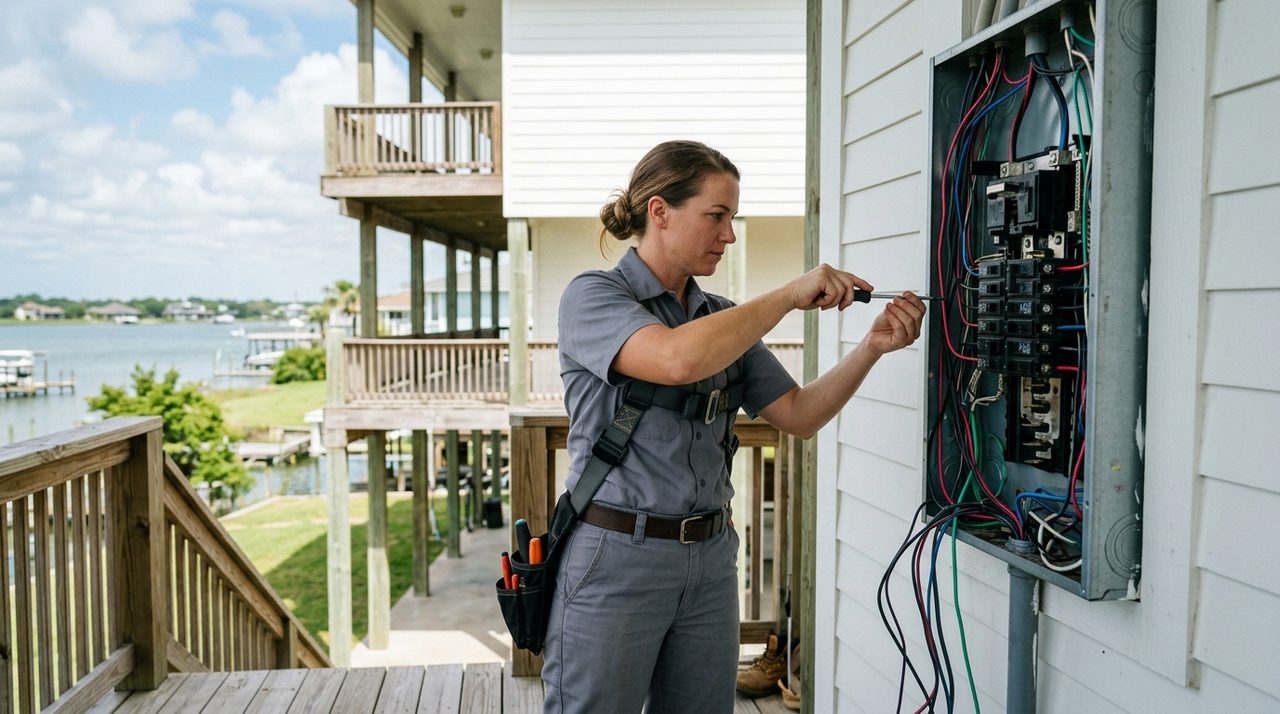
Galveston's island setting puts electricians up against a combination of challenges that no inland Houston neighborhood faces: salt-air corrosion that attacks panels and service hardware year-round, FEMA Zone AE flood requirements that dictate where electrical equipment can be mounted, and a housing stock ranging from 19th-century pier-and-beam Victorians to modern piling-raised beach houses — all permitted through the City of Galveston Development Services Department, never the City of Houston Permitting Center. Understanding which of those realities applies to your specific block and era of home determines which electrical problems you are most likely to face and what a proper fix actually looks like.
Ranked by verified Google rating × review volume × verification tier. How we rank →
4123 Avenue Q, Galveston, TX 77550
5214 Ave Q 1/2, Galveston, TX 77551
6341 Stewart Rd #400, Galveston, TX 77551
Why it matters to you
Most of Galveston Island sits in FEMA Zone AE, meaning base flood elevations are mapped and enforced — yet a significant share of older homes, particularly mid-century ranch-style and early beach cottages built before modern elevation requirements, still have main panels, subpanels, or meter bases positioned at or near grade. Harvey (2017) and Beryl (2024) inundated many of these properties; even brief submersion corrodes breaker contacts, compromises UL-listed ratings on main lugs, and creates hidden fault paths that a visual inspection alone cannot reveal.
What a good pro does
A licensed Master Electrician — required under TDLR rules to pull any permit in Texas — should perform a load-center inspection that includes breaker torque checks and thermal imaging, not just a visual walk-through. When a panel replacement is warranted, the City of Galveston Development Services Department issues the electrical permit and will require the new equipment to meet current flood-elevation standards under the local floodplain ordinance; confirm the required mounting height with the permit office before ordering equipment. Panel replacement in this market runs an estimated $1,800–$3,200 for a 200A service, but coastal surcharges for corrosion-rated enclosures can push that higher.
Sources: FEMA National Flood Hazard Layer (NFHL), Texas Department of Licensing & Regulation, Municipal permit office (see area profile)
Why it matters to you
Galveston's Gulf-front and bay-side exposure means airborne salt ions attack service entrance masts, weatherheads, outdoor sub-feed conduit, and disconnect enclosures far faster than any inland Houston neighborhood. Homeowners in the East End Historic District and beachside West End alike report meter cans with corroded lugs and exterior conduit runs with pitting failures within 10–15 years of installation — sometimes sooner on properties within two blocks of the seawall. This is an ongoing maintenance reality, not a one-time repair.
What a good pro does
Specify stainless-steel or hot-dip galvanized hardware and PVC-jacketed conduit for all exterior runs rather than standard galvanized steel, which the salt environment degrades quickly. A qualified electrician familiar with Galveston's coastal conditions should inspect service entrance components every five to seven years and treat or replace hardware before corrosion reaches conductors or bonding connections. Any replacement of the weatherhead, mast, or meter base requires an electrical permit from the City of Galveston Development Services Department and a CenterPoint Energy reconnect appointment after the city inspection clears.
Sources: Municipal permit office (see area profile), Texas Department of Licensing & Regulation, International Residential Code (as adopted by City of Houston)
Why it matters to you
Galveston's census median year built is 1973, but the historic core contains a large share of homes built in the 1890s through 1940s that received 100-amp or smaller service upgrades mid-century and have never been revisited. After Winter Storm Uri (2021) drove many owners to add electric space heaters or heat-pump water heaters as gas-supply backup, and as window AC units multiply to manage coastal humidity loads, these original 100-amp services trip constantly under combined heat and cooling demands. Aluminum wiring installed during the 1965–1975 period is also present in Galveston's post-war renovations, adding termination oxidation risk at every device.
What a good pro does
A Master Electrician licensed through TDLR should perform a full load calculation before recommending a service size; many Galveston homes now warrant 200A service to safely carry HVAC, water heating, and plug loads simultaneously. The City of Galveston Development Services Department issues electrical permits for service upgrades; budget an estimated $1,800–$3,200 for the 100A-to-200A upgrade. If aluminum branch-circuit wiring is found, remediation with CO/ALR-rated devices and AlumiConn connectors at every termination — not just paste — is the accepted approach, with whole-home remediation estimated at $3,500–$8,000 depending on circuit count.
Sources: Texas Department of Licensing & Regulation, Municipal permit office (see area profile), International Residential Code (as adopted by City of Houston)
Why it matters to you
Galveston bore direct exposure to Hurricane Beryl in July 2024 and felt sustained winds from the May 2024 derecho; both events tore service drops from weatherheads, sheared overhead mast risers, and pulled meter cans off the exteriors of pier-and-beam and piling-raised homes where the mast has an unusually long unsupported span. Because Galveston has a high proportion of older homes with overhead utility service rather than underground laterals, this failure mode is widespread. CenterPoint Energy restores only the utility-side drop; the homeowner owns the weatherhead, mast, and meter base — and those cannot legally be energized until both the City of Galveston electrical inspection and a CenterPoint reconnect are completed.
What a good pro does
After any hurricane event, have a TDLR-licensed electrician assess the mast, weatherhead, and meter base before requesting a CenterPoint reconnect appointment — attempting to reconnect before correcting damage is both a code violation and a safety hazard. Specify a heavier-gauge rigid conduit mast (minimum 2-inch rigid metal conduit per IRC provisions for mast installations) and secure all brackets to structural framing, not just sheathing, given Galveston's wind-load environment. Permits for this work are pulled through the City of Galveston Development Services Department; budget an estimated $600–$1,400 for mast and weatherhead replacement, with costs rising if the meter base or bonding ground also need replacement.
Sources: International Residential Code (as adopted by City of Houston), Texas Department of Licensing & Regulation, Municipal permit office (see area profile)
Hiring electricians in Galveston? Galveston's housing stock spans from historic 19th-century Victorian homes to modern beach developments, creating an exceptionally diverse home service landscape. Homeowners must contend with persistent salt air corrosion, high flood risk across much of the island, and hurricane exposure that drives demand for wind-resistant roofing, elevated foundations, and robust moisture management. Permit jurisdiction falls under the City of Galveston Development Services Department or Galveston County, never the City of Houston Permitting Center.
Building era
Highly mixed — 1800s historic core through 21st-century beach and master-planned construction.
Typical style
Mix of Victorian, Gulf Coast vernacular, raised beach houses, mid-century ranch, and modern coastal developments; no single dominant style across the area.
Foundations
Mixed — many historic and coastal homes on pier-and-beam or raised pilings; newer mainland construction often slab-on-grade. Not confirmed at subdivision level — check property records.
Common systems
Older homes may have outdated electrical and galvanized plumbing requiring upgrades; coastal properties require corrosion-resistant HVAC equipment rated for salt air environments; newer builds typically feature modern central HVAC and PEX or copper plumbing.
What that means for repairs
Historic restoration is common in Galveston's core; coastal properties frequently undergo elevation projects, hurricane hardening, and replacement of salt-air-corroded exterior systems. Flood damage repair drives significant renovation activity across all housing types.
Permit jurisdiction
City of Galveston Development Services Department (within city limits); individual incorporated cities handle their own permitting elsewhere in Galveston County; unincorporated areas fall under Galveston County jurisdiction. Not the City of Houston Permitting Center.
HOA & deed restrictions
No county-wide mandatory HOA. HOAs exist at the subdivision, condo, and master-planned community level. Many single-family homes in Galveston have no HOA. Check deed restrictions recorded with the Galveston County Clerk for specific properties.
Historic districts
No City of Houston historic district designation — Galveston is outside Houston's jurisdiction. The City of Galveston maintains its own historic preservation program and local historic districts, governed by Galveston's ordinances separate from Houston's HAHC.
Contractor note
Contractors must verify whether work falls within City of Galveston, another incorporated Galveston County city, or unincorporated county jurisdiction, as permitting requirements and floodplain regulations differ significantly. Properties in local historic districts within the City of Galveston may require additional preservation review separate from any Houston process.
FEMA flood zone
FEMA Zone AE (high flood risk) — source: fema_nfhl. Galveston's island geography and coastal exposure create significant flood risk from both storm surge and rainfall. Proximity to the Gulf of Mexico and Galveston Bay compounds risk across most of the area.
Hurricane Harvey impact
Hurricane Harvey's flood impacts in Galveston County were highly localized and varied by precise location — bayfront vs. mainland interior, creek proximity, and elevation. Specific street-level flooding data for this area could not be confirmed without a more precise subdivision or address — check FEMA Harvey flood inundation maps and Galveston County floodplain administrator reports for property-specific history.
Heat & humidity load
Extreme humidity and salt air accelerate corrosion of HVAC condensers, metal roofing components, and exterior fasteners. Summer heat combined with coastal moisture drives high demand for dehumidification, mold remediation, and HVAC maintenance. Prolonged UV exposure degrades exterior paint and sealants faster than inland areas.
Working with contractors here
Contractors in Galveston most commonly work on flood damage repair, foundation elevation projects, hurricane-hardening (impact windows, fortified roofing), and replacement of salt-air-corroded exterior systems including HVAC condensers, metal railings, and fasteners. The wide range of housing eras means contractors must be prepared for both historic restoration requiring period-appropriate materials and modern coastal construction techniques. Job scoping should always include assessment of flood history, current elevation relative to base flood elevation, and whether the property falls within a City of Galveston historic district requiring preservation review. Corrosion-resistant materials and marine-grade hardware should be specified as standard for any exterior work.
Local Tip
Always ask for a written estimate before work begins. Texas contractors are required to provide one on jobs over $1,000.
Galveston's housing stock spans from historic 19th-century Victorian homes to modern beach developments, creating an exceptionally diverse home service landscape. Homeowners must contend with persistent salt air corrosion, high flood risk across much of the island, and hurricane exposure that drives demand for wind-resistant roofing, elevated foundations, and robust moisture management. Permit jurisdiction falls under the City of Galveston Development Services Department or Galveston County, never the City of Houston Permitting Center.
Source: U.S. Census Bureau, ACS 5-Year 2023
On Galveston Island, storm surge and Gulf wind are the defining hazards: much of Galveston sits in FEMA Zone AE coastal high-hazard territory, so wind-rated, elevation- and surge-aware work is the baseline, not an upgrade.
Source: FEMA National Flood Hazard Layer (NFHL). Flood zones vary by parcel — verify your individual FIRM panel.
Install a whole-house surge protector AND a GFCI-protected, corrosion-resistant outdoor subpanel for post-storm contractor equipment — a setup a licensed electrician can complete in a day — because in Galveston, TX the combination of surge inundation and wind damage means multiple trades will need powered tools on-site for weeks after a major hurricane. Coastal wind-zone requirements enforced by the City of Galveston and Texas TDLR also mandate specific conduit and weatherhead ratings that only a licensed electrician can properly specify and install. Much of the housing stock predates modern wind codes (median build year 1973), so retrofits matter more here. Confirm the current FEMA panel for your Galveston parcel — the area maps to Zone AE, but adjacent lots can differ.
Coastal homes in Galveston, TX need GFCI protection on every outdoor and garage circuit, corrosion-resistant stainless or PVC conduit for all exterior runs, and a whole-house surge arrester — a licensed electrician can spec and install all three in a single service call that costs far less than replacing salt-corroded wiring after a severe thunderstorm admits water into degraded conduit. After the May 2024 derecho, electricians across the Galveston Bay area reported that the most common failure was compromised weatherhead seals that had never been inspected since original installation. Confirm the current FEMA panel for your Galveston parcel — the area maps to Zone AE, but adjacent lots can differ.
Ice accumulation on coastal transmission lines in Galveston, TX produces the same destructive conductor-swing surges as a hurricane restoration event — a whole-house surge arrester at the meter base, installed by a TDLR-licensed electrician, protects your panel, HVAC controls, and appliances from both types of events with a single device. After Uri 2021, licensed electricians along the Gulf Coast reported a surge in service calls for fried smart-home systems that a $150–$300 arrester could have fully protected. With a median build year of 1973, the older building stock here is more exposed to hard-freeze damage than newer construction. As a Galveston County community, Galveston may follow county rather than City of Houston storm rebuild rules.
Sources: FEMA National Flood Hazard Layer (NFHL), Ready.gov -- Hurricanes, CenterPoint Energy -- Storm Center, City of Houston -- Emergency Preparedness, Ready.gov -- Winter Weather, Harris County Flood Control District
Houston-specific estimators to plan your project before you call a pro. All results are planning estimates — a licensed local pro confirms the details on site.
Disconnect & drain every outdoor hose bib
Remove hoses, drain the spigots, and cover each with an insulated faucet sock. Un-drained hose bibs are the #1 burst point in a Houston freeze.
Insulate exposed pipes in the attic & garage
Wrap any pipe in an unconditioned space (attic runs, garage walls) with foam sleeves. Houston homes rarely insulate these because they only matter a few nights a year — which is exactly why they burst.
Open cabinet doors & keep a pencil-width drip
On hard-freeze nights, open kitchen/bath cabinets so warm air reaches the pipes and let faucets on exterior walls drip to relieve pressure.
Protect the attic/garage water heater & its lines
An attic or garage tank sits in unconditioned space. Insulate the cold-inlet and hot-outlet lines and confirm the emergency drain pan is clear so a leak doesn't reach the ceiling.
This is a planning estimate only — actual requirements depend on an on-site assessment by a licensed Houston pro. If a pipe has already burst, shut off your main water supply and call a licensed Houston plumber immediately — freeze bursts flood fast.
Sources: Municipal permit office (see area profile)Texas Department of Licensing & RegulationFEMA National Flood Hazard Layer (NFHL)
Sources: FEMA National Flood Hazard Layer (NFHL)Municipal permit office (see area profile)
Sources: Texas Department of Licensing & RegulationMunicipal permit office (see area profile)
Sources: Municipal permit office (see area profile)FEMA National Flood Hazard Layer (NFHL)
Sources: Texas Department of Licensing & RegulationNorth American Board of Certified Energy Practitioners (NABCEP)FEMA National Flood Hazard Layer (NFHL)Municipal permit office (see area profile)