Closed
2615 39th Ave N, Texas City, TX 77590
Texas City's mixed housing stock — from 1950s–1970s neighborhoods near the historic core and industrial waterfront to 2010s–2020s master-planned communities like Lago Mar and Park Place South — creates two very different electrical service landscapes for homeowners. Salt air off Galveston Bay accelerates corrosion inside panels, meter cans, and weatherheads faster than anywhere in the inland metro, and all electrical permits run through the City of Texas City's own Permits and Inspections Department, not Houston. Understanding which problems your home's era actually faces, and who governs the permit, keeps your project on track and your equipment code-compliant.
Ranked by verified Google rating × review volume × verification tier. How we rank →
Some highly-rated pros serve Texas City from nearby and may not keep a Texas City street address. Those are listed under "Also serving Texas City" with their real city and distance, so you always know where each business is based.
2615 39th Ave N, Texas City, TX 77590
Highly-rated pros based nearby who cover Texas City. Distance shown from the Texas City area.
Serving Texas City Based in La Marque · 5 mi away
Serving Texas City Based in La Marque · 5.2 mi away
Serving Texas City Based in Galveston · 8.8 mi away
Serving Texas City Based in League City · 10 mi away
Why it matters to you
Texas City's position on the northwestern shore of Galveston Bay means airborne chlorides from the Gulf and the bay work into every exterior electrical component year-round — a problem compounded by proximity to petrochemical facilities that add sulfur compounds to the air. In older neighborhoods near the historic core, homes built in the 1950s–1970s frequently have original aluminum meter cans and service entrance cables that show severe external pitting and internal oxidation invisible to a casual inspection. Even in newer Lago Mar homes, coastal salt exposure degrades standard zinc-plated weatherhead hardware at a pace homeowners from the inland Houston suburbs would not anticipate.
What a good pro does
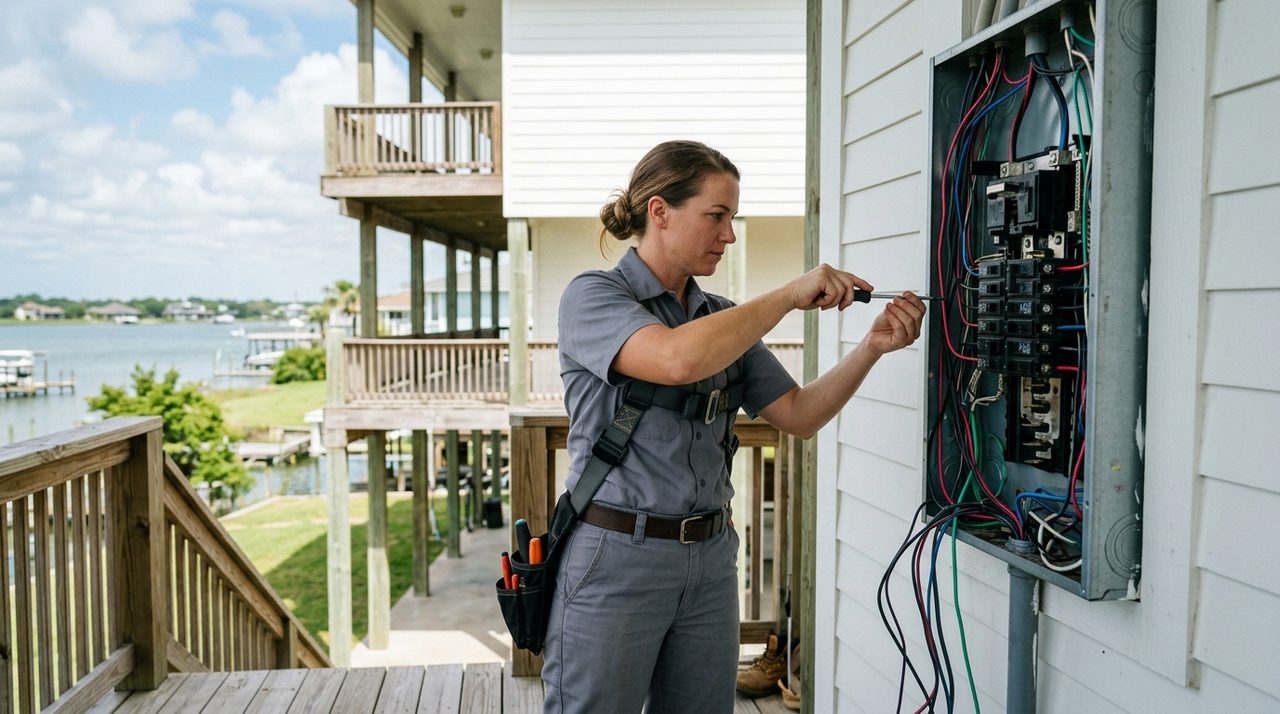
A qualified electrician working in Texas City should specify marine-grade or stainless-steel hardware at the weatherhead and meter can, and apply an anti-oxidant compound rated for aluminum conductors on all service-entrance terminations. All service-entrance work requires a permit pulled through the City of Texas City Permits and Inspections Department; CenterPoint Energy must also be coordinated for the utility-side disconnect and reconnect after any meter base replacement. The supervising Master Electrician must hold an active TDLR license, which can be verified on TDLR's public lookup before work begins.
Sources: Texas Department of Licensing & Regulation, Municipal permit office (see area profile)
Why it matters to you
Homes built near Texas City's historic core and the refinery corridor in the mid-20th century — representing a significant portion of the city's census median build year of 1981 — were originally wired for all-gas appliances and window AC units, making 100-amp service adequate at the time. After Winter Storm Uri in February 2021 prompted many Gulf Coast homeowners to add electric space heaters, heat-pump water heaters, or backup HVAC supplemental heat, those original 100-amp panels are now routinely overloaded, producing nuisance breaker trips and, in worst cases, overheated conductors at the main lugs. Adding an EV charger or a whole-home standby generator transfer switch on top of these new loads pushes the risk further.
What a good pro does
A service upgrade from 100A to 200A — estimated at $1,800–$3,200 installed in the Houston metro, though Texas City permit fees and site conditions vary — is the correct fix, not a load-shed workaround. The City of Texas City requires an electrical permit for service upgrades; the Master Electrician on record must coordinate a CenterPoint inspection of the utility riser alongside the city inspection, which adds scheduling time homeowners should account for. Confirm your panel brand as well: homes from the 1965–1975 window in this area sometimes retain Federal Pacific Stab-Lok panels that compound the upgrade urgency.
Sources: Texas Department of Licensing & Regulation, Municipal permit office (see area profile)
Why it matters to you
Newer master-planned communities in Texas City — particularly Lago Mar, managed by Principle Management Group, and Park Place South — have mandatory HOAs with architectural review requirements that govern where Level 2 EVSE conduit can be routed on exterior walls and whether panel-side conduit runs through a garage are visible from the street or common areas. These deed restrictions operate independently of the electrical permit, meaning a homeowner who gets City of Texas City approval but skips HOA architectural review can face a removal order even on fully code-compliant work. Newer 2010s–2020s Lago Mar homes typically have 200-amp panels sufficient to support a 50-amp EVSE circuit without a panel upgrade, but that capacity must be confirmed with a load calculation before ordering equipment.
What a good pro does
Start with a written architectural review request to your HOA management company before scheduling an electrician; Lago Mar and Park Place South applications require a conduit routing diagram showing finished appearances. After HOA approval, the electrician pulls an electrical permit through the City of Texas City — not the City of Houston or Harris County — before any wire is pulled. A Level 2 charger supply circuit with adequate panel capacity typically runs $400–$900 installed (estimate); if a panel upgrade is concurrent, budget the combined scope at permit application time to avoid a second inspection cycle.
Sources: Local HOA / deed restrictions (see area profile), Municipal permit office (see area profile), Texas Department of Licensing & Regulation
Why it matters to you
Texas City's Galveston County coastal position placed it squarely in Hurricane Beryl's 2024 track, with sustained winds capable of tearing overhead service drops from mast risers and pulling meter cans off older masonry or wood-frame facades. The homeowner — not CenterPoint Energy — owns the weatherhead, mast, and meter base on their side of the meter socket; CenterPoint restores only the utility conductors, leaving the damaged homeowner-side equipment unrepaired and the home without power until a licensed electrician completes and permits the repairs. Older single-story homes near the bay with overhead service rather than underground laterals are most exposed to repeat damage in future storm seasons.
What a good pro does
After any wind event, do not attempt to reconnect or splice weatherhead conductors yourself — arc flash and energized conductor risk make this an electrician's scope only. The repair sequence is: engage a TDLR-licensed Master Electrician to replace the weatherhead, mast, and meter base; the electrician files a permit with the City of Texas City Permits and Inspections Department; after city inspection sign-off, CenterPoint schedules a reconnect appointment. Homeowners in older neighborhoods should ask their electrician about upgrading from overhead to underground lateral service when the mast is already off — the trench cost, while additional, eliminates repeat storm vulnerability.
Sources: Texas Department of Licensing & Regulation, Municipal permit office (see area profile), FEMA National Flood Hazard Layer (NFHL)
Hiring electricians in Texas City? Texas City is an incorporated Galveston County city with a wide range of housing stock, from newer master-planned communities like Lago Mar to older neighborhoods near the historic core and refineries. Homeowners here face coastal weather exposure, salt-air corrosion, and varying flood risk depending on elevation and proximity to the bay. Permitting runs through the City of Texas City, not Houston, and HOA requirements vary significantly by subdivision.
Building era
Mixed — older core neighborhoods date to the mid-20th century; master-planned communities like Lago Mar and Park Place South are primarily 2010s–2020s construction.
Typical style
Modern production-builder suburban homes (brick and stone, one- and two-story) in newer subdivisions; older areas feature more varied Gulf Coast residential styles.
Foundations
Predominantly slab-on-grade in modern subdivisions; some older coastal and bay-adjacent homes may be pier-and-beam or raised construction — confirm via Galveston County Appraisal District records.
Common systems
Newer homes feature modern central HVAC, PEX or CPVC plumbing, and 200-amp electrical panels; older homes may have original ductwork, galvanized or copper plumbing, and smaller electrical services requiring upgrades.
What that means for repairs
Older homes near the historic core often need HVAC modernization, electrical panel upgrades, and corrosion-related exterior repairs due to salt air and industrial proximity. Newer HOA communities focus on cosmetic upgrades and energy efficiency improvements.
Permit jurisdiction
City of Texas City Permits and Inspections Department (independent municipality, not Houston Permitting Center).
HOA & deed restrictions
Mixed — mandatory HOAs govern newer subdivisions including Lago Mar Owners Association (managed by Principle Management Group) and Park Place South Homeowners Association. Older neighborhoods may have only recorded deed restrictions with no active HOA. HOA status must be confirmed lot-by-lot via deed records, Galveston County Clerk, or hoa.texas.gov.
Historic districts
No City of Houston historic district designation confirmed. Texas City is a separate incorporated municipality; any local historic designations would be administered by the City of Texas City.
Contractor note
Contractors must pull permits through the City of Texas City, not Harris County or the City of Houston. HOA-governed subdivisions like Lago Mar and Park Place South require architectural approval before exterior work begins; confirm requirements with the specific HOA management company.
FEMA flood zone
FEMA Zone X (low flood risk) per official NFHL data. However, Texas City is a low-lying coastal community along Galveston Bay, and localized flooding can occur in areas near Dickinson Bayou, Moses Lake, and the bay shoreline. Flood risk varies significantly by subdivision and elevation.
Hurricane Harvey impact
Specific Harvey 2017 flood depths and damage data for Texas City subdivisions were not confirmed in available research. As a low-lying coastal community in Galveston County, Texas City likely experienced storm surge and rainfall impacts, but street-level or subdivision-specific flood data should be verified through FEMA claims records, the Galveston County Appraisal District, or the Texas General Land Office.
Heat & humidity load
Extreme humidity and salt air from Galveston Bay accelerate exterior corrosion on HVAC condensers, metal roofing components, and fasteners. Older homes without adequate insulation or modern HVAC systems face heavy cooling loads. Mold risk is elevated in poorly ventilated homes, especially those with pier-and-beam foundations near the coast.
Working with contractors here
Texas City's dual housing stock creates two distinct contractor markets. In newer master-planned communities like Lago Mar and Park Place South, work centers on warranty-period punch lists, fence and patio additions within HOA guidelines, and energy-efficiency upgrades. In older neighborhoods, contractors commonly handle HVAC system replacements, electrical panel upgrades from 100-amp to 200-amp service, re-piping from galvanized to PEX, and exterior repairs driven by salt-air corrosion. Coastal proximity means roofing contractors must account for wind uplift ratings and corrosion-resistant fasteners. All work requires City of Texas City permits, and contractors unfamiliar with the local permitting process should budget additional time compared to Houston-area jurisdictions.
Local Tip
Always ask for a written estimate before work begins. Texas contractors are required to provide one on jobs over $1,000.
Texas City is an incorporated Galveston County city with a wide range of housing stock, from newer master-planned communities like Lago Mar to older neighborhoods near the historic core and refineries. Homeowners here face coastal weather exposure, salt-air corrosion, and varying flood risk depending on elevation and proximity to the bay. Permitting runs through the City of Texas City, not Houston, and HOA requirements vary significantly by subdivision.
Source: U.S. Census Bureau, ACS 5-Year 2023
Most of Texas City maps to FEMA Zone X (low mapped flood risk), but Houston's flash-flood reality means even low-risk blocks benefit from smart drainage and storm-hardened installs; as a Galveston County coastal community, tropical surge and wind add a layer generic guidance misses.
Source: FEMA National Flood Hazard Layer (NFHL). Flood zones vary by parcel — verify your individual FIRM panel.
A TDLR-licensed electrician can install a generator interlock on your existing panel in a single day, giving you a code-legal way to run your refrigerator, window units, and medical equipment without risking a lineworker's life. Even in lower-mapped-risk areas of Texas City, TX, post-storm outages routinely stretch five to ten days after a major Gulf hurricane makes landfall west of Galveston. As a Galveston County community, Texas City may follow county rather than City of Houston storm rebuild rules.
After the May 2024 derecho left parts of Texas City, TX dark for four days, homeowners without transfer switches had no safe way to connect a generator — a TDLR-licensed electrician can install an interlock kit on most existing panels in four hours, making it one of the most time-effective storm-prep investments available. Book the work now, before the next round of severe weather puts every licensed electrician in Houston on a three-week waiting list. Confirm the current FEMA panel for your Texas City parcel — the area maps to Zone X, but adjacent lots can differ.
Frozen tree limbs brought down distribution lines across Texas City, TX during Uri 2021, and when power was restored in stages the resulting surges destroyed control boards in variable-speed HVAC systems, refrigerators, and smart panels. A whole-house surge arrester installed by a licensed electrician at the meter base is the most cost-effective way to protect those components before the next hard freeze. With a median build year of 1981, the older building stock here is more exposed to hard-freeze damage than newer construction. As a Galveston County community, Texas City may follow county rather than City of Houston storm rebuild rules.
Sources: FEMA National Flood Hazard Layer (NFHL), Ready.gov -- Hurricanes, CenterPoint Energy -- Storm Center, City of Houston -- Emergency Preparedness, Ready.gov -- Winter Weather, Harris County Flood Control District
Houston-specific estimators to plan your project before you call a pro. All results are planning estimates — a licensed local pro confirms the details on site.
Disconnect & drain every outdoor hose bib
Remove hoses, drain the spigots, and cover each with an insulated faucet sock. Un-drained hose bibs are the #1 burst point in a Houston freeze.
Insulate exposed pipes in the attic & garage
Wrap any pipe in an unconditioned space (attic runs, garage walls) with foam sleeves. Houston homes rarely insulate these because they only matter a few nights a year — which is exactly why they burst.
Open cabinet doors & keep a pencil-width drip
On hard-freeze nights, open kitchen/bath cabinets so warm air reaches the pipes and let faucets on exterior walls drip to relieve pressure.
Protect the attic/garage water heater & its lines
An attic or garage tank sits in unconditioned space. Insulate the cold-inlet and hot-outlet lines and confirm the emergency drain pan is clear so a leak doesn't reach the ceiling.
This is a planning estimate only — actual requirements depend on an on-site assessment by a licensed Houston pro. If a pipe has already burst, shut off your main water supply and call a licensed Houston plumber immediately — freeze bursts flood fast.
Sources: Municipal permit office (see area profile)Texas Department of Licensing & Regulation
Sources: Local HOA / deed restrictions (see area profile)Municipal permit office (see area profile)
Sources: Municipal permit office (see area profile)