Open Now
117 13th Ave N, Texas City, TX 77590
Texas City sits on Galveston Bay's northwestern shore where salt-laden Gulf air, median home construction from 1981, and a wide spread between aging industrial-era bungalows and brand-new Lago Mar production homes create genuinely different AC failure modes on the same street. Permits run exclusively through the City of Texas City Permits and Inspections Department — not Houston's One-Stop portal — and HOA screening rules in newer subdivisions add a second approval layer that surprises homeowners relocating from unincorporated Harris County. Understanding which of those two worlds your home sits in determines what repairs cost, how fast inspections move, and which failure is most likely to hit you first.
Ranked by verified Google rating × review volume × verification tier. How we rank →
Some highly-rated pros serve Texas City from nearby and may not keep a Texas City street address. Those are listed under "Also serving Texas City" with their real city and distance, so you always know where each business is based.
117 13th Ave N, Texas City, TX 77590
1426 14th Ave N, Texas City, TX 77590
1030 14th St N, Texas City, TX 77590
Highly-rated pros based nearby who cover Texas City. Distance shown from the Texas City area.
Serving Texas City Based in La Marque · 3.8 mi away
Serving Texas City Based in La Marque · 4.3 mi away
Serving Texas City Based in La Marque · 7 mi away
Serving Texas City Based in La Marque · 7 mi away
Why it matters to you
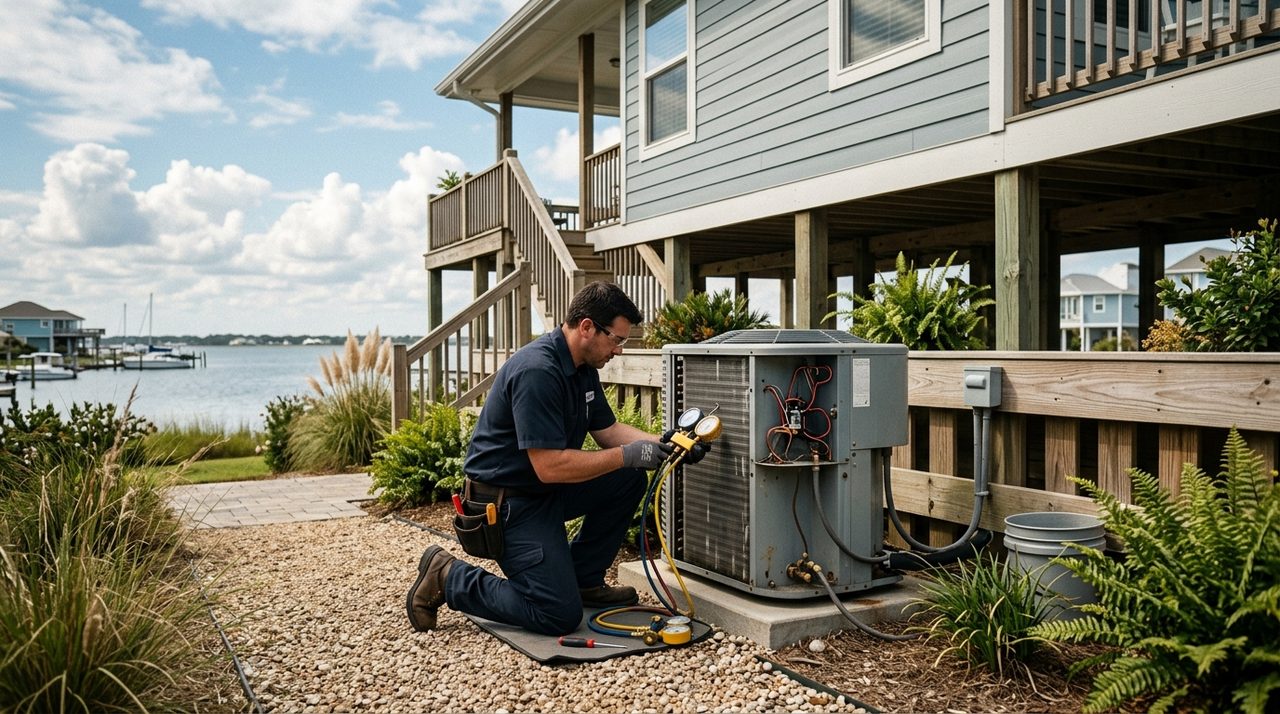
Texas City's position on Galveston Bay means outdoor condenser units face constant salt-spray exposure that doesn't exist even 20 miles north in League City or Friendswood. Aluminum fins and copper tubing on condenser coils begin to pit and corrode within a few seasons without annual coil washing and protective coating, and once fin damage reduces airflow, the compressor runs hotter, shortens its own life, and eventually fails — an outcome that shows up disproportionately in Texas City's older neighborhoods near the ship channel and bay front where units may be original 1990s or early 2000s equipment.
What a good pro does
A qualified technician should perform an annual coil cleaning with a low-pH rinse formulated for coastal environments, followed by a fin-protective sealant; this is distinct from the quick rinse done in inland markets. If corrosion has already compromised fin density by more than 20–25 percent, coil replacement or full system replacement is more cost-effective than continued patching — a 3-ton 16 SEER2 replacement in Texas City runs an estimated $5,500–$9,500 installed. The contractor must pull a mechanical permit through the City of Texas City Permits and Inspections Department before equipment is swapped; work pulled under Houston's permitting portal is not valid here.
Sources: Municipal permit office (see area profile), Texas Department of Licensing & Regulation
Why it matters to you
Even by Houston standards, Texas City's bayfront microclimate pushes relative humidity higher and longer than inland suburbs, which means evaporator coils on slab-on-grade homes here drip condensate nearly nonstop through June, July, and August. When the primary condensate drain clogs — a routine event with algae-prone PVC in this climate — the pan overflows directly onto the slab below the air handler, and without a floor drain in the interior closet (common in the 1970s–1990s-era homes near Texas City's historic core), that moisture has nowhere to go but under the slab or into adjacent drywall.
What a good pro does
Ask your technician to flush the condensate drain with a biological treatment at every tune-up, not just when a clog is diagnosed; condensate drain clearing in the Houston metro typically runs $95–$225 as an estimate. For older air handlers in tight interior closets, a secondary float-switch shutoff that kills the system before the pan overflows is a low-cost insurance policy worth adding during any service visit. All drain pan modifications on slab-on-grade homes in Texas City still require the work to be documented under the mechanical permit pulled through the city's Permits and Inspections office.
Sources: Municipal permit office (see area profile), Texas Department of Licensing & Regulation
Why it matters to you
Texas City's census median construction year is 1981, and the older neighborhoods clustered near the downtown core and refineries have a significant share of housing with original or once-replaced equipment that predates the 2010 federal cutoff on new R-22 systems. The EPA's phaseout banned new R-22 production and import as of January 2020, and reclaimed R-22 in the Houston market now commonly runs $80–$150 per pound as an estimate, meaning a modest refrigerant leak that would cost a few hundred dollars to fix on a modern R-410A system can cost $600–$1,500 or more on an older unit — often making full replacement the rational choice rather than a repair.
What a good pro does
If your last service visit included an R-22 top-off without a documented leak repair, treat that as a warning: you are paying a premium to extend the life of equipment the refrigerant supply chain no longer supports. Have a TDLR-licensed contractor evaluate whether a retrofit refrigerant like R-407C is compatible with your specific compressor, or get a side-by-side cost comparison for full system replacement. Either path requires a mechanical permit pulled through the City of Texas City — not Harris County, not Houston — and the permit fee typically adds an estimated $75–$250 to the project cost.
Sources: Texas Department of Licensing & Regulation, Municipal permit office (see area profile), ENERGY STAR / U.S. Dept. of Energy
Why it matters to you
In Texas City's newer master-planned subdivisions — Lago Mar (managed by Principle Management Group) and Park Place South — deed restrictions commonly require that condenser units be screened from street view and that any exterior mechanical equipment change receive architectural committee approval before installation begins. A homeowner who schedules a straight condenser swap without checking HOA requirements first can find the work flagged after the fact, creating fines, required relocation of the unit, or mandated screening structures that cost more than the original repair.
What a good pro does
Before scheduling condenser replacement or relocation in Lago Mar or Park Place South, request the current architectural guidelines from your HOA management company and submit a change request that includes the proposed unit location, pad dimensions, and any screening plan. Approval timelines vary, so budget at least one to two weeks before scheduling installation. Once HOA approval is in hand, your TDLR-licensed contractor still pulls a separate mechanical permit through the City of Texas City's Permits and Inspections Department — HOA approval does not substitute for the city permit, and the city permit does not substitute for HOA approval.
Sources: Local HOA / deed restrictions (see area profile), Municipal permit office (see area profile), Texas Department of Licensing & Regulation
Hiring ac repair in Texas City? Texas City is an incorporated Galveston County city with a wide range of housing stock, from newer master-planned communities like Lago Mar to older neighborhoods near the historic core and refineries. Homeowners here face coastal weather exposure, salt-air corrosion, and varying flood risk depending on elevation and proximity to the bay. Permitting runs through the City of Texas City, not Houston, and HOA requirements vary significantly by subdivision.
Building era
Mixed — older core neighborhoods date to the mid-20th century; master-planned communities like Lago Mar and Park Place South are primarily 2010s–2020s construction.
Typical style
Modern production-builder suburban homes (brick and stone, one- and two-story) in newer subdivisions; older areas feature more varied Gulf Coast residential styles.
Foundations
Predominantly slab-on-grade in modern subdivisions; some older coastal and bay-adjacent homes may be pier-and-beam or raised construction — confirm via Galveston County Appraisal District records.
Common systems
Newer homes feature modern central HVAC, PEX or CPVC plumbing, and 200-amp electrical panels; older homes may have original ductwork, galvanized or copper plumbing, and smaller electrical services requiring upgrades.
What that means for repairs
Older homes near the historic core often need HVAC modernization, electrical panel upgrades, and corrosion-related exterior repairs due to salt air and industrial proximity. Newer HOA communities focus on cosmetic upgrades and energy efficiency improvements.
Permit jurisdiction
City of Texas City Permits and Inspections Department (independent municipality, not Houston Permitting Center).
HOA & deed restrictions
Mixed — mandatory HOAs govern newer subdivisions including Lago Mar Owners Association (managed by Principle Management Group) and Park Place South Homeowners Association. Older neighborhoods may have only recorded deed restrictions with no active HOA. HOA status must be confirmed lot-by-lot via deed records, Galveston County Clerk, or hoa.texas.gov.
Historic districts
No City of Houston historic district designation confirmed. Texas City is a separate incorporated municipality; any local historic designations would be administered by the City of Texas City.
Contractor note
Contractors must pull permits through the City of Texas City, not Harris County or the City of Houston. HOA-governed subdivisions like Lago Mar and Park Place South require architectural approval before exterior work begins; confirm requirements with the specific HOA management company.
FEMA flood zone
FEMA Zone X (low flood risk) per official NFHL data. However, Texas City is a low-lying coastal community along Galveston Bay, and localized flooding can occur in areas near Dickinson Bayou, Moses Lake, and the bay shoreline. Flood risk varies significantly by subdivision and elevation.
Hurricane Harvey impact
Specific Harvey 2017 flood depths and damage data for Texas City subdivisions were not confirmed in available research. As a low-lying coastal community in Galveston County, Texas City likely experienced storm surge and rainfall impacts, but street-level or subdivision-specific flood data should be verified through FEMA claims records, the Galveston County Appraisal District, or the Texas General Land Office.
Heat & humidity load
Extreme humidity and salt air from Galveston Bay accelerate exterior corrosion on HVAC condensers, metal roofing components, and fasteners. Older homes without adequate insulation or modern HVAC systems face heavy cooling loads. Mold risk is elevated in poorly ventilated homes, especially those with pier-and-beam foundations near the coast.
Working with contractors here
Texas City's dual housing stock creates two distinct contractor markets. In newer master-planned communities like Lago Mar and Park Place South, work centers on warranty-period punch lists, fence and patio additions within HOA guidelines, and energy-efficiency upgrades. In older neighborhoods, contractors commonly handle HVAC system replacements, electrical panel upgrades from 100-amp to 200-amp service, re-piping from galvanized to PEX, and exterior repairs driven by salt-air corrosion. Coastal proximity means roofing contractors must account for wind uplift ratings and corrosion-resistant fasteners. All work requires City of Texas City permits, and contractors unfamiliar with the local permitting process should budget additional time compared to Houston-area jurisdictions.
Local Tip
Always ask for a written estimate before work begins. Texas contractors are required to provide one on jobs over $1,000.
Texas City is an incorporated Galveston County city with a wide range of housing stock, from newer master-planned communities like Lago Mar to older neighborhoods near the historic core and refineries. Homeowners here face coastal weather exposure, salt-air corrosion, and varying flood risk depending on elevation and proximity to the bay. Permitting runs through the City of Texas City, not Houston, and HOA requirements vary significantly by subdivision.
Source: U.S. Census Bureau, ACS 5-Year 2023
Most of Texas City maps to FEMA Zone X (low mapped flood risk), but Houston's flash-flood reality means even low-risk blocks benefit from smart drainage and storm-hardened installs; as a Galveston County coastal community, tropical surge and wind add a layer generic guidance misses.
Source: FEMA National Flood Hazard Layer (NFHL). Flood zones vary by parcel — verify your individual FIRM panel.
After a hurricane passes through Texas City, TX, clear debris from condenser coil fins with a gentle water rinse before restoring power — compressed leaf litter and shingle granules restrict airflow and can overheat the compressor on a first cooling call during the post-storm heat spike. A TDLR-licensed technician can also inspect the refrigerant charge, which can shift if the unit was significantly jostled. As a Galveston County community, Texas City may follow county rather than City of Houston storm rebuild rules.
Wind-driven rain during a severe thunderstorm can overwhelm attic ventilation in Texas City, TX and soak fiberglass duct insulation, reducing system efficiency for weeks until the insulation dries — a post-storm attic check for wet duct wrap costs far less than the efficiency loss on your summer CenterPoint bill. A TDLR-licensed HVAC technician can re-wrap and seal affected sections during a single service visit. Confirm the current FEMA panel for your Texas City parcel — the area maps to Zone X, but adjacent lots can differ.
Hard freezes in Texas City, TX can crack condensate trap fittings in attic air handlers, flooding the secondary pan and ceiling drywall the moment temperatures rise — replace plastic condensate traps with PVC cemented fittings and confirm float-switch operation before winter as a direct freeze-prep step. This ten-minute inspection by a licensed HVAC technician prevents the water-damage call that follows the thaw. With a median build year of 1981, the older building stock here is more exposed to hard-freeze damage than newer construction. As a Galveston County community, Texas City may follow county rather than City of Houston storm rebuild rules.
Sources: FEMA National Flood Hazard Layer (NFHL), Ready.gov -- Hurricanes, CenterPoint Energy -- Storm Center, City of Houston -- Emergency Preparedness, Ready.gov -- Winter Weather, Harris County Flood Control District
Houston-specific estimators to plan your project before you call a pro. All results are planning estimates — a licensed local pro confirms the details on site.
Living space you want cooled (400–10,000 sq ft).
Recommended nominal size
Estimated cooling load
This is a planning estimate only — actual requirements depend on an on-site assessment by a licensed Houston pro. Houston's humidity and long cooling season make an oversized unit a common, costly mistake — it short-cycles and never dehumidifies. A licensed contractor confirms sizing with a full Manual J calculation.
Disconnect & drain every outdoor hose bib
Remove hoses, drain the spigots, and cover each with an insulated faucet sock. Un-drained hose bibs are the #1 burst point in a Houston freeze.
Insulate exposed pipes in the attic & garage
Wrap any pipe in an unconditioned space (attic runs, garage walls) with foam sleeves. Houston homes rarely insulate these because they only matter a few nights a year — which is exactly why they burst.
Open cabinet doors & keep a pencil-width drip
On hard-freeze nights, open kitchen/bath cabinets so warm air reaches the pipes and let faucets on exterior walls drip to relieve pressure.
Protect the attic/garage water heater & its lines
An attic or garage tank sits in unconditioned space. Insulate the cold-inlet and hot-outlet lines and confirm the emergency drain pan is clear so a leak doesn't reach the ceiling.
This is a planning estimate only — actual requirements depend on an on-site assessment by a licensed Houston pro. If a pipe has already burst, shut off your main water supply and call a licensed Houston plumber immediately — freeze bursts flood fast.
Sources: Municipal permit office (see area profile)Texas Department of Licensing & Regulation
Sources: Local HOA / deed restrictions (see area profile)Municipal permit office (see area profile)