Texas City Plaza, 915 6th St N, Texas City, TX 77590
Best Pest Control in Texas City, TX
Texas City's blend of 1950s–1970s Gulf Coast bungalows near the historic core and shiny 2010s–2020s production homes in Lago Mar and Park Place South creates two completely different pest pressure profiles on the same street grid — salt air accelerates exterior gaps that let pests in, while Galveston County's coastal humidity keeps termite and mosquito pressure elevated year-round. Pest control operators here must be licensed through the Texas Department of Licensing and Regulation (TDLR), and homeowners in HOA-governed subdivisions like Lago Mar need to confirm exterior treatment timing and bait-station placement with the Lago Mar Owners Association before scheduling service. Understanding which pressures apply to your specific home's age and location — not a generic Houston-metro template — is what separates effective treatment from repeated callbacks.
Verified against Google Business data
Updated 2026
See the 4 Pest Control Serving Texas City 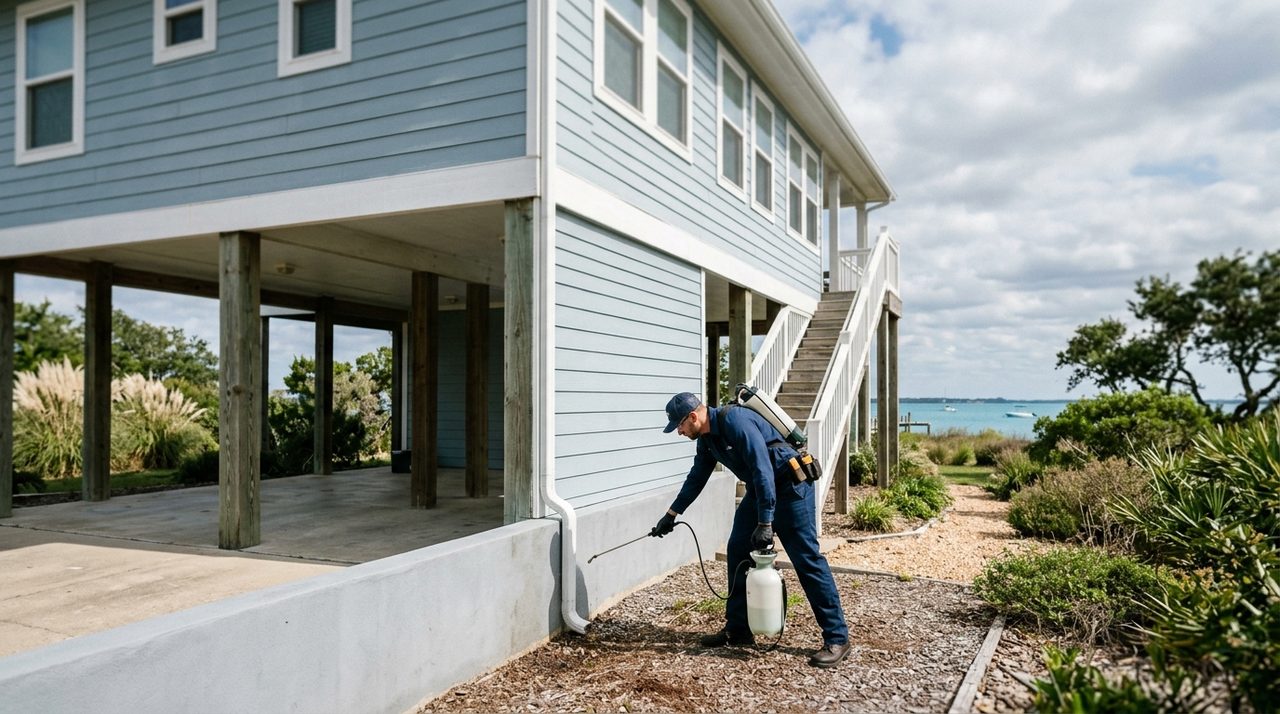
- Median home built
- 1981
- Median home value
- $190,600
- FEMA flood zone
- X (low)
- Typical cost (est.)
- $150–$1,800
- Most common local issue
- Formosan termite intrusion at slab expansion joints in mid-20th-century core neighborhoods
Ranked by verified Google rating × review volume × verification tier. How we rank →
Some highly-rated pros serve Texas City from nearby and may not keep a Texas City street address. Those are listed under "Also serving Texas City" with their real city and distance, so you always know where each business is based.
Min rating:
4 resultsBased in Texas City
Closed
826 9th Ave N, Texas City, TX 77590
Also serving Texas City
Highly-rated pros based nearby who cover Texas City. Distance shown from the Texas City area.
Serving Texas City Based in La Marque · 5.4 mi away
Closed
Serving Texas City Based in La Marque · 5.4 mi away
Pest Control in Texas City: What You Should Know
Formosan Termite Pressure in Older Core Neighborhoods Near the Historic Refinery District
Why it matters to you
Texas City's mid-20th-century housing stock — many homes built in the 1950s–1970s near the historic industrial core — sits on slab-on-grade foundations that predate modern termiticide pre-treatment requirements. Coptotermes formosanus (Formosan subterranean termite) exploits expansion joints, cast-in plumbing sleeves, and original post-tension penetrations as direct soil-to-wood highways, and Galveston County's coastal humidity keeps colony activity elevated well into fall. Homeowners in these older blocks often discover damage only when floor trim or door frames begin to shift — by which point galleries can extend several feet into wall framing.
What a good pro does
A TDLR-licensed termite applicator (Category 2 endorsement) should perform a full slab perimeter inspection, probing weep holes and plumbing entry points, before recommending either a liquid barrier treatment (Termidor-type, estimated $800–$1,800 based on linear footage) or a bait station network (Sentricon-type, estimated $1,200–$2,000 plus $300–$500/year monitoring). In older Texas City homes with original landscaping mulch banked against the foundation — a common sight in the neighborhoods south of Texas Avenue — source reduction and exterior exclusion caulking are prerequisites that a quality operator addresses before any chemical application.
Post-Storm Nuisance Wildlife Intrusion Through Salt-Air-Corroded Soffits and Fascia
Why it matters to you
Beryl's Category 1 landfall in July 2024 and the May 2024 derecho both produced wind damage across Galveston County, and Texas City's coastal position meant salt-laden gusts stripped soffit panels and ridge caps from homes that were already weakened by years of marine-air corrosion — a hazard largely absent in inland Houston suburbs. Roof rats, Virginia opossums, and Mexican free-tailed bats can establish in a compromised attic within days of a storm event, and Texas Parks and Wildlife Department (TPWD) regulations require specific handling protocols for bats, meaning a general pest operator cannot simply trap and remove them without proper coordination.
What a good pro does
After any named storm, homeowners should have a TDLR-licensed pest control operator with wildlife endorsement inspect the roofline from a ladder — not just from ground level — before patching begins. The operator should document entry points, identify species present (bat presence changes the legal timeline for exclusion), and coordinate exclusion work with a roofing contractor who understands corrosion-resistant fastener requirements for Galveston County coastal installations. Homeowners with TWIA wind coverage should confirm whether attic remediation tied to storm-induced wildlife intrusion qualifies under their policy before authorizing treatment.
Sources: Texas Windstorm Insurance Association (TWIA), Texas Department of Licensing & Regulation
American Cockroach Sewer Intrusion in Pre-1980 Homes With Aging Cast-Iron Drain Lines
Why it matters to you
Homes in Texas City's older core — the census median year built is 1981, meaning a substantial share of owner-occupied housing predates that — commonly retain original cast-iron sanitary drain lines that have corroded, cracked, or settled unevenly on the area's compressible coastal soils. Periplaneta americana (American cockroach, locally called 'waterbugs') thrives in warm sewer infrastructure and migrates into living spaces through floor drain gaps, slab plumbing penetrations, and corroded cleanout covers, particularly after heavy rain events displace them from the storm sewer network. Interior spray treatments alone cannot break this cycle because the harborage is below the slab.
What a good pro does
An effective Texas City program targets both the indoor population and the outdoor reservoir: a TDLR-licensed applicator should treat floor drains with a gel or dust formulation, seal visible plumbing penetrations at the slab surface, and apply a granular perimeter bait around the exterior foundation. Homeowners should also have a licensed plumber camera-inspect aging cast-iron lines for root intrusion or collapse — a separate trade pull from the City of Texas City Permits and Inspections Department — because pest control cannot succeed long-term if the drain infrastructure continues to provide open harborage. Recurring quarterly service (estimated $40–$70 per visit) maintains suppression between inspections.
HOA Exterior Treatment Restrictions in Lago Mar and Park Place South
Why it matters to you
Texas City's newest master-planned communities — Lago Mar (managed by Principle Management Group) and Park Place South — carry mandatory HOA deed restrictions that govern the placement of visible pest control equipment on common-area turf and front-yard hardscape. Homeowners who schedule fire ant broadcast treatment or perimeter bait station installation without first confirming the HOA's approval window risk being cited for deed restriction violations, and community-wide pest programs negotiated by the HOA may conflict with individual quarterly service contracts already in place. Red imported fire ants (Solenopsis invicta) are a documented pressure in these irrigated-turf communities, with mounds concentrating near irrigation heads and HVAC disconnect boxes — both locations that may require HOA coordination before treatment.
What a good pro does
Before scheduling any exterior pest service in Lago Mar or Park Place South, confirm current deed restriction language directly with Principle Management Group or the Park Place South HOA — not just from the original closing documents, which may be outdated. A TDLR-licensed applicator familiar with HOA-governed Texas City communities can advise on low-visibility bait station placements and schedule broadcast fire ant treatments during approved windows. Individual homeowners should also ask the HOA whether a community-wide pest contract exists, since duplicating treatment areas can create liability and product conflicts that void both programs' warranties.
Sources: Local HOA / deed restrictions (see area profile), Texas Department of Licensing & Regulation
Pest Control in Texas City: What You Should Know
Hiring pest control in Texas City? Texas City is an incorporated Galveston County city with a wide range of housing stock, from newer master-planned communities like Lago Mar to older neighborhoods near the historic core and refineries. Homeowners here face coastal weather exposure, salt-air corrosion, and varying flood risk depending on elevation and proximity to the bay. Permitting runs through the City of Texas City, not Houston, and HOA requirements vary significantly by subdivision.
- Housing era
- Mixed — older core neighborhoods date to the mid-20th century
- Foundation
- Predominantly slab-on-grade in modern subdivisions
- Flood zone
- FEMA Zone X (low flood risk) per official NFHL data
- Permits
- City of Texas City Permits and Inspections Department (independent municipality, not Houston Permitting Center)
Housing stock & systems
Building era
Mixed — older core neighborhoods date to the mid-20th century; master-planned communities like Lago Mar and Park Place South are primarily 2010s–2020s construction.
Typical style
Modern production-builder suburban homes (brick and stone, one- and two-story) in newer subdivisions; older areas feature more varied Gulf Coast residential styles.
Foundations
Predominantly slab-on-grade in modern subdivisions; some older coastal and bay-adjacent homes may be pier-and-beam or raised construction — confirm via Galveston County Appraisal District records.
Common systems
Newer homes feature modern central HVAC, PEX or CPVC plumbing, and 200-amp electrical panels; older homes may have original ductwork, galvanized or copper plumbing, and smaller electrical services requiring upgrades.
What that means for repairs
Older homes near the historic core often need HVAC modernization, electrical panel upgrades, and corrosion-related exterior repairs due to salt air and industrial proximity. Newer HOA communities focus on cosmetic upgrades and energy efficiency improvements.
Permits & restrictions
Permit jurisdiction
City of Texas City Permits and Inspections Department (independent municipality, not Houston Permitting Center).
HOA & deed restrictions
Mixed — mandatory HOAs govern newer subdivisions including Lago Mar Owners Association (managed by Principle Management Group) and Park Place South Homeowners Association. Older neighborhoods may have only recorded deed restrictions with no active HOA. HOA status must be confirmed lot-by-lot via deed records, Galveston County Clerk, or hoa.texas.gov.
Historic districts
No City of Houston historic district designation confirmed. Texas City is a separate incorporated municipality; any local historic designations would be administered by the City of Texas City.
Contractor note
Contractors must pull permits through the City of Texas City, not Harris County or the City of Houston. HOA-governed subdivisions like Lago Mar and Park Place South require architectural approval before exterior work begins; confirm requirements with the specific HOA management company.
Flood & weather
FEMA flood zone
FEMA Zone X (low flood risk) per official NFHL data. However, Texas City is a low-lying coastal community along Galveston Bay, and localized flooding can occur in areas near Dickinson Bayou, Moses Lake, and the bay shoreline. Flood risk varies significantly by subdivision and elevation.
Hurricane Harvey impact
Specific Harvey 2017 flood depths and damage data for Texas City subdivisions were not confirmed in available research. As a low-lying coastal community in Galveston County, Texas City likely experienced storm surge and rainfall impacts, but street-level or subdivision-specific flood data should be verified through FEMA claims records, the Galveston County Appraisal District, or the Texas General Land Office.
Heat & humidity load
Extreme humidity and salt air from Galveston Bay accelerate exterior corrosion on HVAC condensers, metal roofing components, and fasteners. Older homes without adequate insulation or modern HVAC systems face heavy cooling loads. Mold risk is elevated in poorly ventilated homes, especially those with pier-and-beam foundations near the coast.
Working with contractors here
Texas City's dual housing stock creates two distinct contractor markets. In newer master-planned communities like Lago Mar and Park Place South, work centers on warranty-period punch lists, fence and patio additions within HOA guidelines, and energy-efficiency upgrades. In older neighborhoods, contractors commonly handle HVAC system replacements, electrical panel upgrades from 100-amp to 200-amp service, re-piping from galvanized to PEX, and exterior repairs driven by salt-air corrosion. Coastal proximity means roofing contractors must account for wind uplift ratings and corrosion-resistant fasteners. All work requires City of Texas City permits, and contractors unfamiliar with the local permitting process should budget additional time compared to Houston-area jurisdictions.
Local Tip
Always ask for a written estimate before work begins. Texas contractors are required to provide one on jobs over $1,000.
About Texas City
Texas City is an incorporated Galveston County city with a wide range of housing stock, from newer master-planned communities like Lago Mar to older neighborhoods near the historic core and refineries. Homeowners here face coastal weather exposure, salt-air corrosion, and varying flood risk depending on elevation and proximity to the bay. Permitting runs through the City of Texas City, not Houston, and HOA requirements vary significantly by subdivision.
- Median year built
- 1981
- Median home value
- $190,600
- Owner-occupied
- 53.9%
- Population
- 54,159
- Housing units
- 23,248
- Median income
- $65,447
Source: U.S. Census Bureau, ACS 5-Year 2023
Flood & storm risk
FEMA Zone XLow flood riskMost of Texas City maps to FEMA Zone X (low mapped flood risk), but Houston's flash-flood reality means even low-risk blocks benefit from smart drainage and storm-hardened installs; as a Galveston County coastal community, tropical surge and wind add a layer generic guidance misses.
Source: FEMA National Flood Hazard Layer (NFHL). Flood zones vary by parcel — verify your individual FIRM panel.
Free Texas City Tools & Calculators
Houston-specific estimators to plan your project before you call a pro. All results are planning estimates — a licensed local pro confirms the details on site.
Houston Subtropical Pest Treatment Planner
Open full tool & FAQ →Your Houston treatment schedule
| Pest | Cadence | Active window |
|---|---|---|
Mosquito control A standard 4-week barrier treatment holds a typical suburban lot through Houston's core mosquito season. | Every 28 days | April – October |
Termite (subterranean) A once-a-year spring inspection is the baseline for a drier, sunnier Houston lot — catch mud tubes and swarmer wings before damage compounds. | Annual inspection | Spring |
General pest guard (roaches, ants, spiders) Houston's year-round warmth means general pests never fully die off — a quarterly perimeter treatment is the standard maintenance rhythm. | Quarterly | Mar · Jun · Sep · Dec |
This is a planning estimate only — actual requirements depend on an on-site assessment by a licensed Houston pro. Texas requires an SPCB-licensed applicator for chemical treatment — ask for the technician's license number.
Frequently Asked Questions
Do pest control companies in Texas City need a City of Texas City permit to spray my home, or is the TDLR license enough?
For routine pest control service — interior and exterior perimeter sprays, bait station installation, or rodent exclusion — no City of Texas City permit is required on top of the operator's state credentials. The technician must hold a current TDLR Technician registration and work under a TDLR-licensed Certified Applicator with the appropriate category endorsements (termites, general household pests, etc.); ask to see both before work begins. The one exception is structural fumigation (tenting), which requires advance notification to the local fire marshal regardless of jurisdiction, so confirm that step with the City of Texas City if a fumigation is ever recommended for your home.
My Lago Mar home was built in 2018 — do I still have serious termite risk, or is that mainly a problem for the older Texas City core neighborhoods?
Newer production homes in Lago Mar and Park Place South are less vulnerable than mid-20th-century bungalows near the historic core, but they are not immune — Galveston County's coastal humidity keeps Formosan and native subterranean termite pressure elevated year-round, and modern slab-on-grade construction still has expansion joints and plumbing penetrations that termites can exploit. Most Texas production builders apply a soil pre-treatment before the slab is poured, but that chemical barrier degrades over 5–10 years, meaning homes built in the 2010s are now entering the window where re-treatment or bait station monitoring becomes worth evaluating. Ask any prospective operator for proof that they hold a TDLR termite endorsement and whether they can pull your builder's original pre-treatment records from permit files at the City of Texas City.
Texas City maps mostly to FEMA Zone X, so why are pest control companies telling me I need mosquito treatments after every big rainstorm?
Zone X means mapped flood risk from riverine overflow is low, but it says nothing about the standing water that collects in flat coastal yards sitting on clay-influenced soils after Gulf rain events — water that can sit 72 or more hours and breed Aedes aegypti mosquitoes in that window. Harris County Mosquito Control District aerial spraying covers rights-of-way to the north, but Galveston County's program covers public areas only and does not treat private yards, leaving barrier sprays and larviciding for standing water as the homeowner's responsibility. If your yard regularly holds water after storms, a combined source-reduction assessment and monthly barrier program during mosquito season (roughly April through October) is a practical step regardless of your flood zone classification.
Sources: FEMA National Flood Hazard Layer (NFHL)Harris County Flood Control District
About what should I expect to pay for a quarterly pest control plan in Texas City, and what does that actually cover?
For a typical Texas City home in the 2,000 sq ft range, quarterly recurring service plans run an estimated $40–$70 per visit, with the first treatment sometimes priced higher (roughly $150–$300) to address any existing infestation. Standard quarterly plans generally cover general household pests — cockroaches, ants including fire ants at the perimeter, spiders, and occasional rodent bait monitoring — but termite treatment is almost always a separate contract, with liquid barrier applications estimated at $800–$1,800 for a slab home and Sentricon-type bait station systems running $1,200–$2,000 plus an annual monitoring contract of $300–$500. All cost figures are estimates; get itemized quotes from at least two TDLR-licensed operators and confirm exactly which pest categories are covered before signing.
My Lago Mar HOA sent me a notice about a community-wide pest program. Can I still hire my own pest control company, and do I need HOA approval for exterior bait stations?
Lago Mar's HOA, managed by Principle Management Group, generally allows individual homeowners to contract their own TDLR-licensed pest control operator, but visible exterior equipment — bait station boxes, rodent station housings, or stakes in common-area turf — typically requires architectural review before installation. Check your CC&Rs and submit an approval request before the technician sets anything outside; timing of broadcast sprays near community amenities or shared greenspace may also be restricted. If the community-wide program already covers perimeter fire ant treatment on common turf, coordinate with your individual operator to avoid redundant applications and confirm there is no conflict with the HOA's contracted products.
Sources: Local HOA / deed restrictions (see area profile)
When is the worst season for fire ant mounds in Texas City yards, and should I schedule treatment before or after summer?
In Galveston County's coastal climate, fire ant mound activity peaks twice — in spring (March through May) as soil warms and queens begin new colonies, and again in fall (September through October) when cooling temperatures push colonies back toward the surface after summer heat drives them deeper. The most effective timing for perimeter broadcast treatment in Texas City yards is late February to early March before peak spring activity, with a follow-up in September; mounds near irrigation heads and foundation edges near the slab are a particular concern because coastal yards tend to hold enough moisture to support large colony sizes year-round. Ask your operator whether they are applying a broadcast granular product to the full turf area rather than just spot-treating visible mounds, since re-infestation from neighboring lots is near-certain in a coastal community without perimeter-wide coverage.