Closed
1213 14th St, Galveston, TX 77550
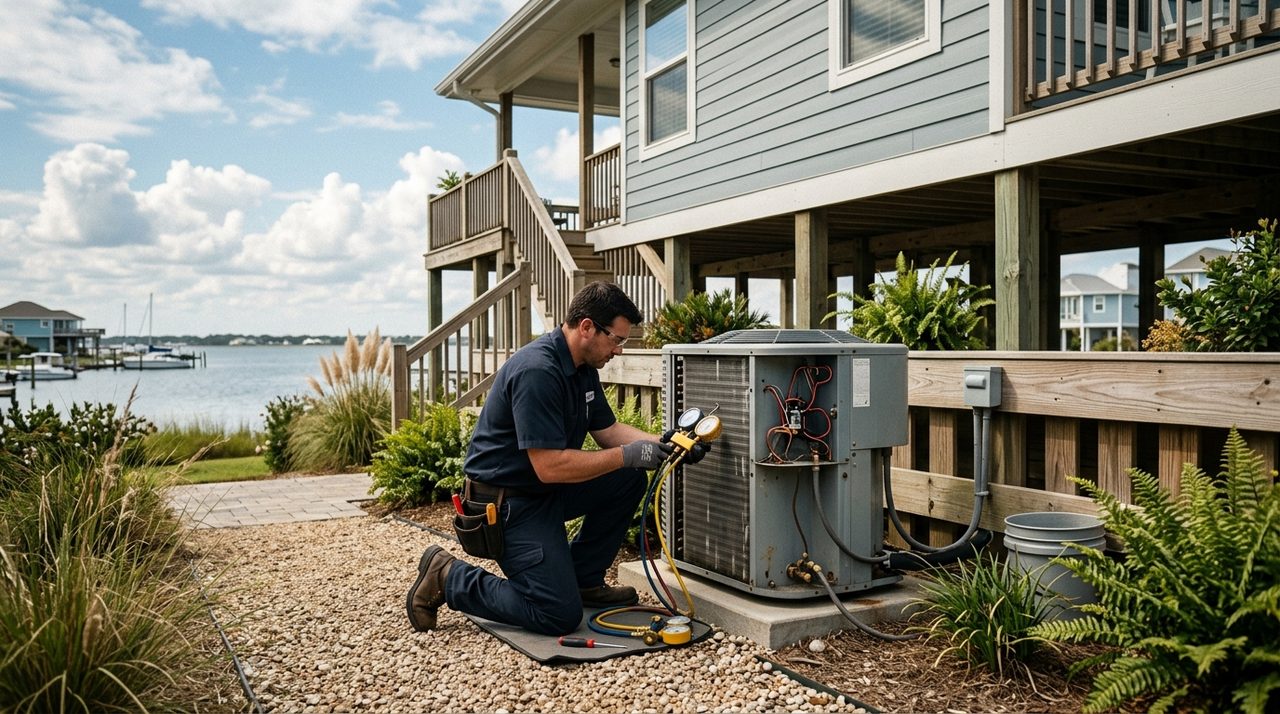
Galveston's position on a barrier island in FEMA Zone AE means every outdoor HVAC condenser faces a double threat: Gulf salt air that corrodes aluminum fins and copper line sets faster than anywhere else in the Houston metro, and hurricane-driven storm surge that can submerge equipment entirely. With a housing stock ranging from 19th-century Victorians to modern elevated beach homes, and permits governed by the City of Galveston Development Services Department — never Houston's One-Stop portal — getting AC work done right here requires a contractor who understands both coastal corrosion and island-specific permitting.
Ranked by verified Google rating × review volume × verification tier. How we rank →
Some highly-rated pros serve Galveston from nearby and may not keep a Galveston street address. Those are listed under "Also serving Galveston" with their real city and distance, so you always know where each business is based.
1213 14th St, Galveston, TX 77550
1413 23rd St, Galveston, TX 77550
3515 Avenue Q, Galveston, TX 77550
2414 Beluche Dr, Galveston, TX 77551
2415 Avenue K, Galveston, TX 77550
3411 81st St, Galveston, TX 77551
Highly-rated pros based nearby who cover Galveston. Distance shown from the Galveston area.
Serving Galveston Based in La Marque · 3.8 mi away
Why it matters to you
Galveston's persistent onshore Gulf breeze carries salt particulates that accelerate galvanic corrosion on condenser coil fins, copper refrigerant lines, and electrical contactors — turning a component that might last 15 years in Sugar Land into a failure point in 5–8 years. Homeowners in both the historic East End and newer West End beach developments report condenser failures well before manufacturer life expectancy, and the island's 90%-plus relative humidity keeps everything wet between storms.
What a good pro does
A qualified contractor should specify E-coat or phenolic-resin-coated condenser coils for any Galveston replacement — these marine-grade coatings are the industry standard for coastal installations, not an upgrade. Electrical disconnects and contactors should be stainless or corrosion-resistant rated, and the TDLR-licensed contractor must pull a mechanical permit through the City of Galveston Development Services Department before installation. Estimated replacement cost for a 3-ton coastal-rated split system runs $6,500–$10,500, reflecting the equipment premium for salt-air-rated components.
Sources: Texas Department of Licensing & Regulation, Municipal permit office (see area profile)
Why it matters to you
Much of Galveston sits in FEMA Zone AE, and Harvey (2017) and Beryl (2024) both demonstrated that condenser units at grade level can be fully submerged by storm surge — saltwater intrusion through compressor windings and coil assemblies typically means total replacement, not repair. Pier-and-beam and piling-elevated homes often have ground-level condensers that are the most vulnerable component on the property, and insurance claims in Galveston County coastal ZIP codes are commonly routed through TWIA, which has its own documentation and adjuster timelines that can delay permitted replacement by weeks.
What a good pro does
After any flooding event, do not energize a submerged condenser — have a TDLR-licensed technician inspect for moisture in the compressor crankcase and winding resistance before attempting restart. If replacement is needed, consider working with your contractor to elevate the new condenser pad above the property's base flood elevation; the City of Galveston Development Services Department mechanical permit process will apply regardless of whether the work is insurance-funded. Keep your TWIA claim number and adjuster contact ready before the contractor schedules the permit inspection.
Sources: FEMA National Flood Hazard Layer (NFHL), Texas Windstorm Insurance Association (TWIA), Municipal permit office (see area profile)
Why it matters to you
With a Census median year built of 1973 and an owner-occupancy rate of only 46.7%, Galveston has a large share of rental and vacation properties where R-22 systems have been kept running with periodic top-offs rather than full replacement. The EPA's R-22 phaseout banned new production as of January 2020, and reclaimed R-22 prices in the Houston market now run $80–$150 per pound — meaning a refrigerant leak in a Galveston vacation rental can cost $600–$1,500 just to recharge, without fixing the underlying corrosion-induced leak that salt air almost certainly caused.
What a good pro does
If a technician quotes an R-22 recharge on a Galveston property, ask them to perform a leak search first — the leak is almost never a fluke on a coastal island, and recharging without repair is money wasted. A TDLR-licensed contractor can evaluate whether a drop-in retrofit refrigerant (R-407C) is compressor-compatible, but the honest economics on a pre-2010 coastal system usually favor full replacement with a modern R-410A or R-454B unit, which also resets the corrosion clock. Replacement permits go through City of Galveston Development Services, not Houston.
Sources: Texas Department of Licensing & Regulation, Municipal permit office (see area profile), ENERGY STAR / U.S. Dept. of Energy
Why it matters to you
Galveston's humidity regularly exceeds 90% for large portions of the cooling season, pushing air handler condensate production to its maximum — and many of the island's historic Victorian and Gulf Coast vernacular homes have air handlers tucked into interior closets or attic spaces on pier-and-beam foundations without secondary drain pans or accessible floor drains. A clogged condensate line in these homes can overflow into finished ceilings or hardwood floors, and on pier-and-beam construction the moisture pathway goes directly into the crawl space where wood rot and mold can establish quickly.
What a good pro does
Have a technician flush and treat the condensate drain line at every seasonal startup — in Galveston's climate this is not optional maintenance but a near-certain annual service need, typically costing $95–$225. For air handlers lacking secondary drain pans, a TDLR-licensed contractor can retrofit a float-switch shutoff that cuts power to the system before overflow occurs; this work requires a City of Galveston mechanical permit if it involves modifying the air handler installation. Historic district properties should confirm with Galveston's preservation office whether interior mechanical modifications trigger additional review.
Sources: Texas Department of Licensing & Regulation, Municipal permit office (see area profile)
Hiring ac repair in Galveston? Galveston's housing stock spans from historic 19th-century Victorian homes to modern beach developments, creating an exceptionally diverse home service landscape. Homeowners must contend with persistent salt air corrosion, high flood risk across much of the island, and hurricane exposure that drives demand for wind-resistant roofing, elevated foundations, and robust moisture management. Permit jurisdiction falls under the City of Galveston Development Services Department or Galveston County, never the City of Houston Permitting Center.
Building era
Highly mixed — 1800s historic core through 21st-century beach and master-planned construction.
Typical style
Mix of Victorian, Gulf Coast vernacular, raised beach houses, mid-century ranch, and modern coastal developments; no single dominant style across the area.
Foundations
Mixed — many historic and coastal homes on pier-and-beam or raised pilings; newer mainland construction often slab-on-grade. Not confirmed at subdivision level — check property records.
Common systems
Older homes may have outdated electrical and galvanized plumbing requiring upgrades; coastal properties require corrosion-resistant HVAC equipment rated for salt air environments; newer builds typically feature modern central HVAC and PEX or copper plumbing.
What that means for repairs
Historic restoration is common in Galveston's core; coastal properties frequently undergo elevation projects, hurricane hardening, and replacement of salt-air-corroded exterior systems. Flood damage repair drives significant renovation activity across all housing types.
Permit jurisdiction
City of Galveston Development Services Department (within city limits); individual incorporated cities handle their own permitting elsewhere in Galveston County; unincorporated areas fall under Galveston County jurisdiction. Not the City of Houston Permitting Center.
HOA & deed restrictions
No county-wide mandatory HOA. HOAs exist at the subdivision, condo, and master-planned community level. Many single-family homes in Galveston have no HOA. Check deed restrictions recorded with the Galveston County Clerk for specific properties.
Historic districts
No City of Houston historic district designation — Galveston is outside Houston's jurisdiction. The City of Galveston maintains its own historic preservation program and local historic districts, governed by Galveston's ordinances separate from Houston's HAHC.
Contractor note
Contractors must verify whether work falls within City of Galveston, another incorporated Galveston County city, or unincorporated county jurisdiction, as permitting requirements and floodplain regulations differ significantly. Properties in local historic districts within the City of Galveston may require additional preservation review separate from any Houston process.
FEMA flood zone
FEMA Zone AE (high flood risk) — source: fema_nfhl. Galveston's island geography and coastal exposure create significant flood risk from both storm surge and rainfall. Proximity to the Gulf of Mexico and Galveston Bay compounds risk across most of the area.
Hurricane Harvey impact
Hurricane Harvey's flood impacts in Galveston County were highly localized and varied by precise location — bayfront vs. mainland interior, creek proximity, and elevation. Specific street-level flooding data for this area could not be confirmed without a more precise subdivision or address — check FEMA Harvey flood inundation maps and Galveston County floodplain administrator reports for property-specific history.
Heat & humidity load
Extreme humidity and salt air accelerate corrosion of HVAC condensers, metal roofing components, and exterior fasteners. Summer heat combined with coastal moisture drives high demand for dehumidification, mold remediation, and HVAC maintenance. Prolonged UV exposure degrades exterior paint and sealants faster than inland areas.
Working with contractors here
Contractors in Galveston most commonly work on flood damage repair, foundation elevation projects, hurricane-hardening (impact windows, fortified roofing), and replacement of salt-air-corroded exterior systems including HVAC condensers, metal railings, and fasteners. The wide range of housing eras means contractors must be prepared for both historic restoration requiring period-appropriate materials and modern coastal construction techniques. Job scoping should always include assessment of flood history, current elevation relative to base flood elevation, and whether the property falls within a City of Galveston historic district requiring preservation review. Corrosion-resistant materials and marine-grade hardware should be specified as standard for any exterior work.
Local Tip
Always ask for a written estimate before work begins. Texas contractors are required to provide one on jobs over $1,000.
Galveston's housing stock spans from historic 19th-century Victorian homes to modern beach developments, creating an exceptionally diverse home service landscape. Homeowners must contend with persistent salt air corrosion, high flood risk across much of the island, and hurricane exposure that drives demand for wind-resistant roofing, elevated foundations, and robust moisture management. Permit jurisdiction falls under the City of Galveston Development Services Department or Galveston County, never the City of Houston Permitting Center.
Source: U.S. Census Bureau, ACS 5-Year 2023
On Galveston Island, storm surge and Gulf wind are the defining hazards: much of Galveston sits in FEMA Zone AE coastal high-hazard territory, so wind-rated, elevation- and surge-aware work is the baseline, not an upgrade.
Source: FEMA National Flood Hazard Layer (NFHL). Flood zones vary by parcel — verify your individual FIRM panel.
Coastal Galveston, TX faces wind speeds and storm surge that demand condenser units rated to ASCE 7 wind-uplift standards; before hurricane season, confirm with a TDLR-licensed HVAC contractor that your equipment's mounting and the line-set connections meet those ratings for your Gulf-exposure zone. Salt air accelerates corrosion on coil fins and contactors, so a pre-season coil coating with corrosion-inhibiting treatment is strongly recommended. Much of the housing stock predates modern wind codes (median build year 1973), so retrofits matter more here. Confirm the current FEMA panel for your Galveston parcel — the area maps to Zone AE, but adjacent lots can differ.
In Galveston, TX, a severe thunderstorm's wind-driven rain can push water into the air-handler cabinet through poorly sealed penetrations, short-circuiting control boards and soaking blower motors — seal all line-set wall penetrations with foam rated for outdoor exposure and verify the air-handler drain pan and float switch are clear before storm season. A technician-installed secondary drain line provides a critical backup if the primary condensate drain becomes overwhelmed during a heavy-rain event. Confirm the current FEMA panel for your Galveston parcel — the area maps to Zone AE, but adjacent lots can differ.
Coastal Galveston, TX rarely experiences extended hard freezes, but Uri 2021 demonstrated that even barrier-island HVAC systems can lock up when heat-pump defrost cycles fail in sustained sleet — the combination of salt air corrosion on defrost sensors and sub-freezing temps caused widespread coastal outages that dragged on for the entire freeze event. A pre-winter salt-wash of outdoor coils and replacement of any corroded defrost sensors gives your system its best chance during the next anomalous freeze. With a median build year of 1973, the older building stock here is more exposed to hard-freeze damage than newer construction. As a Galveston County community, Galveston may follow county rather than City of Houston storm rebuild rules.
Sources: FEMA National Flood Hazard Layer (NFHL), Ready.gov -- Hurricanes, CenterPoint Energy -- Storm Center, City of Houston -- Emergency Preparedness, Ready.gov -- Winter Weather, Harris County Flood Control District
Houston-specific estimators to plan your project before you call a pro. All results are planning estimates — a licensed local pro confirms the details on site.
Living space you want cooled (400–10,000 sq ft).
Recommended nominal size
Estimated cooling load
This is a planning estimate only — actual requirements depend on an on-site assessment by a licensed Houston pro. Houston's humidity and long cooling season make an oversized unit a common, costly mistake — it short-cycles and never dehumidifies. A licensed contractor confirms sizing with a full Manual J calculation.
Disconnect & drain every outdoor hose bib
Remove hoses, drain the spigots, and cover each with an insulated faucet sock. Un-drained hose bibs are the #1 burst point in a Houston freeze.
Insulate exposed pipes in the attic & garage
Wrap any pipe in an unconditioned space (attic runs, garage walls) with foam sleeves. Houston homes rarely insulate these because they only matter a few nights a year — which is exactly why they burst.
Open cabinet doors & keep a pencil-width drip
On hard-freeze nights, open kitchen/bath cabinets so warm air reaches the pipes and let faucets on exterior walls drip to relieve pressure.
Protect the attic/garage water heater & its lines
An attic or garage tank sits in unconditioned space. Insulate the cold-inlet and hot-outlet lines and confirm the emergency drain pan is clear so a leak doesn't reach the ceiling.
This is a planning estimate only — actual requirements depend on an on-site assessment by a licensed Houston pro. If a pipe has already burst, shut off your main water supply and call a licensed Houston plumber immediately — freeze bursts flood fast.
Sources: Municipal permit office (see area profile)Texas Department of Licensing & Regulation
Sources: FEMA National Flood Hazard Layer (NFHL)Texas Windstorm Insurance Association (TWIA)
Sources: Texas Windstorm Insurance Association (TWIA)Municipal permit office (see area profile)
Sources: Municipal permit office (see area profile)