Open Now
4918-B Seawall Blvd, Galveston, TX 77551
Galveston's coastal island setting — FEMA Zone AE flood territory, pier-and-beam Victorian homes dating to the 1800s, and repeated hurricane inundation from Harvey through Beryl — creates pest pressures that differ sharply from anything found on the Houston mainland. Salt air accelerates the decay of wood structural members that subterranean termites and wood-boring pests exploit, post-surge standing water breeds mosquitoes in yards that drain slowly into the Gulf-facing drainage network, and every major storm strips fascia and soffit from the island's aging coastal vernacular homes, opening attics to rats and wildlife within days. Pest control operators working on Galveston Island must be licensed through TDLR and should understand that no City of Houston permitting applies here — jurisdiction falls under the City of Galveston Development Services Department or Galveston County.
Ranked by verified Google rating × review volume × verification tier. How we rank →
4918-B Seawall Blvd, Galveston, TX 77551
601 23rd St #1568, Galveston, TX 77553
6615 Stewart Rd Ste 117, Galveston, TX 77551
Why it matters to you
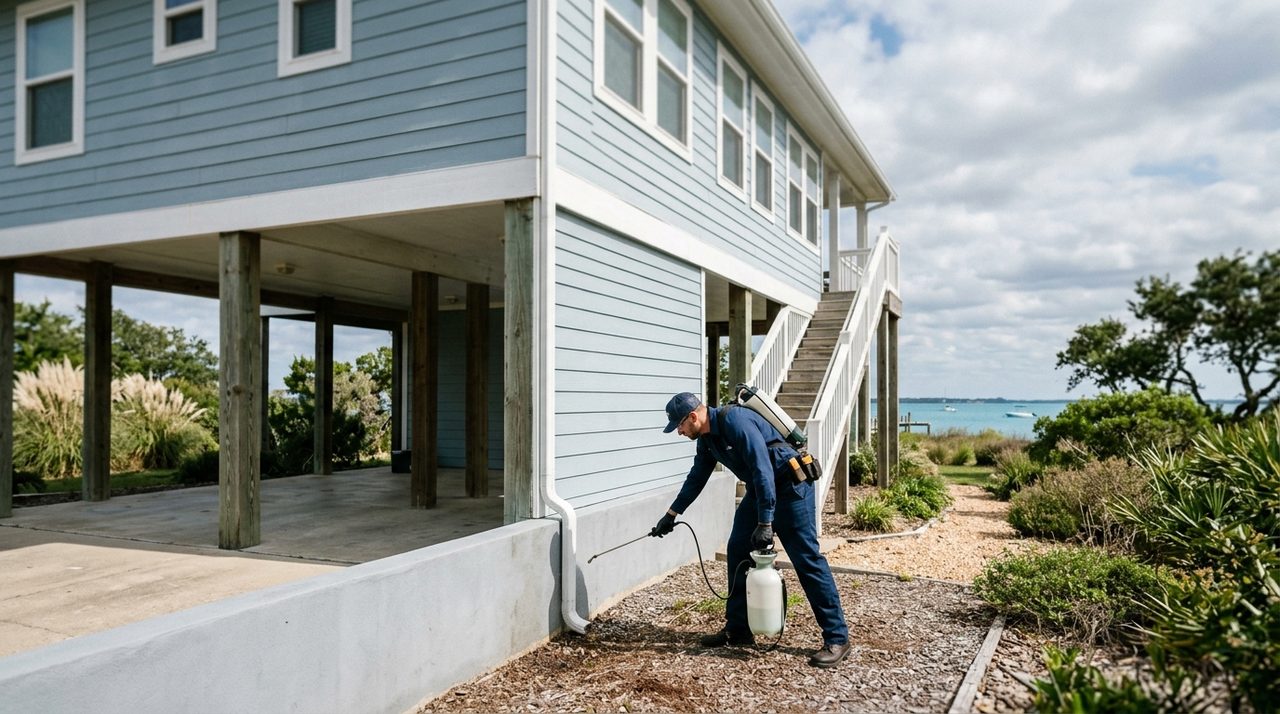
Galveston's 19th- and early 20th-century Victorian and Gulf Coast vernacular homes were built on pier-and-beam or raised piling foundations, meaning soil-to-wood contact points — sill plates, stair stringers, porch framing — are often mere inches from grade. Salt air and repeated flood inundation accelerate wood moisture content and decay, making these members dramatically more attractive to Coptotermes formosanus and Reticulitermes species, both of which thrive in Houston's USDA Zone 5 termite pressure zone. For a home where original heart pine or cypress framing is part of its historic character, a missed termite infestation can mean irreplaceable structural loss.
What a good pro does
A TDLR-licensed termite operator with a Category 2 (wood-destroying pest) endorsement should perform an annual wood-destroying insect report that physically probes sill plates and porch framing, not just a visual scan. For active infestations in historically sensitive structures, localized liquid Termidor-type treatment around foundation piers combined with Sentricon-type bait stations at perimeter grade is typically preferred over broad trenching that could disturb historic masonry or elevation-system footings. Expect liquid barrier treatment estimates of $800–$1,800 and bait station programs at $1,200–$2,000 installed, with required annual monitoring contracts.
Sources: Texas Department of Licensing & Regulation, FEMA National Flood Hazard Layer (NFHL)
Why it matters to you
Virtually all of Galveston Island sits in FEMA Zone AE, and surge events — most recently Beryl's July 2024 Gulf landfall — leave standing water pooled in low-elevation yards, beneath raised homes, and in debris-clogged drainage swales for days to a week or more on Galveston's nearly flat island topography. This standing water is prime habitat for both Aedes aegypti (dengue/Zika vector) and Culex quinquefasciatus (West Nile vector). Harris County Mosquito Control District does not cover Galveston County; Galveston County Mosquito Control handles public rights-of-way but does not treat private property, leaving residential yards entirely to homeowners and private operators.
What a good pro does
Immediately after any named storm or surge event, a TDLR-licensed pest operator should conduct a source-reduction walk of the property — identifying trapped water under pier foundations, in hollow piling caps, in boat storage areas, and in any debris — before applying a larvicide (BTI or spinosad-based) to standing water that cannot be drained. Monthly barrier spray programs ($75–$150 per application estimated) targeting vegetation around deck and piling perimeters provide ongoing suppression through mosquito season, which on Galveston's warm Gulf coast effectively runs March through November.
Sources: FEMA National Flood Hazard Layer (NFHL), Harris County Flood Control District, Texas Department of Licensing & Regulation
Why it matters to you
Every significant wind event on Galveston Island — Harvey's 130+ mph gusts, Beryl's Category 1 landfall, and the May 2024 derecho — strips wood soffit panels, fiber-cement fascia, and ridge cap material from the island's aging housing stock, which has a census median year built of 1973 but includes a large share of pre-1940 homes with original wood soffits. Roof rats (Rattus rattus), Virginia opossums, and Mexican free-tailed bats can colonize an open soffit cavity within 48–72 hours of a storm. Texas law (TPWD) imposes specific handling and exclusion protocols for bats, and TWIA homeowner policies may cover attic remediation costs triggered by documented storm damage.
What a good pro does
After any storm that causes visible exterior damage, have a TDLR-licensed pest control operator inspect the roofline and attic before a roofer closes the opening — sealing an active colony inside creates a far costlier problem. A proper exclusion treats all weep holes, gable vents, and utility penetrations with galvanized hardware cloth rated for marine environments, since standard steel mesh corrodes within one season in Galveston's salt air. If bats are present, the operator must follow TPWD exclusion timing rules (generally avoiding maternity season May–July). Document storm-caused entry points with photos before work begins and submit to your TWIA adjuster, as remediation costs can reach $500–$1,500 or more depending on attic scope.
Sources: Texas Windstorm Insurance Association (TWIA), Texas Department of Licensing & Regulation, FEMA National Flood Hazard Layer (NFHL)
Why it matters to you
Galveston's older homes — particularly the pre-1980 stock concentrated in the island's historic East End and Midtown neighborhoods — frequently retain original cast-iron drain lines and have plumbing penetrations that shift seasonally as raised foundations respond to humidity and the island's sandy-clay substrate. Periplaneta americana moves freely through the island's combined drainage infrastructure and enters homes through floor drain covers, open pipe sleeves, and gaps at toilet flanges, especially after heavy rain displaces them from street-level storm sewers. In homes that were flood-remediated after Harvey or Beryl and had walls opened and resealed, improperly closed utility chases are an especially common new pathway.
What a good pro does
Effective control requires more than quarterly interior spraying: a TDLR-licensed general household pest operator should perform an exterior exclusion assessment targeting pipe penetrations through the subfloor and foundation, and treat floor drains with appropriate EPA-registered gel bait or insect growth regulator flush. Homeowners in post-flood remediated homes should specifically ask the operator to inspect any wall cavity that was opened and closed during remediation work — these are a disproportionate source of roach harborage in Galveston's post-Harvey and post-Beryl housing stock. One-time treatment estimates run $150–$300; quarterly plans average $40–$70 per visit.
Sources: Texas Department of Licensing & Regulation, EPA Lead Renovation, Repair and Painting (RRP) Rule, FEMA National Flood Hazard Layer (NFHL)
Hiring pest control in Galveston? Galveston's housing stock spans from historic 19th-century Victorian homes to modern beach developments, creating an exceptionally diverse home service landscape. Homeowners must contend with persistent salt air corrosion, high flood risk across much of the island, and hurricane exposure that drives demand for wind-resistant roofing, elevated foundations, and robust moisture management. Permit jurisdiction falls under the City of Galveston Development Services Department or Galveston County, never the City of Houston Permitting Center.
Building era
Highly mixed — 1800s historic core through 21st-century beach and master-planned construction.
Typical style
Mix of Victorian, Gulf Coast vernacular, raised beach houses, mid-century ranch, and modern coastal developments; no single dominant style across the area.
Foundations
Mixed — many historic and coastal homes on pier-and-beam or raised pilings; newer mainland construction often slab-on-grade. Not confirmed at subdivision level — check property records.
Common systems
Older homes may have outdated electrical and galvanized plumbing requiring upgrades; coastal properties require corrosion-resistant HVAC equipment rated for salt air environments; newer builds typically feature modern central HVAC and PEX or copper plumbing.
What that means for repairs
Historic restoration is common in Galveston's core; coastal properties frequently undergo elevation projects, hurricane hardening, and replacement of salt-air-corroded exterior systems. Flood damage repair drives significant renovation activity across all housing types.
Permit jurisdiction
City of Galveston Development Services Department (within city limits); individual incorporated cities handle their own permitting elsewhere in Galveston County; unincorporated areas fall under Galveston County jurisdiction. Not the City of Houston Permitting Center.
HOA & deed restrictions
No county-wide mandatory HOA. HOAs exist at the subdivision, condo, and master-planned community level. Many single-family homes in Galveston have no HOA. Check deed restrictions recorded with the Galveston County Clerk for specific properties.
Historic districts
No City of Houston historic district designation — Galveston is outside Houston's jurisdiction. The City of Galveston maintains its own historic preservation program and local historic districts, governed by Galveston's ordinances separate from Houston's HAHC.
Contractor note
Contractors must verify whether work falls within City of Galveston, another incorporated Galveston County city, or unincorporated county jurisdiction, as permitting requirements and floodplain regulations differ significantly. Properties in local historic districts within the City of Galveston may require additional preservation review separate from any Houston process.
FEMA flood zone
FEMA Zone AE (high flood risk) — source: fema_nfhl. Galveston's island geography and coastal exposure create significant flood risk from both storm surge and rainfall. Proximity to the Gulf of Mexico and Galveston Bay compounds risk across most of the area.
Hurricane Harvey impact
Hurricane Harvey's flood impacts in Galveston County were highly localized and varied by precise location — bayfront vs. mainland interior, creek proximity, and elevation. Specific street-level flooding data for this area could not be confirmed without a more precise subdivision or address — check FEMA Harvey flood inundation maps and Galveston County floodplain administrator reports for property-specific history.
Heat & humidity load
Extreme humidity and salt air accelerate corrosion of HVAC condensers, metal roofing components, and exterior fasteners. Summer heat combined with coastal moisture drives high demand for dehumidification, mold remediation, and HVAC maintenance. Prolonged UV exposure degrades exterior paint and sealants faster than inland areas.
Working with contractors here
Contractors in Galveston most commonly work on flood damage repair, foundation elevation projects, hurricane-hardening (impact windows, fortified roofing), and replacement of salt-air-corroded exterior systems including HVAC condensers, metal railings, and fasteners. The wide range of housing eras means contractors must be prepared for both historic restoration requiring period-appropriate materials and modern coastal construction techniques. Job scoping should always include assessment of flood history, current elevation relative to base flood elevation, and whether the property falls within a City of Galveston historic district requiring preservation review. Corrosion-resistant materials and marine-grade hardware should be specified as standard for any exterior work.
Local Tip
Always ask for a written estimate before work begins. Texas contractors are required to provide one on jobs over $1,000.
Galveston's housing stock spans from historic 19th-century Victorian homes to modern beach developments, creating an exceptionally diverse home service landscape. Homeowners must contend with persistent salt air corrosion, high flood risk across much of the island, and hurricane exposure that drives demand for wind-resistant roofing, elevated foundations, and robust moisture management. Permit jurisdiction falls under the City of Galveston Development Services Department or Galveston County, never the City of Houston Permitting Center.
Source: U.S. Census Bureau, ACS 5-Year 2023
On Galveston Island, storm surge and Gulf wind are the defining hazards: much of Galveston sits in FEMA Zone AE coastal high-hazard territory, so wind-rated, elevation- and surge-aware work is the baseline, not an upgrade.
Source: FEMA National Flood Hazard Layer (NFHL). Flood zones vary by parcel — verify your individual FIRM panel.
Houston-specific estimators to plan your project before you call a pro. All results are planning estimates — a licensed local pro confirms the details on site.
| Pest | Cadence | Active window |
|---|---|---|
Mosquito control A standard 4-week barrier treatment holds a typical suburban lot through Houston's core mosquito season. | Every 28 days | April – October |
Termite (subterranean) A once-a-year spring inspection is the baseline for a drier, sunnier Houston lot — catch mud tubes and swarmer wings before damage compounds. | Annual inspection | Spring |
General pest guard (roaches, ants, spiders) Houston's year-round warmth means general pests never fully die off — a quarterly perimeter treatment is the standard maintenance rhythm. | Quarterly | Mar · Jun · Sep · Dec |
This is a planning estimate only — actual requirements depend on an on-site assessment by a licensed Houston pro. Texas requires an SPCB-licensed applicator for chemical treatment — ask for the technician's license number.
Sources: Harris County Flood Control DistrictFEMA National Flood Hazard Layer (NFHL)
Sources: Texas Department of Licensing & RegulationLocal HOA / deed restrictions (see area profile)
Sources: Texas Windstorm Insurance Association (TWIA)Texas Department of Licensing & Regulation