Open Now
3620 Emmett F Lowry Expy, Texas City, TX 77590
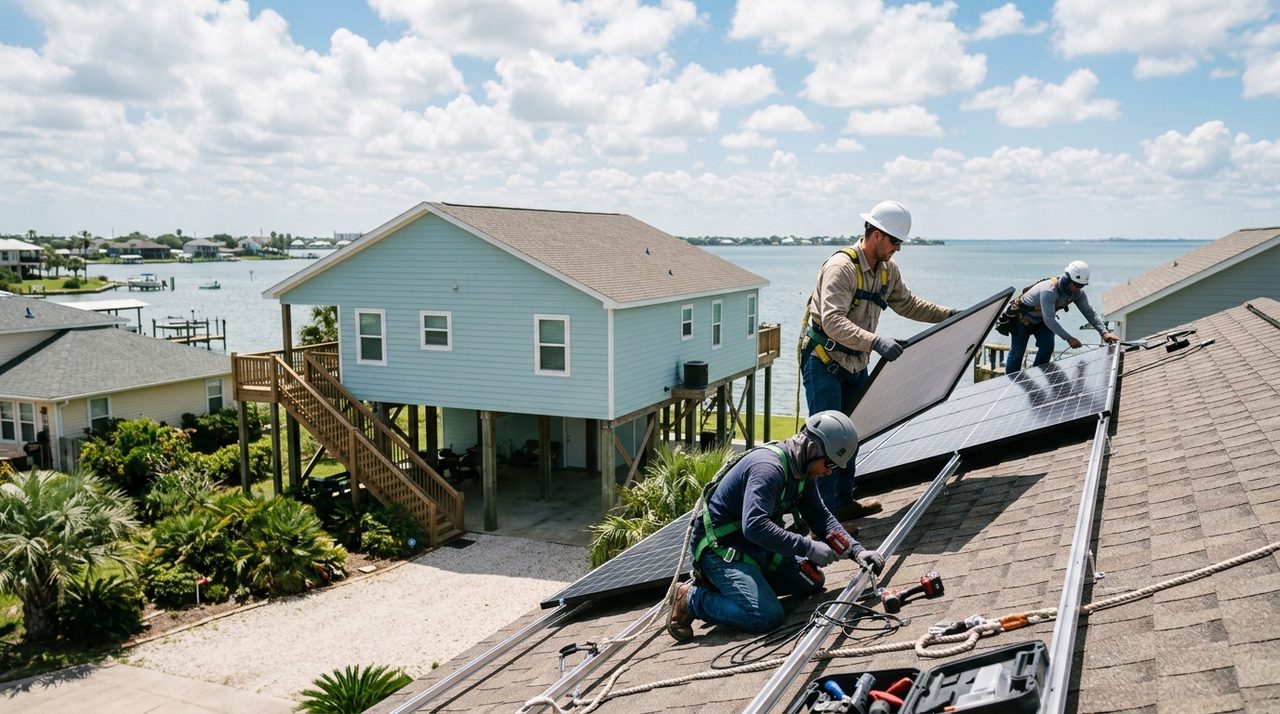
Texas City homeowners sit at the intersection of two solar realities: newer master-planned communities like Lago Mar and Park Place South offer modern 200-amp panels and pitched roofs ready for arrays, while older mid-20th-century neighborhoods near the historic core and refinery row face salt-air corrosion, aging electrical services, and roofs that may not survive a full 25-year panel lifespan. Add Galveston County's coastal wind exposure—and the TWIA insurance implications that come with it—and a solar install here demands more upfront engineering than a comparable project 30 miles inland. This page covers what actually matters for Texas City's specific housing stock, permit jurisdiction, and Gulf Coast climate.
Ranked by verified Google rating × review volume × verification tier. How we rank →
Some highly-rated pros serve Texas City from nearby and may not keep a Texas City street address. Those are listed under "Also serving Texas City" with their real city and distance, so you always know where each business is based.
3620 Emmett F Lowry Expy, Texas City, TX 77590
Highly-rated pros based nearby who cover Texas City. Distance shown from the Texas City area.
Serving Texas City Based in La Marque · 7 mi away
Serving Texas City Based in Galveston · 7.4 mi away
Serving Texas City Based in La Marque · 8.2 mi away
Serving Texas City Based in Galveston · 9.2 mi away
Serving Texas City Based in Kemah · 9.7 mi away
Serving Texas City Based in League City · 10 mi away
Why it matters to you
Texas City is an incorporated Galveston County city, which places most homes in TWIA (Texas Windstorm Insurance Association) territory. Post-Harvey and post-Beryl inspections across the Galveston County coast found that improperly documented or under-torqued rail attachments voided windstorm coverage—not just on the panels, but on the roof deck beneath them. For a city where census median home values sit around $190,600, losing windstorm coverage over a missing hardware certification is a catastrophic and entirely avoidable financial risk.
What a good pro does
A qualified installer must provide TWIA-compliant racking documentation—manufacturer wind-uplift ratings matching ASCE 7 design speeds of 130–140 mph—before you sign anything. Ask for the specific WPI-8 or equivalent windstorm inspection certificate issued by a TWIA-authorized inspector after installation; without it, your carrier can deny storm claims on the entire structure, not just the panels. All electrical work must be permitted through the City of Texas City Permits and Inspections Department, not Houston or Harris County.
Sources: Texas Windstorm Insurance Association (TWIA), Municipal permit office (see area profile), International Residential Code (as adopted by City of Houston)
Why it matters to you
Texas City's proximity to Galveston Bay and the Gulf, combined with industrial emissions from nearby petrochemical facilities, creates a corrosive salt-air environment that degrades standard aluminum racking hardware, galvanized lag bolts, and flashing within 5–8 years—well before a 25-year panel warranty runs its course. This is most acute in older neighborhoods near the historic core where original roof decks and sheeting may already show corrosion-related fastener pullout, making wind-uplift ratings difficult to achieve without deck remediation.
What a good pro does
Specify marine-grade stainless steel lag bolts and aluminum racking with anodized or powder-coated corrosion-resistant finish rated for coastal environments; ask the installer to show you the coating specification, not just a verbal assurance. Older Texas City homes should have a structural inspection of the roof deck before installation to confirm fastener holding strength, and any compromised decking should be replaced before panels go up. The master electrician pulling the permit through the City of Texas City should also spec corrosion-resistant conduit fittings at all exterior penetrations.
Sources: International Residential Code (as adopted by City of Houston), Municipal permit office (see area profile), North American Board of Certified Energy Practitioners (NABCEP)
Why it matters to you
Texas Property Code §202.010 guarantees your right to install solar in Texas City, but it explicitly allows HOAs like the Lago Mar Owners Association to require that panels not be visible from the street. In Lago Mar's newer 2010s–2020s streetscapes, where homes often face south on east-west streets, this HOA rule can push your array to the rear slope or an east-facing elevation—cutting annual production by an estimated 15–25% compared to an optimal south-facing layout and directly affecting your payback timeline on a $22,000–$35,000 gross investment.
What a good pro does
Before signing a contract, request architectural review guidelines directly from the Lago Mar Owners Association (managed by Principle Management Group) or the Park Place South HOA and share them with your installer for a placement analysis. A reputable installer will model production output for both the HOA-approved placement and the optimal placement so you can quantify exactly what the restriction costs you annually in kilowatt-hours. HOA approval must be secured in writing before the City of Texas City permit application is submitted, since permit inspectors may ask for it.
Sources: Local HOA / deed restrictions (see area profile), Municipal permit office (see area profile), ENERGY STAR / U.S. Dept. of Energy
Why it matters to you
Texas City's census median year built is 1981, and much of the older housing stock near the historic core and bay-adjacent streets carries original or early-replacement asphalt shingles that are now 15–25 years old—at or past end-of-life under Houston's UV index 10–11 summers and high-humidity heat cycles. An installer who mounts a 25-year panel system on a roof with 5 years of useful life is setting you up for a $8,000–$14,000 panel remove-and-reinstall cost when the re-roof becomes unavoidable, a cost that is almost never disclosed upfront. Houston's 9-month cooling season also means a system sized on national averages will likely offset only 40–50% of your actual load instead of the 80–100% commonly quoted.
What a good pro does
Require a written roof age and condition assessment—ideally a separate roofing inspection, not just the installer's visual check—before finalizing any contract on a pre-2005 Texas City home. If the roof has fewer than 10 years of life remaining, budget a re-roof into the total project cost now. For system sizing, insist that the installer pull your actual CenterPoint Energy 12-month usage history (available via your account portal) and size the array to your real consumption, including any pool pumps or window units common in older Texas City homes—not a national average. All permits must be filed with the City of Texas City, and a licensed master electrician registered with TDLR must pull the electrical permit.
Sources: Texas Department of Licensing & Regulation, North American Board of Certified Energy Practitioners (NABCEP), Municipal permit office (see area profile)
Hiring solar installers in Texas City? Texas City is an incorporated Galveston County city with a wide range of housing stock, from newer master-planned communities like Lago Mar to older neighborhoods near the historic core and refineries. Homeowners here face coastal weather exposure, salt-air corrosion, and varying flood risk depending on elevation and proximity to the bay. Permitting runs through the City of Texas City, not Houston, and HOA requirements vary significantly by subdivision.
Building era
Mixed — older core neighborhoods date to the mid-20th century; master-planned communities like Lago Mar and Park Place South are primarily 2010s–2020s construction.
Typical style
Modern production-builder suburban homes (brick and stone, one- and two-story) in newer subdivisions; older areas feature more varied Gulf Coast residential styles.
Foundations
Predominantly slab-on-grade in modern subdivisions; some older coastal and bay-adjacent homes may be pier-and-beam or raised construction — confirm via Galveston County Appraisal District records.
Common systems
Newer homes feature modern central HVAC, PEX or CPVC plumbing, and 200-amp electrical panels; older homes may have original ductwork, galvanized or copper plumbing, and smaller electrical services requiring upgrades.
What that means for repairs
Older homes near the historic core often need HVAC modernization, electrical panel upgrades, and corrosion-related exterior repairs due to salt air and industrial proximity. Newer HOA communities focus on cosmetic upgrades and energy efficiency improvements.
Permit jurisdiction
City of Texas City Permits and Inspections Department (independent municipality, not Houston Permitting Center).
HOA & deed restrictions
Mixed — mandatory HOAs govern newer subdivisions including Lago Mar Owners Association (managed by Principle Management Group) and Park Place South Homeowners Association. Older neighborhoods may have only recorded deed restrictions with no active HOA. HOA status must be confirmed lot-by-lot via deed records, Galveston County Clerk, or hoa.texas.gov.
Historic districts
No City of Houston historic district designation confirmed. Texas City is a separate incorporated municipality; any local historic designations would be administered by the City of Texas City.
Contractor note
Contractors must pull permits through the City of Texas City, not Harris County or the City of Houston. HOA-governed subdivisions like Lago Mar and Park Place South require architectural approval before exterior work begins; confirm requirements with the specific HOA management company.
FEMA flood zone
FEMA Zone X (low flood risk) per official NFHL data. However, Texas City is a low-lying coastal community along Galveston Bay, and localized flooding can occur in areas near Dickinson Bayou, Moses Lake, and the bay shoreline. Flood risk varies significantly by subdivision and elevation.
Hurricane Harvey impact
Specific Harvey 2017 flood depths and damage data for Texas City subdivisions were not confirmed in available research. As a low-lying coastal community in Galveston County, Texas City likely experienced storm surge and rainfall impacts, but street-level or subdivision-specific flood data should be verified through FEMA claims records, the Galveston County Appraisal District, or the Texas General Land Office.
Heat & humidity load
Extreme humidity and salt air from Galveston Bay accelerate exterior corrosion on HVAC condensers, metal roofing components, and fasteners. Older homes without adequate insulation or modern HVAC systems face heavy cooling loads. Mold risk is elevated in poorly ventilated homes, especially those with pier-and-beam foundations near the coast.
Working with contractors here
Texas City's dual housing stock creates two distinct contractor markets. In newer master-planned communities like Lago Mar and Park Place South, work centers on warranty-period punch lists, fence and patio additions within HOA guidelines, and energy-efficiency upgrades. In older neighborhoods, contractors commonly handle HVAC system replacements, electrical panel upgrades from 100-amp to 200-amp service, re-piping from galvanized to PEX, and exterior repairs driven by salt-air corrosion. Coastal proximity means roofing contractors must account for wind uplift ratings and corrosion-resistant fasteners. All work requires City of Texas City permits, and contractors unfamiliar with the local permitting process should budget additional time compared to Houston-area jurisdictions.
Local Tip
Always ask for a written estimate before work begins. Texas contractors are required to provide one on jobs over $1,000.
Texas City is an incorporated Galveston County city with a wide range of housing stock, from newer master-planned communities like Lago Mar to older neighborhoods near the historic core and refineries. Homeowners here face coastal weather exposure, salt-air corrosion, and varying flood risk depending on elevation and proximity to the bay. Permitting runs through the City of Texas City, not Houston, and HOA requirements vary significantly by subdivision.
Source: U.S. Census Bureau, ACS 5-Year 2023
Most of Texas City maps to FEMA Zone X (low mapped flood risk), but Houston's flash-flood reality means even low-risk blocks benefit from smart drainage and storm-hardened installs; as a Galveston County coastal community, tropical surge and wind add a layer generic guidance misses.
Source: FEMA National Flood Hazard Layer (NFHL). Flood zones vary by parcel — verify your individual FIRM panel.
After extended outages during past Gulf storms, homeowners in Texas City, TX discovered that grid-tied solar without battery storage goes dark the moment CenterPoint cuts power for line-worker safety. Ask your licensed solar installer about adding a code-compliant rapid-shutdown device and a battery backup that can island critical loads during a multi-day outage. As a Galveston County community, Texas City may follow county rather than City of Houston storm rebuild rules.
Power outages in Texas City, TX caused by severe thunderstorm damage to CenterPoint infrastructure can last 24 to 72 hours even without a named storm; a solar battery backup system paired with a properly permitted transfer switch lets you run essential loads independently of the grid. Ensure your installer pulled a City of Houston permit and scheduled a final inspection so the system is code-confirmed before storm season. Confirm the current FEMA panel for your Texas City parcel — the area maps to Zone X, but adjacent lots can differ.
Winter Storm Uri demonstrated that even low-flood-risk areas of the Houston metro face multi-day power outages when the ERCOT grid is stressed; solar homeowners in Texas City, TX should test their battery backup system's automatic transfer function annually, ideally before December, to confirm it will island critical loads smoothly if the grid fails during a freeze. A TDLR-licensed solar technician can perform this test and verify that the rapid-shutdown system resets correctly when grid power is restored. With a median build year of 1981, the older building stock here is more exposed to hard-freeze damage than newer construction. As a Galveston County community, Texas City may follow county rather than City of Houston storm rebuild rules.
Sources: FEMA National Flood Hazard Layer (NFHL), Ready.gov -- Hurricanes, CenterPoint Energy -- Storm Center, City of Houston -- Emergency Preparedness, Ready.gov -- Winter Weather, Harris County Flood Control District
Houston-specific estimators to plan your project before you call a pro. All results are planning estimates — a licensed local pro confirms the details on site.
Disconnect & drain every outdoor hose bib
Remove hoses, drain the spigots, and cover each with an insulated faucet sock. Un-drained hose bibs are the #1 burst point in a Houston freeze.
Insulate exposed pipes in the attic & garage
Wrap any pipe in an unconditioned space (attic runs, garage walls) with foam sleeves. Houston homes rarely insulate these because they only matter a few nights a year — which is exactly why they burst.
Open cabinet doors & keep a pencil-width drip
On hard-freeze nights, open kitchen/bath cabinets so warm air reaches the pipes and let faucets on exterior walls drip to relieve pressure.
Protect the attic/garage water heater & its lines
An attic or garage tank sits in unconditioned space. Insulate the cold-inlet and hot-outlet lines and confirm the emergency drain pan is clear so a leak doesn't reach the ceiling.
This is a planning estimate only — actual requirements depend on an on-site assessment by a licensed Houston pro. If a pipe has already burst, shut off your main water supply and call a licensed Houston plumber immediately — freeze bursts flood fast.
Sources: Municipal permit office (see area profile)Texas Department of Licensing & Regulation
Sources: Municipal permit office (see area profile)
Sources: Local HOA / deed restrictions (see area profile)
Sources: Texas Windstorm Insurance Association (TWIA)Municipal permit office (see area profile)
Sources: ENERGY STAR / U.S. Dept. of Energy
Sources: FEMA National Flood Hazard Layer (NFHL)Municipal permit office (see area profile)