Closed
2600 South Shore Blvd unit 236, League City, TX 77573
League City's rapid growth since the 1990s has left a wide band of 2000s-era tract homes in master-planned subdivisions like Bay Colony, Tuscan Lakes, and Victory Lakes — neighborhoods where rooftop solar is increasingly popular but where Gulf-coast wind exposure, mandatory HOA architectural review, and the City of League City's own permit queue all shape what actually gets installed and when. Galveston County's coastal wind environment puts League City squarely in ASCE 7 high-wind territory, meaning racking hardware and attachment specs that work fine in north Houston suburbs may not meet the standards that matter here. This page cuts through the generic sales pitch to explain what coastal-suburb solar buyers in League City actually need to verify before signing a contract.
Ranked by verified Google rating × review volume × verification tier. How we rank →
Some highly-rated pros serve League City from nearby and may not keep a League City street address. Those are listed under "Also serving League City" with their real city and distance, so you always know where each business is based.
2600 South Shore Blvd unit 236, League City, TX 77573
1401 Link Rd, League City, TX 77573
2450 South Shore Blvd ste 453, League City, TX 77573
2450 South Shore Blvd unit 318, League City, TX 77573
Highly-rated pros based nearby who cover League City. Distance shown from the League City area.
Serving League City Based in Webster · 2.3 mi away
Serving League City Based in Kemah · 4.4 mi away
Serving League City Based in Webster · 7.9 mi away
Why it matters to you
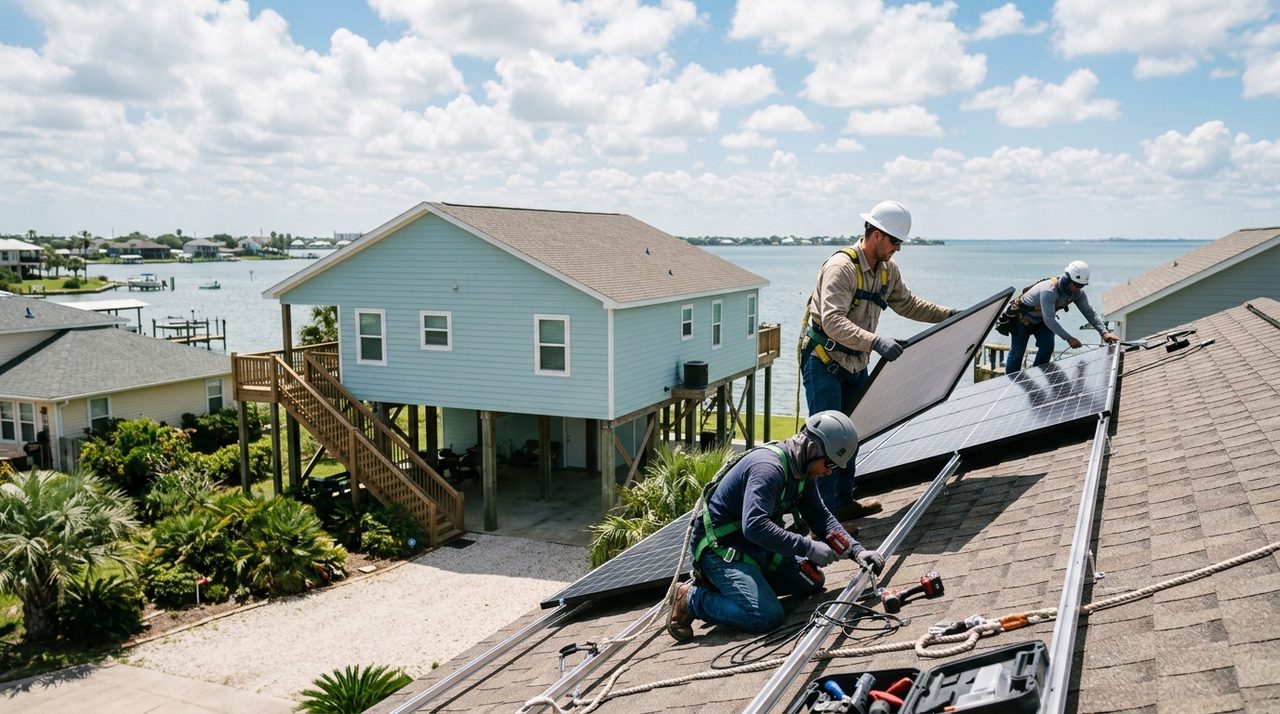
League City sits in Galveston County within ASCE 7 Wind Zone D, where design wind speeds reach 130–140 mph at grade. Post-Harvey and post-Beryl inspections across the SE Houston coast documented rail attachments that were under-torqued or improperly flashed, allowing panels to lift and breach the roof deck. Homes in Bay Colony and South Shore Harbour — many built on relatively open lots with little tree buffering — face unobstructed wind fetch from Galveston Bay, making this a genuine structural issue rather than a marketing talking point.
What a good pro does
Require your installer to provide documentation showing the racking system is engineered and listed to the wind speed in your League City permit jurisdiction's adopted code — the City of League City Building & Permits Division enforces wind-resistant construction standards as part of its local code adoption. Ask specifically for the racking manufacturer's tested uplift values at the fastener pattern proposed for your roof, and confirm the master electrician pulling the permit is coordinating with the structural attachment plan, not treating them as separate scopes. TWIA policyholders should also verify that wind-rated hardware documentation is on file, as TWIA can require it for coverage continuity.
Sources: Texas Windstorm Insurance Association (TWIA), International Residential Code (as adopted by City of Houston), Municipal permit office (see area profile)
Why it matters to you
The majority of League City's post-1990s growth happened inside master-planned subdivisions — Tuscan Lakes, Victory Lakes, Magnolia Creek, and others — that carry mandatory HOAs with architectural review committees. Texas Property Code §202.010 protects your right to install solar but explicitly permits HOAs to require placement that keeps panels 'not visible from the street,' which in practice forces arrays onto north or east rear slopes. In League City's typical east–west street grid, a rear-facing placement mandate can reduce annual production 15–25% compared to the south-facing orientation your installer quoted.
What a good pro does
Before executing a contract, pull the Declaration of Covenants for your subdivision from the Galveston County Clerk's records and identify the exact visibility language — not all League City HOAs phrase it identically. Submit a shading and production comparison showing the HOA committee the output difference between placement options; some committees will approve a slightly street-visible south-facing row if the homeowner documents the energy loss from alternatives. Build at least four to six weeks of HOA review time into your project schedule before the City of League City permit application even begins, since the city's Building & Permits Division will not approve exterior work that violates recorded deed restrictions.
Sources: Local HOA / deed restrictions (see area profile), Municipal permit office (see area profile)
Why it matters to you
League City's median home was built around 2002, which means the original 3-tab asphalt shingles on a large share of Tuscan Lakes, Bay Colony, and Victory Lakes homes are now 20-plus years old — at or past their effective life under Houston's combination of 95°F heat, 90%-plus summer humidity, and UV index averaging 10–11. An installer who mounts a 25-year panel array on a roof with five to eight years of remaining life is setting up a homeowner for an $8,000–$14,000 remove-and-reinstall bill when the re-roof comes due, a cost almost never surfaced in the initial proposal.
What a good pro does
Before permitting, request that your installer perform or commission an independent roof inspection — not the three-minute walkover a sales rep does, but a documented assessment with approximate remaining shingle life. If the inspection finds fewer than ten years of life remaining, price a full re-roof into the project scope upfront; some League City roofing contractors coordinate directly with solar installers on sequenced installs that add minimal cost compared to a later panel pull. The City of League City permit process will flag structural concerns during inspection, but it does not evaluate shingle age — that due diligence falls entirely on the homeowner and installer.
Sources: International Residential Code (as adopted by City of Houston), Municipal permit office (see area profile), ENERGY STAR / U.S. Dept. of Energy
Why it matters to you
Winter Storm Uri and subsequent Beryl-related outages in Galveston County have made battery backup a priority for many League City homeowners. However, the older 1960s–1980s homes near historic downtown League City commonly have 100–150 amp electrical panels that cannot accommodate a Tesla Powerwall or Enphase IQ Battery without a full panel upgrade first. Even in newer subdivisions with 200-amp panels, CenterPoint's interconnection tariff for storage-paired systems requires a separate metering application that adds six to ten weeks to the overall project timeline — meaning a battery quoted for summer installation may not be energized until fall.
What a good pro does
Ask your installer to pull your actual CenterPoint account's historical usage data — not national averages — to size both the array and battery for League City's roughly 3,000 annual cooling degree days and the realistic load profile of your specific home. Confirm in writing whether your panel is rated for battery integration before signing; if a panel upgrade is needed, it requires its own City of League City electrical permit and inspection, and that timeline should be built into the project schedule, not treated as a surprise add-on. All electrical work must be pulled by a TDLR-licensed master electrician and inspected by the City of League City's code enforcement division before the system can be energized.
Sources: Texas Department of Licensing & Regulation, Municipal permit office (see area profile), North American Board of Certified Energy Practitioners (NABCEP)
Hiring solar installers in League City? League City is one of the largest and fastest-growing cities in Galveston County, with housing stock spanning from 1960s-era originals near the historic downtown to expansive master-planned communities built from the 1990s through today. Homeowners here contend with coastal humidity, salt air corrosion, and proximity to Clear Creek and Dickinson Bayou watersheds. The city manages its own permitting and code enforcement, making it distinct from unincorporated Galveston County areas.
Building era
1960s–2020s, with the majority of residential growth occurring from the 1990s onward in master-planned subdivisions.
Typical style
Single-story and two-story suburban tract homes in newer subdivisions (Bay Colony, South Shore Harbour, Tuscan Lakes, Victory Lakes); older ranch-style and traditional homes near historic League City downtown.
Foundations
Predominantly slab-on-grade across all eras.
Common systems
Newer homes (2000s+) feature high-efficiency central HVAC, PEX or CPVC plumbing, and 200-amp electrical panels. Older 1960s–1980s homes may have original copper or galvanized plumbing, R-22 refrigerant HVAC systems, and 100–150 amp panels.
What that means for repairs
Older homes near downtown League City commonly undergo full HVAC replacement, plumbing re-pipes, and kitchen/bath remodels. Newer master-planned communities see cosmetic upgrades, fence replacements, and outdoor living additions. Coastal proximity drives demand for exterior paint, siding repair, and roof maintenance due to salt air and wind.
Permit jurisdiction
City of League City Building & Permits Division (300 W. Walker St., League City, TX 77573). League City is a fully incorporated municipality with its own permitting, inspections, and code enforcement — not governed by Galveston County engineering or the Houston Permitting Center.
HOA & deed restrictions
Most newer subdivisions (Bay Colony, South Shore Harbour, Tuscan Lakes, Victory Lakes, Magnolia Creek, etc.) have mandatory HOAs with architectural review committees. The City of League City maintains an HOA Alliance program facilitating communication between the city and neighborhood HOAs. Older areas near downtown may lack mandatory HOAs and rely on deed restrictions or voluntary civic organizations. Specific HOA names vary by subdivision — not confirmed for all areas; check Galveston County Clerk records.
Historic districts
No City of Houston historic district designation confirmed. League City has its own local historic preservation efforts centered around the original townsite near Main Street, but these are governed by the City of League City, not HAHC.
Contractor note
Contractors must obtain permits through the City of League City and comply with local building codes, which incorporate wind-resistant construction standards due to coastal proximity. Many HOAs require architectural review committee approval before exterior modifications begin.
FEMA flood zone
FEMA Zone X (low flood risk) — source: fema_nfhl. However, portions of League City near Clear Creek, Dickinson Bayou, and their tributaries fall within higher-risk flood zones (A and AE). Homeowners should verify their specific parcel, as flood risk varies significantly across this geographically large city.
Hurricane Harvey impact
Hurricane Harvey (2017) brought significant flooding to portions of League City, particularly along Clear Creek and in low-lying areas near Dickinson Bayou. South Shore Harbour, parts of Bay Colony, and neighborhoods adjacent to waterways experienced notable flooding. The city saw widespread damage, though many newer elevated-pad subdivisions fared better. Specific impact varied block by block — homeowners should check individual property flood history through Galveston County and FEMA records.
Heat & humidity load
League City's coastal location brings extreme humidity, salt air exposure, and Gulf storm risk from June through November. HVAC systems run heavily from May to October, driving demand for annual maintenance, refrigerant checks, and ductwork inspections. Exterior materials — especially metal fixtures, fasteners, and painted surfaces — degrade faster due to salt air corrosion. Roofing inspections are critical given wind exposure from tropical weather systems.
Working with contractors here
Contractors in League City most commonly handle HVAC servicing and replacement, roof repair and replacement (especially after storm seasons), and plumbing work ranging from re-pipes in older homes to fixture upgrades in newer builds. The wide range of housing ages means contractors must be prepared for both modern systems in 2010s-era homes and aging infrastructure in 1960s–1980s properties near downtown. Exterior work — painting, siding repair, fence replacement, and window sealing — is in constant demand due to salt air and humidity. Many jobs in master-planned communities require HOA architectural approval before work begins, so contractors should build pre-approval timelines into project scoping. Wind-rated materials and proper hurricane strap installation are important selling points for roofing and structural contractors given the coastal wind exposure.
Local Tip
Always ask for a written estimate before work begins. Texas contractors are required to provide one on jobs over $1,000.
League City is one of the largest and fastest-growing cities in Galveston County, with housing stock spanning from 1960s-era originals near the historic downtown to expansive master-planned communities built from the 1990s through today. Homeowners here contend with coastal humidity, salt air corrosion, and proximity to Clear Creek and Dickinson Bayou watersheds. The city manages its own permitting and code enforcement, making it distinct from unincorporated Galveston County areas.
Source: U.S. Census Bureau, ACS 5-Year 2023
Most of League City maps to FEMA Zone X (low mapped flood risk), but Houston's flash-flood reality means even low-risk blocks benefit from smart drainage and storm-hardened installs; risk climbs sharply on blocks nearest Clear Creek and Galveston Bay, where it varies parcel to parcel.
Source: FEMA National Flood Hazard Layer (NFHL). Flood zones vary by parcel — verify your individual FIRM panel.
Wind damage, not flooding, is the primary hurricane threat for solar systems in lower-risk League City, TX, so prioritize a pre-season inspection confirming your racking's hurricane-rated uplift capacity meets the local design wind speed in the City of Houston building code. Loose or improperly torqued rail clamps were a leading cause of panel loss across the metro after Beryl 2024's sustained tropical-force winds. Confirm the current FEMA panel for your League City parcel — the area maps to Zone X, but adjacent lots can differ.
Hail damage to solar panels in League City, TX is often invisible from the ground but detectable through performance monitoring — if your system's daily output drops noticeably after a storm, that is a signal to request a licensed inspection before the damage compounds. Cracked panel glass also creates a ground-fault risk that your inverter's built-in GFCI may flag as an error code. As a Galveston County community, League City may follow county rather than City of Houston storm rebuild rules.
Ice accumulation temporarily cuts solar panel output in League City, TX, but the larger freeze-related risk for solar homeowners is an inverter or battery enclosure mounted in an uninsulated garage or attic space exposed to sub-freezing temperatures — equipment manufacturers specify minimum operating temperatures, and falling below them can cause shutdowns or permanent damage. Ask your installer to confirm all system components are within their rated temperature range before the next hard freeze. Because League City drains toward Clear Creek and Galveston Bay, block-level runoff can differ sharply from the mapped zone.
Sources: FEMA National Flood Hazard Layer (NFHL), Ready.gov -- Hurricanes, CenterPoint Energy -- Storm Center, City of Houston -- Emergency Preparedness, Ready.gov -- Winter Weather, Harris County Flood Control District
Houston-specific estimators to plan your project before you call a pro. All results are planning estimates — a licensed local pro confirms the details on site.
Disconnect & drain every outdoor hose bib
Remove hoses, drain the spigots, and cover each with an insulated faucet sock. Un-drained hose bibs are the #1 burst point in a Houston freeze.
Insulate exposed pipes in the attic & garage
Wrap any pipe in an unconditioned space (attic runs, garage walls) with foam sleeves. Houston homes rarely insulate these because they only matter a few nights a year — which is exactly why they burst.
Open cabinet doors & keep a pencil-width drip
On hard-freeze nights, open kitchen/bath cabinets so warm air reaches the pipes and let faucets on exterior walls drip to relieve pressure.
Protect the attic/garage water heater & its lines
An attic or garage tank sits in unconditioned space. Insulate the cold-inlet and hot-outlet lines and confirm the emergency drain pan is clear so a leak doesn't reach the ceiling.
This is a planning estimate only — actual requirements depend on an on-site assessment by a licensed Houston pro. If a pipe has already burst, shut off your main water supply and call a licensed Houston plumber immediately — freeze bursts flood fast.
Sources: Municipal permit office (see area profile)Texas Department of Licensing & Regulation
Sources: Municipal permit office (see area profile)Texas Department of Licensing & Regulation
Sources: North American Board of Certified Energy Practitioners (NABCEP)
Sources: Texas Windstorm Insurance Association (TWIA)Municipal permit office (see area profile)