Closed
1001 Sue Dr, Kemah, TX 77565
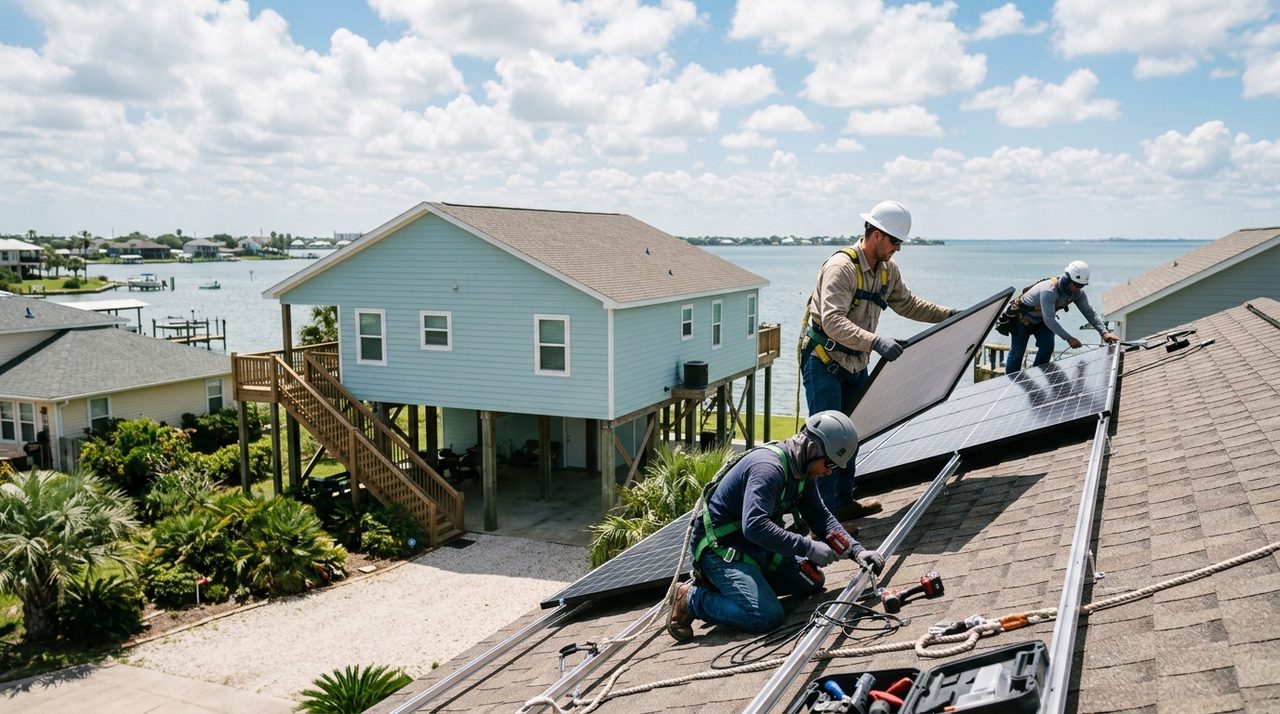
Kemah's bayfront location on Galveston Bay puts solar-ready homes squarely in FEMA Zone AE, where elevated pier-and-beam construction, relentless salt air, and Gulf wind exposure create installation challenges that simply don't exist ten miles inland. With a median year built of 1995 and a mix of raised coastal cottages, 1990s waterfront rebuilds, and newer marina townhomes, Kemah homeowners weighing solar need to think through corrosion-resistant hardware, TWIA insurance documentation, and City of Kemah permit requirements before a single panel goes on the roof.
Ranked by verified Google rating × review volume × verification tier. How we rank →
Some highly-rated pros serve Kemah from nearby and may not keep a Kemah street address. Those are listed under "Also serving Kemah" with their real city and distance, so you always know where each business is based.
1001 Sue Dr, Kemah, TX 77565
Highly-rated pros based nearby who cover Kemah. Distance shown from the Kemah area.
Serving Kemah Based in League City · 2.7 mi away
Serving Kemah Based in League City · 2.7 mi away
Serving Kemah Based in League City · 2.7 mi away
Serving Kemah Based in Webster · 5.6 mi away
Serving Kemah Based in League City · 6.3 mi away
Why it matters to you
Kemah sits directly on Galveston Bay in a TWIA-eligible coastal zone where design wind speeds reach 130–140 mph under ASCE 7. Post-Harvey and post-Beryl inspections across Galveston County found that improperly torqued rail attachments allowed panels to lift and breach roof decks — a catastrophic outcome on Kemah's narrow waterfront lots where a dislodged panel can land in a canal or on an adjacent structure. If your installer cannot produce stamped wind-rated racking documentation, TWIA may deny or reduce your hurricane claim.
What a good pro does
A qualified installer in Kemah must specify racking systems with manufacturer wind-uplift ratings that meet or exceed the local ASCE 7 design speed, submit stamped engineering drawings to the City of Kemah's building department, and provide TWIA-compliant hardware documentation before the system is energized. Verify the installer holds a current TDLR Electrical Contractor license and carries NABCEP PV Installation Professional certification, which ensures familiarity with coastal structural requirements.
Sources: Texas Windstorm Insurance Association (TWIA), Texas Department of Licensing & Regulation, North American Board of Certified Energy Practitioners (NABCEP)
Why it matters to you
Kemah's proximity to Galveston Bay means airborne chlorides attack metal components year-round — a reality confirmed by the salt-air corrosion already documented on HVAC condensers and exterior electrical fixtures throughout the city's 1990s–2000s waterfront housing stock. Standard mill-finish aluminum rails and uncoated steel hardware that perform adequately in Sugar Land or Katy can begin pitting and losing structural integrity within three to five years on a Kemah roofline, creating both a safety risk and a warranty dispute between the racking manufacturer and the homeowner.
What a good pro does
Insist on anodized or powder-coated aluminum racking, marine-grade stainless steel lag bolts, and module frames rated for coastal salt-fog exposure per IEC 61701. A good installer will also apply dielectric anti-corrosion compound at every dissimilar-metal junction and specify conduit fittings rated for wet, salty environments. Ask the installer to show product datasheets confirming salt-fog certification before signing a contract.
Sources: International Residential Code (as adopted by City of Houston), Municipal permit office (see area profile)
Why it matters to you
A large share of Kemah's homes received emergency roof repairs after Harvey (2017) and again after Beryl (2024), often using budget shingles installed under time pressure. Houston-area UV index averages 10–11 and 95°F summer heat degrade those materials in 12–15 years rather than the rated 20–25, meaning a Kemah homeowner who accepted a quick post-storm patch could be facing shingle failure well before a 25-year solar panel array reaches mid-life. Mounting a system on a compromised roof creates an $8,000–$14,000 remove-and-reinstall cost that most installers do not disclose upfront.
What a good pro does
Before any array goes up, a responsible installer performs a documented roof inspection and requests permit history from the City of Kemah's building department to identify post-storm repair dates and materials used. If shingles are within five years of end-of-life, the correct sequence is re-roof first — preferably with impact-rated, wind-rated material appropriate for a coastal AE zone — then install solar. Some Kemah installers can coordinate both scopes under a single City of Kemah permit pull, reducing scheduling gaps and ensuring the roof warranty and solar warranty are aligned.
Sources: Municipal permit office (see area profile), International Residential Code (as adopted by City of Houston), FEMA National Flood Hazard Layer (NFHL)
Why it matters to you
Kemah is an independent incorporated city with its own building department — permits are pulled through City of Kemah, not Houston, Harris County, or Galveston County. Post-Uri demand for battery backup (Tesla Powerwall, Enphase IQ Battery) is high in Kemah, where grid outages during tropical systems can stretch several days. However, CenterPoint Energy's interconnection tariff for storage-paired systems requires a separate metering application that adds six to ten weeks to a project timeline, and the City of Kemah's AHJ has its own rules on battery enclosure fire separation that installers unfamiliar with coastal municipal codes sometimes miss.
What a good pro does
Confirm your installer has pulled permits specifically through the City of Kemah before — not just through Houston or Harris County — and has submitted a CenterPoint interconnection application for a storage-coupled system in this utility territory. All electrical work must be permitted by a TDLR-licensed master electrician. If your home is a 1990s or earlier cottage with an original electrical panel, budget for a 200-amp panel upgrade as a prerequisite to battery integration; the City of Kemah inspector will flag an undersized service before approving the final interconnection.
Sources: Municipal permit office (see area profile), Texas Department of Licensing & Regulation, FEMA National Flood Hazard Layer (NFHL)
Hiring solar installers in Kemah? Kemah is a small incorporated city on Galveston Bay with a mix of original bay cottages, 1990s–2000s waterfront redevelopment, and newer elevated townhome/marina communities. Homeowners here face persistent challenges from storm surge exposure, salt-air corrosion, and FEMA floodplain compliance requirements. Contractors working in Kemah must be familiar with elevated foundation systems, coastal building codes, and the City of Kemah's own permitting process.
Building era
Mixed: pre-1960s original cottages, 1970s–1980s infill, significant 1990s–2000s waterfront redevelopment, and post-2008 elevated infill.
Typical style
Coastal raised beach-house style (pier-supported with elevated living areas), traditional suburban SFRs (brick veneer or siding), and townhome/condo marina-oriented developments with stucco or fiber-cement siding.
Foundations
Mixed — pier-and-beam/elevated pile foundations dominate along the bayfront and canal-adjacent properties; slab-on-grade more common in interior and newer suburban pockets.
Common systems
Older cottages may have original copper or galvanized plumbing and outdated electrical panels; 1990s–2000s homes typically feature central HVAC, PVC/CPVC plumbing, and 200-amp electrical service. Salt-air exposure accelerates corrosion on HVAC condensers, metal roofing components, and exterior electrical fixtures across all eras.
What that means for repairs
Most common renovation activity includes elevating older homes to meet current FEMA BFE requirements, replacing storm-damaged structures with new elevated construction, upgrading HVAC and exterior materials to salt-air-resistant alternatives, and converting or remodeling ground-level areas beneath raised homes for parking or storage.
Permit jurisdiction
City of Kemah (independent incorporated city with its own municipal government and building department).
HOA & deed restrictions
No city-wide mandatory HOA or master association. HOAs are present in specific newer townhome, condo, and marina developments on a project-by-project basis. Older platted areas (e.g., original Kemah Townsite) generally have no organized HOA. Voluntary civic clubs may exist in some pockets but are not confirmed. Deed restrictions vary by subdivision — check Galveston County Clerk records for specific parcels.
Historic districts
No City of Houston historic district designation confirmed. Kemah is an independent incorporated city; no HAHC jurisdiction applies. No locally designated historic districts confirmed in current city records.
Contractor note
Contractors must pull permits through the City of Kemah, not Houston or Galveston County. Coastal AE zone requirements often mandate elevation certificates, flood-resistant materials below BFE, and compliance with FEMA substantial improvement/damage rules for renovations exceeding 50% of the structure's market value.
FEMA flood zone
FEMA Zone AE (high flood risk) — source: fema_nfhl. Kemah sits directly on Galveston Bay and is exposed to both storm surge and tidal flooding. Much of the city falls within AE and potentially VE (velocity) zones along the immediate shoreline. Proximity to Clear Creek and Galveston Bay amplifies flood risk during tropical weather events.
Hurricane Harvey impact
Kemah experienced flooding during Hurricane Harvey (2017) from a combination of extreme rainfall and storm surge/tidal influence from Galveston Bay. Specific damage data for Kemah was not itemized separately from broader Galveston County FEMA reports, but the bayfront location and low elevation made the area vulnerable to both surge-driven and rain-driven flooding. Many older, non-elevated homes in the area sustained water damage. Post-Harvey, elevated construction and stricter floodplain compliance have become more prevalent.
Heat & humidity load
Extreme humidity and sustained heat along Galveston Bay push HVAC systems hard from May through October. Salt-laden coastal air accelerates corrosion on condenser coils, ductwork fasteners, and exterior metal components. Pier-and-beam homes benefit from under-house ventilation but require regular inspection for moisture damage, mold, and pest intrusion during the humid season.
Working with contractors here
Contractors in Kemah most frequently handle foundation elevation projects, HVAC replacement with salt-air-resistant units, and exterior envelope repairs caused by coastal weather exposure. Roof replacements are common after storm events, with wind-rated materials and proper tie-downs critical given the bayfront exposure. Plumbing work in older cottages often involves full re-pipes from galvanized to modern materials. Job scoping must account for FEMA elevation requirements — any substantial improvement to a structure in the AE zone requires bringing the entire building into current floodplain compliance, which can dramatically expand project scope and cost. Access can be tight on narrow waterfront lots, and contractors should verify whether the specific property falls under a project-level HOA with architectural review requirements before beginning exterior work.
Local Tip
Always ask for a written estimate before work begins. Texas contractors are required to provide one on jobs over $1,000.
Kemah is a small incorporated city on Galveston Bay with a mix of original bay cottages, 1990s–2000s waterfront redevelopment, and newer elevated townhome/marina communities. Homeowners here face persistent challenges from storm surge exposure, salt-air corrosion, and FEMA floodplain compliance requirements. Contractors working in Kemah must be familiar with elevated foundation systems, coastal building codes, and the City of Kemah's own permitting process.
Source: U.S. Census Bureau, ACS 5-Year 2023
Much of Kemah maps to FEMA Zone AE (high flood risk), so flood-resilient detailing -- elevated equipment, water-tolerant materials, and drainage-first thinking -- is essential here, not optional; risk climbs sharply on blocks nearest Galveston Bay, where it varies parcel to parcel.
Source: FEMA National Flood Hazard Layer (NFHL). Flood zones vary by parcel — verify your individual FIRM panel.
Coastal Kemah, TX sits in FEMA surge zones where wind and saltwater spray work together to degrade solar racking hardware, so specify stainless-steel or marine-grade aluminum mounting components rated for salt-air exposure when your system is installed or upgraded. After Beryl 2024 demonstrated surge reach along Galveston Bay, confirm your inverter and battery enclosures are elevated well above the mapped surge inundation level for your specific parcel. Confirm the current FEMA panel for your Kemah parcel — the area maps to Zone AE, but adjacent lots can differ.
High-velocity wind rating is especially critical in Kemah, TX because coastal exposure means panels and racking see elevated sustained winds even in non-tropical severe thunderstorm events; verify your installer used a mounting system with an independent wind-load certification, not just the panel manufacturer's standard specification. A post-storm torque audit of all rail clamps and roof attachments should be standard practice after any derecho-level event. As a Galveston County community, Kemah may follow county rather than City of Houston storm rebuild rules.
Ice on solar panels in Kemah, TX typically melts faster than inland due to the moderating influence of the bay, but a sustained hard freeze can still temporarily cut output to near zero; the practical preparation step is ensuring your battery is at full charge before a forecast freeze arrives, which you can do manually through your inverter's app interface or by asking your licensed installer to set an automatic charge-to-full schedule. Post-freeze, inspect racking hardware for any movement caused by thermal contraction, which can loosen fasteners on coastal installations more quickly than in sheltered inland locations. Because Kemah drains toward Galveston Bay, block-level runoff can differ sharply from the mapped zone.
Sources: FEMA National Flood Hazard Layer (NFHL), Ready.gov -- Hurricanes, CenterPoint Energy -- Storm Center, City of Houston -- Emergency Preparedness, Ready.gov -- Winter Weather, Harris County Flood Control District
Houston-specific estimators to plan your project before you call a pro. All results are planning estimates — a licensed local pro confirms the details on site.
Disconnect & drain every outdoor hose bib
Remove hoses, drain the spigots, and cover each with an insulated faucet sock. Un-drained hose bibs are the #1 burst point in a Houston freeze.
Insulate exposed pipes in the attic & garage
Wrap any pipe in an unconditioned space (attic runs, garage walls) with foam sleeves. Houston homes rarely insulate these because they only matter a few nights a year — which is exactly why they burst.
Open cabinet doors & keep a pencil-width drip
On hard-freeze nights, open kitchen/bath cabinets so warm air reaches the pipes and let faucets on exterior walls drip to relieve pressure.
Protect the attic/garage water heater & its lines
An attic or garage tank sits in unconditioned space. Insulate the cold-inlet and hot-outlet lines and confirm the emergency drain pan is clear so a leak doesn't reach the ceiling.
This is a planning estimate only — actual requirements depend on an on-site assessment by a licensed Houston pro. If a pipe has already burst, shut off your main water supply and call a licensed Houston plumber immediately — freeze bursts flood fast.
Sources: Municipal permit office (see area profile)Texas Department of Licensing & Regulation
Sources: International Residential Code (as adopted by City of Houston)Texas Windstorm Insurance Association (TWIA)
Sources: Texas Windstorm Insurance Association (TWIA)Municipal permit office (see area profile)
Sources: FEMA National Flood Hazard Layer (NFHL)International Residential Code (as adopted by City of Houston)
Sources: Municipal permit office (see area profile)
Sources: ENERGY STAR / U.S. Dept. of Energy