Closed
Serving Seabrook Based in Kemah · 2.5 mi away
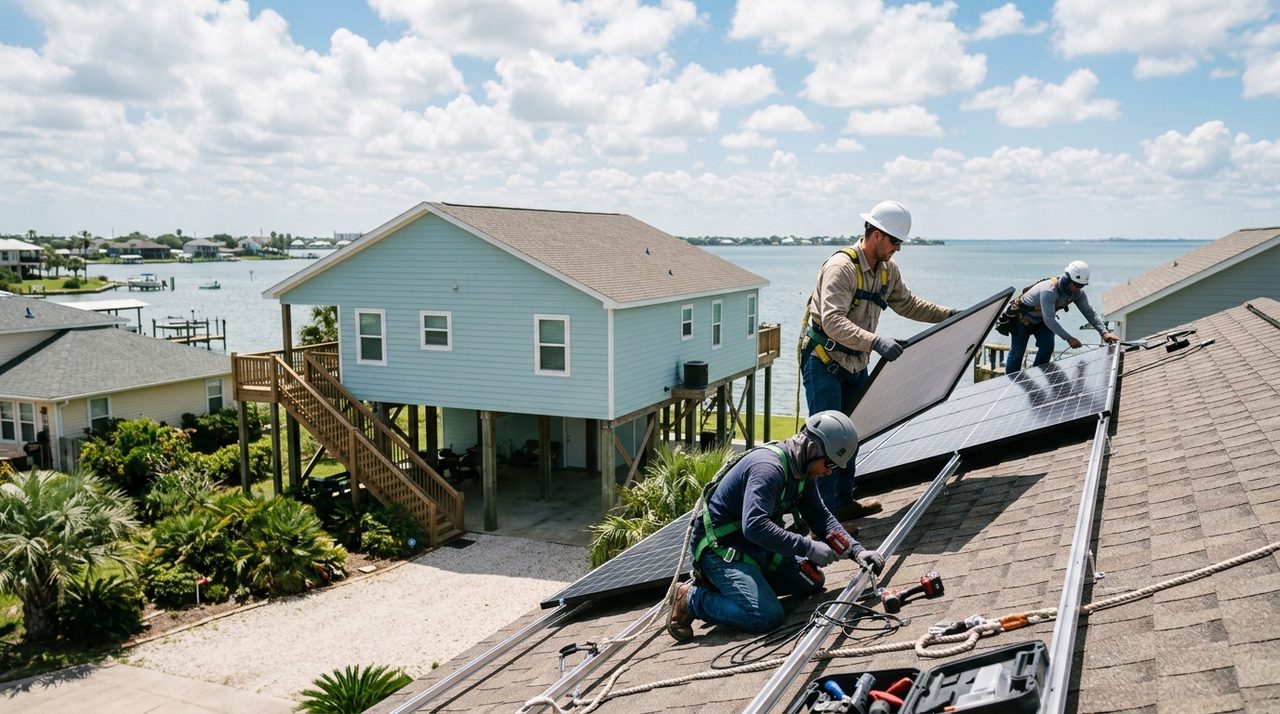
Seabrook's position on Galveston Bay — FEMA Zone AE, salt air, and Gulf-facing wind exposure — makes solar installation a more consequential decision than in inland Houston suburbs. With housing ranging from 1960s waterfront cottages on pier-and-pile foundations to 2000s slab-on-grade subdivisions, every roof age, structural condition, and HOA situation here is genuinely different, and the City of Seabrook's own permit office (not Houston Permitting Center) controls your timeline. Read this before signing any installer contract.
Ranked by verified Google rating × review volume × verification tier. How we rank →
Some highly-rated pros serve Seabrook from nearby and may not keep a Seabrook street address. Those are listed under "Also serving Seabrook" with their real city and distance, so you always know where each business is based.
Highly-rated pros based nearby who cover Seabrook. Distance shown from the Seabrook area.
Serving Seabrook Based in Kemah · 2.5 mi away
Serving Seabrook Based in League City · 2.8 mi away
Serving Seabrook Based in League City · 2.8 mi away
Serving Seabrook Based in League City · 2.8 mi away
Serving Seabrook Based in Webster · 5.6 mi away
Serving Seabrook Based in League City · 7 mi away
Serving Seabrook Based in Webster · 9.4 mi away
Why it matters to you
Seabrook sits squarely in ASCE 7 Wind Zone D, where design wind speeds reach 130–140 mph, and Galveston Bay-facing and canal-front homes absorb salt-laden air year-round. Post-Harvey and post-Beryl inspections across coastal Harris County found improperly flashed rail attachments that failed under storm uplift — and standard aluminum racking hardware used inland corrodes measurably faster here, loosening torque over 3–5 years in ways that aren't visible until a storm event. For the roughly 35% of Seabrook homes in waterfront or canal-adjacent blocks, this is not a theoretical risk.
What a good pro does
Demand that your installer specifies stainless-steel or marine-grade anodized hardware at every rail-to-roof penetration and roof-to-rafter lag point, and ask for written documentation that the racking system is rated to the local design wind speed. Because Seabrook is in coastal Harris County, TWIA-backed homeowners should also verify that their insurer requires wind-rated hardware documentation — losing TWIA eligibility over non-compliant solar hardware is a real exposure. All permitted work must go through the City of Seabrook Building/Permits Department, not Houston Permitting Center.
Sources: Texas Windstorm Insurance Association (TWIA), Municipal permit office (see area profile), International Residential Code (as adopted by City of Houston)
Why it matters to you
With a Census median year built of 1991, a significant share of Seabrook's production suburban homes are carrying original or Harvey-replacement shingles that are now 12–25 years old. Houston's UV index (averaging 10–11 in summer) and 90%+ summer humidity degrade standard 3-tab shingles in 12–15 years rather than the rated 20–25, and many Seabrook homes that received emergency re-roofs after Harvey in 2017–2019 had budget materials installed under insurance pressure that are already showing wear. Mounting a 25-year panel array on a roof that needs replacement in 5 years means a $9,000–$14,000 remove-and-reinstall bill the installer is unlikely to mention.
What a good pro does
Before any solar contract is signed, commission an independent roofing inspection — not the solar installer's in-house walkthrough — to assess remaining shingle life. If the roof has fewer than 10 years of estimated life, replace it first; most quality installers will coordinate the sequencing and can adjust racking specs to the new material. The City of Seabrook issues separate roofing and electrical/solar permits, so both scopes can run concurrently to minimize delays.
Sources: Municipal permit office (see area profile), International Residential Code (as adopted by City of Houston)
Why it matters to you
Seabrook's bayfront humidity and heat island effect mean HVAC systems run harder and longer than in comparable inland suburbs — a typical 2,200 sq ft home here can draw 1,500–1,800 kWh per month from June through September. Installers who use national average consumption figures routinely quote systems that offset only 40–50% of actual annual load instead of the 80–100% homeowners expect. Older Seabrook homes with 1980s-era single-pane windows, aging insulation, and original ductwork compound the problem, because poor building envelope efficiency is a load the solar array has to carry.
What a good pro does
A reputable installer will pull your last 24 months of CenterPoint Energy usage data before sizing — this is standard practice and not an upsell. Ask to see the production model inputs and compare them against your actual bills. If your home pre-dates 1995, seriously consider air-sealing and attic insulation improvements before finalizing array size; reducing your base load by even 15% can let you right-size the system and reduce gross cost before the 30% federal Investment Tax Credit applies.
Sources: ENERGY STAR / U.S. Dept. of Energy, Texas Department of Licensing & Regulation
Why it matters to you
Seabrook has approximately 16 registered HOA and condo communities — including Lake Cove Community Association, Seascape POA, Seabrook Island HOA, and Searidge — with architectural review processes that vary meaningfully from one subdivision to the next. Texas Property Code §202.010 protects your right to install solar, but it explicitly allows HOAs to require placement that keeps panels 'not visible from the street.' In Seabrook's canal-front and bay-view neighborhoods, where homes often front both a street and a waterway, 'not visible from the street' can push arrays to east- or north-facing slopes that reduce annual production by 15–25% compared to optimal south-facing orientation.
What a good pro does
Request your subdivision's current Architectural Review Committee (ARC) guidelines before selecting an installer or finalizing array layout — some Seabrook POAs have specific submittal forms and 30–45 day review windows that will affect your project schedule. A good installer will submit the ARC application in parallel with the City of Seabrook permit application so the two approval tracks run concurrently rather than sequentially. If HOA placement constraints force a sub-optimal orientation, ask your installer to model the production loss explicitly so you can make an informed decision about system size.
Sources: Local HOA / deed restrictions (see area profile), Municipal permit office (see area profile)
Hiring solar installers in Seabrook? Seabrook is an incorporated city on Galveston Bay with housing ranging from 1960s waterfront homes to 2000s subdivision development, creating a wide spectrum of home service needs. The coastal location and FEMA AE flood zone designation mean that flood mitigation, elevation considerations, and storm-hardening are central to nearly every major home project. Homeowners should expect subdivision-level HOA requirements that vary block by block and plan for salt-air corrosion on exterior systems.
Building era
1970s–2000s, with some 1960s waterfront homes and ongoing infill.
Typical style
Production suburban traditional (one- and two-story brick or brick-and-siding) with coastal/contemporary elevated homes along waterfront and canal-front areas.
Foundations
Mixed — predominantly slab-on-grade in newer subdivisions; pier-and-beam or pier-and-pile construction common in older waterfront and canal-front homes due to floodplain and storm-surge requirements.
Common systems
Central HVAC systems typical of 1980s–2000s construction (aging units in older homes); copper and CPVC plumbing in newer builds, galvanized possible in 1960s–1970s stock; standard 200-amp electrical panels in newer homes, potential 100-amp in older homes.
What that means for repairs
Flood damage repair and mitigation retrofits are common drivers of renovation activity. Waterfront homes frequently undergo elevation projects, foundation reinforcement, and storm-resistant window/door upgrades. Older homes often need full plumbing repipes and HVAC replacements due to age and salt-air corrosion.
Permit jurisdiction
City of Seabrook Building/Permits Department (incorporated city — not Houston Permitting Center or Harris County).
HOA & deed restrictions
Subdivision-by-subdivision. Many subdivisions have mandatory HOAs/POAs including Seabrook Island HOA, Lake Cove Community Association (managed by Goodwin & Company), Seascape POA, and Searidge. Approximately 16 HOA/condo communities are registered in Seabrook. Some older or fringe areas may have no active HOA but may still have recorded deed restrictions.
Historic districts
No City of Houston historic district designation confirmed. Seabrook is an independent incorporated city and not subject to HAHC oversight.
Contractor note
Contractors must pull permits through the City of Seabrook and should verify subdivision-specific HOA architectural review requirements before starting exterior work. Coastal building codes and floodplain management regulations apply and may require elevation certificates.
FEMA flood zone
FEMA Zone AE (high flood risk) — source: fema_nfhl. Seabrook sits directly on Galveston Bay and is subject to both riverine flooding and coastal storm surge, contributing to its very high hazard risk rating.
Hurricane Harvey impact
The Clear Lake/Bay area of southeast Harris County experienced significant flooding during Hurricane Harvey. Seabrook-specific community hazard data rates overall risk as 'Very High.' However, no publicly available subdivision-level or street-level Harvey flood-extent map for Seabrook was identified. Exact street-by-street impact should be verified through Harris County Flood Control District records and individual property seller's disclosures.
Heat & humidity load
Extreme humidity and salt-air proximity accelerate corrosion on HVAC condensers, metal roofing components, and exterior hardware. HVAC systems run at near-continuous capacity May through September, shortening equipment lifespan. Mold and moisture intrusion in slab-on-grade and pier-and-beam homes require proactive dehumidification and ventilation strategies.
Working with contractors here
Contractors working in Seabrook most commonly handle flood damage restoration, foundation repairs (especially on older pier-and-beam waterfront homes), and HVAC replacements accelerated by salt-air corrosion and heavy summer usage. Roofing and exterior siding projects require wind-rated materials compliant with coastal building codes, and many jobs trigger City of Seabrook floodplain management requirements including elevation certificates. The wide range of housing ages — from 1960s waterfront cottages to 2000s subdivision homes — means scoping should always begin with a thorough assessment of existing systems, as plumbing and electrical standards vary significantly across eras. HOA architectural review adds a layer of approval in many subdivisions, so contractors should confirm HOA requirements before beginning visible exterior modifications.
Local Tip
Always ask for a written estimate before work begins. Texas contractors are required to provide one on jobs over $1,000.
Seabrook is an incorporated city on Galveston Bay with housing ranging from 1960s waterfront homes to 2000s subdivision development, creating a wide spectrum of home service needs. The coastal location and FEMA AE flood zone designation mean that flood mitigation, elevation considerations, and storm-hardening are central to nearly every major home project. Homeowners should expect subdivision-level HOA requirements that vary block by block and plan for salt-air corrosion on exterior systems.
Source: U.S. Census Bureau, ACS 5-Year 2023
Much of Seabrook maps to FEMA Zone AE (high flood risk), so flood-resilient detailing -- elevated equipment, water-tolerant materials, and drainage-first thinking -- is essential here, not optional; risk climbs sharply on blocks nearest Galveston Bay, where it varies parcel to parcel.
Source: FEMA National Flood Hazard Layer (NFHL). Flood zones vary by parcel — verify your individual FIRM panel.
Battery backup systems installed in flood-prone Seabrook, TX should be mounted at least one foot above the Base Flood Elevation shown on FEMA Zone AE maps — ask your installer to relocate ground-level units now, before the next Harvey-scale event. A rapid-shutdown-compliant system also lets first responders safely de-energize your roof array if rising water forces evacuation. As a Harris County community, Seabrook may follow county rather than City of Houston storm rebuild rules.
The May 2024 derecho sent straight-line winds well above 80 mph across the Houston metro, and in Seabrook, TX where FEMA Zone AE inside the 100-year floodplain and proximity to Galveston Bay adds a secondary threat, even a brief hailstorm can crack panel tempered glass and allow water into the laminate — schedule a post-storm visual inspection with a TDLR-licensed solar technician after any hail event. Damaged panels that appear functional can develop hot spots that reduce output and, in rare cases, create a fire risk at the junction box. Because Seabrook drains toward Galveston Bay, block-level runoff can differ sharply from the mapped zone.
After Uri's extended blackout, homeowners with solar-plus-storage in Seabrook, TX who had pre-positioned their battery state of charge at 100 percent before the freeze arrived were able to run heat and refrigeration for 48 hours or more without grid support. Ask your licensed solar installer to walk you through the manual charge-management settings so you can maximize stored energy before a forecast hard freeze. Confirm the current FEMA panel for your Seabrook parcel — the area maps to Zone AE, but adjacent lots can differ.
Sources: FEMA National Flood Hazard Layer (NFHL), Ready.gov -- Hurricanes, CenterPoint Energy -- Storm Center, City of Houston -- Emergency Preparedness, Ready.gov -- Winter Weather, Harris County Flood Control District
Houston-specific estimators to plan your project before you call a pro. All results are planning estimates — a licensed local pro confirms the details on site.
Disconnect & drain every outdoor hose bib
Remove hoses, drain the spigots, and cover each with an insulated faucet sock. Un-drained hose bibs are the #1 burst point in a Houston freeze.
Insulate exposed pipes in the attic & garage
Wrap any pipe in an unconditioned space (attic runs, garage walls) with foam sleeves. Houston homes rarely insulate these because they only matter a few nights a year — which is exactly why they burst.
Open cabinet doors & keep a pencil-width drip
On hard-freeze nights, open kitchen/bath cabinets so warm air reaches the pipes and let faucets on exterior walls drip to relieve pressure.
Protect the attic/garage water heater & its lines
An attic or garage tank sits in unconditioned space. Insulate the cold-inlet and hot-outlet lines and confirm the emergency drain pan is clear so a leak doesn't reach the ceiling.
This is a planning estimate only — actual requirements depend on an on-site assessment by a licensed Houston pro. If a pipe has already burst, shut off your main water supply and call a licensed Houston plumber immediately — freeze bursts flood fast.
Sources: Municipal permit office (see area profile)
Sources: FEMA National Flood Hazard Layer (NFHL)Municipal permit office (see area profile)
Sources: Local HOA / deed restrictions (see area profile)
Sources: Municipal permit office (see area profile)FEMA National Flood Hazard Layer (NFHL)