Open Now
6410 I-45, La Marque, TX 77568
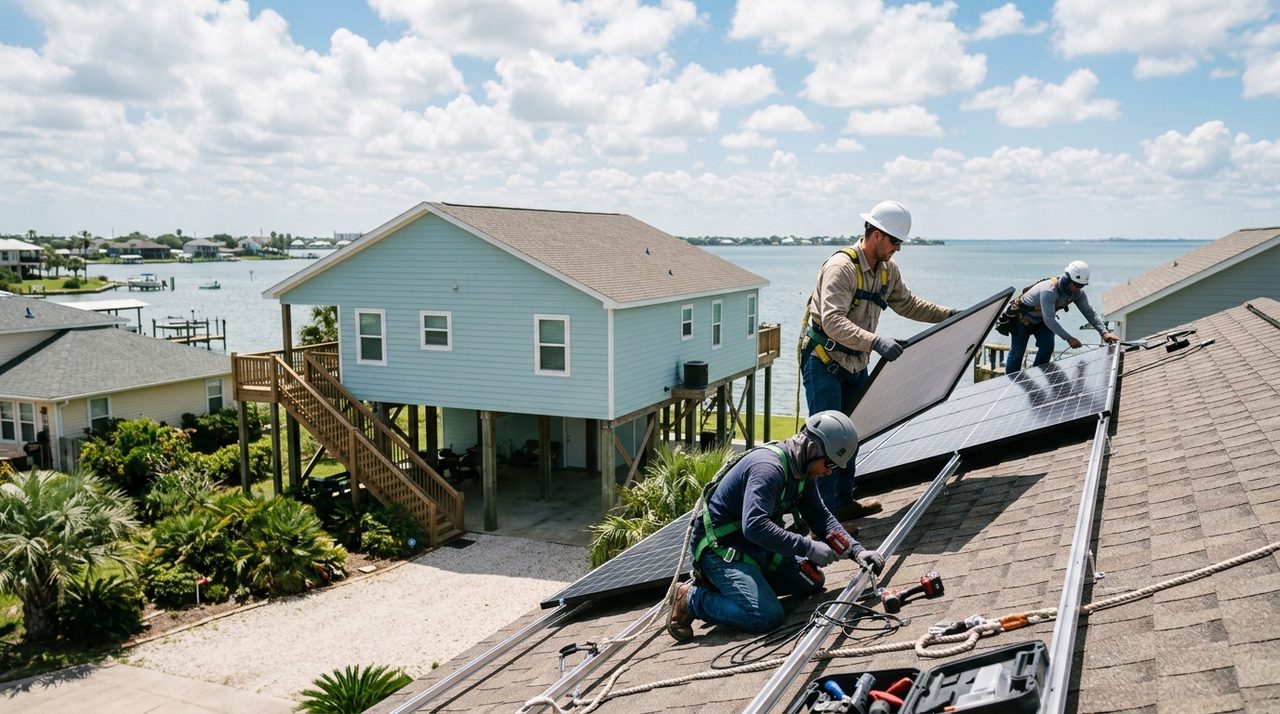
La Marque sits inside Galveston County just a few miles from the Gulf shoreline, meaning every solar installation here must contend simultaneously with ASCE 7 coastal wind uplift requirements, salt-air corrosion, and a housing stock whose median build year of 1978 spans mid-century frames in the city core through 2000s–2010s planned subdivisions like Borondo Pines and Painted Meadows. The City of La Marque runs its own permitting office independent of Harris County or Houston, and utility interconnection flows through CenterPoint — a combination that catches many regional installers off guard. Understanding these La Marque-specific realities before signing a contract can mean the difference between a system that performs for 25 years and one that creates costly headaches within five.
Ranked by verified Google rating × review volume × verification tier. How we rank →
Some highly-rated pros serve La Marque from nearby and may not keep a La Marque street address. Those are listed under "Also serving La Marque" with their real city and distance, so you always know where each business is based.
6410 I-45, La Marque, TX 77568
7805 Bayside Ave, Galveston, TX 77554
Highly-rated pros based nearby who cover La Marque. Distance shown from the La Marque area.
Serving La Marque Based in Texas City · 2.5 mi away
Serving La Marque Based in Santa Fe · 7.3 mi away
Serving La Marque Based in Dickinson · 7.5 mi away
Serving La Marque Based in League City · 8.9 mi away
Serving La Marque Based in League City · 9.2 mi away
Serving La Marque Based in Kemah · 9.5 mi away
Serving La Marque Based in League City · 9.7 mi away
Serving La Marque Based in Galveston · 9.8 mi away
Why it matters to you
As a Galveston County community just inland from the Gulf, La Marque falls squarely in ASCE 7 Wind Zone D with design wind speeds of 130–140 mph. Homeowners who carry Texas Windstorm Insurance Association (TWIA) policies — common in Galveston County — risk policy disputes or claims denials if panel racking and roof-attachment hardware cannot be documented as wind-rated, a gap exposed repeatedly in post-Harvey and post-Beryl inspections of coastal installations.
What a good pro does
A qualified installer working in La Marque should provide stamped engineering documentation for all racking hardware, verify flashing torque specs meet manufacturer requirements for coastal exposure, and supply the homeowner with a copy of the wind-rating certification to attach to their TWIA file before the system is energized. Permits are pulled through the City of La Marque, whose inspectors will flag inadequate structural submittals before approval.
Sources: Texas Windstorm Insurance Association (TWIA), International Residential Code (as adopted by City of Houston), Municipal permit office (see area profile)
Why it matters to you
A significant portion of La Marque's older city-core housing stock was built between the 1940s and 1970s with original or minimally updated electrical panels — 60-amp or 100-amp service boxes that predate modern solar interconnection requirements. Attempting to tie a grid-tied PV system or a Tesla Powerwall-equivalent battery directly into these panels violates code and creates real fire risk; homeowners are often surprised to learn the panel upgrade alone can add $3,000–$6,000 to project costs before a single panel goes on the roof.
What a good pro does
A legitimate Texas-licensed electrical contractor pulling permits through the City of La Marque will assess the existing service panel as part of the site survey and include any required upgrade in the written proposal rather than treating it as a change order after contract signing. Under TDLR rules, all electrical work on permitted solar installations must be performed or directly supervised by a licensed master electrician — verify this credential before work begins.
Sources: Texas Department of Licensing & Regulation, Municipal permit office (see area profile), International Residential Code (as adopted by City of Houston)
Why it matters to you
Newer planned subdivisions in La Marque — including Painted Meadows and Borondo Pines — have active mandatory HOAs with architectural review processes. Under Texas Property Code §202.010, these HOAs can legally require that panels not be visible from the street, which in practice often forces arrays onto rear or east-facing roof slopes. In La Marque's orientation patterns, that shift from optimal south-facing placement can reduce annual energy production by 15–25%, meaning the payback period extends by several years compared to what a generic installer's quote assumes.
What a good pro does
Before finalizing any array design in Painted Meadows or Borondo Pines, submit the layout to the HOA architectural committee for written approval — the City of La Marque does not enforce private HOA covenants, so permit approval and HOA approval are entirely separate steps. A good installer will model production estimates using the HOA-approved placement, not the theoretical best-case orientation, so the payback projections you sign off on reflect what the system will actually generate.
Sources: Local HOA / deed restrictions (see area profile), Municipal permit office (see area profile)
Why it matters to you
La Marque's location in Galveston County means many roofs were replaced under insurance claims after Hurricane Ike (2008) or Harvey (2017) using budget-tier materials installed quickly by storm-chasing crews. Houston-area UV index averaging 10–11 and coastal humidity degrade standard 3-tab shingles in 12–15 years rather than their rated 20–25 years; a home whose roof was emergency-patched in 2017 or 2018 with economy shingles may already be approaching end of useful life. Installing a 25-year panel array on that roof nearly guarantees a $8,000–$14,000 panel removal and reinstallation expense within five to eight years — a cost rarely disclosed upfront.
What a good pro does
Insist that any installer provide a written roof-age assessment as part of the site survey, referencing permit records from the City of La Marque or Galveston County to confirm the actual installation date of the current roofing material. If the roof has fewer than 10–12 years of remaining useful life, replacing it before panel installation — even if it adds $8,000–$18,000 to the project — is almost always the lower total-cost path over the system's lifetime.
Sources: Municipal permit office (see area profile), International Residential Code (as adopted by City of Houston), FEMA National Flood Hazard Layer (NFHL)
Hiring solar installers in La Marque? La Marque is an independent city in Galveston County with housing stock spanning mid-century homes from the 1940s–1960s alongside newer planned subdivisions built in the 2000s–2010s. Homeowners face coastal humidity, moderate flood risk, and a patchwork of HOA-governed and unrestricted properties, making it essential to verify deed restrictions and flood history on a per-parcel basis. The city runs its own permitting process, and contractors should expect significant variation in foundation types, systems age, and regulatory requirements across different parts of town.
Building era
Mixed: 1940s–1960s in older city core; 2000s–2010s in newer planned subdivisions (Painted Meadows, Borondo Pines).
Typical style
Older areas feature mid-century frame and brick single-family homes; newer subdivisions include Craftsman-style (Borondo Pines) and contemporary suburban single-family with brick/stone veneers.
Foundations
Mixed — newer subdivisions are predominantly slab-on-grade; older mid-century homes may have pier-and-beam (inferred from regional patterns, not officially confirmed for La Marque).
Common systems
Older homes (1940s–1960s) may have aging galvanized plumbing, original electrical panels, and window-unit or early central HVAC. Newer subdivision homes typically have copper or PEX plumbing, modern electrical, and central HVAC with heat pumps suited for coastal Gulf climate.
What that means for repairs
Older city-core homes commonly need plumbing re-pipes, electrical panel upgrades, and HVAC modernization. Pier-and-beam foundations in older stock may require leveling. Newer subdivision homes see cosmetic updates and storm-hardening improvements such as impact-rated windows and upgraded roof systems.
Permit jurisdiction
City of La Marque Permitting (independent municipality — does not use Houston Permitting Center or county engineering for permits within city limits).
HOA & deed restrictions
No single citywide mandatory HOA. Several subdivisions have mandatory HOAs/POAs: Painted Meadows Community Association, Inc., Borondo Pines Homeowners Association, and Ambrose Homeowners Association. Many older and non-subdivided areas have no HOA. Deed restriction enforcement varies — HOA subdivisions enforce privately; non-HOA properties should be verified via Galveston County deed records.
Historic districts
No historic district designation confirmed for La Marque. The city is not within the City of Houston's HAHC jurisdiction.
Contractor note
Contractors must pull permits through the City of La Marque and should note that the city does not enforce private HOA covenants. In HOA-governed subdivisions like Painted Meadows and Borondo Pines, separate architectural review or HOA approval may be required before exterior work begins.
FEMA flood zone
FEMA Zone X500 (moderate flood risk) — source: fema_nfhl. La Marque sits in Galveston County's coastal plain, and portions of the city are within mapped FEMA floodplains. Proximity to Highland Bayou and other local drainage channels contributes to flood risk in certain areas.
Hurricane Harvey impact
No reliable, citable source was found documenting specific streets or subdivisions in La Marque that significantly flooded during Hurricane Harvey (2017), nor a city-issued list of recurring flood-problem areas. Galveston County as a whole experienced Harvey impacts, and La Marque's coastal-plain location and moderate flood risk designation suggest vulnerability, but neighborhood-level high-water data is not publicly documented. Homeowners should check individual property flood history through Galveston County and FEMA records.
Heat & humidity load
Coastal humidity in Galveston County accelerates HVAC strain, mold growth, and exterior paint deterioration. Older pier-and-beam homes are particularly susceptible to moisture intrusion beneath the structure. Salt air proximity increases corrosion risk on metal roofing components, HVAC condensers, and exterior hardware. Summer cooling loads are significant and older HVAC systems may struggle to maintain efficiency.
Working with contractors here
La Marque's split between mid-century housing stock and modern planned subdivisions creates two distinct contractor workloads. In older areas, plumbing re-pipes (replacing galvanized lines), electrical upgrades to modern code, and pier-and-beam foundation leveling are the most common calls. Newer subdivisions like Borondo Pines and Painted Meadows generate work centered on warranty-era repairs, cosmetic remodels, and storm-hardening upgrades such as impact-rated windows and fortified roofing. Coastal humidity and salt air mean HVAC maintenance, mold remediation, and exterior coating work are year-round needs across the city. Contractors should verify whether a property falls within an HOA subdivision requiring architectural approval before scoping exterior projects, and all permitted work runs through the City of La Marque — not Harris County or the City of Houston.
Local Tip
Always ask for a written estimate before work begins. Texas contractors are required to provide one on jobs over $1,000.
La Marque is an independent city in Galveston County with housing stock spanning mid-century homes from the 1940s–1960s alongside newer planned subdivisions built in the 2000s–2010s. Homeowners face coastal humidity, moderate flood risk, and a patchwork of HOA-governed and unrestricted properties, making it essential to verify deed restrictions and flood history on a per-parcel basis. The city runs its own permitting process, and contractors should expect significant variation in foundation types, systems age, and regulatory requirements across different parts of town.
Source: U.S. Census Bureau, ACS 5-Year 2023
La Marque carries FEMA Zone X500 (moderate flood risk): outside the 100-year floodplain but inside the 500-year, so heavy-rain events still reach homes and flood-aware work pays off; as a Galveston County coastal community, tropical surge and wind add a layer generic guidance misses.
Source: FEMA National Flood Hazard Layer (NFHL). Flood zones vary by parcel — verify your individual FIRM panel.
Even in La Marque, TX's Zone X500 designation, Gulf hurricanes push heavy rainfall that can overwhelm drainage quickly, so have your solar installer confirm all roof penetrations and flashing around racking feet are sealed with marine-grade sealant rated for 130+ mph wind-driven rain. A compromised roof seal under racking is one of the most common post-hurricane water-intrusion paths in the Houston metro. As a Galveston County community, La Marque may follow county rather than City of Houston storm rebuild rules.
Hail is a near-annual severe-weather hazard across the Houston metro, and La Marque, TX homeowners should check their solar panel warranty for hail-impact rating — most tier-one panels are tested to IEC 61215 one-inch hail but not larger golf-ball-size stones common in Texas supercells. After any hail event, a TDLR-licensed solar technician can run an IV-curve trace test to detect hidden cell damage that a visual inspection would miss. As a Galveston County community, La Marque may follow county rather than City of Houston storm rebuild rules.
A hard freeze in La Marque, TX can cause conduit carrying solar wiring along an exterior wall to contract and stress fittings; before winter, ask your TDLR-licensed installer to inspect any exposed conduit runs and confirm all fittings are properly supported to prevent a disconnect that would take the array offline. Keeping the solar system fully operational through a Uri-style freeze event is critical if your battery backup is your primary source of heat-sustaining power. With a median build year of 1978, the older building stock here is more exposed to hard-freeze damage than newer construction. As a Galveston County community, La Marque may follow county rather than City of Houston storm rebuild rules.
Sources: FEMA National Flood Hazard Layer (NFHL), Ready.gov -- Hurricanes, CenterPoint Energy -- Storm Center, City of Houston -- Emergency Preparedness, Ready.gov -- Winter Weather, Harris County Flood Control District
Houston-specific estimators to plan your project before you call a pro. All results are planning estimates — a licensed local pro confirms the details on site.
Disconnect & drain every outdoor hose bib
Remove hoses, drain the spigots, and cover each with an insulated faucet sock. Un-drained hose bibs are the #1 burst point in a Houston freeze.
Insulate exposed pipes in the attic & garage
Wrap any pipe in an unconditioned space (attic runs, garage walls) with foam sleeves. Houston homes rarely insulate these because they only matter a few nights a year — which is exactly why they burst.
Open cabinet doors & keep a pencil-width drip
On hard-freeze nights, open kitchen/bath cabinets so warm air reaches the pipes and let faucets on exterior walls drip to relieve pressure.
Protect the attic/garage water heater & its lines
An attic or garage tank sits in unconditioned space. Insulate the cold-inlet and hot-outlet lines and confirm the emergency drain pan is clear so a leak doesn't reach the ceiling.
This is a planning estimate only — actual requirements depend on an on-site assessment by a licensed Houston pro. If a pipe has already burst, shut off your main water supply and call a licensed Houston plumber immediately — freeze bursts flood fast.
Sources: Municipal permit office (see area profile)Texas Department of Licensing & Regulation
Sources: Municipal permit office (see area profile)
Sources: North American Board of Certified Energy Practitioners (NABCEP)