Closed
Serving Santa Fe Based in League City · 7.5 mi away
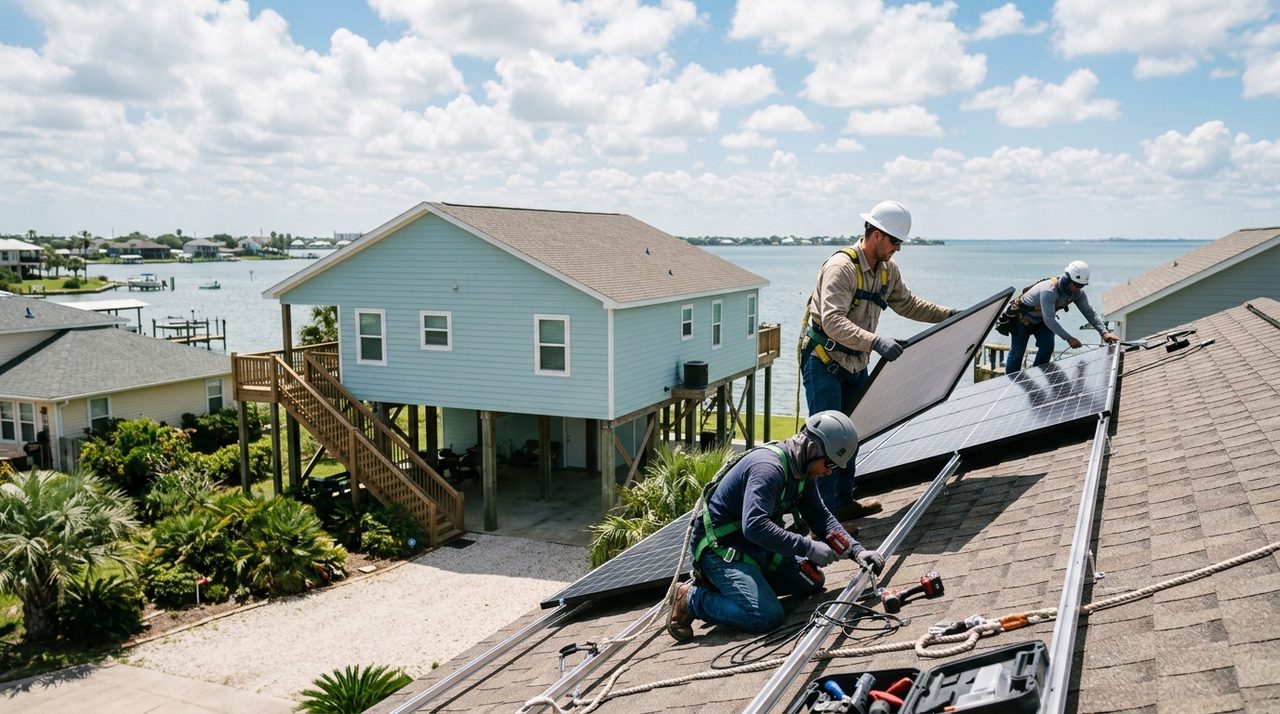
Santa Fe, TX sits in Galveston County's FEMA Zone AE, meaning every roof-mounted solar decision here must account not just for optimal sun angles but for tropical storm wind loads, potential flood intrusion at the ground level, and a coastal permit environment that operates independently from both the City of Houston and Harris County. With a median build year of 1991 and a high owner-occupancy rate of 81%, most Santa Fe homes are entering the window where original 3-tab shingles are aging out under Gulf Coast UV stress — making roof condition assessment a critical first step before any panel goes up. This page explains the four solar challenges that are genuinely specific to Santa Fe homeowners, not generic Houston advice.
Ranked by verified Google rating × review volume × verification tier. How we rank →
Some highly-rated pros serve Santa Fe from nearby and may not keep a Santa Fe street address. Those are listed under "Also serving Santa Fe" with their real city and distance, so you always know where each business is based.
Highly-rated pros based nearby who cover Santa Fe. Distance shown from the Santa Fe area.
Serving Santa Fe Based in League City · 7.5 mi away
Why it matters to you
Santa Fe falls within the Texas Windstorm Insurance Association (TWIA) coverage zone as a Galveston County coastal community, which means your rooftop solar racking system must use hardware documented to meet ASCE 7 design wind speeds of 130–140 mph. Post-Harvey and post-Beryl inspections across coastal Galveston County repeatedly found under-torqued rail attachments and improperly flashed penetrations — deficiencies that can void your TWIA policy if discovered after a claim. For a home worth the Santa Fe median of approximately $290,000, losing wind coverage over non-compliant hardware is a financially serious risk.
What a good pro does
A qualified installer must provide stamped engineering drawings and hardware cut sheets showing wind-rated racking certification before Galveston County (or City of Santa Fe) issues a building permit. Verify that your installer carries NABCEP PV Installation Professional certification and that their master electrician pulls the permit under a valid TDLR Electrical Contractor license — both are required in Texas for a permitted installation. Confirm with your TWIA agent that the final inspection certificate is added to your policy file.
Sources: Texas Windstorm Insurance Association (TWIA), North American Board of Certified Energy Practitioners (NABCEP), Texas Department of Licensing & Regulation
Why it matters to you
With a Census median build year of 1991, many Santa Fe homes are carrying original or early-replacement asphalt shingle roofs that are now 30+ years old — well past the 12–15 year effective lifespan Houston's combination of 95°F heat, sustained high humidity, and UV index averaging 10–11 delivers on standard 3-tab shingles. Installing a 25-year panel array on a roof that needs replacement within five years means paying an estimated $8,000–$14,000 to remove and reinstall the panels on top of re-roof costs — a disclosure most homeowners never receive upfront. Homes that took on emergency roof repairs after Hurricane Harvey (2017) using budget materials face an even shorter window.
What a good pro does
Before signing a solar contract, have the installer provide a written roof-age and condition assessment, and independently verify it with a licensed roofing contractor. If shingles are within seven years of expected end-of-life under Gulf Coast conditions, bundle the re-roof with the solar installation to avoid the remove-and-reinstall cost. A reputable TDLR-licensed electrical contractor will coordinate the roofing and racking scopes rather than proceeding on a marginal roof.
Sources: Texas Department of Licensing & Regulation, International Residential Code (as adopted by City of Houston), FEMA National Flood Hazard Layer (NFHL)
Why it matters to you
Santa Fe's FEMA Zone AE designation means base flood elevation requirements apply to substantial improvements, and any ground-level or garage-slab-level electrical equipment — string inverters, battery storage enclosures, and conduit runs — can be inundated in a major rain event like Harvey's 40–50 inch totals in southern Galveston County. A Tesla Powerwall or Enphase IQ Battery installed at floor grade in a Zone AE garage is not just a warranty risk; a flooded battery enclosure creates a genuine safety hazard and may not be insurable. Post-Uri demand for battery backup is high in Santa Fe, but the flood zone adds a siting constraint that inland Houston installers routinely overlook.
What a good pro does
Specify that all inverters, combiner boxes, and battery storage units be mounted at or above the community's base flood elevation — typically on an interior wall at least 12 inches above finished floor, or higher if the local floodplain ordinance requires it. Confirm the exact BFE for your parcel with the City of Santa Fe or Galveston County floodplain administrator before finalizing the system layout. CenterPoint Energy's interconnection tariff for storage-paired systems requires a separate metering application, so budget an extra 6–10 weeks on top of the standard permit timeline.
Sources: FEMA National Flood Hazard Layer (NFHL), Municipal permit office (see area profile), International Residential Code (as adopted by City of Houston)
Why it matters to you
Whether your Santa Fe address falls within the City of Santa Fe municipal limits or in unincorporated Galveston County determines which office reviews your solar permit, what structural and electrical submittal documents are required, and how long you wait for approval. These are not interchangeable processes: the City of Santa Fe and Galveston County Engineering each have their own plan-check checklists, fee schedules, and inspection scheduling windows. An installer who submits to the wrong jurisdiction wastes weeks and can trigger a stop-work order after the array is partially installed.
What a good pro does
Before executing a contract, require the installer to confirm your permit jurisdiction in writing by your parcel number — not just your mailing address ZIP code — and provide you with the specific office, contact, and estimated review timeline. All solar installations in either jurisdiction require a licensed master electrician to pull the permit under a TDLR Electrical Contractor license, and CenterPoint Energy must approve the interconnection agreement before the system can be legally energized. Do not accept a verbal assurance on jurisdiction; this one verification step prevents the most common project delay in Galveston County's patchwork permit environment.
Sources: Municipal permit office (see area profile), Texas Department of Licensing & Regulation, City of Houston Permitting Center
Hiring solar installers in Santa Fe? Santa Fe sits in Galveston County's FEMA AE high-risk flood zone, making water management the dominant concern for homeowners. Specific details about the neighborhood's housing stock, HOA governance, and permit jurisdiction remain difficult to confirm without a precise subdivision name or ZIP code. Homeowners should prioritize flood-resistant materials, elevated mechanical systems, and proper drainage when planning any renovation or repair.
Building era
Not confirmed - check Galveston County Appraisal District records for primary build decades.
Typical style
Not confirmed - check Galveston County Appraisal District records for architectural styles.
Foundations
Not confirmed - slab-on-grade is typical for SE Houston and Galveston County areas, but verify with local inspection records.
Common systems
Not confirmed - typical SE Houston/Galveston County homes feature central AC systems, copper or PEX plumbing, and standard residential electrical panels, but specifics depend on build era.
What that means for repairs
Given the FEMA AE flood zone designation, flood mitigation upgrades such as elevated HVAC equipment, flood vents, and water-resistant building materials are likely common renovation priorities.
Permit jurisdiction
Not confirmed - if within the City of Santa Fe municipal limits, permits would be handled by the City of Santa Fe; if in unincorporated Galveston County, permits fall under Galveston County Engineering. Verify the exact jurisdiction by address.
HOA & deed restrictions
Not confirmed - research could not verify whether a mandatory HOA, voluntary civic club, or no organized HOA governs this specific area. Check Harris County Clerk and Galveston County Clerk records for recorded deed restrictions.
Historic districts
No City of Houston historic district designation confirmed. Santa Fe is in Galveston County and likely outside City of Houston HAHC jurisdiction.
Contractor note
Contractors should confirm whether the property falls within the City of Santa Fe or unincorporated Galveston County, as permit requirements and floodplain development regulations differ significantly between the two jurisdictions.
FEMA flood zone
FEMA Zone AE (high flood risk) - source: fema_nfhl. Properties in this zone face a 1% annual chance of flooding and require flood insurance for federally backed mortgages. Proximity to local bayous, creeks, or drainage channels could not be confirmed from available research.
Hurricane Harvey impact
Not confirmed from available research - Galveston County broadly experienced significant Harvey flooding in 2017, and the AE flood zone designation suggests this area is vulnerable, but specific street-level impact and recurring flood-prone areas could not be verified. Check Galveston County flood damage records and FEMA claims data for this area.
Heat & humidity load
Houston-area summers bring extreme heat and humidity that stress HVAC systems and promote mold growth, especially in flood-prone areas where moisture intrusion compounds seasonal humidity. Proper attic ventilation, dehumidification, and regular AC maintenance are critical for homes in this zone.
Working with contractors here
The FEMA AE flood zone designation means contractors working in Santa Fe should expect flood mitigation and storm damage repair to be among the most common project types. Elevated mechanical systems, foundation inspections for water damage, and mold remediation are frequent needs. Any substantial improvement or repair exceeding 50% of the structure's market value may trigger floodplain development requirements including elevation to base flood elevation. Contractors should verify the exact permit jurisdiction—City of Santa Fe versus unincorporated Galveston County—before bidding, as compliance requirements vary. Material selections should prioritize flood-resistant options below the base flood elevation per local floodplain ordinances.
Local Tip
Always ask for a written estimate before work begins. Texas contractors are required to provide one on jobs over $1,000.
Santa Fe sits in Galveston County's FEMA AE high-risk flood zone, making water management the dominant concern for homeowners. Specific details about the neighborhood's housing stock, HOA governance, and permit jurisdiction remain difficult to confirm without a precise subdivision name or ZIP code. Homeowners should prioritize flood-resistant materials, elevated mechanical systems, and proper drainage when planning any renovation or repair.
Source: U.S. Census Bureau, ACS 5-Year 2023
Much of Santa Fe maps to FEMA Zone AE (high flood risk), so flood-resilient detailing -- elevated equipment, water-tolerant materials, and drainage-first thinking -- is essential here, not optional; as a Galveston County coastal community, tropical surge and wind add a layer generic guidance misses.
Source: FEMA National Flood Hazard Layer (NFHL). Flood zones vary by parcel — verify your individual FIRM panel.
Coastal Santa Fe, TX sits in FEMA surge zones where wind and saltwater spray work together to degrade solar racking hardware, so specify stainless-steel or marine-grade aluminum mounting components rated for salt-air exposure when your system is installed or upgraded. After Beryl 2024 demonstrated surge reach along Galveston Bay, confirm your inverter and battery enclosures are elevated well above the mapped surge inundation level for your specific parcel. As a Galveston County community, Santa Fe may follow county rather than City of Houston storm rebuild rules.
Salt-air corrosion in Santa Fe, TX can weaken racking fasteners faster than inland installations, making the post-severe-storm inspection even more important than it is elsewhere in the Houston metro. After hail or straight-line wind events, a TDLR-licensed solar contractor should check both the structural attachment hardware and the panel glass for micro-fractures that compromise long-term performance. Confirm the current FEMA panel for your Santa Fe parcel — the area maps to Zone AE, but adjacent lots can differ.
Ice on solar panels in Santa Fe, TX typically melts faster than inland due to the moderating influence of the bay, but a sustained hard freeze can still temporarily cut output to near zero; the practical preparation step is ensuring your battery is at full charge before a forecast freeze arrives, which you can do manually through your inverter's app interface or by asking your licensed installer to set an automatic charge-to-full schedule. Post-freeze, inspect racking hardware for any movement caused by thermal contraction, which can loosen fasteners on coastal installations more quickly than in sheltered inland locations. Confirm the current FEMA panel for your Santa Fe parcel — the area maps to Zone AE, but adjacent lots can differ.
Sources: FEMA National Flood Hazard Layer (NFHL), Ready.gov -- Hurricanes, CenterPoint Energy -- Storm Center, City of Houston -- Emergency Preparedness, Ready.gov -- Winter Weather, Harris County Flood Control District
Houston-specific estimators to plan your project before you call a pro. All results are planning estimates — a licensed local pro confirms the details on site.
Disconnect & drain every outdoor hose bib
Remove hoses, drain the spigots, and cover each with an insulated faucet sock. Un-drained hose bibs are the #1 burst point in a Houston freeze.
Insulate exposed pipes in the attic & garage
Wrap any pipe in an unconditioned space (attic runs, garage walls) with foam sleeves. Houston homes rarely insulate these because they only matter a few nights a year — which is exactly why they burst.
Open cabinet doors & keep a pencil-width drip
On hard-freeze nights, open kitchen/bath cabinets so warm air reaches the pipes and let faucets on exterior walls drip to relieve pressure.
Protect the attic/garage water heater & its lines
An attic or garage tank sits in unconditioned space. Insulate the cold-inlet and hot-outlet lines and confirm the emergency drain pan is clear so a leak doesn't reach the ceiling.
This is a planning estimate only — actual requirements depend on an on-site assessment by a licensed Houston pro. If a pipe has already burst, shut off your main water supply and call a licensed Houston plumber immediately — freeze bursts flood fast.
Sources: Municipal permit office (see area profile)
Sources: Municipal permit office (see area profile)
Sources: Texas Department of Licensing & RegulationNorth American Board of Certified Energy Practitioners (NABCEP)