Closed
1402 Broadway Avenue J, Galveston, TX 77550
Galveston sits entirely within FEMA Zone AE, meaning virtually every block of the island faces a credible annual flood threat from Gulf surge, tropical rainfall, and bay-side inundation — a reality driven home by Harvey in 2017 and again by Beryl in 2024. The island's housing stock ranges from 19th-century Victorian homes on pier-and-beam foundations in the historic core to modern slab-on-grade beach developments, and each type presents a distinct restoration challenge when saltwater or bayou-contaminated floodwater enters. Permits for any demolition, plumbing, or electrical work after a flood event go through the City of Galveston Development Services Department — never the City of Houston Permitting Center — and restoration timelines hinge on understanding that distinction from day one.
Ranked by verified Google rating × review volume × verification tier. How we rank →
Some highly-rated pros serve Galveston from nearby and may not keep a Galveston street address. Those are listed under "Also serving Galveston" with their real city and distance, so you always know where each business is based.
1402 Broadway Avenue J, Galveston, TX 77550
2101 Mechanic St Ste 222, Galveston, TX 77550
711 43rd St, Galveston, TX 77550
4701 Ave N Ursuline St, Galveston, TX 77551
7400 Jones Dr #813, Galveston, TX 77551
104 Moody Ave #102, Galveston, TX 77550
Highly-rated pros based nearby who cover Galveston. Distance shown from the Galveston area.
Serving Galveston Based in La Marque · 4.1 mi away
Why it matters to you
When storm surge or tidal backflow enters a Galveston home, it carries Gulf and Galveston Bay contamination — sewage, marine organisms, petrochemicals — that automatically classifies the loss as Category 3 black water under IICRC S500 standards. This matters directly to your wallet: IICRC S500 requires removal of all porous materials (drywall, insulation, base cabinets, flooring) to a minimum of 12 inches above the actual flood line, not just the visible waterline. Insurers occasionally attempt to reclassify a surge loss as Category 2 gray water to reduce the demo scope; Galveston's documented combined sewage overflow history and proximity to tidal sources makes that reclassification nearly impossible to justify, and a restoration contractor who properly documents water source and on-site testing protects your claim from being underpaid.
What a good pro does
A qualified contractor will collect water samples at the point of entry and document the flood source — bay inundation, Gulf surge, or street flooding with confirmed sewer backup — to support Category 3 classification in your insurance file. They will pull the required demolition permit through the City of Galveston Development Services Department before beginning structural demo, ensuring the scope of work is inspection-ready and the Certificate of Completion can close your claim. Any mold remediation triggered by the demo requires a TDLR-licensed Mold Remediation Contractor (MRC) working under a separate TDLR-issued Mold Assessment Consultant (MAC) report.
Sources: IICRC (water/mold restoration standards), Texas Department of Licensing & Regulation, Municipal permit office (see area profile)
Why it matters to you
Galveston's historic core and many coastal beach houses sit on pier-and-beam or raised piling foundations — a sharp contrast to the slab-on-grade construction dominant in Houston's inner loop. When floodwater recedes, moisture does not simply wick upward through a slab edge; instead, it soaks into the exposed wood subfloor, floor joists, and sill plates from below, and the open under-floor air space can actually delay drying because Gulf humidity (averaging above 70% relative humidity year-round) continuously re-wets the structural wood. In a 19th-century Victorian home in the historic East End, original heart pine subfloor planking acts as a moisture sponge, and without targeted drying equipment positioned beneath the floor system, elevated moisture readings can persist for six to eight weeks post-flood — well past the window when mold colonization begins.
What a good pro does
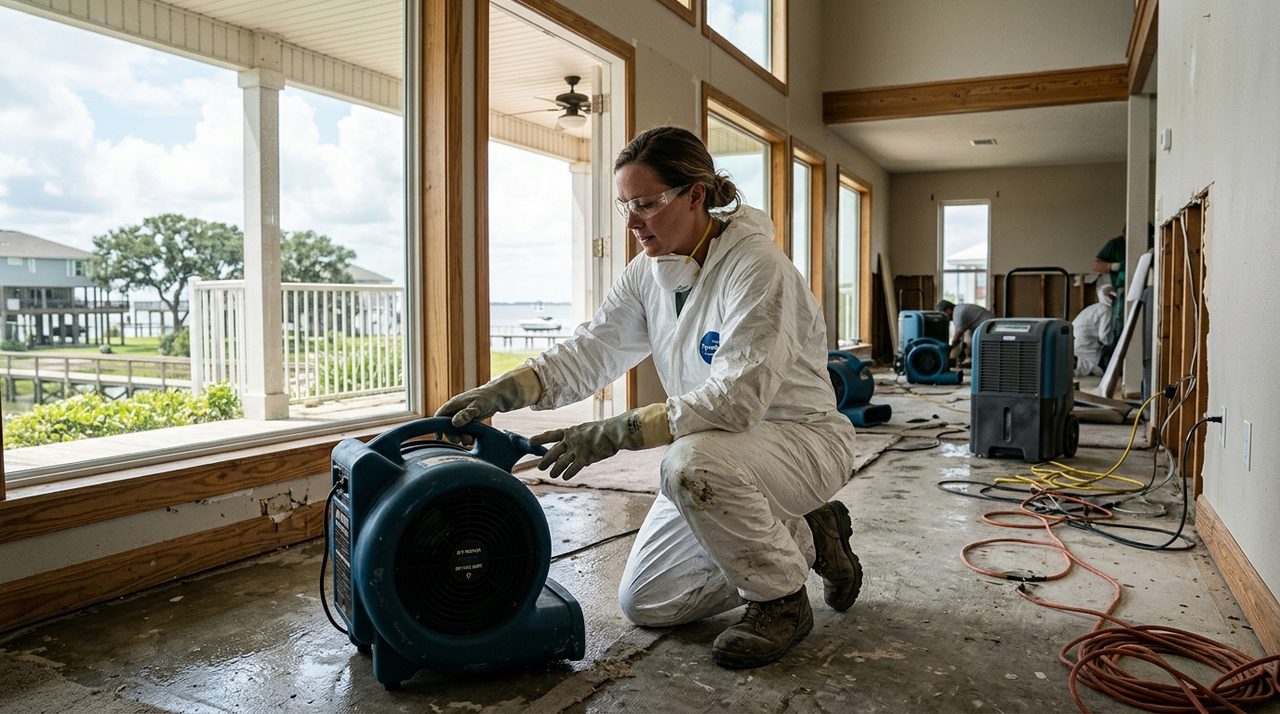
An experienced Galveston restoration contractor will deploy desiccant dehumidifiers and directional airmovers both above and below the floor deck simultaneously, using calibrated moisture meters and thermal imaging to map the full drying front from the sill plate down to the pier caps. If the structure falls within one of the City of Galveston's local historic districts, the contractor must coordinate with Galveston's preservation program before removing any original structural material, as replacement with non-period-appropriate lumber or fasteners can trigger a preservation review that delays reconstruction. Drying logs documenting daily psychrometric readings are essential for both insurance documentation and IICRC S500 compliance.
Sources: IICRC (water/mold restoration standards), Municipal permit office (see area profile), FEMA National Flood Hazard Layer (NFHL)
Why it matters to you
Galveston's coastal environment corrodes HVAC components — condenser coils, electrical connections, duct hangers, and air handler cabinets — far faster than in any inland Houston suburb, and a unit that was already salt-compromised before a flood event is highly likely to fail at the moment you need it most: the post-flood drying phase. When a flooded home's HVAC system operates with saturated flex duct insulation still in place, Houston's and Galveston's combined summer heat and humidity push interior relative humidity into the ideal range for Cladosporium and Aspergillus growth within 48 to 72 hours of flood entry, per IICRC S500 mold growth timelines. Pre-2000 coastal homes on Galveston Island are especially vulnerable because older flex duct insulation degrades faster in the salt-air environment, absorbs more water, and retains it longer than modern duct board.
What a good pro does
A restoration contractor working a Galveston flood loss should include a full duct inspection as part of the initial scope — not as an afterthought — using moisture probes inside the duct liner and thermal imaging at supply registers. If duct insulation shows moisture absorption or visible microbial growth, full duct replacement is the correct scope, not surface treatment; the replacement system should be specified with marine-grade or salt-air-rated components appropriate for Galveston's coastal environment. Any mold remediation work requires a TDLR-licensed MRC, and a new HVAC installation requires permits through the City of Galveston Development Services Department, not Houston's permit office.
Sources: IICRC (water/mold restoration standards), Texas Department of Licensing & Regulation, Municipal permit office (see area profile)
Why it matters to you
Galveston's direct Gulf exposure means that tropical systems and the May 2024 derecho delivered sustained wind-driven rain at angles and pressures that forced water through brick veneer weep holes, original wood siding lap joints, Victorian-era window flanges, and soffit vents before any street flooding arrived. The result is a wall cavity moisture intrusion pattern that runs from the roof deck downward through sheathing to the bottom plate — a fundamentally different drying problem than bottom-up flood work, and one that can be completely invisible from the interior. In Galveston's historic East End Landmark District, original wood-framed double-hung windows and beaded wood siding have no modern weather-resistant barrier behind them, creating direct pathways for wind-driven moisture to saturate balloon-frame wall cavities that haven't been opened since the 1890s.
What a good pro does
After any tropical event or high-wind rainstorm, a thorough restoration inspection of a Galveston home must include thermal imaging of all exterior wall faces and attic sheathing, not just rooms that showed interior water intrusion. Moisture meters should be read at multiple heights on each wall, because wind-driven intrusion often saturates the upper wall cavity while the floor level stays dry — the opposite of flood work. If the home is within a City of Galveston local historic district, any repair to exterior cladding or window flanges requires coordination with Galveston's historic preservation program to ensure replacement materials are period-appropriate before permits are issued through the City of Galveston Development Services Department.
Sources: IICRC (water/mold restoration standards), Municipal permit office (see area profile), FEMA National Flood Hazard Layer (NFHL)
Hiring water & flood restoration in Galveston? Galveston's housing stock spans from historic 19th-century Victorian homes to modern beach developments, creating an exceptionally diverse home service landscape. Homeowners must contend with persistent salt air corrosion, high flood risk across much of the island, and hurricane exposure that drives demand for wind-resistant roofing, elevated foundations, and robust moisture management. Permit jurisdiction falls under the City of Galveston Development Services Department or Galveston County, never the City of Houston Permitting Center.
Building era
Highly mixed — 1800s historic core through 21st-century beach and master-planned construction.
Typical style
Mix of Victorian, Gulf Coast vernacular, raised beach houses, mid-century ranch, and modern coastal developments; no single dominant style across the area.
Foundations
Mixed — many historic and coastal homes on pier-and-beam or raised pilings; newer mainland construction often slab-on-grade. Not confirmed at subdivision level — check property records.
Common systems
Older homes may have outdated electrical and galvanized plumbing requiring upgrades; coastal properties require corrosion-resistant HVAC equipment rated for salt air environments; newer builds typically feature modern central HVAC and PEX or copper plumbing.
What that means for repairs
Historic restoration is common in Galveston's core; coastal properties frequently undergo elevation projects, hurricane hardening, and replacement of salt-air-corroded exterior systems. Flood damage repair drives significant renovation activity across all housing types.
Permit jurisdiction
City of Galveston Development Services Department (within city limits); individual incorporated cities handle their own permitting elsewhere in Galveston County; unincorporated areas fall under Galveston County jurisdiction. Not the City of Houston Permitting Center.
HOA & deed restrictions
No county-wide mandatory HOA. HOAs exist at the subdivision, condo, and master-planned community level. Many single-family homes in Galveston have no HOA. Check deed restrictions recorded with the Galveston County Clerk for specific properties.
Historic districts
No City of Houston historic district designation — Galveston is outside Houston's jurisdiction. The City of Galveston maintains its own historic preservation program and local historic districts, governed by Galveston's ordinances separate from Houston's HAHC.
Contractor note
Contractors must verify whether work falls within City of Galveston, another incorporated Galveston County city, or unincorporated county jurisdiction, as permitting requirements and floodplain regulations differ significantly. Properties in local historic districts within the City of Galveston may require additional preservation review separate from any Houston process.
FEMA flood zone
FEMA Zone AE (high flood risk) — source: fema_nfhl. Galveston's island geography and coastal exposure create significant flood risk from both storm surge and rainfall. Proximity to the Gulf of Mexico and Galveston Bay compounds risk across most of the area.
Hurricane Harvey impact
Hurricane Harvey's flood impacts in Galveston County were highly localized and varied by precise location — bayfront vs. mainland interior, creek proximity, and elevation. Specific street-level flooding data for this area could not be confirmed without a more precise subdivision or address — check FEMA Harvey flood inundation maps and Galveston County floodplain administrator reports for property-specific history.
Heat & humidity load
Extreme humidity and salt air accelerate corrosion of HVAC condensers, metal roofing components, and exterior fasteners. Summer heat combined with coastal moisture drives high demand for dehumidification, mold remediation, and HVAC maintenance. Prolonged UV exposure degrades exterior paint and sealants faster than inland areas.
Working with contractors here
Contractors in Galveston most commonly work on flood damage repair, foundation elevation projects, hurricane-hardening (impact windows, fortified roofing), and replacement of salt-air-corroded exterior systems including HVAC condensers, metal railings, and fasteners. The wide range of housing eras means contractors must be prepared for both historic restoration requiring period-appropriate materials and modern coastal construction techniques. Job scoping should always include assessment of flood history, current elevation relative to base flood elevation, and whether the property falls within a City of Galveston historic district requiring preservation review. Corrosion-resistant materials and marine-grade hardware should be specified as standard for any exterior work.
Local Tip
Always ask for a written estimate before work begins. Texas contractors are required to provide one on jobs over $1,000.
Galveston's housing stock spans from historic 19th-century Victorian homes to modern beach developments, creating an exceptionally diverse home service landscape. Homeowners must contend with persistent salt air corrosion, high flood risk across much of the island, and hurricane exposure that drives demand for wind-resistant roofing, elevated foundations, and robust moisture management. Permit jurisdiction falls under the City of Galveston Development Services Department or Galveston County, never the City of Houston Permitting Center.
Source: U.S. Census Bureau, ACS 5-Year 2023
On Galveston Island, storm surge and Gulf wind are the defining hazards: much of Galveston sits in FEMA Zone AE coastal high-hazard territory, so wind-rated, elevation- and surge-aware work is the baseline, not an upgrade.
Source: FEMA National Flood Hazard Layer (NFHL). Flood zones vary by parcel — verify your individual FIRM panel.
Storm-surge events like those modeled in FEMA VE zones along Galveston Bay can deliver saltwater intrusion that demands specialized extraction protocols beyond standard freshwater flooding, so vet your Galveston, TX restoration contractor now to confirm they carry IICRC WRT and ASD certifications and have surge-specific drying equipment staged locally. Salt contamination accelerates corrosion and mold growth faster than Category 1 freshwater, compressing the safe drying window. Much of the housing stock predates modern wind codes (median build year 1973), so retrofits matter more here. Confirm the current FEMA panel for your Galveston parcel — the area maps to Zone AE, but adjacent lots can differ.
Coastal Galveston, TX properties face wind-driven rain from severe thunderstorms at angles that penetrate weep holes, window flanges, and deck-door thresholds simultaneously, requiring restoration crews familiar with multi-point entry drying rather than single-source extraction. Confirm your restoration contractor has commercial LGR dehumidifiers rated for high-humidity coastal conditions before storm season. Confirm the current FEMA panel for your Galveston parcel — the area maps to Zone AE, but adjacent lots can differ.
Uri 2021 left coastal Houston properties with freeze damage that was slower to dry than inland homes due to ambient humidity near Galveston Bay, and restoration teams using standard refrigerant dehumidifiers without supplemental desiccant units failed to reach acceptable moisture levels in wall cavities. Vet your Galveston, TX restoration contractor to confirm they carry desiccant equipment and understand coastal drying conditions before contracting for freeze-event response. With a median build year of 1973, the older building stock here is more exposed to hard-freeze damage than newer construction. As a Galveston County community, Galveston may follow county rather than City of Houston storm rebuild rules.
Sources: FEMA National Flood Hazard Layer (NFHL), Ready.gov -- Hurricanes, CenterPoint Energy -- Storm Center, City of Houston -- Emergency Preparedness, Ready.gov -- Winter Weather, Harris County Flood Control District
Houston-specific estimators to plan your project before you call a pro. All results are planning estimates — a licensed local pro confirms the details on site.
Disconnect & drain every outdoor hose bib
Remove hoses, drain the spigots, and cover each with an insulated faucet sock. Un-drained hose bibs are the #1 burst point in a Houston freeze.
Insulate exposed pipes in the attic & garage
Wrap any pipe in an unconditioned space (attic runs, garage walls) with foam sleeves. Houston homes rarely insulate these because they only matter a few nights a year — which is exactly why they burst.
Open cabinet doors & keep a pencil-width drip
On hard-freeze nights, open kitchen/bath cabinets so warm air reaches the pipes and let faucets on exterior walls drip to relieve pressure.
Protect the attic/garage water heater & its lines
An attic or garage tank sits in unconditioned space. Insulate the cold-inlet and hot-outlet lines and confirm the emergency drain pan is clear so a leak doesn't reach the ceiling.
This is a planning estimate only — actual requirements depend on an on-site assessment by a licensed Houston pro. If a pipe has already burst, shut off your main water supply and call a licensed Houston plumber immediately — freeze bursts flood fast.
Sources: Municipal permit office (see area profile)Texas Department of Licensing & Regulation
Sources: IICRC (water/mold restoration standards)FEMA National Flood Hazard Layer (NFHL)
Sources: Municipal permit office (see area profile)
Sources: Texas Department of Licensing & RegulationIICRC (water/mold restoration standards)
Sources: IICRC (water/mold restoration standards)Local HOA / deed restrictions (see area profile)