Best Tree Removal in Tomball, TX
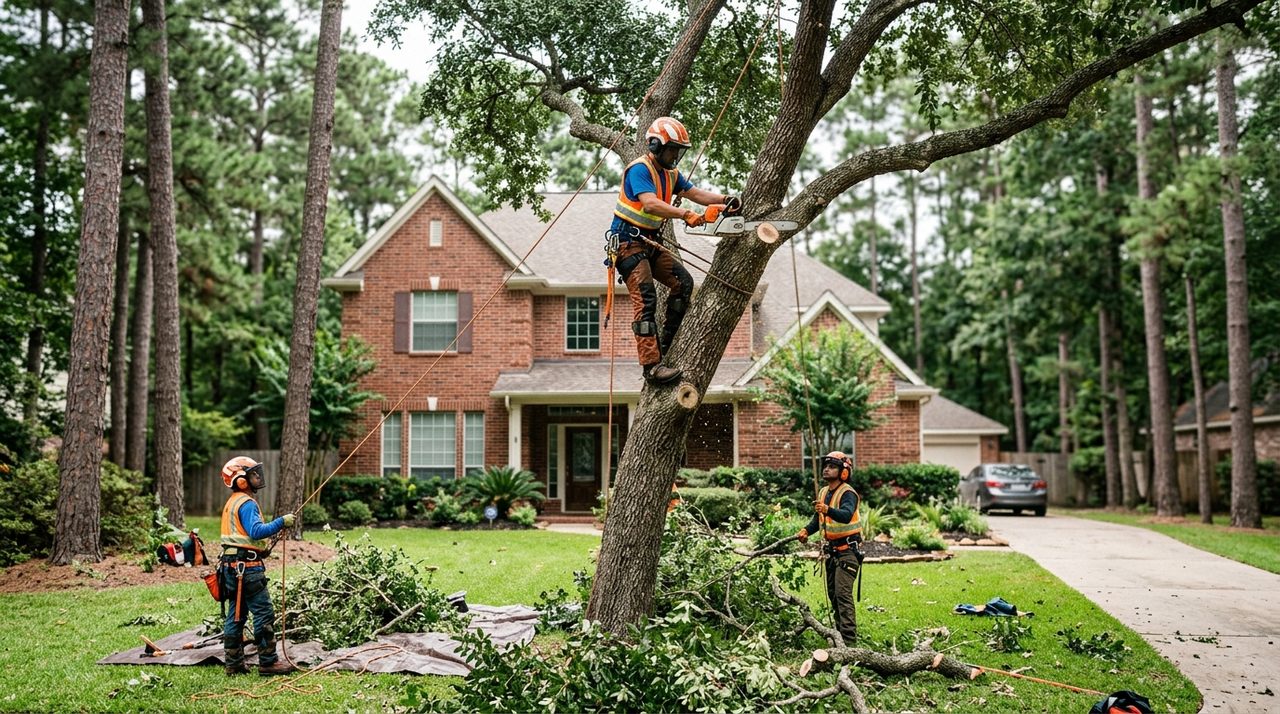
Tomball's tree canopy ranges from the mature post-oaks and loblolly pines that frame Old Town's 1960s–1980s ranch homes to the production-planted crepe myrtles, live oaks, and water oaks now reaching problematic size in master-planned subdivisions built across northwest Harris County from the late 1990s onward. That combination of aging trees over clay-rich soil, slab-on-grade foundations, and mandatory HOA oversight in most modern neighborhoods makes tree removal here more layered than a single phone call to a tree crew. Understanding the permit split between the City of Tomball Building Department and Harris County Engineering — and confirming HOA architectural review requirements before any chainsaw touches bark — is what separates a smooth removal from a fine or a stop-work situation.
- Median home built
- 1990
- Median home value
- $306,400
- FEMA flood zone
- X (low)
- Typical removal cost (est.)
- $750–$3,500+
- Most common local issue
- Water oaks and live oaks outgrowing HOA-governed lots in 1990s–2000s master-planned subdivisions
Ranked by verified Google rating × review volume × verification tier. How we rank →
Some highly-rated pros serve Tomball from nearby and may not keep a Tomball street address. Those are listed under "Also serving Tomball" with their real city and distance, so you always know where each business is based.
Based in Tomball
18037 Solomon Rd Ext, Tomball, TX 77375
Sugarberry Way, Tomball, TX 77375
11627 Standing Pine Ln, Tomball, TX 77375
9903 Kleppel Rd Ste A, Tomball, TX 77375
17210 Lillian Ln, Tomball, TX 77377
24926 Stanolind Rd, Tomball, TX 77375
14202 Meadowlark Ln, Tomball, TX 77377
Also serving Tomball
Highly-rated pros based nearby who cover Tomball. Distance shown from the Tomball area.
Serving Tomball Based in Champions Forest · 6.1 mi away
Serving Tomball Based in The Woodlands · 6.2 mi away
Tree Removal in Tomball: What You Should Know
HOA Architectural Review Must Come Before the Crew Does
Why it matters to you
The majority of Tomball's newer subdivisions — including neighborhoods like Villages of NorthPointe and Stone Lake — operate under mandatory HOAs with architectural review committees (ARCs) that require written approval before any tree above a specified caliper (commonly 6–8 inches DBH) is removed. Skipping that step can result in fines and a mandatory replanting requirement that may cost more than the removal itself. Because HOA membership attaches automatically to property ownership in these master-planned communities, there is no opting out of the process.
What a good pro does
Before scheduling a crew, pull your HOA's CC&Rs from the Harris County deed records or the TREC HOA Management Certificate database and submit a written ARC request with a site sketch showing the tree's location relative to structures. A reputable Tomball-area tree company will ask for ARC approval documentation before booking the job — if a contractor wants to start immediately without asking about your HOA status, treat that as a red flag.
Sources: Local HOA / deed restrictions (see area profile), Municipal permit office (see area profile)
Permit Jurisdiction Is Not One-Size-Fits-All in Tomball
Why it matters to you
Tomball sits across a jurisdictional seam: properties inside the City of Tomball's municipal limits require any applicable permits through the City of Tomball Building Department, while homes in unincorporated Harris County parcels — which include a large portion of the area's master-planned subdivisions sprawling northwest of the city core — fall under Harris County Engineering. Confusing the two jurisdictions can mean pulling the wrong permit or missing a required step entirely, a problem that surfaces during future title searches or insurance claims.
What a good pro does
Before scheduling removal of any tree that might require ground disturbance near utilities or that involves a crane over a public right-of-way, verify the property's municipal status through the Harris County Appraisal District parcel viewer. A qualified contractor working in the Tomball area should routinely check this before quoting, not after the job is done. The City of Houston does not govern any part of Tomball, so City of Houston permit rules are not applicable here.
Sources: Municipal permit office (see area profile), Local HOA / deed restrictions (see area profile)
Clay Soil and Slab Edges — Roots from 1990s-Planted Trees Are Now Problem Size
Why it matters to you
The production-builder homes constructed across Tomball's master-planned subdivisions from the late 1990s through the 2000s were typically planted with live oaks, water oaks, and cedar elms that are now 20–30 years old and have reached the size where surface-feeding roots interact with northwest Harris County's expansive Beaumont-series clay. On a slab-on-grade foundation — the standard here — root-driven soil moisture variation at the slab perimeter can contribute to differential movement, and clay sewer laterals in the older Old Town-adjacent homes built before PVC became standard in the 1980s are vulnerable to root intrusion.
What a good pro does
When root-to-foundation proximity is a concern, request that the contractor assess the distance from the trunk base to the nearest slab edge before quoting — the industry rule of thumb is that surface roots extend roughly 1.5 times the tree's height. Proper stump grinding to at least 8–10 inches below grade, combined with root barrier installation if replanting nearby, reduces resprout and future soil disruption. For Old Town-area homes with clay drain lines, pair the removal with a sewer scope to confirm no existing root intrusion.
Sources: Local HOA / deed restrictions (see area profile), Municipal permit office (see area profile)
Post-Derecho and Post-Beryl Pricing Surges Affect Tomball Homeowners
Why it matters to you
Tomball sits in northwest Harris County, a corridor that felt significant wind damage from both the May 2024 derecho (which pushed 100-plus mph straight-line winds through the broader Houston metro) and Hurricane Beryl in July 2024. After either event, regional demand for tree crews collapses available capacity across the entire north Houston market, and out-of-state operators unfamiliar with local HOA requirements or the City of Tomball permit process move in quickly. Post-storm pricing in the Houston metro routinely runs 40–80 percent above normal rates, and urgency pressure from a tree on a roof makes it easy to skip vetting steps.
What a good pro does
Even under storm-damage urgency, take 15 minutes to verify that the contractor carries liability insurance with limits sufficient to cover your home's value — ask for a certificate of insurance naming you as additional insured, not just a verbal assurance. Confirm they are aware of your HOA's emergency-work provisions (many ARCs have a streamlined process for storm damage) and that they will handle debris disposal properly, since Tomball-area municipalities and Harris County have time-limited curbside debris pickup windows after declared events. Texas does not require a state license for tree removal, but an ISA Certified Arborist credential is worth asking for.
Sources: Local HOA / deed restrictions (see area profile), Municipal permit office (see area profile), FEMA National Flood Hazard Layer (NFHL)
Tree Removal in Tomball: What You Should Know
Hiring tree removal in Tomball? Tomball spans a wide range of housing stock, from older 1960s–1980s homes near the historic city core to newer master-planned subdivisions built from the late 1990s onward. Most HOA-governed neighborhoods feature production-builder brick veneer homes on slab-on-grade foundations, meaning foundation monitoring, HVAC maintenance, and roof upkeep are the primary service needs. Contractors should verify whether a property falls within the City of Tomball, an unincorporated Harris County area, or a specific HOA before beginning work.
- Housing era
- Mixed
- Foundation
- Predominantly slab-on-grade
- Flood zone
- FEMA Zone X (low flood risk) per official NFHL data
- Permits
- Mixed jurisdiction
Housing stock & systems
Building era
Mixed: 1960s–1980s near Old Town Tomball; late 1990s–2010s in master-planned subdivisions.
Typical style
Production-builder Texas Traditional with brick veneer, hip/gable roofs, and attached garages; some older ranch-style homes near the city core.
Foundations
Predominantly slab-on-grade; pier-and-beam limited to pre-1960s or custom/rural construction.
Common systems
Newer subdivisions: central HVAC (often 15–25 years old in late-1990s builds), copper or PEX plumbing, 200-amp electrical panels. Older homes near Old Town: original HVAC systems likely replaced, possible galvanized or cast iron plumbing, older electrical panels that may need upgrading.
What that means for repairs
Older homes near Old Town Tomball see kitchen and bath remodels, re-piping from galvanized to PEX, and electrical panel upgrades. Newer master-planned homes are entering their first major replacement cycles for HVAC systems, water heaters, and roofing.
Permits & restrictions
Permit jurisdiction
Mixed jurisdiction: properties within the City of Tomball require permits through the City of Tomball Building Department; unincorporated Harris County properties require permits through Harris County Engineering. Verify municipal boundaries before pulling permits.
HOA & deed restrictions
Mandatory HOAs/POAs are the norm in modern Tomball-area master-planned subdivisions (e.g., Villages of NorthPointe Community Association, Stone Lake Homeowners Association). Membership attaches to property ownership. Older pockets near Tomball city core may have no organized HOA or voluntary civic clubs. Confirm specific HOA status via Harris County deed records or TREC HOA Management Certificate database.
Historic districts
No City of Houston historic district designation confirmed. Old Town Tomball has some heritage character but no HAHC jurisdiction applies.
Contractor note
Many Tomball-area HOAs require architectural review committee (ARC) approval before exterior modifications. Contractors should confirm HOA approval requirements and verify whether the property is in the City of Tomball or unincorporated Harris County, as permitting processes differ significantly.
Flood & weather
FEMA flood zone
FEMA Zone X (low flood risk) per official NFHL data. Some areas near Cypress Creek and local drainage channels may carry higher risk; always verify specific addresses against the Harris County Flood Control District floodplain viewer.
Hurricane Harvey impact
Some parts of the Tomball/North Harris County area experienced Harvey flooding, particularly near creeks and Cypress Creek, but flooding was very localized. Many newer master-planned subdivisions were designed with detention facilities and experienced less structural flooding than older bayou-adjacent areas. Specific street-level flood history should be verified through Harris County Flood Control District records, seller disclosures, and FEMA claim data.
Heat & humidity load
Sustained summer heat puts heavy demand on HVAC systems, especially in late-1990s to early-2000s homes where original units may be nearing end of life. Slab foundations on Houston's expansive clay soils benefit from consistent watering during drought periods to prevent differential settlement. Attic temperatures in single-story brick veneer homes can exceed 150°F, accelerating roofing material degradation.
Working with contractors here
HVAC replacement and maintenance is the most common service call in Tomball's master-planned subdivisions, as many late-1990s and 2000s-era systems are reaching or past their expected lifespan. Foundation repair and monitoring is also significant due to the expansive clay soils common across northwest Harris County. Roofing work is frequent, driven by both age-related wear and periodic hail events. In older Old Town Tomball homes, re-piping from galvanized to PEX and electrical panel upgrades are common jobs. Contractors should always check HOA ARC requirements for exterior work and confirm the correct permit jurisdiction before starting any project.
Local Tip
Always ask for a written estimate before work begins. Texas contractors are required to provide one on jobs over $1,000.
About Tomball
Tomball spans a wide range of housing stock, from older 1960s–1980s homes near the historic city core to newer master-planned subdivisions built from the late 1990s onward. Most HOA-governed neighborhoods feature production-builder brick veneer homes on slab-on-grade foundations, meaning foundation monitoring, HVAC maintenance, and roof upkeep are the primary service needs. Contractors should verify whether a property falls within the City of Tomball, an unincorporated Harris County area, or a specific HOA before beginning work.
- Median year built
- 1990
- Median home value
- $306,400
- Owner-occupied
- 48.5%
- Population
- 13,032
- Housing units
- 5,495
- Median income
- $71,426
Source: U.S. Census Bureau, ACS 5-Year 2023
Flood & storm risk
FEMA Zone XLow flood riskMost of Tomball maps to FEMA Zone X (low mapped flood risk), but Houston's flash-flood reality means even low-risk blocks benefit from smart drainage and storm-hardened installs.
Source: FEMA National Flood Hazard Layer (NFHL). Flood zones vary by parcel — verify your individual FIRM panel.
Houston Storm Readiness in Tomball
Hurricane & flooding
After a hurricane makes landfall, tree removal demand across the Houston metro surges overnight, so contracting a licensed crew in Tomball, TX for pre-storm hazard removal is far faster and less expensive than emergency post-storm work. Focus removal priority on trees with crowns that extend over the roofline or within one tree-length of the structure, which is where wind-throw damage concentrates. Confirm the current FEMA panel for your Tomball parcel — the area maps to Zone X, but adjacent lots can differ.
Severe storms & hail
After any severe thunderstorm drops large limbs in your yard in Tomball, TX, have a licensed contractor assess the parent tree for hidden decay before assuming the remaining structure is sound. Snap failures during the May 2024 derecho frequently involved trees that had experienced prior lightning strikes or previous partial limb loss that had gone uninspected. As a Harris County community, Tomball may follow county rather than City of Houston storm rebuild rules.
Ice storms & freezes
Wind loading on ice-coated canopies in Tomball, TX during a hard freeze creates the same failure risk as a severe windstorm, and lower flood-risk areas are just as exposed to ice-storm tree damage as any other part of the Houston metro. Uri 2021 left neighborhoods across the city dealing with fallen trees on homes and vehicles for weeks, primarily because no pre-storm removal of structurally weak specimens had been completed. As a Harris County community, Tomball may follow county rather than City of Houston storm rebuild rules.
Sources: FEMA National Flood Hazard Layer (NFHL), Ready.gov -- Hurricanes, CenterPoint Energy -- Storm Center, City of Houston -- Emergency Preparedness, Ready.gov -- Winter Weather, Harris County Flood Control District
Free Tomball Tools & Calculators
Houston-specific estimators to plan your project before you call a pro. All results are planning estimates — a licensed local pro confirms the details on site.
Houston Soil & Tree Proximity Risk Calculator
Open full tool & FAQ →Grouped by mature root aggression & water demand.
Trunk center to the nearest exterior wall.
The root zone likely reaches your foundation's soil during Houston's dry summers, when clay shrinks most. Watch for sticking doors and diagonal cracks, keep soil moisture even with a soaker hose during drought, and have a foundation pro evaluate if you see any movement.
Find a Houston foundation pro →This is a planning estimate only — actual requirements depend on an on-site assessment by a licensed Houston pro. Guidance is based on general species root behavior in expansive clay, not a soil test.
Houston Freeze Prep & Pipe Insulation Checklist
Open full tool & FAQ →Your freeze checklist — 4 tasks
- 1
Disconnect & drain every outdoor hose bib
Remove hoses, drain the spigots, and cover each with an insulated faucet sock. Un-drained hose bibs are the #1 burst point in a Houston freeze.
- 2
Insulate exposed pipes in the attic & garage
Wrap any pipe in an unconditioned space (attic runs, garage walls) with foam sleeves. Houston homes rarely insulate these because they only matter a few nights a year — which is exactly why they burst.
- 3
Open cabinet doors & keep a pencil-width drip
On hard-freeze nights, open kitchen/bath cabinets so warm air reaches the pipes and let faucets on exterior walls drip to relieve pressure.
- 4
Protect the attic/garage water heater & its lines
An attic or garage tank sits in unconditioned space. Insulate the cold-inlet and hot-outlet lines and confirm the emergency drain pan is clear so a leak doesn't reach the ceiling.
This is a planning estimate only — actual requirements depend on an on-site assessment by a licensed Houston pro. If a pipe has already burst, shut off your main water supply and call a licensed Houston plumber immediately — freeze bursts flood fast.
Frequently Asked Questions
Does the City of Tomball require a permit to remove a tree from my private property?
Sources: Municipal permit office (see area profile)
My lot is in a master-planned subdivision with an HOA — can the tree crew start right away, or do I need ARC approval first?
Sources: Local HOA / deed restrictions (see area profile)
The loblolly pines behind my 1990s-era Tomball home look like they have bark beetle damage — is a dead pine more expensive to remove?
Tomball is in FEMA Zone X — does that mean storm-fallen trees won't get any FEMA debris pickup assistance after a major event?
Sources: FEMA National Flood Hazard Layer (NFHL)Harris County Flood Control District