Closed
11709 Boudreaux Rd suite 1150, Tomball, TX 77375
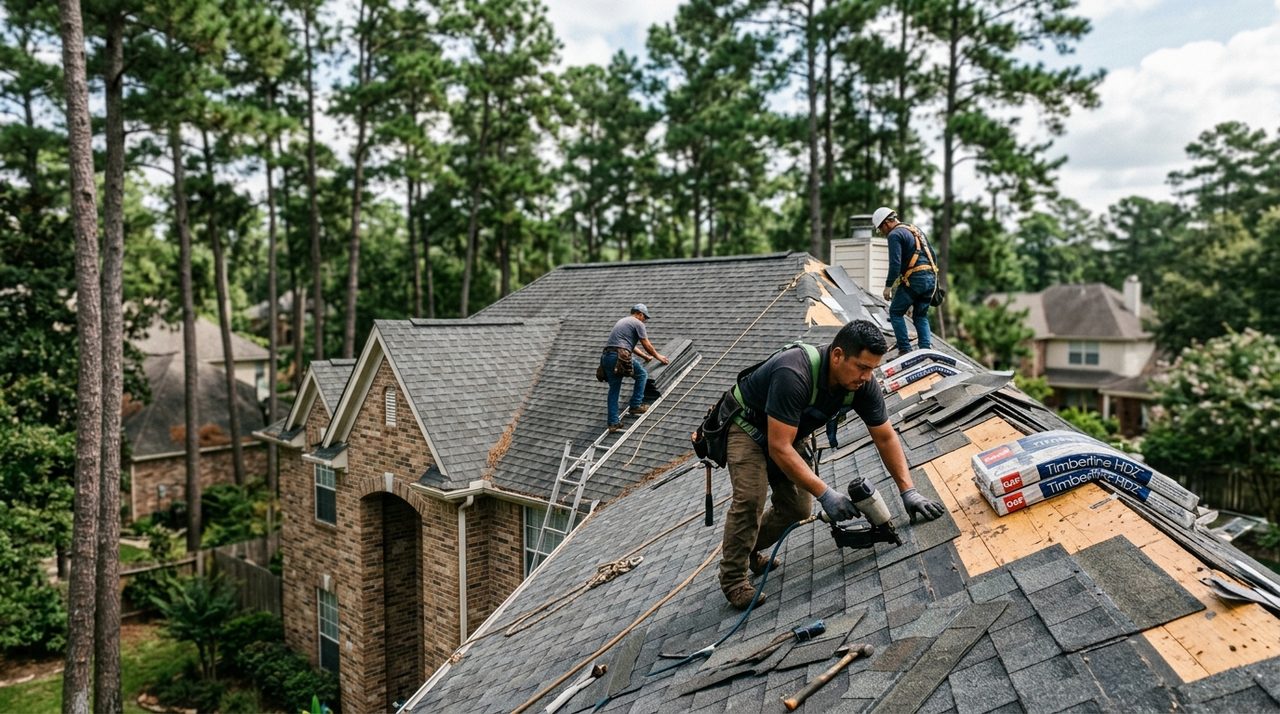
Tomball's roofing landscape is shaped by two distinct housing eras: aging ranch-style homes near Old Town Tomball whose original shingles may already be pushing 20-plus years, and the sprawling late-1990s through 2010s master-planned subdivisions—Villages of NorthPointe, Stone Lake, and their neighbors—where production-builder roofs are now entering their first major replacement cycle and mandatory HOA architectural review adds a critical approval step before any material change. Harris County's northwest corridor sits in a proven hail corridor, and the May 2024 derecho drove straight-line winds through this area that exposed exactly how many of these aging shingle installations were under-nailed for modern wind loads. Reading this page will help you understand which permits apply to your specific Tomball property, how to navigate your HOA's ARC process before signing a contract, and what honest cost estimates look like in the current post-storm market.
Ranked by verified Google rating × review volume × verification tier. How we rank →
11709 Boudreaux Rd suite 1150, Tomball, TX 77375
990 Village Square Dr Suite Q, Tomball, TX 77375
1431 Graham Dr #266, Tomball, TX 77375
311 N Sycamore St, Tomball, TX 77375
515 W Main St #203, Tomball, TX 77375
25420 Kuykendahl Rd Ste B-200, Tomball, TX 77375
9421 Farm to Market 2920 Bldg 20, Tomball, TX 77375
16714 Hereford Rd, Tomball, TX 77377
14439 Medical Complex Dr, Tomball, TX 77377
22955 TX-249 Ste 26, Tomball, TX 77375
Why it matters to you
Tomball's master-planned subdivisions built between the late 1990s and mid-2000s—communities like Villages of NorthPointe—were constructed with standard 25–30 year architectural shingles that, in Houston's 2,700-plus cooling degree days and sustained summer attic deck temperatures exceeding 160°F, realistically perform for only 15–18 years. That means a roof installed in 1999 is not just aging—it may already be past effective life. Homeowners in these subdivisions are now seeing granule loss in gutters, thermal cracking at hip and ridge lines, and accelerated UV binder oxidation on south- and west-facing planes, all on roofs that still look passable from the street.
What a good pro does
A qualified roofer should perform a close-up inspection—not a drive-by assessment—checking granule loss density, mat bruising, and flashing integrity at all roof-to-wall transitions common on Tomball's brick-veneer Texas Traditional homes. Before signing any contract, confirm whether your property falls within the City of Tomball limits or unincorporated Harris County, as the permitting body differs: City of Tomball Building Department versus Harris County Engineering, and each has its own inspection schedule and fee structure.
Sources: Municipal permit office (see area profile), International Residential Code (as adopted by City of Houston)
Why it matters to you
Most modern Tomball-area master-planned subdivisions—including Stone Lake and similar HOA-governed communities—require homeowner submission to an Architectural Review Committee before any change to exterior roofing material, including color upgrades or switching from 3-tab to architectural shingles, let alone a move to metal roofing. ARC review windows commonly run 10–30 days, which means a homeowner who signs a roofing contract the week after a hail event may be legally prohibited from allowing work to begin until the HOA approves the material selection. Non-compliance can result in fines or forced re-roofing at the homeowner's expense.
What a good pro does
Before selecting a shingle brand, color, or product class, pull your HOA's current approved-materials list—obtainable through the Harris County deed records or the TREC HOA Management Certificate database—and submit your ARC application simultaneously with your insurance claim. A roofer experienced in Tomball's master-planned communities will know to schedule the start date around ARC approval, not around adjuster availability, and will provide the committee with manufacturer spec sheets in the format the ARC requires.
Sources: Local HOA / deed restrictions (see area profile), Municipal permit office (see area profile)
Why it matters to you
The May 2024 derecho produced documented straight-line winds exceeding 100 mph across Harris and Fort Bend counties, and northwest Harris County—where Tomball sits—was directly in the affected corridor. Homes built before the 2006 IRC wind-resistance updates frequently used 4-nail fastening patterns rather than the 6-nail pattern now required in high-wind zones; this makes ridge caps, hip shingles, and field tab edges on Tomball's production homes especially vulnerable to uplift. Damage from this event is often not dramatic missing-section failure but subtler: lifted tab edges, cracked sealant strips, and displaced ridge caps that allow water intrusion during the next heavy rain.
What a good pro does
A thorough post-derecho inspection should include physical tab-lift testing across multiple field sections, not just a visual scan for missing pieces. Roofers working on City of Tomball properties must register with the City of Tomball Building Department before pulling a permit for structural repairs; in unincorporated Harris County parcels, registration goes through Harris County Engineering. Texas has no state roofing license through TDLR, so verifying general liability and workers' compensation insurance is the primary consumer protection in a post-storm environment flooded with out-of-area contractors.
Sources: International Residential Code (as adopted by City of Houston), Municipal permit office (see area profile), Texas Windstorm Insurance Association (TWIA)
Why it matters to you
Tomball's older ranch-style homes near Old Town—built 1960s through 1980s—frequently retain original box or gable-only vent systems that do not meet current IRC R806 ridge-to-soffit balanced ventilation ratios. Houston's annual average relative humidity exceeds 75%, and slab-on-grade construction (the norm across all Tomball eras) provides no crawl space buffer for moisture migration. Without proper balanced ventilation, attic condensation silently delaminates OSB and plywood decking year-round—meaning a new shingle installation on a compromised deck will see accelerated re-failure within five to eight years.
What a good pro does
Any Tomball re-roof proposal should include a documented deck inspection that probes for soft spots, delamination, and moisture staining at eave lines before new underlayment goes down. If decking replacement is needed, the scope and material must be included in the permit application filed with either the City of Tomball Building Department or Harris County Engineering, depending on the property's location. Upgrading to a continuous ridge-vent system at the time of re-roof—combined with soffit vent clearing—is the cost-effective window to fix ventilation without paying for a separate attic remediation project later.
Sources: International Residential Code (as adopted by City of Houston), Municipal permit office (see area profile)
Hiring roofers in Tomball? Tomball spans a wide range of housing stock, from older 1960s–1980s homes near the historic city core to newer master-planned subdivisions built from the late 1990s onward. Most HOA-governed neighborhoods feature production-builder brick veneer homes on slab-on-grade foundations, meaning foundation monitoring, HVAC maintenance, and roof upkeep are the primary service needs. Contractors should verify whether a property falls within the City of Tomball, an unincorporated Harris County area, or a specific HOA before beginning work.
Building era
Mixed: 1960s–1980s near Old Town Tomball; late 1990s–2010s in master-planned subdivisions.
Typical style
Production-builder Texas Traditional with brick veneer, hip/gable roofs, and attached garages; some older ranch-style homes near the city core.
Foundations
Predominantly slab-on-grade; pier-and-beam limited to pre-1960s or custom/rural construction.
Common systems
Newer subdivisions: central HVAC (often 15–25 years old in late-1990s builds), copper or PEX plumbing, 200-amp electrical panels. Older homes near Old Town: original HVAC systems likely replaced, possible galvanized or cast iron plumbing, older electrical panels that may need upgrading.
What that means for repairs
Older homes near Old Town Tomball see kitchen and bath remodels, re-piping from galvanized to PEX, and electrical panel upgrades. Newer master-planned homes are entering their first major replacement cycles for HVAC systems, water heaters, and roofing.
Permit jurisdiction
Mixed jurisdiction: properties within the City of Tomball require permits through the City of Tomball Building Department; unincorporated Harris County properties require permits through Harris County Engineering. Verify municipal boundaries before pulling permits.
HOA & deed restrictions
Mandatory HOAs/POAs are the norm in modern Tomball-area master-planned subdivisions (e.g., Villages of NorthPointe Community Association, Stone Lake Homeowners Association). Membership attaches to property ownership. Older pockets near Tomball city core may have no organized HOA or voluntary civic clubs. Confirm specific HOA status via Harris County deed records or TREC HOA Management Certificate database.
Historic districts
No City of Houston historic district designation confirmed. Old Town Tomball has some heritage character but no HAHC jurisdiction applies.
Contractor note
Many Tomball-area HOAs require architectural review committee (ARC) approval before exterior modifications. Contractors should confirm HOA approval requirements and verify whether the property is in the City of Tomball or unincorporated Harris County, as permitting processes differ significantly.
FEMA flood zone
FEMA Zone X (low flood risk) per official NFHL data. Some areas near Cypress Creek and local drainage channels may carry higher risk; always verify specific addresses against the Harris County Flood Control District floodplain viewer.
Hurricane Harvey impact
Some parts of the Tomball/North Harris County area experienced Harvey flooding, particularly near creeks and Cypress Creek, but flooding was very localized. Many newer master-planned subdivisions were designed with detention facilities and experienced less structural flooding than older bayou-adjacent areas. Specific street-level flood history should be verified through Harris County Flood Control District records, seller disclosures, and FEMA claim data.
Heat & humidity load
Sustained summer heat puts heavy demand on HVAC systems, especially in late-1990s to early-2000s homes where original units may be nearing end of life. Slab foundations on Houston's expansive clay soils benefit from consistent watering during drought periods to prevent differential settlement. Attic temperatures in single-story brick veneer homes can exceed 150°F, accelerating roofing material degradation.
Working with contractors here
HVAC replacement and maintenance is the most common service call in Tomball's master-planned subdivisions, as many late-1990s and 2000s-era systems are reaching or past their expected lifespan. Foundation repair and monitoring is also significant due to the expansive clay soils common across northwest Harris County. Roofing work is frequent, driven by both age-related wear and periodic hail events. In older Old Town Tomball homes, re-piping from galvanized to PEX and electrical panel upgrades are common jobs. Contractors should always check HOA ARC requirements for exterior work and confirm the correct permit jurisdiction before starting any project.
Local Tip
Always ask for a written estimate before work begins. Texas contractors are required to provide one on jobs over $1,000.
Tomball spans a wide range of housing stock, from older 1960s–1980s homes near the historic city core to newer master-planned subdivisions built from the late 1990s onward. Most HOA-governed neighborhoods feature production-builder brick veneer homes on slab-on-grade foundations, meaning foundation monitoring, HVAC maintenance, and roof upkeep are the primary service needs. Contractors should verify whether a property falls within the City of Tomball, an unincorporated Harris County area, or a specific HOA before beginning work.
Source: U.S. Census Bureau, ACS 5-Year 2023
Most of Tomball maps to FEMA Zone X (low mapped flood risk), but Houston's flash-flood reality means even low-risk blocks benefit from smart drainage and storm-hardened installs.
Source: FEMA National Flood Hazard Layer (NFHL). Flood zones vary by parcel — verify your individual FIRM panel.
For homeowners in Tomball, TX: beryl 2024 stripped unsealed ridge vents and attic ventilators off roofs across low-flood-risk Houston neighborhoods, creating interior soaking before homeowners even knew there was an opening. Have a roofer install hurricane-rated ridge vent covers or temporarily cap off-ridge ventilators if a storm is within 72 hours of landfall. Confirm the current FEMA panel for your Tomball parcel — the area maps to Zone X, but adjacent lots can differ.
After a severe thunderstorm, the first thing a roofer should check in Tomball, TX is whether wind-driven rain has pushed up under any low-slope transition sections—areas where a steep roof meets a flatter porch or addition—because these joints separate under gust pressure and rarely reseal on their own. Sealing those transitions with a peel-and-stick modified bitumen patch costs far less than replacing the framing they protect. As a Harris County community, Tomball may follow county rather than City of Houston storm rebuild rules.
Even in lower-flood-risk Tomball, TX, a hard freeze following a rainstorm can trap water under lifted perimeter shingles and expand it into cracks in the decking, a failure mode that became widespread during Uri 2021. Ask a roofer to hand-seal any perimeter shingles showing daylight beneath them before December so freeze-water expansion does not open your deck to spring rains. As a Harris County community, Tomball may follow county rather than City of Houston storm rebuild rules.
Sources: FEMA National Flood Hazard Layer (NFHL), Ready.gov -- Hurricanes, CenterPoint Energy -- Storm Center, City of Houston -- Emergency Preparedness, Ready.gov -- Winter Weather, Harris County Flood Control District
Houston-specific estimators to plan your project before you call a pro. All results are planning estimates — a licensed local pro confirms the details on site.
Estimated design wind speed for your zone
Outside the TDI catastrophe area, so a WPI-8 is generally not mandated — but Houston still sees hurricane-force gusts (Beryl, 2024). Insist on properly rated shingles installed to the manufacturer's high-wind nailing pattern (6 nails) and starter strips, or a wind claim can be denied for improper installation.
Find a Houston roofer →This is a planning estimate only — actual requirements depend on an on-site assessment by a licensed Houston pro. Wind-speed zones are approximate; your exact TDI/WPI-8 obligation depends on your address's designation. Verify with the Texas Department of Insurance before contracting.
Disconnect & drain every outdoor hose bib
Remove hoses, drain the spigots, and cover each with an insulated faucet sock. Un-drained hose bibs are the #1 burst point in a Houston freeze.
Insulate exposed pipes in the attic & garage
Wrap any pipe in an unconditioned space (attic runs, garage walls) with foam sleeves. Houston homes rarely insulate these because they only matter a few nights a year — which is exactly why they burst.
Open cabinet doors & keep a pencil-width drip
On hard-freeze nights, open kitchen/bath cabinets so warm air reaches the pipes and let faucets on exterior walls drip to relieve pressure.
Protect the attic/garage water heater & its lines
An attic or garage tank sits in unconditioned space. Insulate the cold-inlet and hot-outlet lines and confirm the emergency drain pan is clear so a leak doesn't reach the ceiling.
This is a planning estimate only — actual requirements depend on an on-site assessment by a licensed Houston pro. If a pipe has already burst, shut off your main water supply and call a licensed Houston plumber immediately — freeze bursts flood fast.
Sources: Municipal permit office (see area profile)
Sources: Local HOA / deed restrictions (see area profile)
Sources: Texas Windstorm Insurance Association (TWIA)Municipal permit office (see area profile)
Sources: Texas Windstorm Insurance Association (TWIA)Local HOA / deed restrictions (see area profile)