17857 Hufsmith - Kohrville Rd, Tomball, TX 77375
Best AC Repair in Tomball, TX
Tomball's HVAC market is shaped by two overlapping realities: late-1990s and 2000s-era production-builder systems in master-planned subdivisions like Villages of NorthPointe are now hitting or exceeding their 20-year design life right as Houston summers push equipment harder than almost anywhere in the country, and northwest Harris County's expansive black-clay soils add a second failure mode that most homeowners never see coming. Whether your home sits inside the City of Tomball Building Department's jurisdiction or in unincorporated Harris County—where permits run through Harris County Engineering—knowing which permit office applies to your address before calling a contractor can save days of delay and hundreds of dollars in rework fees.
Verified against Google Business data
Updated 2026
See the 10 AC Repair Serving Tomball 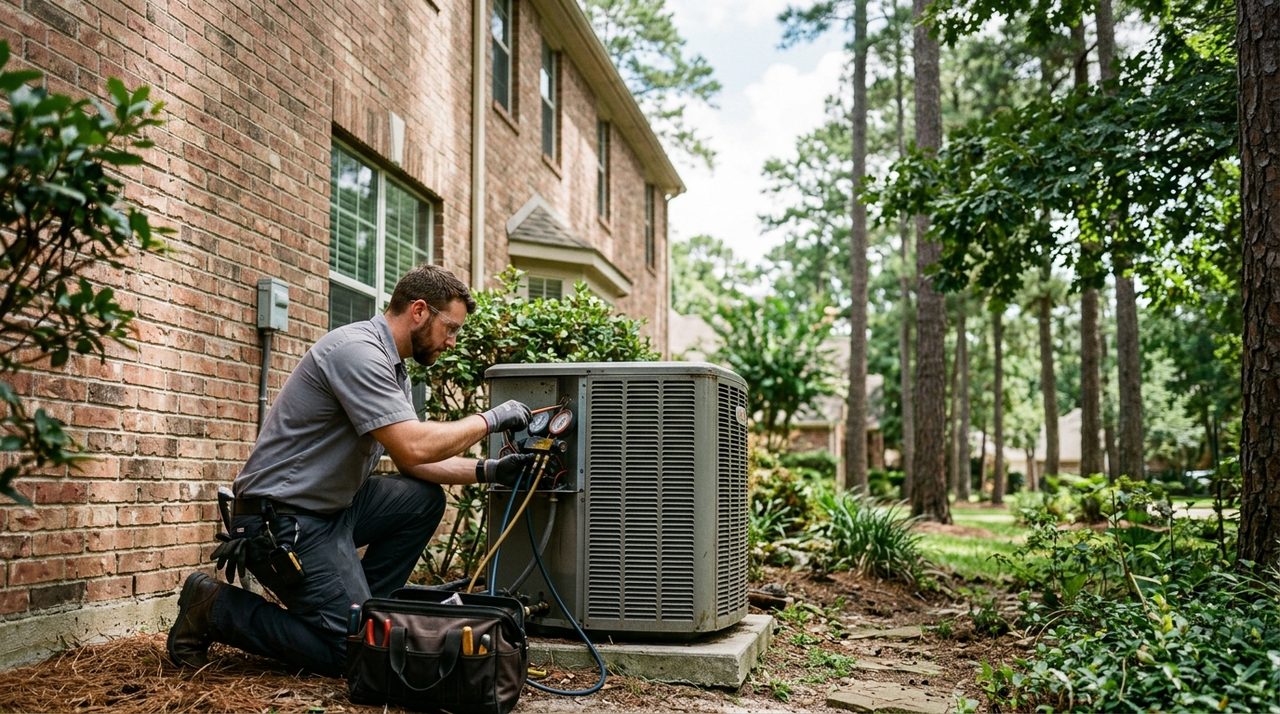
- Median home built
- 1990
- Median home value
- $306,400
- FEMA flood zone
- X (low)
- Typical system replacement (est.)
- $5,500–$9,500
- Most common local issue
- Aging late-1990s/2000s systems reaching end of life in master-planned subdivisions
Ranked by verified Google rating × review volume × verification tier. How we rank →
Min rating:
10 results Open Now
27740 Commercial Park Rd, Tomball, TX 77375
Closed
12023 Holderrieth Rd, Tomball, TX 77375
Open Now
22815 Commercial Ln, Tomball, TX 77375
Open Now
1427 Keefer Rd, Tomball, TX 77375
Open Now
503 E Hufsmith Rd ste 64, Tomball, TX 77375
Closed
23802 FM2978 Ste C4, Tomball, TX 77375
Closed
25435 FM2978 #102, Tomball, TX 77375
23802 FM2978 Ste D3500, Tomball, TX 77375
Open Now
327 S Persimmon St Suite A, Tomball, TX 77375
AC Repair in Tomball: What You Should Know
Late-1990s and 2000s Systems Hitting End-of-Life All at Once
Why it matters to you
Tomball's master-planned subdivisions built between the late 1990s and mid-2000s—Stone Lake, Villages of NorthPointe, and similar communities—mean thousands of production-builder HVAC systems are simultaneously reaching or exceeding their expected 15–20 year lifespan. A system installed in 2001 that has run through Houston's 400-plus hours above 95°F annually is not the same machine it was at installation; compressor wear, refrigerant cycling stress, and failing TXVs are now showing up across the neighborhood in clusters rather than one-offs.
What a good pro does
A qualified technician licensed by the Texas Department of Licensing and Regulation (TDLR) should perform a full system diagnostic—not just a refrigerant top-off—including compressor amp draw, TXV function, and coil condition before recommending repair versus replacement. For full replacement, the contractor must pull a mechanical permit from the correct jurisdiction: City of Tomball Building Department if you're inside city limits, or Harris County Engineering if your parcel is in unincorporated Harris County—verify your boundary before work begins.
Sources: Texas Department of Licensing & Regulation, Municipal permit office (see area profile)
Northwest Harris County Clay Soil Stressing Line Sets and Pad Leveling
Why it matters to you
The high-plasticity Beaumont/Houston Black clay soil underlying northwest Harris County—the same soil that drives Tomball's well-documented foundation repair activity—expands and contracts with every significant rainfall cycle. On slab-on-grade homes (the standard construction in virtually every Tomball subdivision), this movement can kink refrigerant line sets running along or through the slab, tilt outdoor condenser pads off level, and pull duct connections loose in interior air-handler closets. Original 1990s copper line sets are especially vulnerable after two decades of this stress cycling.
What a good pro does
Before any refrigerant recharge—which runs $350–$650 for R-410A systems in the Houston market—a thorough technician should walk the full line-set route, check pad levelness, and inspect duct boots at the air handler. Line sets showing kinks or compression points need sectional replacement, not just a pressure test. TDLR-licensed contractors performing any equipment or line-set replacement in Tomball must pull the applicable mechanical permit regardless of whether the scope feels 'minor.'
Sources: Texas Department of Licensing & Regulation, Municipal permit office (see area profile)
Evaporator Coil Mold and Condensate Overflow on Slab Foundations
Why it matters to you
Houston's sustained high humidity—90%+ relative humidity for large portions of the year—means Tomball's slab-on-grade homes face a specific risk: clogged condensate drain lines cause pan overflow that has nowhere to go on a concrete slab, leading to sub-slab moisture intrusion, warped flooring, and microbial growth inside air-handler closets. Homes with air handlers tucked into interior hallway closets, common in Tomball's production-builder floor plans, are especially vulnerable because there is typically no floor drain to catch an overflow event.
What a good pro does
Condensate drain clearing is one of the most frequent Tomball service calls and typically costs $95–$225—a fraction of the water-damage remediation bill if a pan overflows unnoticed. A good technician will flush the drain line, treat the pan with algaecide tablets, and inspect the secondary drain pan and the float-switch cutoff that should shut the system down before overflow occurs. Homeowners whose air handlers lack a secondary float switch should ask their TDLR-licensed contractor about adding one; it's a low-cost safeguard that can prevent thousands in flooring and drywall damage.
Sources: Texas Department of Licensing & Regulation, ENERGY STAR / U.S. Dept. of Energy
HOA Architectural Review and Permit Jurisdiction Running in Parallel
Why it matters to you
In Tomball's master-planned subdivisions, replacing a condenser unit involves two separate approval tracks that must both be satisfied before work is complete. The community's HOA architectural review committee (ARC)—common in communities like Villages of NorthPointe—may require the new unit to be screened from street view using specific fence or lattice materials, and approval must often come before installation, not after. Simultaneously, the mechanical permit must be pulled from the correct municipal authority: the City of Tomball Building Department for in-city parcels or Harris County Engineering for unincorporated addresses—these are not interchangeable.
What a good pro does
Before scheduling installation, confirm your property's HOA status via Harris County deed records or the TREC HOA Management Certificate database, obtain any required ARC pre-approval in writing, and ask your TDLR-licensed contractor to verify your permit jurisdiction by address. Condenser screening requirements can constrain unit placement and airflow clearance, so the equipment selection and pad location should be finalized only after HOA requirements are known. Permit fees typically add $75–$250 to project cost depending on jurisdiction.
Sources: Local HOA / deed restrictions (see area profile), Municipal permit office (see area profile), Texas Department of Licensing & Regulation
AC Repair in Tomball: What You Should Know
Hiring ac repair in Tomball? Tomball spans a wide range of housing stock, from older 1960s–1980s homes near the historic city core to newer master-planned subdivisions built from the late 1990s onward. Most HOA-governed neighborhoods feature production-builder brick veneer homes on slab-on-grade foundations, meaning foundation monitoring, HVAC maintenance, and roof upkeep are the primary service needs. Contractors should verify whether a property falls within the City of Tomball, an unincorporated Harris County area, or a specific HOA before beginning work.
- Housing era
- Mixed
- Foundation
- Predominantly slab-on-grade
- Flood zone
- FEMA Zone X (low flood risk) per official NFHL data
- Permits
- Mixed jurisdiction
Housing stock & systems
Building era
Mixed: 1960s–1980s near Old Town Tomball; late 1990s–2010s in master-planned subdivisions.
Typical style
Production-builder Texas Traditional with brick veneer, hip/gable roofs, and attached garages; some older ranch-style homes near the city core.
Foundations
Predominantly slab-on-grade; pier-and-beam limited to pre-1960s or custom/rural construction.
Common systems
Newer subdivisions: central HVAC (often 15–25 years old in late-1990s builds), copper or PEX plumbing, 200-amp electrical panels. Older homes near Old Town: original HVAC systems likely replaced, possible galvanized or cast iron plumbing, older electrical panels that may need upgrading.
What that means for repairs
Older homes near Old Town Tomball see kitchen and bath remodels, re-piping from galvanized to PEX, and electrical panel upgrades. Newer master-planned homes are entering their first major replacement cycles for HVAC systems, water heaters, and roofing.
Permits & restrictions
Permit jurisdiction
Mixed jurisdiction: properties within the City of Tomball require permits through the City of Tomball Building Department; unincorporated Harris County properties require permits through Harris County Engineering. Verify municipal boundaries before pulling permits.
HOA & deed restrictions
Mandatory HOAs/POAs are the norm in modern Tomball-area master-planned subdivisions (e.g., Villages of NorthPointe Community Association, Stone Lake Homeowners Association). Membership attaches to property ownership. Older pockets near Tomball city core may have no organized HOA or voluntary civic clubs. Confirm specific HOA status via Harris County deed records or TREC HOA Management Certificate database.
Historic districts
No City of Houston historic district designation confirmed. Old Town Tomball has some heritage character but no HAHC jurisdiction applies.
Contractor note
Many Tomball-area HOAs require architectural review committee (ARC) approval before exterior modifications. Contractors should confirm HOA approval requirements and verify whether the property is in the City of Tomball or unincorporated Harris County, as permitting processes differ significantly.
Flood & weather
FEMA flood zone
FEMA Zone X (low flood risk) per official NFHL data. Some areas near Cypress Creek and local drainage channels may carry higher risk; always verify specific addresses against the Harris County Flood Control District floodplain viewer.
Hurricane Harvey impact
Some parts of the Tomball/North Harris County area experienced Harvey flooding, particularly near creeks and Cypress Creek, but flooding was very localized. Many newer master-planned subdivisions were designed with detention facilities and experienced less structural flooding than older bayou-adjacent areas. Specific street-level flood history should be verified through Harris County Flood Control District records, seller disclosures, and FEMA claim data.
Heat & humidity load
Sustained summer heat puts heavy demand on HVAC systems, especially in late-1990s to early-2000s homes where original units may be nearing end of life. Slab foundations on Houston's expansive clay soils benefit from consistent watering during drought periods to prevent differential settlement. Attic temperatures in single-story brick veneer homes can exceed 150°F, accelerating roofing material degradation.
Working with contractors here
HVAC replacement and maintenance is the most common service call in Tomball's master-planned subdivisions, as many late-1990s and 2000s-era systems are reaching or past their expected lifespan. Foundation repair and monitoring is also significant due to the expansive clay soils common across northwest Harris County. Roofing work is frequent, driven by both age-related wear and periodic hail events. In older Old Town Tomball homes, re-piping from galvanized to PEX and electrical panel upgrades are common jobs. Contractors should always check HOA ARC requirements for exterior work and confirm the correct permit jurisdiction before starting any project.
Local Tip
Always ask for a written estimate before work begins. Texas contractors are required to provide one on jobs over $1,000.
About Tomball
Tomball spans a wide range of housing stock, from older 1960s–1980s homes near the historic city core to newer master-planned subdivisions built from the late 1990s onward. Most HOA-governed neighborhoods feature production-builder brick veneer homes on slab-on-grade foundations, meaning foundation monitoring, HVAC maintenance, and roof upkeep are the primary service needs. Contractors should verify whether a property falls within the City of Tomball, an unincorporated Harris County area, or a specific HOA before beginning work.
- Median year built
- 1990
- Median home value
- $306,400
- Owner-occupied
- 48.5%
- Population
- 13,032
- Housing units
- 5,495
- Median income
- $71,426
Source: U.S. Census Bureau, ACS 5-Year 2023
Flood & storm risk
FEMA Zone XLow flood riskMost of Tomball maps to FEMA Zone X (low mapped flood risk), but Houston's flash-flood reality means even low-risk blocks benefit from smart drainage and storm-hardened installs.
Source: FEMA National Flood Hazard Layer (NFHL). Flood zones vary by parcel — verify your individual FIRM panel.
Houston Storm Readiness in Tomball
Hurricane & flooding
Power-surge damage to HVAC control boards is one of the costliest hurricane aftermaths in Tomball, TX; install a dedicated whole-system surge protector rated for your unit's tonnage at the disconnect box before the season opens. CenterPoint's distribution lines in lower-risk areas often restore power with significant voltage spikes, and an unprotected board can fail the moment the grid comes back. Confirm the current FEMA panel for your Tomball parcel — the area maps to Zone X, but adjacent lots can differ.
Severe storms & hail
Wind-driven rain during a severe thunderstorm can overwhelm attic ventilation in Tomball, TX and soak fiberglass duct insulation, reducing system efficiency for weeks until the insulation dries — a post-storm attic check for wet duct wrap costs far less than the efficiency loss on your summer CenterPoint bill. A TDLR-licensed HVAC technician can re-wrap and seal affected sections during a single service visit. As a Harris County community, Tomball may follow county rather than City of Houston storm rebuild rules.
Ice storms & freezes
Hard freezes in Tomball, TX can crack condensate trap fittings in attic air handlers, flooding the secondary pan and ceiling drywall the moment temperatures rise — replace plastic condensate traps with PVC cemented fittings and confirm float-switch operation before winter as a direct freeze-prep step. This ten-minute inspection by a licensed HVAC technician prevents the water-damage call that follows the thaw. As a Harris County community, Tomball may follow county rather than City of Houston storm rebuild rules.
Sources: FEMA National Flood Hazard Layer (NFHL), Ready.gov -- Hurricanes, CenterPoint Energy -- Storm Center, City of Houston -- Emergency Preparedness, Ready.gov -- Winter Weather, Harris County Flood Control District
Free Tomball Tools & Calculators
Houston-specific estimators to plan your project before you call a pro. All results are planning estimates — a licensed local pro confirms the details on site.
Houston AC Tonnage & Sizing Estimator
Open full tool & FAQ →Living space you want cooled (400–10,000 sq ft).
5.0tons
Recommended nominal size
60,000 BTU/hr
Estimated cooling load
This is a planning estimate only — actual requirements depend on an on-site assessment by a licensed Houston pro. Houston's humidity and long cooling season make an oversized unit a common, costly mistake — it short-cycles and never dehumidifies. A licensed contractor confirms sizing with a full Manual J calculation.
Houston Freeze Prep & Pipe Insulation Checklist
Open full tool & FAQ →Your freeze checklist — 4 tasks
- 1
Disconnect & drain every outdoor hose bib
Remove hoses, drain the spigots, and cover each with an insulated faucet sock. Un-drained hose bibs are the #1 burst point in a Houston freeze.
- 2
Insulate exposed pipes in the attic & garage
Wrap any pipe in an unconditioned space (attic runs, garage walls) with foam sleeves. Houston homes rarely insulate these because they only matter a few nights a year — which is exactly why they burst.
- 3
Open cabinet doors & keep a pencil-width drip
On hard-freeze nights, open kitchen/bath cabinets so warm air reaches the pipes and let faucets on exterior walls drip to relieve pressure.
- 4
Protect the attic/garage water heater & its lines
An attic or garage tank sits in unconditioned space. Insulate the cold-inlet and hot-outlet lines and confirm the emergency drain pan is clear so a leak doesn't reach the ceiling.
This is a planning estimate only — actual requirements depend on an on-site assessment by a licensed Houston pro. If a pipe has already burst, shut off your main water supply and call a licensed Houston plumber immediately — freeze bursts flood fast.
Frequently Asked Questions
Do I need a permit to replace my AC system in Tomball, TX, and who issues it?
It depends on whether your property sits inside the City of Tomball city limits or in unincorporated Harris County — these are two separate permit jurisdictions with different offices, fee structures, and inspection timelines. Properties inside city limits pull mechanical permits through the City of Tomball Building Department; properties outside must go through Harris County Engineering. Your TDLR-licensed HVAC contractor is required to pull the permit — homeowners cannot self-pull mechanical permits for HVAC work in either jurisdiction — so confirm your address boundary before scheduling the job to avoid delays.
Sources: Municipal permit office (see area profile)Texas Department of Licensing & Regulation
My Tomball subdivision has an HOA — do I need ARC approval before the AC tech replaces my outdoor condenser unit?
Many master-planned Tomball subdivisions, including communities like Villages of NorthPointe, require Architectural Review Committee (ARC) approval before any exterior equipment change, which includes replacing or repositioning a condenser unit. Some HOAs mandate screening from street view using specific fence or lattice materials, which can affect where a replacement unit is placed. Confirm your specific HOA's CC&Rs via the Harris County deed records or the TREC HOA Management Certificate database before scheduling installation, since ARC approval and the municipal mechanical permit run on parallel tracks and both must be satisfied.
Sources: Local HOA / deed restrictions (see area profile)Municipal permit office (see area profile)
My late-1990s Tomball home still runs R-22 refrigerant — is it worth recharging it this summer?
Almost certainly not on a cost basis: R-22 has been banned from new production since January 2020, and reclaimed R-22 in the Houston market can run $80–$150 per pound (estimate), meaning a leak repair and recharge on an aging system can cost $600–$1,500 or more with no guarantee the compressor survives another Houston summer. Late-1990s systems in Tomball's master-planned subdivisions are already at or past the 20-year design life, so most contractors will recommend a full replacement with a current R-410A or R-32 system rather than spending on a refrigerant that is increasingly scarce and expensive.
Sources: ENERGY STAR / U.S. Dept. of Energy
Is there a best time of year to schedule a non-emergency AC replacement in Tomball to avoid the longest wait times?
Late September through November is historically the window when demand drops sharply after the summer peak, and most Tomball-area HVAC contractors can schedule installations within a few days rather than the one-to-two-week backlog common in June and July. If your late-1990s or 2000s system is limping but functional, a fall replacement also lets you skip a summer emergency call — which in Tomball's climate can mean same-day rates and limited equipment availability. Spring (March–April) is a secondary window, but it narrows fast as temperatures climb toward Houston's 90-degree threshold.
Tomball is in FEMA Zone X, so should I worry about my outdoor condenser unit flooding during heavy rain events?
Zone X means low mapped flood risk, but northwest Harris County's flash-flood reality means even properties outside the floodplain can see temporary standing water during intense storms — Tomball received significant rainfall during both Hurricane Harvey (2017) and Beryl (2024). Condenser units sitting at ground level on settled concrete pads can be submerged in a fast-moving sheet-flow event, and flood-exposed coils corrode quickly in Houston's humid air even after water recedes. If your pad has settled below yard grade due to clay-soil movement — common in northwest Harris County — ask your contractor to evaluate pad height and drainage slope during the service call.
What should I ask an HVAC contractor before hiring them for a system replacement in Tomball to make sure they handle the permit and HOA steps correctly?
Ask specifically whether they will pull the mechanical permit under their TDLR contractor license and whether they have experience working in both City of Tomball and unincorporated Harris County jurisdictions, since the permitting process differs between the two. Also ask whether they will provide documentation suitable for an HOA ARC submission if your subdivision requires it, and confirm they will schedule the required inspection before closing out the job — in Harris County unincorporated areas, uninspected permits can create title issues when you sell. A contractor who hesitates on any of these points is a red flag in a metro where permit-jurisdiction confusion is a documented source of homeowner headaches.
Sources: Texas Department of Licensing & RegulationMunicipal permit office (see area profile)