Open Now
24624 Interstate 45 N Suite 200, Spring, TX 77386
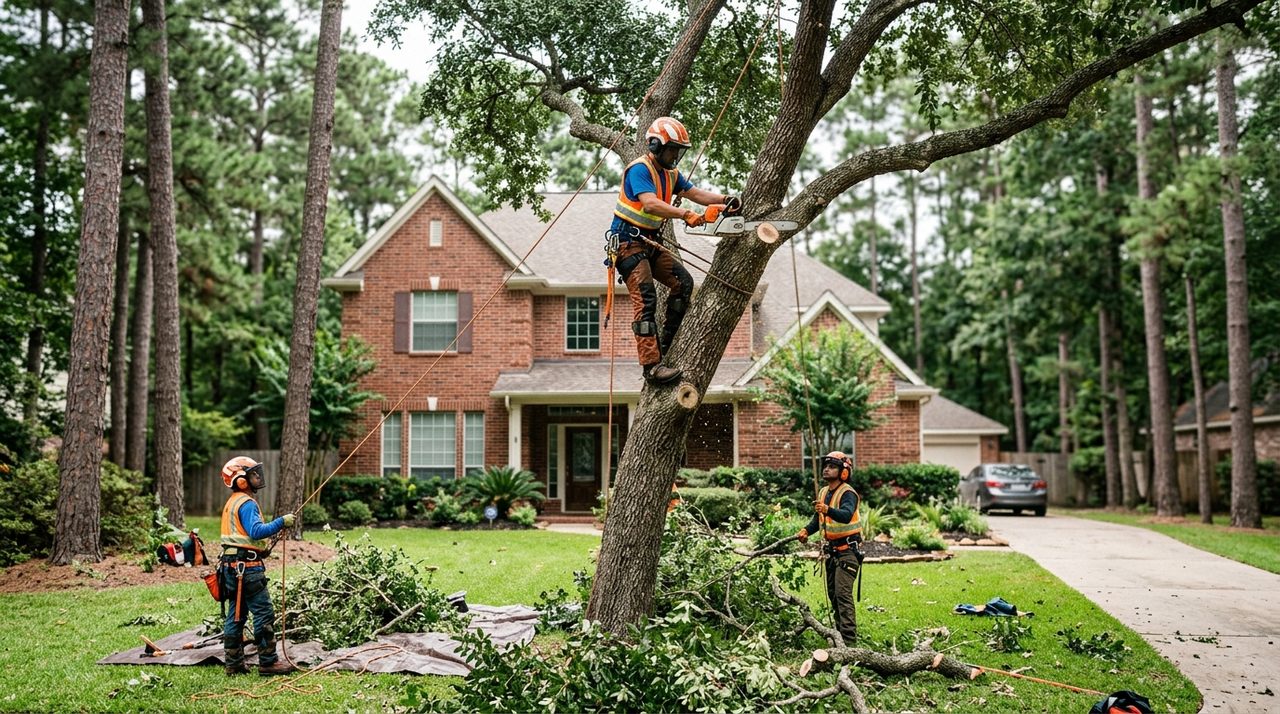
The Woodlands was deliberately built around its tree canopy — the 1974 master plan preserved native pines and oaks as a core community asset, which means virtually every lot in every village, from Grogan's Mill to Creekside Park, has significant mature trees within feet of driveways, foundations, and rooflines. That same canopy that defines the community's identity became a liability during the May 2024 derecho and Hurricane Beryl 2024, when straight-line winds snapped loblolly pines and toppled water oaks across Montgomery County. Understanding how The Woodlands Township's deed restrictions, Montgomery County permitting (not City of Houston), and the area's pine-beetle pressure all intersect will save you money and keep you out of covenant trouble before the first cut is made.
Ranked by verified Google rating × review volume × verification tier. How we rank →
24624 Interstate 45 N Suite 200, Spring, TX 77386
9000 Six Pines Dr, Shenandoah, TX 77380
9145 TX-242, Conroe, TX 77385
9444 Simmons Dr, Conroe, TX 77385
29123 Portsoy Dr, Magnolia, TX 77354
5810 Nueces Dr Num 50, Spring, TX 77389
17782 W Loop Rd, Conroe, TX 77384
5411 Susanna Ln, Spring, TX 77389
74 S Hidden View Cir, The Woodlands, TX 77381
11980 Creek Gate Rd, Conroe, TX 77385
Why it matters to you
The Woodlands is not governed by the City of Houston or a single HOA — it operates under deed restrictions enforced at the village level, with The Woodlands Township providing overarching covenant oversight. Many village covenants specifically prohibit removing trees above a defined trunk diameter without prior architectural review committee approval, and violations can result in fines or mandatory replanting at the homeowner's expense. Because the community's entire identity is built on canopy preservation dating to the 1974 founding, enforcement here is taken more seriously than in many suburban subdivisions.
What a good pro does
Before scheduling any removal, pull your specific lot's deed restrictions through Montgomery County records and contact your village association's architectural review process — do not rely on a tree contractor to do this for you. A reputable arborist working regularly in The Woodlands will know to ask for covenant documentation upfront and can help you document hazard conditions (storm damage, disease, structural failure) that are typically exempted from standard approval delays.
Sources: Local HOA / deed restrictions (see area profile), Municipal permit office (see area profile)
Why it matters to you
The loblolly and shortleaf pines that characterize The Woodlands' original northern and western villages — Grogan's Mill, Panther Creek, Cochran's Crossing — are susceptible to southern pine beetle (Dendroctonus frontalis) outbreaks, particularly after drought stress. Dead standing pines become brittle and structurally unpredictable within 12 to 18 months of beetle kill, and a 60-foot dead pine over a 1970s-era home presents a fundamentally different risk profile than a live tree of the same size. Removal costs for dead or beetle-killed pines commonly carry a 25–50% hazard premium over live-tree pricing (est.), and in The Woodlands' tightly wooded lots, rigging and crane access can push large-pine removal well above $3,500.
What a good pro does
If you notice pitch tubes, reddish boring dust, or yellowing crowns on your pines — especially in older village sections — get an ISA Certified Arborist assessment immediately rather than waiting for the tree to show obvious decline. Montgomery County does not require a homeowner permit for tree removal on private property, but a credentialed arborist's written hazard assessment is valuable documentation if your village covenant committee requires justification for emergency removal.
Sources: Municipal permit office (see area profile)
Why it matters to you
The May 2024 derecho's 100-plus mph straight-line winds caused widespread canopy damage across Montgomery County, and Hurricane Beryl followed months later — two major surge events in one calendar year meant every legitimate local tree company was backlogged for weeks. During these windows, out-of-state and unlicensed crews flood the area, often offering cash-only deals with no proof of liability insurance and no understanding of The Woodlands Township's covenant requirements. Texas does not issue a state tree-removal license through TDLR, so there is no license number to verify — insurance coverage and ISA certification are the only objective credentialing benchmarks available to homeowners.
What a good pro does
Before signing anything post-storm, ask for a current certificate of liability insurance naming you as an additional insured and verify ISA Certified Arborist credentials at the ISA's public lookup tool. Get at least two written quotes with line-item stump grinding pricing, as post-storm surge pricing in the Houston metro regularly runs 40–80% above normal rates (est.) — knowing the baseline helps you identify price gouging versus legitimate demand-driven increases.
Sources: Local HOA / deed restrictions (see area profile)
Why it matters to you
The Woodlands' phased build-out from 1974 through the 2020s means the community has homes across five decades of construction, and the oldest sections in Grogan's Mill and Panther Creek have had 40-plus years for live oak and water oak roots — and aggressively self-seeding Chinese tallow trees near the area's bayou corridors — to grow toward slab edges and driveway hardscape. Chinese tallow (a state-listed invasive in Texas under TCEQ guidelines) volunteers rapidly near the drainage greenbelts woven throughout The Woodlands and will re-sprout vigorously from an improperly ground stump. Root intrusion into older clay sewer laterals is also a real risk in the community's earliest-built homes.
What a good pro does
When removing any large oak or tallow within 20 feet of your foundation or driveway, insist that the contractor include stump grinding to at least 12 inches below grade rather than a flush cut — stump grinding in the Houston metro typically runs $150–$400 per stump (est.) and is almost always quoted separately. For Chinese tallow specifically, confirm the contractor is aware that many wood-recycling facilities in the region refuse tallow biomass, and ask how they plan to dispose of the material to avoid leaving it on-site where it can re-root.
Sources: Texas Commission on Environmental Quality, Local HOA / deed restrictions (see area profile)
Hiring tree removal in The Woodlands? The Woodlands is a large master-planned community in Montgomery County governed by The Woodlands Township rather than a traditional HOA, with deed restrictions and covenants on individual lots. Housing spans multiple decades since the community's 1974 founding, meaning contractors encounter a wide range of system ages and conditions. Permitting runs through Montgomery County rather than the City of Houston, which affects licensing and inspection requirements for all trades.
Building era
1970s through 2020s — phased development since 1974, with northern sections generally representing later phases.
Typical style
Not confirmed from available sources — likely a mix of traditional, transitional, and contemporary styles typical of Houston-area master-planned communities.
Foundations
Not confirmed — slab-on-grade is typical for the region but not source-verified for this specific area.
Common systems
Given the multi-decade build-out, expect a wide range: older homes may have R-22 HVAC systems and copper/galvanized plumbing, while newer construction features R-410A systems and PEX plumbing.
What that means for repairs
Older 1970s–1990s sections likely drive demand for HVAC upgrades, kitchen and bath remodels, and plumbing replacements. Deed restrictions and township architectural guidelines affect exterior modifications.
Permit jurisdiction
Montgomery County — The Woodlands is an unincorporated community and does not have its own city permit office. Permits are handled through Montgomery County engineering and development services.
HOA & deed restrictions
No traditional mandatory HOA for the overall community. The Woodlands Township, a special-purpose district, provides governance and services. Deed restrictions and covenants apply to individual lots. Some villages or sub-neighborhoods may have their own associations or architectural review processes — check specific lot records.
Historic districts
No City of Houston historic district designation — The Woodlands is in unincorporated Montgomery County, outside HAHC jurisdiction.
Contractor note
Contractors must follow Montgomery County permitting requirements, not City of Houston codes. Exterior modifications may also require approval through The Woodlands Township or village-level covenant enforcement processes, so confirm before starting work.
FEMA flood zone
FEMA Zone X (low flood risk) per official NFHL data. The Woodlands was designed with an integrated drainage system including retention ponds and natural waterways, though proximity to specific creeks or drainage channels may vary by lot.
Hurricane Harvey impact
Not verified from available sources for The Woodlands North specifically. Some areas of The Woodlands experienced flooding during Harvey in 2017, but neighborhood-specific impact and recurring flood streets could not be confirmed — check Montgomery County floodplain maps and FEMA claims data for parcel-level information.
Heat & humidity load
Houston-area summers with sustained high heat and humidity stress HVAC systems heavily, especially in older homes with less efficient insulation. The wooded setting of the community can contribute to moisture-related issues, mold risk, and increased pest pressure around foundations and attic spaces.
Working with contractors here
The Woodlands' multi-decade build-out means contractors encounter everything from 1970s-era homes needing full system overhauls to recently constructed properties still under builder warranty. HVAC replacement and efficiency upgrades are common in older sections, while newer homes may need cosmetic updates or smart home integrations. The township's deed restrictions and village-level architectural controls mean exterior work — roofing, fencing, painting — often requires pre-approval before starting. Contractors should confirm Montgomery County permit requirements rather than assuming City of Houston processes apply. The heavily wooded lots that define the community create recurring demand for tree-related services, gutter maintenance, and drainage work around foundations.
Local Tip
Always ask for a written estimate before work begins. Texas contractors are required to provide one on jobs over $1,000.
The Woodlands is a large master-planned community in Montgomery County governed by The Woodlands Township rather than a traditional HOA, with deed restrictions and covenants on individual lots. Housing spans multiple decades since the community's 1974 founding, meaning contractors encounter a wide range of system ages and conditions. Permitting runs through Montgomery County rather than the City of Houston, which affects licensing and inspection requirements for all trades.
Source: U.S. Census Bureau, ACS 5-Year 2023
Most of The Woodlands maps to FEMA Zone X (low mapped flood risk), but Houston's flash-flood reality means even low-risk blocks benefit from smart drainage and storm-hardened installs.
Source: FEMA National Flood Hazard Layer (NFHL). Flood zones vary by parcel — verify your individual FIRM panel.
Wind is the primary tree hazard in lower-risk The Woodlands, TX neighborhoods during a Gulf hurricane, so focus pre-storm efforts on removing dead or structurally weak trees that could reach your roof line or power drop. A TDLR-licensed contractor can perform a hazard assessment and complete removal well before a storm's 72-hour watch window, when crews become unavailable across the Houston metro. Confirm the current FEMA panel for your The Woodlands parcel — the area maps to Zone X, but adjacent lots can differ.
Proactive removal of trees with significant deadwood or structural defects in The Woodlands, TX costs a fraction of the emergency extraction and roof repair that follows a thunderstorm failure. Severe storms in the Houston area can produce 70-plus mph gusts with almost no advance warning, which means the pre-storm window is the only realistic time to act before a low-flood-risk yard becomes a debris field. As a Montgomery County community, The Woodlands may follow county rather than City of Houston storm rebuild rules.
The most actionable winter prep for tree removal in The Woodlands, TX is removing any tree or large limb that hangs directly over a roofline, vehicle parking area, or power service drop before the first freeze advisory. Ice adds weight faster than most homeowners expect, and Houston trees that have never experienced sustained ice loading have no adaptive resilience to that stress. Confirm the current FEMA panel for your The Woodlands parcel — the area maps to Zone X, but adjacent lots can differ.
Sources: FEMA National Flood Hazard Layer (NFHL), Ready.gov -- Hurricanes, CenterPoint Energy -- Storm Center, City of Houston -- Emergency Preparedness, Ready.gov -- Winter Weather, Harris County Flood Control District
Houston-specific estimators to plan your project before you call a pro. All results are planning estimates — a licensed local pro confirms the details on site.
Grouped by mature root aggression & water demand.
Trunk center to the nearest exterior wall.
The root zone likely reaches your foundation's soil during Houston's dry summers, when clay shrinks most. Watch for sticking doors and diagonal cracks, keep soil moisture even with a soaker hose during drought, and have a foundation pro evaluate if you see any movement.
Find a Houston foundation pro →This is a planning estimate only — actual requirements depend on an on-site assessment by a licensed Houston pro. Guidance is based on general species root behavior in expansive clay, not a soil test.
Disconnect & drain every outdoor hose bib
Remove hoses, drain the spigots, and cover each with an insulated faucet sock. Un-drained hose bibs are the #1 burst point in a Houston freeze.
Insulate exposed pipes in the attic & garage
Wrap any pipe in an unconditioned space (attic runs, garage walls) with foam sleeves. Houston homes rarely insulate these because they only matter a few nights a year — which is exactly why they burst.
Open cabinet doors & keep a pencil-width drip
On hard-freeze nights, open kitchen/bath cabinets so warm air reaches the pipes and let faucets on exterior walls drip to relieve pressure.
Protect the attic/garage water heater & its lines
An attic or garage tank sits in unconditioned space. Insulate the cold-inlet and hot-outlet lines and confirm the emergency drain pan is clear so a leak doesn't reach the ceiling.
This is a planning estimate only — actual requirements depend on an on-site assessment by a licensed Houston pro. If a pipe has already burst, shut off your main water supply and call a licensed Houston plumber immediately — freeze bursts flood fast.
Sources: Municipal permit office (see area profile)Local HOA / deed restrictions (see area profile)
Sources: Local HOA / deed restrictions (see area profile)