2014 45th St, Galveston, TX 77550
Best Tree Removal in Galveston, TX
Galveston Island's tree removal challenges are unlike anywhere else in the Houston metro: a salt-air environment that accelerates decay in standing trees, a FEMA Zone AE coastal footprint where storm-damaged wood debris intersects directly with federal flood-assistance rules, and a permit jurisdiction that runs through the City of Galveston Development Services Department — not Houston. Whether you're dealing with hurricane-battered palms on a historic East End raised Victorian or a wind-thrown water oak threatening a beach-house piling foundation on the West End, understanding the island's specific regulatory, environmental, and storm-surge realities will save you money and legal headaches.
Verified against Google Business data
Updated 2026
See the 2 Tree Removal Serving Galveston 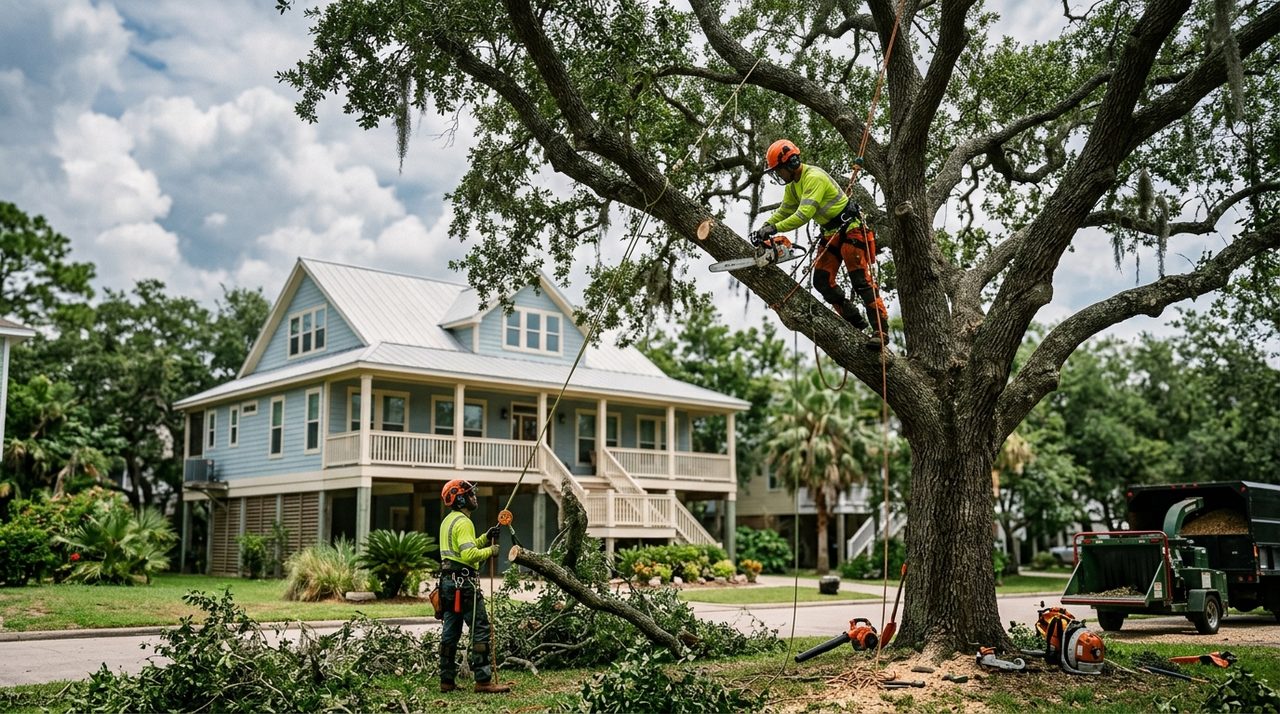
- Median home built
- 1973
- Median home value
- $294,300
- FEMA flood zone
- AE (high)
- Typical tree removal cost (est.)
- $750–$5,000+
- Most common local issue
- Post-hurricane emergency removal surge with fly-by-night operators
Ranked by verified Google rating × review volume × verification tier. How we rank →
Some highly-rated pros serve Galveston from nearby and may not keep a Galveston street address. Those are listed under "Also serving Galveston" with their real city and distance, so you always know where each business is based.
Min rating:
2 resultsBased in Galveston
Also serving Galveston
Highly-rated pros based nearby who cover Galveston. Distance shown from the Galveston area.
Closed
Serving Galveston Based in La Marque · 4.2 mi away
Tree Removal in Galveston: What You Should Know
Hurricane and Gulf-Wind Surge: Post-Storm Pricing and Operator Fraud
Why it matters to you
Galveston took direct hurricane-force impacts from Beryl in 2024 and sits perpetually in the Gulf's crosshairs — every named landfall within 100 miles triggers an island-wide removal backlog almost overnight. In those weeks, out-of-state crews with no local track record flood the Strand and Seawall Boulevard corridor, quoting inflated prices on storm-damaged trees and sometimes collecting deposits before disappearing. Because roughly 53% of Galveston housing units are non-owner-occupied vacation or rental properties (ACS 2023), absentee owners are especially vulnerable to phone-only quotes on trees they can't personally inspect.
What a good pro does
Before signing anything after a named storm, verify the crew carries general liability insurance and ask for the certificate naming you as an additional insured — not just a verbal claim. Prioritize ISA Certified Arborists, whose credentials you can confirm at the ISA's public directory. Get at least two written, on-site quotes before authorizing work, and pay no more than a 10–15% deposit up front. Expect legitimate estimates for a large, storm-damaged coastal live oak or palm over 50 feet on Galveston Island to run $2,500–$5,000+ with a hazard premium, so a quote dramatically below that range warrants scrutiny.
Sources: Municipal permit office (see area profile), FEMA National Flood Hazard Layer (NFHL)
FEMA Zone AE Rules: What Storm-Debris Removal May — and May Not — Reimburse
Why it matters to you
Nearly all of Galveston Island is mapped in FEMA Zone AE, and in a presidentially declared disaster, homeowners are frequently confused about whether tree removal costs can be recouped through FEMA Individual Assistance, NFIP flood policies, or the City of Galveston's curbside debris pickup program. Standard NFIP flood policies do not cover tree removal as a line item — that cost is typically a private-pay expense unless the tree caused direct structural damage to an insured building. After Beryl 2024, the City of Galveston's debris removal window for right-of-way pickup was strictly time-limited, and material left at the curb after the cutoff became the homeowner's financial responsibility.
What a good pro does
Document every downed or damaged tree with timestamped photos before any cutting begins — this record supports both insurance claims and any FEMA Individual Assistance application for structural damage the tree caused. Separate debris into clean wood, hazardous material, and construction debris as directed by current City of Galveston pickup guidelines, since mixing categories can disqualify a load from free municipal collection. Confirm with your homeowner's insurer which rider, if any, covers tree removal — wind-damage policies vary widely and some specifically exclude removal when the tree did not strike a covered structure.
Sources: FEMA National Flood Hazard Layer (NFHL), Harris County Flood Control District, Municipal permit office (see area profile)
Salt-Air Decay and Coastal Tree Hazard: The Hidden Failure Point
Why it matters to you
The persistent onshore Gulf breeze that defines island life accelerates bark and cambium decay in many tree species, particularly in older specimens near the Seawall or East End historic district where corrosive salt-laden air has been at work for decades. A tree that looks structurally sound from the sidewalk can be deeply compromised at its core — a condition that makes aerial removal far more unpredictable and expensive than comparable inland work, because climbers cannot safely ascend a trunk with hidden rot without risk of sudden wood failure. This is especially acute on Galveston's 19th-century residential blocks, where mature salt-stressed trees often predate the 1900 Storm.
What a good pro does
Before committing to removal, request a formal hazard assessment from an ISA Certified Arborist who will probe and sound the trunk rather than assess from the ground only. Removal of a confirmed-decayed large specimen on Galveston Island typically warrants a crane-assisted or sectional rigging operation rather than standard climbing, which adds cost — budget for the hazard premium of 25–50% above baseline pricing. No state license is required for tree work in Texas, so the arborist credential and proof of liability insurance remain the primary vetting tools for homeowners.
Sources: Municipal permit office (see area profile), Texas Commission on Environmental Quality
Pier-and-Beam and Raised-Piling Foundations: Root and Access Complications
Why it matters to you
Unlike the slab-on-grade construction common across inland Harris County suburbs, a large share of Galveston's housing stock — particularly the historic East End Victorians and elevated coastal builds — sits on pier-and-beam or piling foundations. Tree roots that migrate toward these foundations can undermine soil bearing capacity around the piers and, in the island's sandy and semi-clay blended soils near the bay side, can destabilize a foundation that was already re-engineered after prior surge events. Removing a large tree close to an elevated structure also presents rigging access challenges because equipment cannot always be positioned under the home's raised deck.
What a good pro does
A competent removal contractor should walk the full perimeter before quoting, noting foundation type, pier locations, and equipment staging constraints — quotes that are given over the phone for Galveston island properties without a site visit should be treated with skepticism. Stump grinding near pier foundations should stop short of the root ball's structural zone; confirm with the contractor how close to the pier the grinder will operate and whether a root barrier or backfill is included. Permits for tree removal on private residential property are not required by the City of Galveston for routine work, but confirm this with the City of Galveston Development Services Department for any tree touching a historic-district structure, as additional preservation review may apply.
Sources: Municipal permit office (see area profile), Local HOA / deed restrictions (see area profile)
Tree Removal in Galveston: What You Should Know
Hiring tree removal in Galveston? Galveston's housing stock spans from historic 19th-century Victorian homes to modern beach developments, creating an exceptionally diverse home service landscape. Homeowners must contend with persistent salt air corrosion, high flood risk across much of the island, and hurricane exposure that drives demand for wind-resistant roofing, elevated foundations, and robust moisture management. Permit jurisdiction falls under the City of Galveston Development Services Department or Galveston County, never the City of Houston Permitting Center.
- Housing era
- Highly mixed — 1800s historic core through 21st-century beach and master-planned construction
- Foundation
- Mixed — many historic and coastal homes on pier-and-beam or raised pilings
- Flood zone
- FEMA Zone AE (high flood risk) — source
- Permits
- City of Galveston Development Services Department (within city limits)
Housing stock & systems
Building era
Highly mixed — 1800s historic core through 21st-century beach and master-planned construction.
Typical style
Mix of Victorian, Gulf Coast vernacular, raised beach houses, mid-century ranch, and modern coastal developments; no single dominant style across the area.
Foundations
Mixed — many historic and coastal homes on pier-and-beam or raised pilings; newer mainland construction often slab-on-grade. Not confirmed at subdivision level — check property records.
Common systems
Older homes may have outdated electrical and galvanized plumbing requiring upgrades; coastal properties require corrosion-resistant HVAC equipment rated for salt air environments; newer builds typically feature modern central HVAC and PEX or copper plumbing.
What that means for repairs
Historic restoration is common in Galveston's core; coastal properties frequently undergo elevation projects, hurricane hardening, and replacement of salt-air-corroded exterior systems. Flood damage repair drives significant renovation activity across all housing types.
Permits & restrictions
Permit jurisdiction
City of Galveston Development Services Department (within city limits); individual incorporated cities handle their own permitting elsewhere in Galveston County; unincorporated areas fall under Galveston County jurisdiction. Not the City of Houston Permitting Center.
HOA & deed restrictions
No county-wide mandatory HOA. HOAs exist at the subdivision, condo, and master-planned community level. Many single-family homes in Galveston have no HOA. Check deed restrictions recorded with the Galveston County Clerk for specific properties.
Historic districts
No City of Houston historic district designation — Galveston is outside Houston's jurisdiction. The City of Galveston maintains its own historic preservation program and local historic districts, governed by Galveston's ordinances separate from Houston's HAHC.
Contractor note
Contractors must verify whether work falls within City of Galveston, another incorporated Galveston County city, or unincorporated county jurisdiction, as permitting requirements and floodplain regulations differ significantly. Properties in local historic districts within the City of Galveston may require additional preservation review separate from any Houston process.
Flood & weather
FEMA flood zone
FEMA Zone AE (high flood risk) — source: fema_nfhl. Galveston's island geography and coastal exposure create significant flood risk from both storm surge and rainfall. Proximity to the Gulf of Mexico and Galveston Bay compounds risk across most of the area.
Hurricane Harvey impact
Hurricane Harvey's flood impacts in Galveston County were highly localized and varied by precise location — bayfront vs. mainland interior, creek proximity, and elevation. Specific street-level flooding data for this area could not be confirmed without a more precise subdivision or address — check FEMA Harvey flood inundation maps and Galveston County floodplain administrator reports for property-specific history.
Heat & humidity load
Extreme humidity and salt air accelerate corrosion of HVAC condensers, metal roofing components, and exterior fasteners. Summer heat combined with coastal moisture drives high demand for dehumidification, mold remediation, and HVAC maintenance. Prolonged UV exposure degrades exterior paint and sealants faster than inland areas.
Working with contractors here
Contractors in Galveston most commonly work on flood damage repair, foundation elevation projects, hurricane-hardening (impact windows, fortified roofing), and replacement of salt-air-corroded exterior systems including HVAC condensers, metal railings, and fasteners. The wide range of housing eras means contractors must be prepared for both historic restoration requiring period-appropriate materials and modern coastal construction techniques. Job scoping should always include assessment of flood history, current elevation relative to base flood elevation, and whether the property falls within a City of Galveston historic district requiring preservation review. Corrosion-resistant materials and marine-grade hardware should be specified as standard for any exterior work.
Local Tip
Always ask for a written estimate before work begins. Texas contractors are required to provide one on jobs over $1,000.
About Galveston
Galveston's housing stock spans from historic 19th-century Victorian homes to modern beach developments, creating an exceptionally diverse home service landscape. Homeowners must contend with persistent salt air corrosion, high flood risk across much of the island, and hurricane exposure that drives demand for wind-resistant roofing, elevated foundations, and robust moisture management. Permit jurisdiction falls under the City of Galveston Development Services Department or Galveston County, never the City of Houston Permitting Center.
- Median year built
- 1973
- Median home value
- $294,300
- Owner-occupied
- 46.7%
- Population
- 53,348
- Housing units
- 34,921
- Median income
- $57,216
Source: U.S. Census Bureau, ACS 5-Year 2023
Flood & storm risk
FEMA Zone AEHigh flood riskOn Galveston Island, storm surge and Gulf wind are the defining hazards: much of Galveston sits in FEMA Zone AE coastal high-hazard territory, so wind-rated, elevation- and surge-aware work is the baseline, not an upgrade.
Source: FEMA National Flood Hazard Layer (NFHL). Flood zones vary by parcel — verify your individual FIRM panel.
Houston Storm Readiness in Galveston
Hurricane & flooding
Storm surge recorded during Harvey 2017 submerged root zones along the Galveston Bay shoreline for days, killing trees that then became widow-makers in subsequent storm seasons, so post-hurricane tree assessments in Galveston, TX are just as important as pre-storm removals. TDLR-licensed crews working coastal sites must account for soft, saturated soils when rigging removal to prevent secondary structure damage. Much of the housing stock predates modern wind codes (median build year 1973), so retrofits matter more here. Confirm the current FEMA panel for your Galveston parcel — the area maps to Zone AE, but adjacent lots can differ.
Severe storms & hail
Lightning strike risk is elevated for tall isolated trees on open coastal Galveston, TX properties, and a lightning-struck tree frequently becomes a hazard tree requiring professional removal within one to two seasons. Have a licensed contractor assess any tree that has been struck, since internal decay following a strike is rarely visible from the ground and the tree can fail without warning in subsequent storms. Confirm the current FEMA panel for your Galveston parcel — the area maps to Zone AE, but adjacent lots can differ.
Ice storms & freezes
Ice coating on coastal Galveston, TX trees can be amplified by freezing salt spray, increasing canopy weight beyond what even healthy root systems can resist during a hard freeze. Scheduling removal of high-risk trees before winter, rather than reacting after a failure event, is both safer and significantly less expensive than emergency extraction from a storm-damaged coastal property. With a median build year of 1973, the older building stock here is more exposed to hard-freeze damage than newer construction. As a Galveston County community, Galveston may follow county rather than City of Houston storm rebuild rules.
Sources: FEMA National Flood Hazard Layer (NFHL), Ready.gov -- Hurricanes, CenterPoint Energy -- Storm Center, City of Houston -- Emergency Preparedness, Ready.gov -- Winter Weather, Harris County Flood Control District
Free Galveston Tools & Calculators
Houston-specific estimators to plan your project before you call a pro. All results are planning estimates — a licensed local pro confirms the details on site.
Houston Soil & Tree Proximity Risk Calculator
Open full tool & FAQ →Grouped by mature root aggression & water demand.
Trunk center to the nearest exterior wall.
Moderate risk
The root zone likely reaches your foundation's soil during Houston's dry summers, when clay shrinks most. Watch for sticking doors and diagonal cracks, keep soil moisture even with a soaker hose during drought, and have a foundation pro evaluate if you see any movement.
Find a Houston foundation pro →This is a planning estimate only — actual requirements depend on an on-site assessment by a licensed Houston pro. Guidance is based on general species root behavior in expansive clay, not a soil test.
Houston Freeze Prep & Pipe Insulation Checklist
Open full tool & FAQ →Your freeze checklist — 4 tasks
- 1
Disconnect & drain every outdoor hose bib
Remove hoses, drain the spigots, and cover each with an insulated faucet sock. Un-drained hose bibs are the #1 burst point in a Houston freeze.
- 2
Insulate exposed pipes in the attic & garage
Wrap any pipe in an unconditioned space (attic runs, garage walls) with foam sleeves. Houston homes rarely insulate these because they only matter a few nights a year — which is exactly why they burst.
- 3
Open cabinet doors & keep a pencil-width drip
On hard-freeze nights, open kitchen/bath cabinets so warm air reaches the pipes and let faucets on exterior walls drip to relieve pressure.
- 4
Protect the attic/garage water heater & its lines
An attic or garage tank sits in unconditioned space. Insulate the cold-inlet and hot-outlet lines and confirm the emergency drain pan is clear so a leak doesn't reach the ceiling.
This is a planning estimate only — actual requirements depend on an on-site assessment by a licensed Houston pro. If a pipe has already burst, shut off your main water supply and call a licensed Houston plumber immediately — freeze bursts flood fast.
Frequently Asked Questions
Do I need a permit from the City of Galveston to remove a tree on my private property?
Permits for tree removal on private property in Galveston are governed by the City of Galveston Development Services Department — not the City of Houston Permitting Center, which has no jurisdiction on the island. Galveston does not require a routine removal permit for most private-property trees, but if your property falls within one of Galveston's local historic districts, additional preservation review may be required before work begins. Always confirm with the City of Galveston Development Services Department before scheduling work, especially on the historic East End where district rules can apply to site features as well as structures.
Sources: Municipal permit office (see area profile)
My Galveston home is in FEMA Zone AE — can any of my hurricane tree-debris removal costs be reimbursed after a declared disaster?
After a federally declared disaster, FEMA Public Assistance programs can cover debris removal from public rights-of-way by eligible local governments, but removal of storm-damaged trees from your private lot is generally a private-pay expense not reimbursable through FEMA's individual assistance programs. Homeowners in FEMA Zone AE should review their NFIP or private flood policy carefully, as most flood policies cover structural damage rather than tree-removal labor. Keep itemized receipts and before-and-after photos of all debris work in case documentation is needed for any supplemental assistance claim.
Are there Chinese tallow trees on Galveston Island, and is removal handled any differently there than on the mainland?
Yes, Chinese tallow is widespread on Galveston Island, particularly near drainage ditches, the bayshore, and disturbed lots that see recurring flood activity — conditions common across the island's AE flood zone. Because stumps resprout aggressively, stump grinding to at least 8–10 inches below grade is especially important in Galveston's moist coastal soil, and some recycling facilities will not accept tallow wood, so confirm disposal logistics with your contractor before work starts. The Texas Commission on Environmental Quality lists Chinese tallow as an invasive species, and removal near Galveston's tidal drainage areas should avoid pushing cut material into waterways.
How long after a major Gulf storm should I expect to wait before a reputable Galveston tree company can schedule my job?
After a direct or near-direct hit like Hurricane Beryl in 2024, established island tree companies typically face backlogs of three to six weeks for non-emergency removals, with emergency crane work on structures taking priority. Post-storm pricing on Galveston Island tends to run at the high end of the 40–80% surge premium seen across the metro, partly because mobilizing heavy equipment across the causeway adds logistical cost. If your situation is not an active structural hazard, waiting four to eight weeks for a vetted ISA Certified Arborist rather than hiring the first crew that appears in your neighborhood after a storm is generally the more cost-effective approach.
I have a raised Victorian on Galveston's East End with large trees close to the piling foundation — do ISA arborists in the area understand that foundation type?
Galveston's historic East End homes built on wooden piling or raised pier-and-beam foundations present different root-conflict risks than the slab-on-grade construction common in most Houston suburbs, and a qualified ISA Certified Arborist familiar with coastal island work should assess proximity before removal rather than assuming mainland slab-specific rules apply. The primary concern with raised foundations on Galveston Island is root intrusion into aging piling sleeves and the risk of compromised soil structure beneath the pier footings during extraction of large root balls. Ask any arborist you interview whether they have direct experience working around raised-piling foundations on the island, since the rigging and extraction approach differs meaningfully from inland work.
Does Galveston's HOA landscape affect whether I need approval before removing a tree in a beach subdivision?
There is no county-wide mandatory HOA in Galveston, so whether you need architectural committee approval depends entirely on the deed restrictions recorded for your specific subdivision with the Galveston County Clerk — many single-family lots on the island have no HOA at all. Condo and master-planned beach communities on the West End are more likely to have active HOAs with canopy or landscaping rules that require written approval before removing any tree above a specified trunk diameter. Pull your deed restrictions before scheduling work; violations can result in fines or mandatory replanting even in low-density beach neighborhoods where enforcement feels informal.
Sources: Local HOA / deed restrictions (see area profile)