Closed
2245 Texas Dr #300, Sugar Land, TX 77479
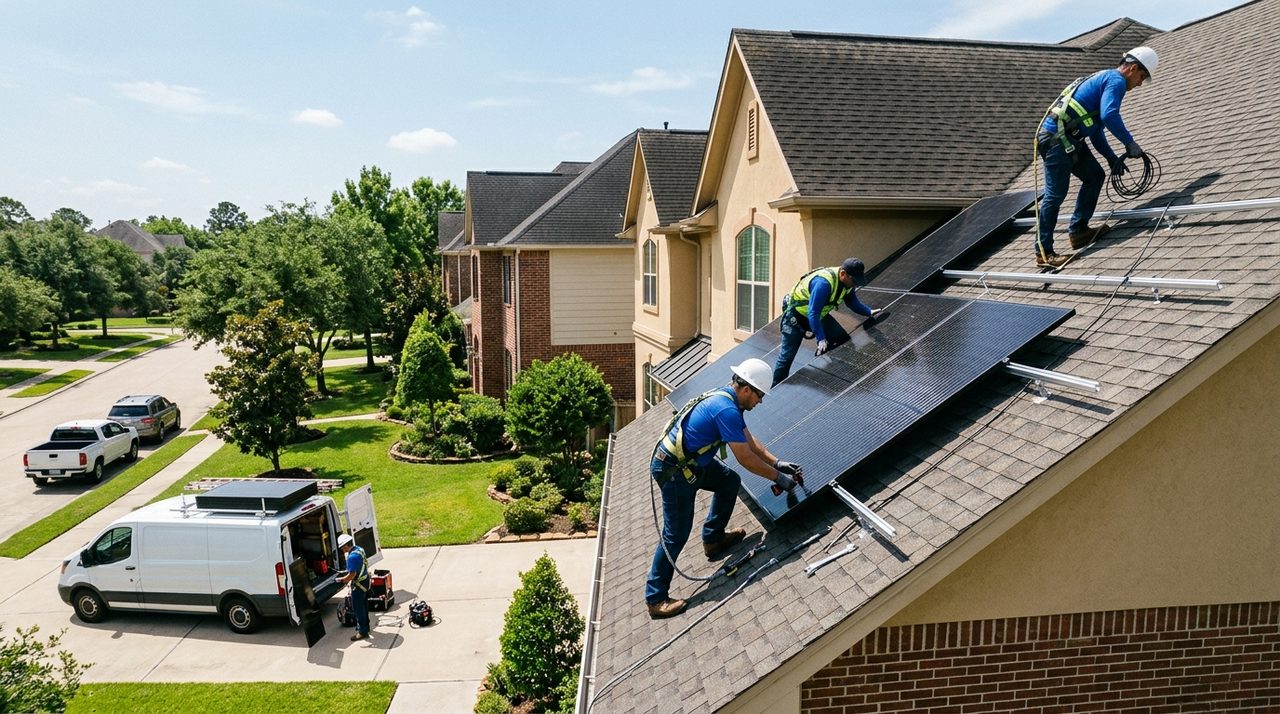
Sugar Land's master-planned subdivisions — from First Colony's 1980s–1990s brick ranches to Telfair's 2000s–2010s two-stories — present a specific solar challenge: every array must clear not just the City of Sugar Land Development Services permit office but also each subdivision's architectural control committee before a single bracket goes on the roof. With median homes built around 1994, composition shingle roofs are hitting their second lifecycle just as homeowners are ready to go solar, making installation sequencing a critical financial decision. This page explains the four issues that actually separate a well-executed Sugar Land solar project from one that costs you money twice.
Ranked by verified Google rating × review volume × verification tier. How we rank →
Some highly-rated pros serve Sugar Land from nearby and may not keep a Sugar Land street address. Those are listed under "Also serving Sugar Land" with their real city and distance, so you always know where each business is based.
2245 Texas Dr #300, Sugar Land, TX 77479
Highly-rated pros based nearby who cover Sugar Land. Distance shown from the Sugar Land area.
Serving Sugar Land Based in Stafford · 3.8 mi away
Serving Sugar Land Based in Stafford · 4.3 mi away
Serving Sugar Land Based in Alief · 5.2 mi away
Serving Sugar Land Based in Missouri City · 6.6 mi away
Serving Sugar Land Based in Sharpstown · 8.1 mi away
Serving Sugar Land Based in Meyerland · 8.4 mi away
Serving Sugar Land Based in Westbury · 8.7 mi away
Serving Sugar Land Based in Briargrove · 9.2 mi away
Why it matters to you
Virtually every Sugar Land subdivision — Sugar Lakes POA, New Territory Residential Community Association, First Colony community associations, and Telfair's POA — enforces deed restrictions with an active architectural control committee. Texas Property Code §202.010 protects your right to install solar but explicitly allows HOAs to require placement that keeps panels 'not visible from the street,' which in Sugar Land's north- and west-facing rear yards often means east-facing or heavily shaded slopes. A system forced onto an east-facing pitch rather than the optimal south-facing slope can realistically deliver 15–25% less annual production — a gap that changes your payback math significantly.
What a good pro does
A qualified installer working in Sugar Land should pull your subdivision's specific deed restrictions and submit a compliant placement proposal to the architectural control committee before finalizing the system design — not after. They should model both the HOA-required placement and the optimal placement so you see the production and financial difference in writing before signing a contract. Approval timelines vary by subdivision and can add two to six weeks; budget for that in your project schedule.
Sources: Local HOA / deed restrictions (see area profile), Municipal permit office (see area profile)
Why it matters to you
Sugar Land's median home was built in 1994, which means a large share of the housing stock carries original or Harvey-era (2017–2019) replacement shingles that are now 15–25 years old. Houston's combination of a UV index regularly hitting 10–11, summer heat cycles above 95°F, and high humidity degrades standard 3-tab asphalt shingles in 12–15 years rather than their rated 20–25. Mounting a 25-year panel array on a shingle roof that has 5–8 years of life left creates a near-certain future expense: panel removal, full re-roof, and reinstallation — a cost that can run $8,000–$18,000 (est.) and is rarely disclosed upfront by installers focused on closing the solar deal.
What a good pro does
Before any racking goes on, a responsible installer should review your roof's age, material, and condition and provide a written assessment. If the roof has fewer than 10 years of remaining life, re-roofing first — or in the same project — is the financially sound choice. City of Sugar Land Development Services requires a building permit for the solar installation; a permit for concurrent roofing work can often be pulled at the same time, and the HOA architectural committee review for roofing materials should happen simultaneously to avoid double submissions.
Sources: Municipal permit office (see area profile), Local HOA / deed restrictions (see area profile), International Residential Code (as adopted by City of Houston)
Why it matters to you
Sugar Land's 1980s–1990s brick homes frequently carry aging original HVAC systems running well below modern efficiency ratings, and many homeowners are adding pool pumps or EV chargers as the neighborhood matures. Houston logs roughly 3,000 cooling degree days annually, and a typical 2,200 sq ft Sugar Land home can consume 1,400–1,800 kWh per month during the June–September peak. Installers who size systems using national consumption averages instead of your actual CenterPoint Energy billing history routinely deliver systems that offset only 40–50% of real load — while quoting 80–100%.
What a good pro does
A properly scoped Sugar Land installation starts with 12–24 months of your CenterPoint account data, not a square-footage estimate. If you are planning an HVAC replacement, pool pump upgrade, or EV charger addition, those loads should be factored into the system size before the City of Sugar Land permit is submitted — resizing after interconnection approval adds months. The installer must hold a valid TDLR Electrical Contractor license and have a licensed master electrician pull the City of Sugar Land permit; verify NABCEP PV Installation Professional certification as an additional quality indicator.
Sources: Texas Department of Licensing & Regulation, North American Board of Certified Energy Practitioners (NABCEP), Municipal permit office (see area profile)
Why it matters to you
Winter Storm Uri (February 2021) and the grid stress from Hurricane Beryl (July 2024) have made battery backup a serious consideration for Sugar Land homeowners, many of whom lost power for days in homes that had no backup. Tesla Powerwall and Enphase IQ Battery systems paired with solar are increasingly requested, but CenterPoint Energy's interconnection tariff for storage-paired systems requires a separate metering application that routinely adds 6–10 weeks to the project timeline beyond the standard solar interconnection queue. Sugar Land homes built before 2000 may also need electrical panel evaluation before battery integration, since battery systems draw on and feed back through your main panel.
What a good pro does
The City of Sugar Land Development Services issues the permit for battery storage installations, and the application must reflect the full system including storage from the start — amending mid-permit adds time. Your installer should submit the CenterPoint interconnection application for the storage-paired system on day one of the project, not after the hardware arrives. For homes in the 1985–1999 build range, request a written panel assessment before signing a battery contract; a panel upgrade, if needed, runs $2,500–$5,000 (est.) and must also be permitted through the City of Sugar Land.
Sources: Municipal permit office (see area profile), Texas Department of Licensing & Regulation, ENERGY STAR / U.S. Dept. of Energy
Hiring solar installers in Sugar Land? Sugar Land is composed of numerous master-planned communities, each governed by its own mandatory HOA or POA with actively enforced deed restrictions. The housing stock is predominantly 1980s–2000s suburban brick construction on slab-on-grade foundations, requiring contractors to navigate both city permitting and subdivision-level architectural review for most exterior projects. Proximity to the Brazos River and Oyster Creek creates localized flood risk despite generally favorable FEMA designations.
Building era
Primarily 1980s–2000s, with newer construction in communities like Telfair from the late 2000s–2010s and older sections dating to the 1970s.
Typical style
Traditional suburban brick homes (1- and 2-story) with brick veneer, composition shingle roofs, and attached garages; variants include Colonial-influenced, Mediterranean-influenced, and transitional brick/stone combinations.
Foundations
Slab-on-grade (standard for post-1970 Fort Bend County suburban construction).
Common systems
Central HVAC systems (many original units in 1980s–1990s homes nearing or past replacement age), copper or CPVC plumbing supply lines, cast iron or PVC drain lines depending on era, 200-amp electrical panels in most homes.
What that means for repairs
Kitchen and bathroom remodels are common in 1980s–1990s homes as original finishes age out. HVAC replacement is a major category given system lifespans. Many homeowners pursue exterior updates (stone accents, roof replacement, garage door upgrades) subject to HOA architectural review and approval.
Permit jurisdiction
City of Sugar Land Development Services (Sugar Land is an incorporated city with its own permitting office).
HOA & deed restrictions
HOA or POA membership is mandatory at the subdivision level across virtually all Sugar Land neighborhoods. Examples include Sugar Lakes POA, Ranch Country Association (POA), New Territory Residential Community Association, and First Colony community associations. Each subdivision enforces its own deed restrictions, architectural standards, and assessment schedules. No single city-wide HOA exists.
Historic districts
No historic district designation confirmed. Sugar Land is an incorporated city in Fort Bend County, outside City of Houston HAHC jurisdiction.
Contractor note
Contractors must obtain permits through the City of Sugar Land and should anticipate HOA architectural review requirements for exterior work. Many subdivisions require pre-approval from the HOA's architectural control committee before visible modifications can begin.
FEMA flood zone
FEMA Zone X (low flood risk) per official NFHL data. However, portions of Sugar Land near the Brazos River, Oyster Creek, and areas behind levee systems may carry higher risk designations at the parcel level. Property-specific FEMA lookups are recommended.
Hurricane Harvey impact
Sugar Land experienced significant flooding in some areas during Hurricane Harvey (2017), particularly in subdivisions near the Brazos River, Oyster Creek, and low-lying areas associated with levee districts. Not all subdivisions were equally affected — some experienced minimal impact while others saw substantial water intrusion. Specific subdivision-level Harvey damage records should be verified through Fort Bend County records.
Heat & humidity load
Extreme summer heat and humidity place heavy demand on HVAC systems, particularly in 1980s–1990s homes with aging equipment. Slab-on-grade foundations on expansive clay soils are susceptible to movement during drought-to-rain cycles, making foundation monitoring and proper drainage maintenance critical. Composition shingle roofs degrade faster under sustained UV exposure.
Working with contractors here
HVAC replacement and repair is among the most common contractor activities in Sugar Land, as many homes from the 1980s–1990s build-out are on their second or third system. Roof replacement is frequent given the age of the housing stock and storm exposure. Foundation repair is a recurring need due to expansive clay soils and seasonal moisture fluctuations. Contractors should budget extra time for HOA architectural review and approval processes, which vary by subdivision and can add weeks to project timelines. Exterior work — including paint colors, fencing, roofing materials, and landscaping — is tightly regulated by deed restrictions, so contractors must confirm approved materials and specifications with the relevant HOA before ordering supplies or beginning work.
Local Tip
Always ask for a written estimate before work begins. Texas contractors are required to provide one on jobs over $1,000.
Sugar Land is composed of numerous master-planned communities, each governed by its own mandatory HOA or POA with actively enforced deed restrictions. The housing stock is predominantly 1980s–2000s suburban brick construction on slab-on-grade foundations, requiring contractors to navigate both city permitting and subdivision-level architectural review for most exterior projects. Proximity to the Brazos River and Oyster Creek creates localized flood risk despite generally favorable FEMA designations.
Source: U.S. Census Bureau, ACS 5-Year 2023
Most of Sugar Land maps to FEMA Zone X (low mapped flood risk), but Houston's flash-flood reality means even low-risk blocks benefit from smart drainage and storm-hardened installs; risk climbs sharply on blocks nearest the Brazos River, where it varies parcel to parcel.
Source: FEMA National Flood Hazard Layer (NFHL). Flood zones vary by parcel — verify your individual FIRM panel.
Your solar panels themselves are rated to survive high winds, but the roof structure beneath them must also be sound — have a TDLR-licensed installer inspect flashing and attachment points in Sugar Land, TX before hurricane season to confirm the assembly will perform as a unit. If CenterPoint declares a major outage event, your battery backup system's automatic transfer function is what decides whether your home stays powered. Because Sugar Land drains toward the Brazos River, block-level runoff can differ sharply from the mapped zone.
Power outages in Sugar Land, TX caused by severe thunderstorm damage to CenterPoint infrastructure can last 24 to 72 hours even without a named storm; a solar battery backup system paired with a properly permitted transfer switch lets you run essential loads independently of the grid. Ensure your installer pulled a City of Houston permit and scheduled a final inspection so the system is code-confirmed before storm season. Confirm the current FEMA panel for your Sugar Land parcel — the area maps to Zone X, but adjacent lots can differ.
Ice accumulation temporarily cuts solar panel output in Sugar Land, TX, but the larger freeze-related risk for solar homeowners is an inverter or battery enclosure mounted in an uninsulated garage or attic space exposed to sub-freezing temperatures — equipment manufacturers specify minimum operating temperatures, and falling below them can cause shutdowns or permanent damage. Ask your installer to confirm all system components are within their rated temperature range before the next hard freeze. Confirm the current FEMA panel for your Sugar Land parcel — the area maps to Zone X, but adjacent lots can differ.
Sources: FEMA National Flood Hazard Layer (NFHL), Ready.gov -- Hurricanes, CenterPoint Energy -- Storm Center, City of Houston -- Emergency Preparedness, Ready.gov -- Winter Weather, Harris County Flood Control District
Houston-specific estimators to plan your project before you call a pro. All results are planning estimates — a licensed local pro confirms the details on site.
Disconnect & drain every outdoor hose bib
Remove hoses, drain the spigots, and cover each with an insulated faucet sock. Un-drained hose bibs are the #1 burst point in a Houston freeze.
Insulate exposed pipes in the attic & garage
Wrap any pipe in an unconditioned space (attic runs, garage walls) with foam sleeves. Houston homes rarely insulate these because they only matter a few nights a year — which is exactly why they burst.
Open cabinet doors & keep a pencil-width drip
On hard-freeze nights, open kitchen/bath cabinets so warm air reaches the pipes and let faucets on exterior walls drip to relieve pressure.
Protect the attic/garage water heater & its lines
An attic or garage tank sits in unconditioned space. Insulate the cold-inlet and hot-outlet lines and confirm the emergency drain pan is clear so a leak doesn't reach the ceiling.
This is a planning estimate only — actual requirements depend on an on-site assessment by a licensed Houston pro. If a pipe has already burst, shut off your main water supply and call a licensed Houston plumber immediately — freeze bursts flood fast.
Sources: Municipal permit office (see area profile)Local HOA / deed restrictions (see area profile)
Sources: Texas Department of Licensing & RegulationNorth American Board of Certified Energy Practitioners (NABCEP)
Sources: Municipal permit office (see area profile)