Open Now
2245 Texas Dr #300, Sugar Land, TX 77479
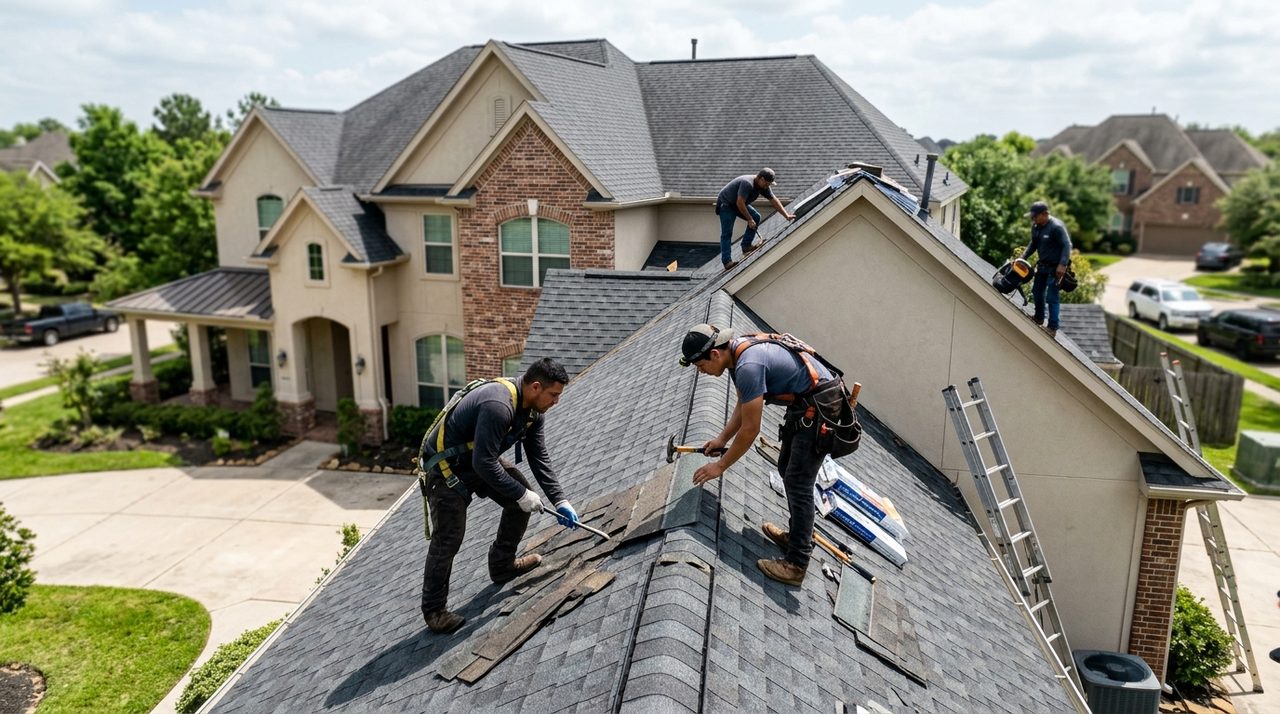
Sugar Land's housing stock — brick-veneer homes built predominantly between 1980 and 2005 across tightly governed master-planned subdivisions — is entering its peak re-roofing window just as hail and wind events are intensifying. Every roofing project in Sugar Land must clear two bureaucratic gates: a permit from the City of Sugar Land Development Services and, in nearly every subdivision, a pre-approval from the relevant HOA or POA architectural control committee. Understanding both layers before materials are ordered can be the difference between a smooth repair and a costly delay.
Ranked by verified Google rating × review volume × verification tier. How we rank →
2245 Texas Dr #300, Sugar Land, TX 77479
17034 University Blvd, Sugar Land, TX 77479
19901 Southwest Fwy, Sugar Land, TX 77479
14090 Southwest Fwy #300, Sugar Land, TX 77478
77 Sugar Creek Center Blvd Ste 600, Sugar Land, TX 77478
19901 Southwest Fwy, Sugar Land, TX 77479
337 Southwestern Blvd, Sugar Land, TX 77478
6920 Brisbane Ct Suite 206, Sugar Land, TX 77479
14090 Southwest Fwy, Sugar Land, TX 77478
902 Walker School Rd, Sugar Land, TX 77479
Why it matters to you
Virtually every Sugar Land neighborhood — from First Colony and New Territory to Sugar Lakes and Telfair — is governed by a POA or HOA with an architectural control committee that must pre-approve roofing material changes, including shingle color and profile upgrades. After the May 2024 derecho produced 100+ mph straight-line winds across Fort Bend County, homeowners who tried to upgrade from their original 3-tab shingles to Class 4 impact-resistant architectural shingles found themselves waiting 10–30 days for ARC decisions while tarps remained on their roofs.
What a good pro does
A contractor experienced in Sugar Land's subdivision landscape will pull the specific deed restriction document for your POA before selecting any product and submit a complete ARC packet — manufacturer cut sheet, color sample, and installation specs — on Day 1 rather than after the permit is filed. Confirm with your HOA in writing whether the approved shingle list is maintained by the community manager or the ARC itself, as the two can differ by subdivision.
Sources: Local HOA / deed restrictions (see area profile), Municipal permit office (see area profile)
Why it matters to you
Unlike an unincorporated Harris County neighborhood, Sugar Land is a fully incorporated city that runs its own Development Services permit office entirely independent of the City of Houston. A full re-roof or structural deck repair requires a building permit from Sugar Land's office, with its own fee schedule, inspection schedule, and approved contractor registration process. Many storm-chasers who flood the area after hail events are not registered with the City of Sugar Land and cannot legally pull permits, leaving homeowners exposed to unpermitted work that can complicate future home sales or insurance claims.
What a good pro does
Before signing any roofing contract, ask the contractor to confirm their City of Sugar Land contractor registration number and verify it is current with Development Services. Texas has no state-issued roofing license through TDLR, so city registration and verifiable general liability plus workers' compensation insurance are the primary consumer protections available. Request the permit number before work begins and confirm the inspection has been scheduled.
Sources: Municipal permit office (see area profile), Local HOA / deed restrictions (see area profile)
Why it matters to you
Sugar Land's median home was built in 1994, meaning a large share of the housing stock carries original or first-replacement composition shingle roofs that are now 20–30+ years old. Houston's 2,700+ annual cooling degree days and attic deck temperatures that regularly exceed 160°F accelerate asphalt binder oxidation, compressing the real-world life of a nominal 25–30 year shingle to 15–18 years. A roof installed on a 1988 First Colony brick colonial or a 1995 New Territory two-story may show granule loss and fiberglass mat brittleness that is invisible from the street but detectable up close.
What a good pro does
Request a written inspection report that documents granule embedment depth, ridge cap condition, and the state of pipe boot flashings — all failure points that become critical after Houston's thermal cycling. When replacing, consider Class 4 impact-resistant architectural shingles, which can qualify Sugar Land homes for TWIA wind-and-hail endorsement discounts; confirm eligibility with your insurer before finalizing shingle selection. Energy Star-rated cool-roof shingles are also worth evaluating given Fort Bend County's solar intensity.
Sources: Texas Windstorm Insurance Association (TWIA), ENERGY STAR / U.S. Dept. of Energy, International Residential Code (as adopted by City of Houston)
Why it matters to you
Many of Sugar Land's 1980s and 1990s ranch and two-story homes were expanded over the decades with rear additions, enclosed patios, or sunrooms covered by low-slope (under 2:12 pitch) modified bitumen or built-up roof sections. Houston's rainfall intensity — Harvey deposited 60 inches over four days — overwhelms the interior drains and scuppers on these sections and causes prolonged ponding that degrades membranes and wets the OSB deck below. Because Sugar Land sits on slab-on-grade construction, a saturated low-slope deck has nowhere to drain and moisture migrates laterally into wall assemblies.
What a good pro does
A qualified roofer will probe the low-slope membrane for soft spots indicating deck delamination before specifying a replacement system. New installs should upgrade scupper sizing and confirm drain slope meets IRC minimums. Modified bitumen or TPO replacement on these sections runs approximately $4.50–$7.50 per square foot installed (estimated), and the cost of ignoring a failing drain detail is invariably higher than proactive repair.
Sources: International Residential Code (as adopted by City of Houston), FEMA National Flood Hazard Layer (NFHL)
Hiring roofers in Sugar Land? Sugar Land is composed of numerous master-planned communities, each governed by its own mandatory HOA or POA with actively enforced deed restrictions. The housing stock is predominantly 1980s–2000s suburban brick construction on slab-on-grade foundations, requiring contractors to navigate both city permitting and subdivision-level architectural review for most exterior projects. Proximity to the Brazos River and Oyster Creek creates localized flood risk despite generally favorable FEMA designations.
Building era
Primarily 1980s–2000s, with newer construction in communities like Telfair from the late 2000s–2010s and older sections dating to the 1970s.
Typical style
Traditional suburban brick homes (1- and 2-story) with brick veneer, composition shingle roofs, and attached garages; variants include Colonial-influenced, Mediterranean-influenced, and transitional brick/stone combinations.
Foundations
Slab-on-grade (standard for post-1970 Fort Bend County suburban construction).
Common systems
Central HVAC systems (many original units in 1980s–1990s homes nearing or past replacement age), copper or CPVC plumbing supply lines, cast iron or PVC drain lines depending on era, 200-amp electrical panels in most homes.
What that means for repairs
Kitchen and bathroom remodels are common in 1980s–1990s homes as original finishes age out. HVAC replacement is a major category given system lifespans. Many homeowners pursue exterior updates (stone accents, roof replacement, garage door upgrades) subject to HOA architectural review and approval.
Permit jurisdiction
City of Sugar Land Development Services (Sugar Land is an incorporated city with its own permitting office).
HOA & deed restrictions
HOA or POA membership is mandatory at the subdivision level across virtually all Sugar Land neighborhoods. Examples include Sugar Lakes POA, Ranch Country Association (POA), New Territory Residential Community Association, and First Colony community associations. Each subdivision enforces its own deed restrictions, architectural standards, and assessment schedules. No single city-wide HOA exists.
Historic districts
No historic district designation confirmed. Sugar Land is an incorporated city in Fort Bend County, outside City of Houston HAHC jurisdiction.
Contractor note
Contractors must obtain permits through the City of Sugar Land and should anticipate HOA architectural review requirements for exterior work. Many subdivisions require pre-approval from the HOA's architectural control committee before visible modifications can begin.
FEMA flood zone
FEMA Zone X (low flood risk) per official NFHL data. However, portions of Sugar Land near the Brazos River, Oyster Creek, and areas behind levee systems may carry higher risk designations at the parcel level. Property-specific FEMA lookups are recommended.
Hurricane Harvey impact
Sugar Land experienced significant flooding in some areas during Hurricane Harvey (2017), particularly in subdivisions near the Brazos River, Oyster Creek, and low-lying areas associated with levee districts. Not all subdivisions were equally affected — some experienced minimal impact while others saw substantial water intrusion. Specific subdivision-level Harvey damage records should be verified through Fort Bend County records.
Heat & humidity load
Extreme summer heat and humidity place heavy demand on HVAC systems, particularly in 1980s–1990s homes with aging equipment. Slab-on-grade foundations on expansive clay soils are susceptible to movement during drought-to-rain cycles, making foundation monitoring and proper drainage maintenance critical. Composition shingle roofs degrade faster under sustained UV exposure.
Working with contractors here
HVAC replacement and repair is among the most common contractor activities in Sugar Land, as many homes from the 1980s–1990s build-out are on their second or third system. Roof replacement is frequent given the age of the housing stock and storm exposure. Foundation repair is a recurring need due to expansive clay soils and seasonal moisture fluctuations. Contractors should budget extra time for HOA architectural review and approval processes, which vary by subdivision and can add weeks to project timelines. Exterior work — including paint colors, fencing, roofing materials, and landscaping — is tightly regulated by deed restrictions, so contractors must confirm approved materials and specifications with the relevant HOA before ordering supplies or beginning work.
Local Tip
Always ask for a written estimate before work begins. Texas contractors are required to provide one on jobs over $1,000.
Sugar Land is composed of numerous master-planned communities, each governed by its own mandatory HOA or POA with actively enforced deed restrictions. The housing stock is predominantly 1980s–2000s suburban brick construction on slab-on-grade foundations, requiring contractors to navigate both city permitting and subdivision-level architectural review for most exterior projects. Proximity to the Brazos River and Oyster Creek creates localized flood risk despite generally favorable FEMA designations.
Source: U.S. Census Bureau, ACS 5-Year 2023
Most of Sugar Land maps to FEMA Zone X (low mapped flood risk), but Houston's flash-flood reality means even low-risk blocks benefit from smart drainage and storm-hardened installs; risk climbs sharply on blocks nearest the Brazos River, where it varies parcel to parcel.
Source: FEMA National Flood Hazard Layer (NFHL). Flood zones vary by parcel — verify your individual FIRM panel.
For homeowners in Sugar Land, TX: beryl 2024 stripped unsealed ridge vents and attic ventilators off roofs across low-flood-risk Houston neighborhoods, creating interior soaking before homeowners even knew there was an opening. Have a roofer install hurricane-rated ridge vent covers or temporarily cap off-ridge ventilators if a storm is within 72 hours of landfall. Because Sugar Land drains toward the Brazos River, block-level runoff can differ sharply from the mapped zone.
Hail damage to roofs in Sugar Land, TX is often invisible from the ground but destroys the granule layer that blocks UV degradation, cutting shingle life by half without a single active leak. Ask a TDLR-licensed roofer to inspect after any storm that produced hail an inch or larger in diameter and document findings for your insurer before the one-year claim deadline passes. Confirm the current FEMA panel for your Sugar Land parcel — the area maps to Zone X, but adjacent lots can differ.
Even in lower-flood-risk Sugar Land, TX, a hard freeze following a rainstorm can trap water under lifted perimeter shingles and expand it into cracks in the decking, a failure mode that became widespread during Uri 2021. Ask a roofer to hand-seal any perimeter shingles showing daylight beneath them before December so freeze-water expansion does not open your deck to spring rains. Confirm the current FEMA panel for your Sugar Land parcel — the area maps to Zone X, but adjacent lots can differ.
Sources: FEMA National Flood Hazard Layer (NFHL), Ready.gov -- Hurricanes, CenterPoint Energy -- Storm Center, City of Houston -- Emergency Preparedness, Ready.gov -- Winter Weather, Harris County Flood Control District
Houston-specific estimators to plan your project before you call a pro. All results are planning estimates — a licensed local pro confirms the details on site.
Estimated design wind speed for your zone
Outside the TDI catastrophe area, so a WPI-8 is generally not mandated — but Houston still sees hurricane-force gusts (Beryl, 2024). Insist on properly rated shingles installed to the manufacturer's high-wind nailing pattern (6 nails) and starter strips, or a wind claim can be denied for improper installation.
Find a Houston roofer →This is a planning estimate only — actual requirements depend on an on-site assessment by a licensed Houston pro. Wind-speed zones are approximate; your exact TDI/WPI-8 obligation depends on your address's designation. Verify with the Texas Department of Insurance before contracting.
Disconnect & drain every outdoor hose bib
Remove hoses, drain the spigots, and cover each with an insulated faucet sock. Un-drained hose bibs are the #1 burst point in a Houston freeze.
Insulate exposed pipes in the attic & garage
Wrap any pipe in an unconditioned space (attic runs, garage walls) with foam sleeves. Houston homes rarely insulate these because they only matter a few nights a year — which is exactly why they burst.
Open cabinet doors & keep a pencil-width drip
On hard-freeze nights, open kitchen/bath cabinets so warm air reaches the pipes and let faucets on exterior walls drip to relieve pressure.
Protect the attic/garage water heater & its lines
An attic or garage tank sits in unconditioned space. Insulate the cold-inlet and hot-outlet lines and confirm the emergency drain pan is clear so a leak doesn't reach the ceiling.
This is a planning estimate only — actual requirements depend on an on-site assessment by a licensed Houston pro. If a pipe has already burst, shut off your main water supply and call a licensed Houston plumber immediately — freeze bursts flood fast.
Sources: Municipal permit office (see area profile)Local HOA / deed restrictions (see area profile)
Sources: EPA Lead Renovation, Repair and Painting (RRP) Rule
Sources: Local HOA / deed restrictions (see area profile)
Sources: International Residential Code (as adopted by City of Houston)