Open Now
12860 Jess Pirtle Blvd, Sugar Land, TX 77478
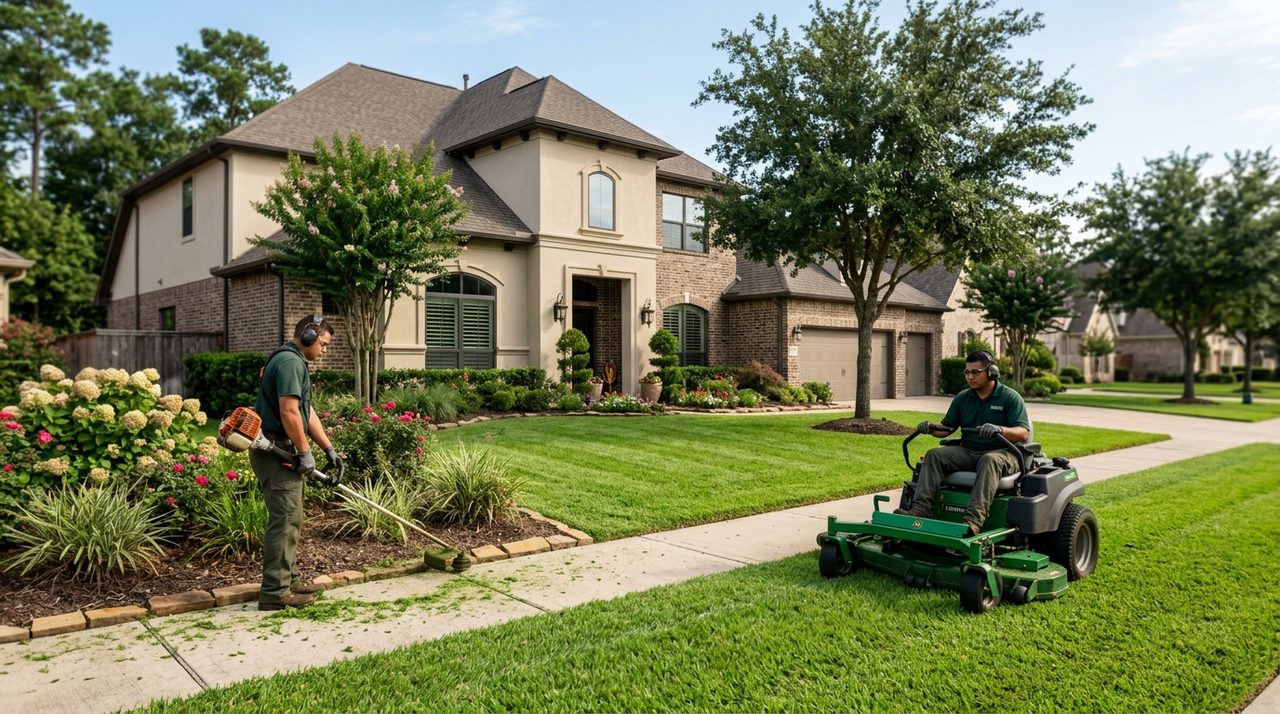
Sugar Land's master-planned subdivisions — First Colony, New Territory, Telfair, Sugar Lakes, and dozens of others — layer mandatory HOA architectural review on top of City of Sugar Land permitting for virtually every visible landscaping change, making contractor selection and sequencing more consequential here than in unincorporated Houston. The housing stock is predominantly 1980s–2000s brick slab construction on expansive Fort Bend County clay, so drainage failures, foundation-adjacent planting mistakes, and summer turf die-off are recurring problems on these lots — not occasional ones. This page explains the four landscape challenges that actually repeat in Sugar Land yards and what a competent local landscaper does differently to handle them.
Ranked by verified Google rating × review volume × verification tier. How we rank →
Some highly-rated pros serve Sugar Land from nearby and may not keep a Sugar Land street address. Those are listed under "Also serving Sugar Land" with their real city and distance, so you always know where each business is based.
12860 Jess Pirtle Blvd, Sugar Land, TX 77478
225 Matlage Way #1772, Sugar Land, TX 77487
15110 Adelfina St, Sugar Land, TX 77498
Highly-rated pros based nearby who cover Sugar Land. Distance shown from the Sugar Land area.
Serving Sugar Land Based in Stafford · 3.4 mi away
Serving Sugar Land Based in Stafford · 3.9 mi away
Serving Sugar Land Based in Stafford · 3.9 mi away
Serving Sugar Land Based in Alief · 4.1 mi away
Serving Sugar Land Based in Stafford · 4.5 mi away
Serving Sugar Land Based in Stafford · 5.1 mi away
Why it matters to you
In Sugar Land, virtually every subdivision — from First Colony's community associations to New Territory Residential Community Association to the Ranch Country POA — maintains an Architectural Control Committee that must pre-approve visible landscape changes: turf species, mulch type, tree placement, landscape wall height, and even bed border materials. A landscaper who skips this step and installs can trigger a formal violation notice and a costly removal order against the homeowner, not just the contractor.
What a good pro does
A competent Sugar Land landscaper submits a complete planting plan with species list, hardscape dimensions, and material specs to the relevant HOA's ACC before scheduling any work — and builds the review window, which can run two to four weeks depending on the subdivision, into the project timeline. Confirm which POA or community association governs your specific address, since Sugar Land has no single city-wide HOA and the rules vary meaningfully block to block.
Sources: Local HOA / deed restrictions (see area profile), Municipal permit office (see area profile)
Why it matters to you
Sugar Land sits on the same expansive Beaumont/Houston Black clay that plagues the rest of the Houston metro, and homes built in the 1980s and 1990s — the majority of the housing stock here — were graded to code at construction but have since settled, shifted, and accumulated decades of mulch that redirects sheet flow toward foundations and fence lines. Even in FEMA Zone X, where most Sugar Land parcels map, intense Gulf rain events pond water for hours in low spots and drown St. Augustine root systems.
What a good pro does
A landscaper experienced with Fort Bend County clay will re-evaluate positive drainage slope away from the slab before replanting beds, and will specify French drains or dry creek outfalls where grade corrections alone are insufficient. Drainage correction for a typical Sugar Land suburban lot runs an estimated $2,500–$7,500 depending on linear footage and outfall options; that investment protects both the landscape install and the slab foundation underneath it.
Sources: Harris County Flood Control District, FEMA National Flood Hazard Layer (NFHL), International Residential Code (as adopted by City of Houston)
Why it matters to you
Sugar Land's 1980s–2000s brick homes are universally slab-on-grade, and the expansive Fort Bend clay beneath them is highly sensitive to moisture variation. Live oaks, Chinese tallows, and crepe myrtles planted within 10–15 feet of a foundation draw moisture unevenly from the clay, accelerating differential settlement and the foundation repairs — commonly $5,000–$15,000 or more — that follow. This is not a hypothetical: foundation repair is already one of the most common contractor calls in Sugar Land.
What a good pro does
A responsible landscaper here measures setback from the foundation before specifying any tree, recommends root barrier installation for medium-canopy species planted in the 10–20-foot zone, and steers clients toward lower-moisture-demand alternatives like yaupon holly or native ornamental grasses for foundation-adjacent beds. This conversation should happen at the design stage, not after the HOA has already approved the planting plan.
Sources: International Residential Code (as adopted by City of Houston), Local HOA / deed restrictions (see area profile)
Why it matters to you
Much of Sugar Land is served by Municipal Utility Districts that enforce tiered water restrictions during drought periods, limiting irrigation to specific days and windows. St. Augustine — the dominant turf species in these subdivisions — is already prone to brown patch fungus in Sugar Land's humid summers and to take-all root rot after wet springs, and improper irrigation scheduling accelerates both problems. A lawn on the wrong watering schedule can fail visibly within two to three weeks of a Stage 2 restriction cycle.
What a good pro does
A landscaper serving Sugar Land should program smart irrigation controllers to the specific MUD restriction schedule applicable to your address, calibrate run times to actual evapotranspiration demand rather than a default timer, and schedule preventive fungicide applications in April and October when brown patch pressure peaks. Retrofitting an existing system with a smart controller and pressure-regulating heads runs an estimated $350–$800 installed and typically pays for itself in one turf-replacement season avoided.
Sources: Texas Commission on Environmental Quality, Municipal permit office (see area profile)
Hiring landscapers in Sugar Land? Sugar Land is composed of numerous master-planned communities, each governed by its own mandatory HOA or POA with actively enforced deed restrictions. The housing stock is predominantly 1980s–2000s suburban brick construction on slab-on-grade foundations, requiring contractors to navigate both city permitting and subdivision-level architectural review for most exterior projects. Proximity to the Brazos River and Oyster Creek creates localized flood risk despite generally favorable FEMA designations.
Building era
Primarily 1980s–2000s, with newer construction in communities like Telfair from the late 2000s–2010s and older sections dating to the 1970s.
Typical style
Traditional suburban brick homes (1- and 2-story) with brick veneer, composition shingle roofs, and attached garages; variants include Colonial-influenced, Mediterranean-influenced, and transitional brick/stone combinations.
Foundations
Slab-on-grade (standard for post-1970 Fort Bend County suburban construction).
Common systems
Central HVAC systems (many original units in 1980s–1990s homes nearing or past replacement age), copper or CPVC plumbing supply lines, cast iron or PVC drain lines depending on era, 200-amp electrical panels in most homes.
What that means for repairs
Kitchen and bathroom remodels are common in 1980s–1990s homes as original finishes age out. HVAC replacement is a major category given system lifespans. Many homeowners pursue exterior updates (stone accents, roof replacement, garage door upgrades) subject to HOA architectural review and approval.
Permit jurisdiction
City of Sugar Land Development Services (Sugar Land is an incorporated city with its own permitting office).
HOA & deed restrictions
HOA or POA membership is mandatory at the subdivision level across virtually all Sugar Land neighborhoods. Examples include Sugar Lakes POA, Ranch Country Association (POA), New Territory Residential Community Association, and First Colony community associations. Each subdivision enforces its own deed restrictions, architectural standards, and assessment schedules. No single city-wide HOA exists.
Historic districts
No historic district designation confirmed. Sugar Land is an incorporated city in Fort Bend County, outside City of Houston HAHC jurisdiction.
Contractor note
Contractors must obtain permits through the City of Sugar Land and should anticipate HOA architectural review requirements for exterior work. Many subdivisions require pre-approval from the HOA's architectural control committee before visible modifications can begin.
FEMA flood zone
FEMA Zone X (low flood risk) per official NFHL data. However, portions of Sugar Land near the Brazos River, Oyster Creek, and areas behind levee systems may carry higher risk designations at the parcel level. Property-specific FEMA lookups are recommended.
Hurricane Harvey impact
Sugar Land experienced significant flooding in some areas during Hurricane Harvey (2017), particularly in subdivisions near the Brazos River, Oyster Creek, and low-lying areas associated with levee districts. Not all subdivisions were equally affected — some experienced minimal impact while others saw substantial water intrusion. Specific subdivision-level Harvey damage records should be verified through Fort Bend County records.
Heat & humidity load
Extreme summer heat and humidity place heavy demand on HVAC systems, particularly in 1980s–1990s homes with aging equipment. Slab-on-grade foundations on expansive clay soils are susceptible to movement during drought-to-rain cycles, making foundation monitoring and proper drainage maintenance critical. Composition shingle roofs degrade faster under sustained UV exposure.
Working with contractors here
HVAC replacement and repair is among the most common contractor activities in Sugar Land, as many homes from the 1980s–1990s build-out are on their second or third system. Roof replacement is frequent given the age of the housing stock and storm exposure. Foundation repair is a recurring need due to expansive clay soils and seasonal moisture fluctuations. Contractors should budget extra time for HOA architectural review and approval processes, which vary by subdivision and can add weeks to project timelines. Exterior work — including paint colors, fencing, roofing materials, and landscaping — is tightly regulated by deed restrictions, so contractors must confirm approved materials and specifications with the relevant HOA before ordering supplies or beginning work.
Local Tip
Always ask for a written estimate before work begins. Texas contractors are required to provide one on jobs over $1,000.
Sugar Land is composed of numerous master-planned communities, each governed by its own mandatory HOA or POA with actively enforced deed restrictions. The housing stock is predominantly 1980s–2000s suburban brick construction on slab-on-grade foundations, requiring contractors to navigate both city permitting and subdivision-level architectural review for most exterior projects. Proximity to the Brazos River and Oyster Creek creates localized flood risk despite generally favorable FEMA designations.
Source: U.S. Census Bureau, ACS 5-Year 2023
Most of Sugar Land maps to FEMA Zone X (low mapped flood risk), but Houston's flash-flood reality means even low-risk blocks benefit from smart drainage and storm-hardened installs; risk climbs sharply on blocks nearest the Brazos River, where it varies parcel to parcel.
Source: FEMA National Flood Hazard Layer (NFHL). Flood zones vary by parcel — verify your individual FIRM panel.
Sources: Municipal permit office (see area profile)Texas Commission on Environmental Quality
Sources: Local HOA / deed restrictions (see area profile)
Sources: Municipal permit office (see area profile)FEMA National Flood Hazard Layer (NFHL)