13955 Murphy Rd Suite 104, Stafford, TX 77477
Best Solar Installers in Stafford, TX
Stafford's housing stock — predominantly 1970s–1990s slab-on-grade brick ranch homes sitting on Fort Bend County's expansive Beaumont clay — creates a specific set of challenges for solar installation that generic installer pitches rarely address: aging shingles approaching end of life, subdivision HOAs with wildly different architectural rules, and a permitting process run entirely through the City of Stafford's own permits department, not Fort Bend County or the City of Houston. Understanding those realities before you sign a contract is what separates a smooth 25-year system from a costly mid-project surprise.
Verified against Google Business data
Updated 2026
See the 10 Solar Installers Serving Stafford 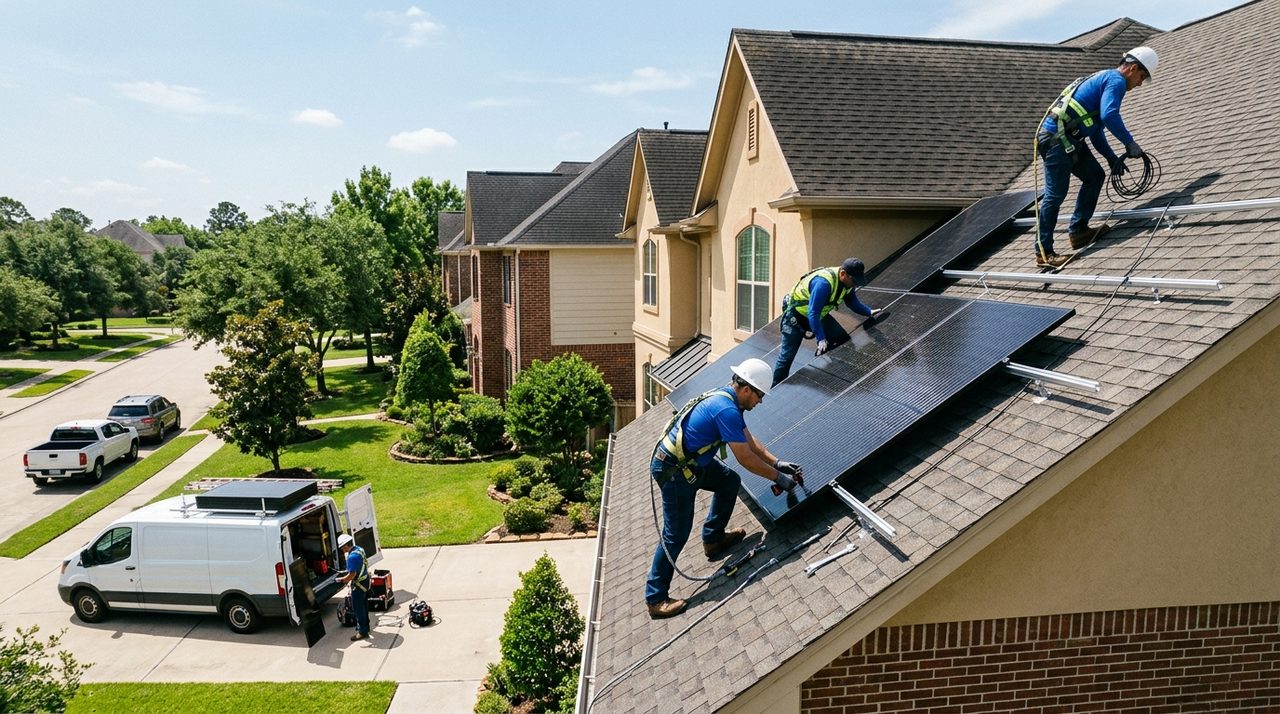
- Median home built
- 1992
- Median home value
- $247,900
- FEMA flood zone
- X (low)
- Typical system cost (est., after 30% ITC)
- $15,400–$24,500
- Most common local issue
- Aging 1970s–1990s shingles requiring re-roof before panel mounting
Ranked by verified Google rating × review volume × verification tier. How we rank →
Some highly-rated pros serve Stafford from nearby and may not keep a Stafford street address. Those are listed under "Also serving Stafford" with their real city and distance, so you always know where each business is based.
Min rating:
10 resultsBased in Stafford
Closed
4111 Greenbriar Dr A, Stafford, TX 77477
Also serving Stafford
Highly-rated pros based nearby who cover Stafford. Distance shown from the Stafford area.
Closed
Serving Stafford Based in Missouri City · 2.2 mi away
Serving Stafford Based in Alief · 3.1 mi away
Closed
Serving Stafford Based in Sugar Land · 4 mi away
Closed
Serving Stafford Based in Westbury · 4.1 mi away
Open Now
Serving Stafford Based in Meyerland · 4.8 mi away
Closed
Serving Stafford Based in Sharpstown · 5.4 mi away
Closed
Serving Stafford Based in Westbury · 6.7 mi away
Closed
Serving Stafford Based in Bellaire · 6.9 mi away
Solar Installers in Stafford: What You Should Know
Stafford's Median 1992-Built Roofs Are at a Solar Compatibility Crossroads
Why it matters to you
Stafford's census median year built is 1992, meaning a large share of the city's brick ranch and neo-eclectic production homes are now carrying original or first-replacement 3-tab asphalt shingles that are 12–25 years old. Houston's combination of 95°F+ summer heat, UV index averaging 10–11, and high humidity degrades standard shingles in 12–15 years rather than the rated 20–25 — so a Stafford home with a 2005 re-roof may already be at end of shingle life. An installer who mounts a 25-year panel array on a roof with fewer than 8–10 years of remaining life is setting you up for a $8,000–$14,000 panel removal and reinstallation bill when you're forced to re-roof, a cost almost never disclosed upfront.
What a good pro does
Before any racking goes up, a reputable installer should pull the permit through the City of Stafford Permits Department and provide a written roof-age assessment with photos. If the shingles are within 10 years of end of life, a concurrent re-roof should be scoped into the contract and priced together — not treated as a separate homeowner surprise. Installers must hold a TDLR-issued Electrical Contractor license and have a licensed master electrician pull the Stafford electrical permit; verify both credentials before signing.
Sources: Municipal permit office (see area profile), Texas Department of Licensing & Regulation, North American Board of Certified Energy Practitioners (NABCEP)
Your HOA's Architectural Rules May Force a Less Efficient Array Layout
Why it matters to you
Stafford has no city-wide HOA, but many of its individual subdivisions — such as those governed by the Grove West Community Association and similar POAs — maintain active architectural review committees that enforce deed restrictions on exterior modifications. Under Texas Property Code §202.010, your right to install solar is protected, but HOAs can legally require placement so panels are not visible from the street. In Stafford's typical one-story brick ranch neighborhoods where the street-facing slope is often the south-facing slope, this can force an east- or west-facing rear placement that cuts annual production by 15–25% compared to optimal south orientation — a performance gap your installer's production estimate may not reflect.
What a good pro does
Before finalizing system design, pull your subdivision's deed restrictions from the Fort Bend County Clerk and submit an architectural review application to your specific POA if one governs your property. A qualified installer will build the HOA timeline into the project schedule rather than treating it as your problem alone, and will rerun production modeling for any placement restriction so you see the actual expected offset — not a best-case-south-facing number. Confirm that permit applications go to the City of Stafford, not Fort Bend County, as Stafford operates its own independent permits office.
Sources: Local HOA / deed restrictions (see area profile), Municipal permit office (see area profile)
Houston's Extreme Cooling Load Means Undersized Arrays Fall Short Fast
Why it matters to you
A typical Stafford home from the 1970s–1990s era — built before modern insulation standards, often with original single-pane windows and attic insulation well below current code — routinely draws 1,400–1,800 kWh per month during Houston's June–September peak cooling season. Stafford sits in CenterPoint Energy's service territory, and CenterPoint's interconnection process for new solar adds its own timeline to project completion. Installers who size systems using national consumption averages rather than your actual CenterPoint historical usage data routinely deliver systems that offset only 40–50% of real load instead of the 80–100% quoted in the sales presentation — a mismatch that is especially punishing in an older, less air-sealed Stafford ranch home.
What a good pro does
Request that your installer pull and model your last 12–24 months of CenterPoint billing data before finalizing system size. For pre-1990 Stafford homes with poor envelope performance, a good installer will also flag whether basic air-sealing and attic insulation improvements should precede solar to avoid oversizing to compensate for avoidable losses. All electrical work must be permitted through the City of Stafford and signed off by a TDLR-licensed master electrician, with CenterPoint interconnection approval required before the system can be energized.
Sources: Texas Department of Licensing & Regulation, ENERGY STAR / U.S. Dept. of Energy, Municipal permit office (see area profile)
Post-Uri Battery Storage Is in Demand — But Adds Real Complexity in Stafford's Older Homes
Why it matters to you
Winter Storm Uri (February 2021) made battery backup — Tesla Powerwall, Enphase IQ Battery — a priority for many Stafford homeowners, and the demand has only grown after subsequent CenterPoint grid stress events. The complication in Stafford's 1970s–1980s housing stock is that many of these homes still have 100-amp electrical panels, which cannot safely integrate a battery storage system without a panel upgrade to 200 amps. That upgrade adds $2,000–$4,500 to project costs and requires its own separate permit through the City of Stafford. Additionally, CenterPoint's interconnection tariff for storage-paired solar systems requires a separate metering application that typically adds 6–10 weeks to the timeline beyond a standard grid-tied install.
What a good pro does
A thorough installer will assess your panel capacity during the initial site visit and give you a firm upgrade quote upfront if your home has a 100-amp service — standard in many of Stafford's pre-1990 ranch homes. The panel upgrade permit, solar building permit, and CenterPoint interconnection application should all be managed by the installer, with a realistic timeline that accounts for City of Stafford inspection scheduling and CenterPoint's queue. Verify that your installer holds a current TDLR Electrical Contractor license and that a NABCEP-certified designer is involved in system layout.
Sources: Texas Department of Licensing & Regulation, North American Board of Certified Energy Practitioners (NABCEP), Municipal permit office (see area profile)
Solar Installers in Stafford: What You Should Know
Hiring solar installers in Stafford? Stafford is an incorporated city in Fort Bend County composed of many individual subdivisions, each with its own HOA rules, deed restrictions, and housing characteristics. The housing stock spans from 1970s ranch homes to 2010s production builds, predominantly slab-on-grade construction on expansive clay soils. Homeowners should verify their specific subdivision's HOA requirements and flood status before scoping any exterior or structural project.
- Housing era
- 1970s–1990s (bulk of existing stock), with newer infill and subdivisions from the 2000s–2010s
- Foundation
- Slab-on-grade (overwhelmingly standard for the era and region
- Flood zone
- FEMA Zone X (low flood risk) per official NFHL data
- Permits
- City of Stafford Permits Department (Stafford is an incorporated city with its own permitting…
Housing stock & systems
Building era
1970s–1990s (bulk of existing stock), with newer infill and subdivisions from the 2000s–2010s.
Typical style
One- and two-story brick veneer ranch homes, traditional and neo-eclectic production builder homes, with some townhomes and garden homes in newer phases.
Foundations
Slab-on-grade (overwhelmingly standard for the era and region; pier-and-beam limited to rare older or custom structures).
Common systems
Central AC with gas furnace; copper or CPVC supply plumbing in older homes transitioning to PEX in newer builds; 1970s–1980s homes may have original galvanized drain lines; electrical panels range from 100-amp in older homes to 200-amp in newer construction.
What that means for repairs
Kitchen and bathroom remodels are common in the 1970s–1990s stock as homeowners update finishes and fixtures. Foundation repair due to expansive clay soil movement is a recurring need. HVAC system replacements are frequent in pre-2000 homes reaching end of equipment life.
Permits & restrictions
Permit jurisdiction
City of Stafford Permits Department (Stafford is an incorporated city with its own permitting authority).
HOA & deed restrictions
No city-wide HOA exists. Many individual subdivisions have mandatory HOAs/POAs (e.g., Grove West Community Association, Inc.) that enforce deed restrictions and architectural standards. Some properties may have no HOA or minimal deed restrictions. Must be confirmed per property via deed records and Fort Bend County Clerk.
Historic districts
No historic district designation confirmed for any area within Stafford.
Contractor note
Contractors must pull permits through the City of Stafford, not Harris County or the City of Houston. Subdivision-level HOA architectural review committees may require pre-approval for exterior modifications, so contractors should confirm HOA requirements before beginning work.
Flood & weather
FEMA flood zone
FEMA Zone X (low flood risk) per official NFHL data. While the broader Fort Bend County area includes Brazos River floodplain zones, the Stafford city center area generally falls outside high-risk flood designations. Property-level verification via FEMA FIRM panels and Fort Bend County floodplain GIS is recommended.
Hurricane Harvey impact
Stafford was not identified as one of the hardest-hit cities during Hurricane Harvey (2017). While Fort Bend County experienced substantial flooding along the Brazos River, the worst-documented impacts were south and southwest of Stafford in Missouri City, Sugar Land, and Richmond/Rosenberg. Specific Stafford streets or subdivisions with repetitive flood losses could not be confirmed from available public records. Buyers and contractors should still check NFIP claims history and seller flood disclosures for individual properties.
Heat & humidity load
Extended Houston-area heat and humidity stress HVAC systems in the aging 1970s–1990s housing stock, making seasonal tune-ups and refrigerant checks essential. Slab foundations on expansive clay soils are vulnerable to differential movement during summer drought cycles, requiring homeowners to maintain consistent watering around foundations. Attic temperatures in single-story ranch homes can exceed 150°F, accelerating roof underlayment and radiant barrier degradation.
Working with contractors here
Foundation monitoring and repair is among the most common contractor engagements in Stafford due to the expansive clay soils and the age of the 1970s–1990s slab-on-grade housing stock. HVAC replacement is a high-demand service as original equipment in older homes reaches 20–30 years of age. Whole-home repiping is increasingly needed in pre-1990s homes with galvanized drain lines or deteriorating copper supply lines. Contractors should note that Stafford is an independent city with its own permitting process, inspection schedules, and code enforcement — not governed by the City of Houston or Fort Bend County for permitting purposes. Job scoping for exterior work must account for subdivision-level HOA architectural standards, which vary significantly across the city.
Local Tip
Always ask for a written estimate before work begins. Texas contractors are required to provide one on jobs over $1,000.
About Stafford
Stafford is an incorporated city in Fort Bend County composed of many individual subdivisions, each with its own HOA rules, deed restrictions, and housing characteristics. The housing stock spans from 1970s ranch homes to 2010s production builds, predominantly slab-on-grade construction on expansive clay soils. Homeowners should verify their specific subdivision's HOA requirements and flood status before scoping any exterior or structural project.
- Median year built
- 1992
- Median home value
- $247,900
- Owner-occupied
- 43%
- Population
- 17,279
- Housing units
- 6,988
- Median income
- $85,910
Source: U.S. Census Bureau, ACS 5-Year 2023
Flood & storm risk
FEMA Zone XLow flood riskMost of Stafford maps to FEMA Zone X (low mapped flood risk), but Houston's flash-flood reality means even low-risk blocks benefit from smart drainage and storm-hardened installs.
Source: FEMA National Flood Hazard Layer (NFHL). Flood zones vary by parcel — verify your individual FIRM panel.
Houston Storm Readiness in Stafford
Hurricane & flooding
Wind damage, not flooding, is the primary hurricane threat for solar systems in lower-risk Stafford, TX, so prioritize a pre-season inspection confirming your racking's hurricane-rated uplift capacity meets the local design wind speed in the City of Houston building code. Loose or improperly torqued rail clamps were a leading cause of panel loss across the metro after Beryl 2024's sustained tropical-force winds. As a Fort Bend County community, Stafford may follow county rather than City of Houston storm rebuild rules.
Severe storms & hail
Hail damage to solar panels in Stafford, TX is often invisible from the ground but detectable through performance monitoring — if your system's daily output drops noticeably after a storm, that is a signal to request a licensed inspection before the damage compounds. Cracked panel glass also creates a ground-fault risk that your inverter's built-in GFCI may flag as an error code. Confirm the current FEMA panel for your Stafford parcel — the area maps to Zone X, but adjacent lots can differ.
Ice storms & freezes
For Stafford, TX homeowners whose primary storm concern is wind and power disruption rather than flood, a freeze event like Uri 2021 highlights the value of solar battery backup: when CenterPoint lost generation capacity statewide, a charged battery bank sustained critical loads regardless of what was happening on the grid. Confirm with your TDLR-licensed installer that your battery's thermal management system is rated to operate in temperatures below 20°F, which Uri brought to the Houston area. As a Fort Bend County community, Stafford may follow county rather than City of Houston storm rebuild rules.
Sources: FEMA National Flood Hazard Layer (NFHL), Ready.gov -- Hurricanes, CenterPoint Energy -- Storm Center, City of Houston -- Emergency Preparedness, Ready.gov -- Winter Weather, Harris County Flood Control District
Free Stafford Tools & Calculators
Houston-specific estimators to plan your project before you call a pro. All results are planning estimates — a licensed local pro confirms the details on site.
Houston Freeze Prep & Pipe Insulation Checklist
Open full tool & FAQ →Your freeze checklist — 4 tasks
- 1
Disconnect & drain every outdoor hose bib
Remove hoses, drain the spigots, and cover each with an insulated faucet sock. Un-drained hose bibs are the #1 burst point in a Houston freeze.
- 2
Insulate exposed pipes in the attic & garage
Wrap any pipe in an unconditioned space (attic runs, garage walls) with foam sleeves. Houston homes rarely insulate these because they only matter a few nights a year — which is exactly why they burst.
- 3
Open cabinet doors & keep a pencil-width drip
On hard-freeze nights, open kitchen/bath cabinets so warm air reaches the pipes and let faucets on exterior walls drip to relieve pressure.
- 4
Protect the attic/garage water heater & its lines
An attic or garage tank sits in unconditioned space. Insulate the cold-inlet and hot-outlet lines and confirm the emergency drain pan is clear so a leak doesn't reach the ceiling.
This is a planning estimate only — actual requirements depend on an on-site assessment by a licensed Houston pro. If a pipe has already burst, shut off your main water supply and call a licensed Houston plumber immediately — freeze bursts flood fast.
Frequently Asked Questions
Do I pull a solar permit through Fort Bend County or through the City of Stafford?
Stafford is an incorporated independent city with its own permitting authority, so all solar electrical and building permits go through the City of Stafford Permits Department — not Fort Bend County and not the City of Houston. Your installer's licensed master electrician must pull the permit there, and City of Stafford inspectors (not county staff) will schedule the required inspections. Confirm your installer knows this distinction before contract signing, because submitting to the wrong jurisdiction resets your timeline entirely.
Sources: Municipal permit office (see area profile)Texas Department of Licensing & Regulation
My Stafford home is in a subdivision with a homeowners association. Can the HOA block my solar installation entirely?
Texas Property Code §202.010 prevents any HOA from outright banning solar panels, but it does allow the HOA to require placement that keeps panels 'not visible from the street,' which in many Stafford subdivisions with front-facing roof planes can force a rear-slope or east-facing layout that reduces annual production by an estimated 15–25% compared to an optimal south-facing array. Because Stafford has no city-wide HOA and individual subdivision rules vary dramatically — Grove West Community Association enforces different standards than newer phases with minimal deed restrictions — you must pull your specific deed from the Fort Bend County Clerk and contact your subdivision's architectural review committee before scoping the array.
Sources: Local HOA / deed restrictions (see area profile)
Stafford is in FEMA Zone X, so do I need to worry about flood and drainage issues when installing panels or ground-mount racking?
Zone X means your parcel carries low mapped flood risk, which is genuinely good news for ground-mount permitting and insurance conversations, but Houston's routine 10-inch single-storm events affect even Zone X lots through localized ponding and sheet flow. For any ground-mount system on Stafford's Beaumont clay soil, confirm that racking bases and conduit trenches are positioned and graded to shed water rather than collect it, because standing water accelerates clay heave cycles that can misalign footings over time. Roof-mount systems are not directly affected by Zone X status, but rooftop penetrations and conduit runs should be sealed to hurricane-grade standards given the Gulf Coast storm environment.
How long should I realistically budget for a solar project to go from signed contract to a live, grid-connected system in Stafford?
In Stafford, a straightforward roof-mount grid-tied system typically takes an estimated 10–16 weeks from contract to energization: roughly 2–4 weeks for City of Stafford permit review and approval, 1–2 days for installation, 1–2 weeks for the city inspection, and then 4–8 weeks for CenterPoint Energy's interconnection agreement review and meter swap. Adding a battery backup unit (Tesla Powerwall or Enphase IQ) extends the CenterPoint queue by an estimated additional 6–10 weeks because storage-paired systems require a separate metering application. If your pre-1990s home needs a panel upgrade before battery integration, budget extra time for that permit and inspection cycle as well.
Sources: Municipal permit office (see area profile)
What credential should I verify when comparing solar installers bidding on my Stafford home?
Require that the company holds an active Electrical Contractor license issued by the Texas Department of Licensing and Regulation (TDLR) — this is the license that legally authorizes pulling the electrical permit at the City of Stafford. Beyond the legal minimum, look for NABCEP PV Installation Professional certification on the project lead, which is the nationally recognized benchmark for installation quality and system design competence. Ask each bidder to provide both the TDLR license number (verifiable on the TDLR public search) and the NABCEP credential ID before you compare quotes.
Sources: Texas Department of Licensing & RegulationNorth American Board of Certified Energy Practitioners (NABCEP)
Is late fall or winter a better time to schedule a Stafford solar installation to lock in production before summer?
October through February is generally the most contractor-available window in the Houston metro, permit backlogs at the City of Stafford tend to run shorter than the spring-summer rush, and cooler rooftop temperatures make installation safer and more precise for torqueing racking hardware to spec. Critically, a system contracted in October and energized by January or February puts you on the grid before Houston's peak cooling season — the months when a 2,200-square-foot Stafford home can consume 1,400–1,800 kWh in a single month — so you capture the maximum first-year offset rather than missing the costliest billing cycles. Keep in mind that the federal 30% Investment Tax Credit requires the system to be placed in service (activated and inspected) within the same tax year you intend to claim it, so discuss timing with your tax advisor if year-end matters to you.
Sources: ENERGY STAR / U.S. Dept. of Energy