9920 Plantation Ln, Stafford, TX 77477
Best AC Repair in Stafford, TX
Stafford's housing stock peaks around a 1992 median build year, meaning a large share of its brick-veneer ranch and neo-eclectic production homes are now running HVAC equipment that is 25–35 years old — well past the 15–20 year service life typical in Houston's punishing cooling climate. Because Stafford is an independent incorporated city in Fort Bend County, all mechanical permits must flow through the City of Stafford Permits Department, not the City of Houston or any county office, a distinction that trips up out-of-area contractors and delays inspections. This page breaks down the specific AC challenges facing Stafford homeowners — aging R-22 systems, clay-soil stress on refrigerant line sets, condensate drain failures on slab-on-grade foundations, and the subdivision HOA approval layer that precedes any condenser replacement.
Verified against Google Business data
Updated 2026
See the 10 AC Repair Serving Stafford 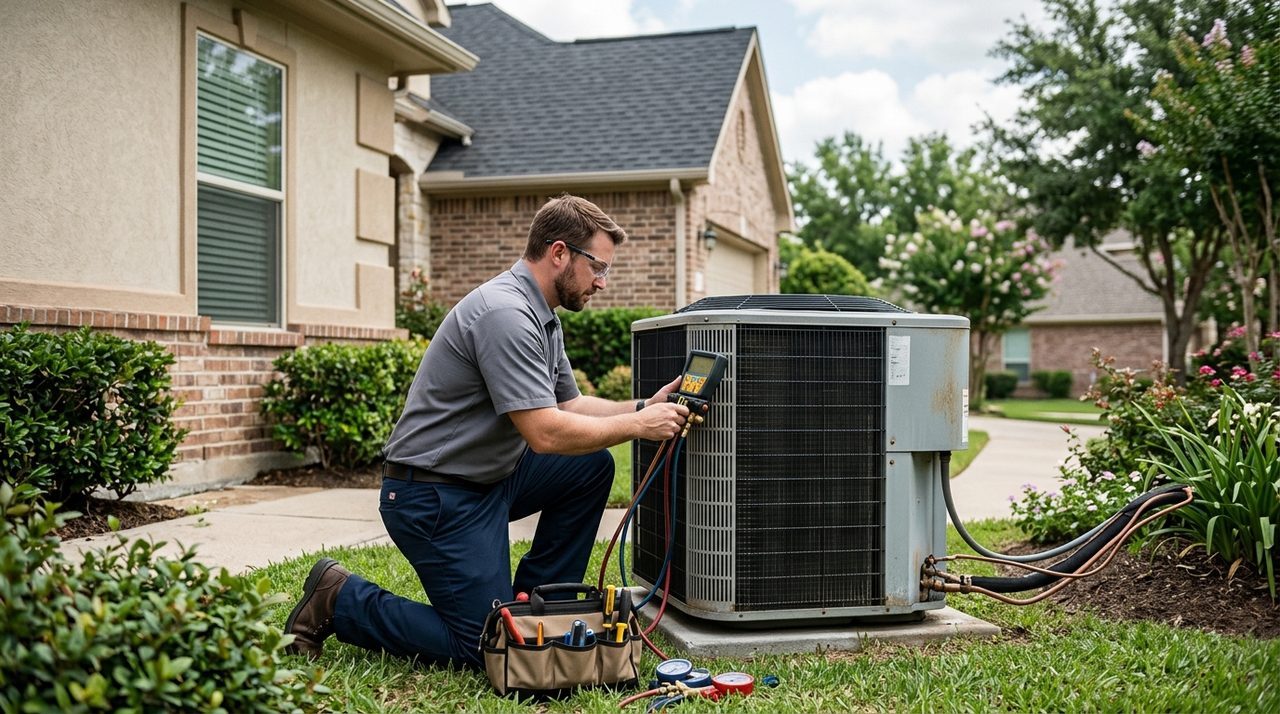
- Median home built
- 1992
- Median home value
- $247,900
- FEMA flood zone
- X (low)
- Typical cost (est.)
- $5,500–$9,500 full system replacement; $95–$225 condensate drain service
- Most common local issue
- End-of-life R-22 equipment in 1980s–1990s homes reaching 25–35 years of operation
Ranked by verified Google rating × review volume × verification tier. How we rank →
Min rating:
10 results Closed
13004 Murphy Rd #218, Stafford, TX 77477
Open Now
13120 Mula Ct, Stafford, TX 77477
2719 5th St, Stafford, TX 77477
13955 Murphy Rd #214, Stafford, TX 77477
Open Now
5680 Hwy 6 STE 128, Missouri City, TX 77459
12999 Murphy Rd Suite L2, Stafford, TX 77477
Closed
1403 Staffordshire Rd, Stafford, TX 77477
Closed
4411 Bluebonnet Dr Ste #111, Stafford, TX 77477
AC Repair in Stafford: What You Should Know
Aging R-22 Systems Hitting a Refrigerant and Parts Dead End in Stafford's 1980s–1990s Homes
Why it matters to you
With a Census-reported median build year of 1992, a substantial portion of Stafford homes still carry original or first-replacement split systems designed for R-22 refrigerant. The EPA's January 2020 ban on new R-22 production has pushed reclaimed refrigerant prices to $80–$150 per pound in the Houston market, meaning a single leak repair on an older Stafford ranch home can easily cost $600–$1,500 — often more than the remaining useful life of the equipment justifies. Stafford's roughly 43 percent owner-occupancy rate also means a meaningful share of these older systems live in rental properties where deferred replacement is common, and latent problems surface only after a summer breakdown.
What a good pro does
A qualified technician should begin with an electronic leak search rather than a blind refrigerant top-off, then present a side-by-side cost comparison of continued R-22 repair versus full system replacement with a modern R-410A or R-32 unit. Any replacement equipment must be permitted through the City of Stafford Permits Department and installed by a TDLR-licensed contractor — homeowner self-pull is not permitted for mechanical work in Stafford. Retrofit drop-in refrigerants like R-407C require compressor compatibility evaluation before use and are not a universal substitute.
Sources: Texas Department of Licensing & Regulation, Municipal permit office (see area profile)
Clay Soil Movement Stressing Refrigerant Line Sets and Outdoor Unit Pads
Why it matters to you
Stafford sits on Fort Bend County's expansive Houston Black clay, the same high-plasticity soil responsible for the foundation repair activity that contractors describe as among the most common engagements in the area. As clay shrinks during dry summers and swells after Gulf Coast rain events, the concrete pads under condenser units settle and tilt, and the copper refrigerant line sets that run through or beneath slab-on-grade homes experience differential stress that can produce slow leaks at brazed joints or kink points. In Stafford's 1980s and 1990s production homes, many of these original line sets are now 30-plus years old and were never sized for a modern higher-efficiency replacement unit.
What a good pro does
When scoping a condenser replacement or refrigerant leak diagnosis in Stafford, a thorough technician should inspect the concrete equipment pad for level and settlement, re-level or replace a tilted pad as part of the installation, and pressure-test the existing line set before reusing it with new equipment. Line sets showing signs of corrosion, kinking, or undersized diameter for the new tonnage should be replaced entirely rather than patched — the added cost is modest compared to a refrigerant callback six months later. All of this work is mechanical permit territory under the City of Stafford's own inspection schedule.
Sources: Municipal permit office (see area profile), Texas Department of Licensing & Regulation
Condensate Drain Overflows Threatening Slab-on-Grade Interiors
Why it matters to you
Houston's extended high-humidity season — with relative humidity regularly above 90 percent — means Stafford's air handlers produce large volumes of condensate daily during the June–September cooling peak. In the one- and two-story brick-veneer homes typical of Stafford's 1980s and 1990s subdivisions, air handlers are almost universally installed in interior closets on slab-on-grade foundations with no floor drain. When condensate lines clog with algae or debris — one of the most common service calls in the Houston metro — the primary pan overflows directly onto the slab, creating moisture intrusion risk and potential microbial growth inside the air handler cabinet itself. Stafford's slab construction leaves no crawl space to catch or redirect the overflow.
What a good pro does
A properly serviced Stafford HVAC system should have its condensate drain flushed and treated with an algaecide tablet at every seasonal tune-up, with a float-activated secondary shutoff switch installed in the drain pan if one is not already present — this cuts power to the system before an overflow occurs. Secondary drain pan installation beneath the air handler provides a last-resort catch. Condensate drain clearing is an estimate of $95–$225 for a standard service call, making it one of the most cost-effective preventive measures a Stafford homeowner can schedule before June.
Sources: Municipal permit office (see area profile), Texas Department of Licensing & Regulation
HOA Architectural Approval Before Condenser Placement in Stafford Subdivisions
Why it matters to you
Stafford has no city-wide HOA, but many of its individual subdivisions — including associations like the Grove West Community Association — enforce active deed restrictions that may dictate condenser unit placement, required screening materials, and setback distances from property lines or fencing. Because these rules vary subdivision by subdivision and must be confirmed through deed records and the Fort Bend County Clerk's office, a contractor who begins condenser placement without an HOA architectural review committee approval risks a forced relocation of the unit after installation — an expensive correction on top of an already significant equipment investment. The City of Stafford's mechanical permit is a separate track and does not substitute for HOA pre-approval.
What a good pro does
Before any condenser replacement is scheduled, the homeowner should pull their deed restrictions from the Fort Bend County Clerk's records and contact their subdivision's HOA or POA to confirm whether an architectural committee application is required and what the typical review timeline looks like. A Stafford-experienced HVAC contractor will factor the HOA approval window into the project schedule rather than treating it as an afterthought. The City of Stafford mechanical permit should be pulled simultaneously so that both approvals arrive before equipment is ordered, avoiding delays when summer demand compresses contractor availability.
Sources: Local HOA / deed restrictions (see area profile), Municipal permit office (see area profile)
AC Repair in Stafford: What You Should Know
Hiring ac repair in Stafford? Stafford is an incorporated city in Fort Bend County composed of many individual subdivisions, each with its own HOA rules, deed restrictions, and housing characteristics. The housing stock spans from 1970s ranch homes to 2010s production builds, predominantly slab-on-grade construction on expansive clay soils. Homeowners should verify their specific subdivision's HOA requirements and flood status before scoping any exterior or structural project.
- Housing era
- 1970s–1990s (bulk of existing stock), with newer infill and subdivisions from the 2000s–2010s
- Foundation
- Slab-on-grade (overwhelmingly standard for the era and region
- Flood zone
- FEMA Zone X (low flood risk) per official NFHL data
- Permits
- City of Stafford Permits Department (Stafford is an incorporated city with its own permitting…
Housing stock & systems
Building era
1970s–1990s (bulk of existing stock), with newer infill and subdivisions from the 2000s–2010s.
Typical style
One- and two-story brick veneer ranch homes, traditional and neo-eclectic production builder homes, with some townhomes and garden homes in newer phases.
Foundations
Slab-on-grade (overwhelmingly standard for the era and region; pier-and-beam limited to rare older or custom structures).
Common systems
Central AC with gas furnace; copper or CPVC supply plumbing in older homes transitioning to PEX in newer builds; 1970s–1980s homes may have original galvanized drain lines; electrical panels range from 100-amp in older homes to 200-amp in newer construction.
What that means for repairs
Kitchen and bathroom remodels are common in the 1970s–1990s stock as homeowners update finishes and fixtures. Foundation repair due to expansive clay soil movement is a recurring need. HVAC system replacements are frequent in pre-2000 homes reaching end of equipment life.
Permits & restrictions
Permit jurisdiction
City of Stafford Permits Department (Stafford is an incorporated city with its own permitting authority).
HOA & deed restrictions
No city-wide HOA exists. Many individual subdivisions have mandatory HOAs/POAs (e.g., Grove West Community Association, Inc.) that enforce deed restrictions and architectural standards. Some properties may have no HOA or minimal deed restrictions. Must be confirmed per property via deed records and Fort Bend County Clerk.
Historic districts
No historic district designation confirmed for any area within Stafford.
Contractor note
Contractors must pull permits through the City of Stafford, not Harris County or the City of Houston. Subdivision-level HOA architectural review committees may require pre-approval for exterior modifications, so contractors should confirm HOA requirements before beginning work.
Flood & weather
FEMA flood zone
FEMA Zone X (low flood risk) per official NFHL data. While the broader Fort Bend County area includes Brazos River floodplain zones, the Stafford city center area generally falls outside high-risk flood designations. Property-level verification via FEMA FIRM panels and Fort Bend County floodplain GIS is recommended.
Hurricane Harvey impact
Stafford was not identified as one of the hardest-hit cities during Hurricane Harvey (2017). While Fort Bend County experienced substantial flooding along the Brazos River, the worst-documented impacts were south and southwest of Stafford in Missouri City, Sugar Land, and Richmond/Rosenberg. Specific Stafford streets or subdivisions with repetitive flood losses could not be confirmed from available public records. Buyers and contractors should still check NFIP claims history and seller flood disclosures for individual properties.
Heat & humidity load
Extended Houston-area heat and humidity stress HVAC systems in the aging 1970s–1990s housing stock, making seasonal tune-ups and refrigerant checks essential. Slab foundations on expansive clay soils are vulnerable to differential movement during summer drought cycles, requiring homeowners to maintain consistent watering around foundations. Attic temperatures in single-story ranch homes can exceed 150°F, accelerating roof underlayment and radiant barrier degradation.
Working with contractors here
Foundation monitoring and repair is among the most common contractor engagements in Stafford due to the expansive clay soils and the age of the 1970s–1990s slab-on-grade housing stock. HVAC replacement is a high-demand service as original equipment in older homes reaches 20–30 years of age. Whole-home repiping is increasingly needed in pre-1990s homes with galvanized drain lines or deteriorating copper supply lines. Contractors should note that Stafford is an independent city with its own permitting process, inspection schedules, and code enforcement — not governed by the City of Houston or Fort Bend County for permitting purposes. Job scoping for exterior work must account for subdivision-level HOA architectural standards, which vary significantly across the city.
Local Tip
Always ask for a written estimate before work begins. Texas contractors are required to provide one on jobs over $1,000.
About Stafford
Stafford is an incorporated city in Fort Bend County composed of many individual subdivisions, each with its own HOA rules, deed restrictions, and housing characteristics. The housing stock spans from 1970s ranch homes to 2010s production builds, predominantly slab-on-grade construction on expansive clay soils. Homeowners should verify their specific subdivision's HOA requirements and flood status before scoping any exterior or structural project.
- Median year built
- 1992
- Median home value
- $247,900
- Owner-occupied
- 43%
- Population
- 17,279
- Housing units
- 6,988
- Median income
- $85,910
Source: U.S. Census Bureau, ACS 5-Year 2023
Flood & storm risk
FEMA Zone XLow flood riskMost of Stafford maps to FEMA Zone X (low mapped flood risk), but Houston's flash-flood reality means even low-risk blocks benefit from smart drainage and storm-hardened installs.
Source: FEMA National Flood Hazard Layer (NFHL). Flood zones vary by parcel — verify your individual FIRM panel.
Houston Storm Readiness in Stafford
Hurricane & flooding
After a hurricane passes through Stafford, TX, clear debris from condenser coil fins with a gentle water rinse before restoring power — compressed leaf litter and shingle granules restrict airflow and can overheat the compressor on a first cooling call during the post-storm heat spike. A TDLR-licensed technician can also inspect the refrigerant charge, which can shift if the unit was significantly jostled. As a Fort Bend County community, Stafford may follow county rather than City of Houston storm rebuild rules.
Severe storms & hail
The May 2024 derecho proved that even lower-risk areas like Stafford, TX are not immune to structural damage: flying debris punctured condenser coil cabinets on streets with no flooding history at all. Inspect your condenser cabinet panels for dents or breaches after any significant storm, and cover exposed refrigerant components with UV-stable foam insulation before a technician can arrive. Confirm the current FEMA panel for your Stafford parcel — the area maps to Zone X, but adjacent lots can differ.
Ice storms & freezes
In lower-flood-risk areas like Stafford, TX, the primary Uri 2021 HVAC failure mode was loss of heating entirely when heat-pump defrost boards were overwhelmed — verify that your backup heat strips are energized and pulling correct amperage with a quick licensed-technician check every fall, because a failed heat strip during a power-restored freeze night leaves the house unprotected. CenterPoint's rotating outage schedule during Uri meant systems that failed had no repair window for days. As a Fort Bend County community, Stafford may follow county rather than City of Houston storm rebuild rules.
Sources: FEMA National Flood Hazard Layer (NFHL), Ready.gov -- Hurricanes, CenterPoint Energy -- Storm Center, City of Houston -- Emergency Preparedness, Ready.gov -- Winter Weather, Harris County Flood Control District
Free Stafford Tools & Calculators
Houston-specific estimators to plan your project before you call a pro. All results are planning estimates — a licensed local pro confirms the details on site.
Houston AC Tonnage & Sizing Estimator
Open full tool & FAQ →Living space you want cooled (400–10,000 sq ft).
5.0tons
Recommended nominal size
60,000 BTU/hr
Estimated cooling load
This is a planning estimate only — actual requirements depend on an on-site assessment by a licensed Houston pro. Houston's humidity and long cooling season make an oversized unit a common, costly mistake — it short-cycles and never dehumidifies. A licensed contractor confirms sizing with a full Manual J calculation.
Houston Freeze Prep & Pipe Insulation Checklist
Open full tool & FAQ →Your freeze checklist — 4 tasks
- 1
Disconnect & drain every outdoor hose bib
Remove hoses, drain the spigots, and cover each with an insulated faucet sock. Un-drained hose bibs are the #1 burst point in a Houston freeze.
- 2
Insulate exposed pipes in the attic & garage
Wrap any pipe in an unconditioned space (attic runs, garage walls) with foam sleeves. Houston homes rarely insulate these because they only matter a few nights a year — which is exactly why they burst.
- 3
Open cabinet doors & keep a pencil-width drip
On hard-freeze nights, open kitchen/bath cabinets so warm air reaches the pipes and let faucets on exterior walls drip to relieve pressure.
- 4
Protect the attic/garage water heater & its lines
An attic or garage tank sits in unconditioned space. Insulate the cold-inlet and hot-outlet lines and confirm the emergency drain pan is clear so a leak doesn't reach the ceiling.
This is a planning estimate only — actual requirements depend on an on-site assessment by a licensed Houston pro. If a pipe has already burst, shut off your main water supply and call a licensed Houston plumber immediately — freeze bursts flood fast.
Frequently Asked Questions
Do I need a permit from the City of Stafford to replace my AC system, and how long does the inspection process take?
Yes — because Stafford is an independent incorporated city, your contractor must pull a mechanical permit through the City of Stafford Permits Department, not Fort Bend County or the City of Houston. Inspection scheduling timelines vary, but in a mid-size suburban permit office like Stafford's you should budget 3–7 business days between permit issuance and final inspection as an estimate; ask your contractor whether they have an active relationship with the Stafford office before signing anything. Any contractor who suggests pulling a Houston or county permit for work inside Stafford city limits is incorrect and risks a failed inspection.
Sources: Municipal permit office (see area profile)
My Stafford home was built in 1986 and still has the original air handler in an interior closet. Is that setup a problem when replacing the system?
Interior-closet air handlers common in Stafford's 1980s ranch-era construction often lack floor drains, which becomes a code and moisture issue during replacement when modern equipment is installed and inspected — the City of Stafford's mechanical inspection will check condensate drainage compliance. Additionally, original ductwork in these homes may be undersized by today's load-calculation standards, and a direct equipment swap without a Manual J check can leave you with an oversized unit that short-cycles in Stafford's high-humidity environment. Ask any contractor whether they plan to verify duct sizing and confirm secondary condensate drain routing before the rough-in inspection.
Sources: Municipal permit office (see area profile)
Stafford is listed as FEMA Zone X — does that mean I don't need to worry about flood damage to my outdoor condenser unit?
Zone X indicates low mapped flood risk, but Houston's flash-flood reality means individual lots in Stafford can still see standing water after intense rain events even without a FEMA-designated floodplain — something the May 2024 derecho and Hurricane Beryl (2024) reinforced across Fort Bend County. If your condenser sits on a concrete pad that has settled low relative to your yard grade, it's worth asking an installer to raise the unit or regrade the pad during a replacement rather than assuming Zone X eliminates all risk. Unlike coastal ZIP codes, Stafford homeowners typically use standard homeowner's insurance rather than TWIA for storm damage claims, so verify your policy covers wind-thrown debris damage to the condenser before storm season.
Sources: FEMA National Flood Hazard Layer (NFHL)Texas Windstorm Insurance Association (TWIA)
I'm in a Stafford subdivision with a POA — do I need architectural committee approval before a contractor can swap out my condenser unit?
It depends entirely on your specific subdivision's CC&Rs, because Stafford has no city-wide HOA and individual POAs like the Grove West Community Association enforce their own deed restrictions independently. Some Stafford subdivision rules require condenser units to be screened from street view or mandate that the architectural review committee sign off on placement before installation begins, adding a parallel approval track on top of the City of Stafford mechanical permit. Pull your deed restrictions through the Fort Bend County Clerk records before your contractor schedules installation, and confirm with your POA board in writing whether equipment replacement triggers a formal ARC submittal.
Sources: Local HOA / deed restrictions (see area profile)
What's the best time of year to schedule an AC replacement in Stafford without getting stuck on a long wait list?
Stafford's hottest months — June through August — are when every AC contractor in the SW Houston corridor is booked solid with emergency calls, meaning replacement lead times that are 1–2 weeks in spring can stretch to 3–5 weeks or longer mid-summer as an estimate. If your system is flagged as end-of-life during a spring tune-up, scheduling replacement in March, April, or early October typically means better contractor availability, faster City of Stafford permit inspection slots, and less pressure to accept the first equipment quote you receive. Waiting until a July failure during a 100°F stretch leaves you with fewer negotiating options and higher likelihood of accepting a mismatched unit that's in stock rather than right-sized for your home.
My Stafford home's HVAC contractor mentioned the outdoor unit pad has tilted — is that a Stafford-specific problem and does it affect my equipment warranty?
Pad tilt is a predictable outcome of Stafford's expansive Fort Bend clay soils, which swell and shrink seasonally and cause differential settling under concrete pads — especially under the 1980s–1990s slabs that make up the bulk of Stafford's housing stock. A condenser that tilts beyond manufacturer tolerances (typically more than 2 degrees) can cause compressor oil migration and premature wear, and most equipment manufacturers will void the compressor warranty if the unit is documented as operating out of level. When getting replacement quotes, ask contractors whether pad releveling or a new composite equipment pad is included in the scope — it's a modest addition to a $5,500–$9,500 system replacement estimate but protects the warranty from day one.