Closed
12710 Century Dr, Stafford, TX 77477
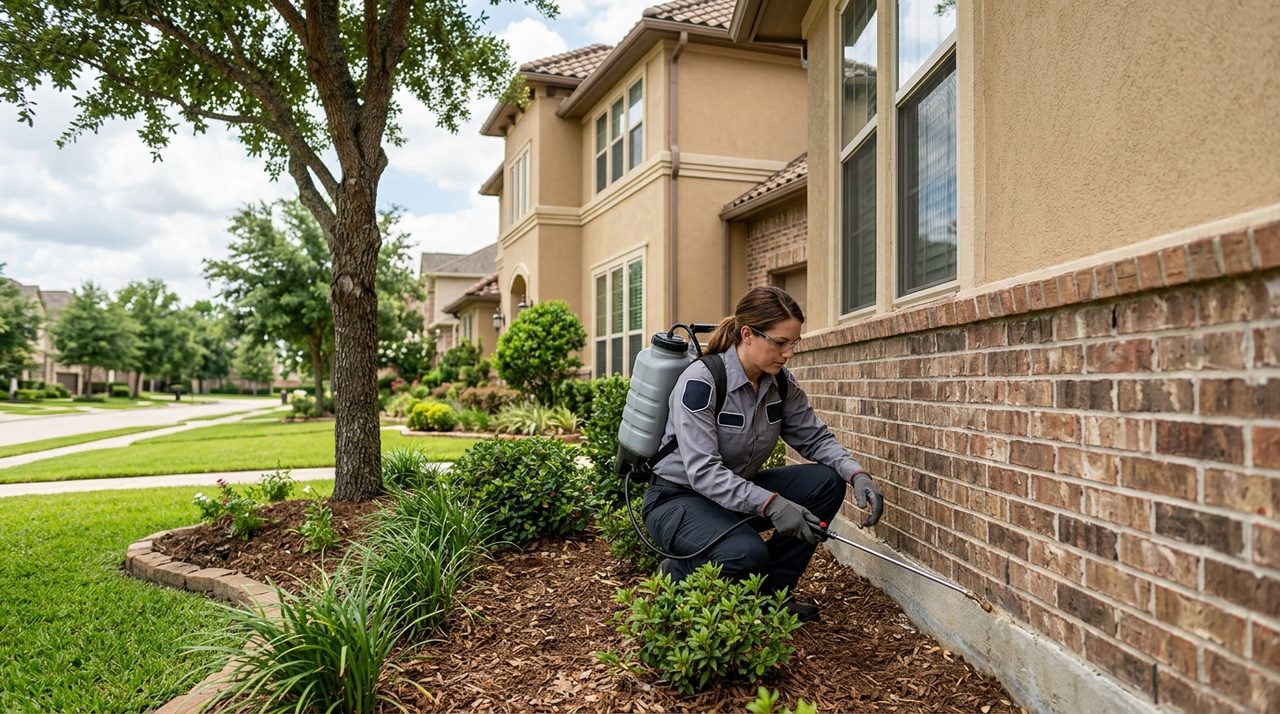
Stafford's housing stock — dominated by 1970s–1990s slab-on-grade brick veneer homes on expansive Fort Bend County clay soils — creates a specific set of pest pressures that newer subdivisions and crawlspace-construction areas simply don't share: seasonal slab movement reopens plumbing penetrations and weep holes year after year, and the city's patchwork of subdivision HOAs means exterior bait stations and broadcast treatments require per-property rules verification before any work begins. Add Houston's position in the nation's highest termite pressure zone and Stafford's predominantly pre-2000 housing, and pest control here demands more than a generic quarterly spray program.
Ranked by verified Google rating × review volume × verification tier. How we rank →
Some highly-rated pros serve Stafford from nearby and may not keep a Stafford street address. Those are listed under "Also serving Stafford" with their real city and distance, so you always know where each business is based.
12710 Century Dr, Stafford, TX 77477
4100 Greenbriar Dr Suite 180-B, Stafford, TX 77477
Highly-rated pros based nearby who cover Stafford. Distance shown from the Stafford area.
Serving Stafford Based in Sugar Land · 2.3 mi away
Serving Stafford Based in Sugar Land · 2.9 mi away
Serving Stafford Based in Sharpstown · 2.9 mi away
Serving Stafford Based in Alief · 3.2 mi away
Serving Stafford Based in Sugar Land · 3.2 mi away
Serving Stafford Based in Alief · 4.2 mi away
Serving Stafford Based in Alief · 4.2 mi away
Why it matters to you
The majority of Stafford's housing stock was built between the 1970s and 1990s, before modern termiticide pre-treatment under slabs became standard practice. Houston sits in USDA's highest subterranean termite pressure zone, and Formosan and native Reticulitermes termites exploit exactly the gaps that Fort Bend County's expansive clay soils keep opening: expansion joints, post-tension cable sleeves, and the plumbing penetrations that shift every wet-dry cycle. A 1982 ranch home in Stafford with original slab and mulched foundation plantings is a particularly high-risk profile.
What a good pro does
A licensed Texas pest control operator — holding a TDLR Structural Pest Control license with a Termite category endorsement — should perform a full slab-perimeter inspection before prescribing treatment. For pre-1990 Stafford homes, liquid barrier treatment (Termidor-type) applied along the full linear footage of the foundation is typically more appropriate than bait-only programs; liquid barrier treatment for a 2,000 sq ft slab-on-grade home runs an estimated $800–$1,800 depending on linear footage. Annual re-inspection is warranted given the ongoing soil movement.
Sources: Texas Department of Licensing & Regulation, FEMA National Flood Hazard Layer (NFHL)
Why it matters to you
Stafford's 1970s–1980s homes frequently retain original galvanized drain lines, which corrode and gap at joints — creating direct harborage and migration corridors for Periplaneta americana (the 'waterbug'). Brick veneer construction standard across Stafford adds another entry point: the weep holes required by code for moisture drainage sit at grade level and provide ground-level access during and after heavy rainfall, when displaced sewer roaches surge into living spaces. Interior-only spray programs do not address either of these structural entry pathways.
What a good pro does
Effective treatment in Stafford's older brick-veneer inventory combines exterior weep-hole exclusion (using breathable copper mesh rather than solid blocking, which building codes require to remain open), drain-line gel bait application, and perimeter liquid barrier. Technicians should be registered under a TDLR-licensed Certified Applicator and able to distinguish sewer-origin versus harborage-origin infestations — the treatment plan differs materially. Estimated cost for a one-time interior and exterior perimeter treatment runs $150–$300 for an average home.
Why it matters to you
Fort Bend County's Beaumont/Houston Black clay soil expands and contracts with seasonal moisture, creating vertical slab differential that routinely reopens gaps around utility chases, garage door thresholds, and plumbing penetrations — even in homes that were properly sealed at construction. Stafford also experienced wind damage from the May 2024 derecho and Hurricane Beryl's July 2024 landfall, and post-storm pipe repairs in many homes left utility chases and exterior wall penetrations imperfectly resealed, giving Rattus norvegicus fresh access points into attics and wall voids.
What a good pro does
Rodent exclusion in Stafford requires a physical inspection of the full foundation perimeter, garage door sweeps, and any post-storm repair sites — not just interior trap placement. A TDLR-licensed operator should document all active entry points, seal them with appropriate materials (steel wool in hydraulic cement or metal flashing, not foam alone), and set a monitoring program. Exclusion plus interior treatment in a typical Stafford home runs an estimated $400–$900. Because Stafford is an independent incorporated city, any structural modification requiring a permit must go through the City of Stafford Permits Department — not Harris County or the City of Houston.
Sources: Texas Department of Licensing & Regulation, Local HOA / deed restrictions (see area profile)
Why it matters to you
There is no city-wide HOA in Stafford, but many of the city's individual subdivisions — such as those governed by the Grove West Community Association — maintain active architectural control committees that regulate visible exterior modifications including pest control bait stations, granular broadcast treatments on turf, and perimeter spray applications near shared green space. Because HOA rules are deed-level and vary subdivision by subdivision, a treatment plan approved in one Stafford neighborhood may violate deed restrictions three streets over, and violations can result in fines regardless of the pest control rationale.
What a good pro does
Before scheduling any exterior perimeter or lawn treatment, Stafford homeowners should pull their recorded deed from the Fort Bend County Clerk to confirm HOA membership and obtain the applicable deed restrictions. Share those restrictions with your pest control operator before the service date — a good operator will adapt bait station placement, product selection, and application timing to comply. TDLR-licensed operators are not automatically familiar with individual HOA rules, so the homeowner must bridge that communication gap proactively.
Sources: Local HOA / deed restrictions (see area profile), Texas Department of Licensing & Regulation
Hiring pest control in Stafford? Stafford is an incorporated city in Fort Bend County composed of many individual subdivisions, each with its own HOA rules, deed restrictions, and housing characteristics. The housing stock spans from 1970s ranch homes to 2010s production builds, predominantly slab-on-grade construction on expansive clay soils. Homeowners should verify their specific subdivision's HOA requirements and flood status before scoping any exterior or structural project.
Building era
1970s–1990s (bulk of existing stock), with newer infill and subdivisions from the 2000s–2010s.
Typical style
One- and two-story brick veneer ranch homes, traditional and neo-eclectic production builder homes, with some townhomes and garden homes in newer phases.
Foundations
Slab-on-grade (overwhelmingly standard for the era and region; pier-and-beam limited to rare older or custom structures).
Common systems
Central AC with gas furnace; copper or CPVC supply plumbing in older homes transitioning to PEX in newer builds; 1970s–1980s homes may have original galvanized drain lines; electrical panels range from 100-amp in older homes to 200-amp in newer construction.
What that means for repairs
Kitchen and bathroom remodels are common in the 1970s–1990s stock as homeowners update finishes and fixtures. Foundation repair due to expansive clay soil movement is a recurring need. HVAC system replacements are frequent in pre-2000 homes reaching end of equipment life.
Permit jurisdiction
City of Stafford Permits Department (Stafford is an incorporated city with its own permitting authority).
HOA & deed restrictions
No city-wide HOA exists. Many individual subdivisions have mandatory HOAs/POAs (e.g., Grove West Community Association, Inc.) that enforce deed restrictions and architectural standards. Some properties may have no HOA or minimal deed restrictions. Must be confirmed per property via deed records and Fort Bend County Clerk.
Historic districts
No historic district designation confirmed for any area within Stafford.
Contractor note
Contractors must pull permits through the City of Stafford, not Harris County or the City of Houston. Subdivision-level HOA architectural review committees may require pre-approval for exterior modifications, so contractors should confirm HOA requirements before beginning work.
FEMA flood zone
FEMA Zone X (low flood risk) per official NFHL data. While the broader Fort Bend County area includes Brazos River floodplain zones, the Stafford city center area generally falls outside high-risk flood designations. Property-level verification via FEMA FIRM panels and Fort Bend County floodplain GIS is recommended.
Hurricane Harvey impact
Stafford was not identified as one of the hardest-hit cities during Hurricane Harvey (2017). While Fort Bend County experienced substantial flooding along the Brazos River, the worst-documented impacts were south and southwest of Stafford in Missouri City, Sugar Land, and Richmond/Rosenberg. Specific Stafford streets or subdivisions with repetitive flood losses could not be confirmed from available public records. Buyers and contractors should still check NFIP claims history and seller flood disclosures for individual properties.
Heat & humidity load
Extended Houston-area heat and humidity stress HVAC systems in the aging 1970s–1990s housing stock, making seasonal tune-ups and refrigerant checks essential. Slab foundations on expansive clay soils are vulnerable to differential movement during summer drought cycles, requiring homeowners to maintain consistent watering around foundations. Attic temperatures in single-story ranch homes can exceed 150°F, accelerating roof underlayment and radiant barrier degradation.
Working with contractors here
Foundation monitoring and repair is among the most common contractor engagements in Stafford due to the expansive clay soils and the age of the 1970s–1990s slab-on-grade housing stock. HVAC replacement is a high-demand service as original equipment in older homes reaches 20–30 years of age. Whole-home repiping is increasingly needed in pre-1990s homes with galvanized drain lines or deteriorating copper supply lines. Contractors should note that Stafford is an independent city with its own permitting process, inspection schedules, and code enforcement — not governed by the City of Houston or Fort Bend County for permitting purposes. Job scoping for exterior work must account for subdivision-level HOA architectural standards, which vary significantly across the city.
Local Tip
Always ask for a written estimate before work begins. Texas contractors are required to provide one on jobs over $1,000.
Stafford is an incorporated city in Fort Bend County composed of many individual subdivisions, each with its own HOA rules, deed restrictions, and housing characteristics. The housing stock spans from 1970s ranch homes to 2010s production builds, predominantly slab-on-grade construction on expansive clay soils. Homeowners should verify their specific subdivision's HOA requirements and flood status before scoping any exterior or structural project.
Source: U.S. Census Bureau, ACS 5-Year 2023
Most of Stafford maps to FEMA Zone X (low mapped flood risk), but Houston's flash-flood reality means even low-risk blocks benefit from smart drainage and storm-hardened installs.
Source: FEMA National Flood Hazard Layer (NFHL). Flood zones vary by parcel — verify your individual FIRM panel.
Houston-specific estimators to plan your project before you call a pro. All results are planning estimates — a licensed local pro confirms the details on site.
| Pest | Cadence | Active window |
|---|---|---|
Mosquito control A standard 4-week barrier treatment holds a typical suburban lot through Houston's core mosquito season. | Every 28 days | April – October |
Termite (subterranean) A once-a-year spring inspection is the baseline for a drier, sunnier Houston lot — catch mud tubes and swarmer wings before damage compounds. | Annual inspection | Spring |
General pest guard (roaches, ants, spiders) Houston's year-round warmth means general pests never fully die off — a quarterly perimeter treatment is the standard maintenance rhythm. | Quarterly | Mar · Jun · Sep · Dec |
This is a planning estimate only — actual requirements depend on an on-site assessment by a licensed Houston pro. Texas requires an SPCB-licensed applicator for chemical treatment — ask for the technician's license number.
Sources: FEMA National Flood Hazard Layer (NFHL)Harris County Flood Control District
Sources: Local HOA / deed restrictions (see area profile)