Closed
Serving Richmond Based in Sugar Land · 8.5 mi away
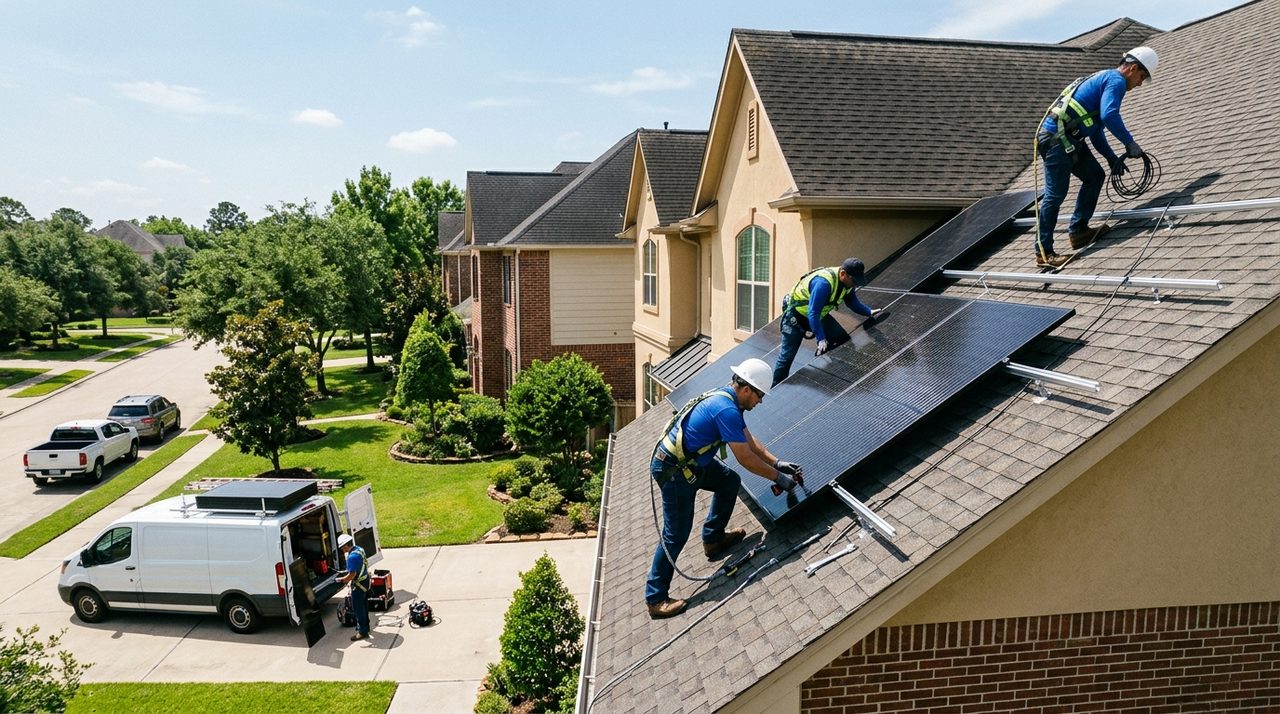
Richmond, TX sits squarely on Fort Bend County's expansive Beaumont clay, where slab-on-grade homes in subdivisions like Pecan Grove, Harvest Green, and Long Meadow Farms represent the dominant housing stock — most of it built during the 2000s–2020s construction boom that defines the area's modern character. That combination of relatively new roofs, 200-amp electrical panels, and mandatory HOA architectural review committees makes Richmond a realistic but nuanced market for residential solar: the bones are usually ready, but the approval layers and soil conditions require installers who know Fort Bend specifically. This page explains the four issues that actually determine whether a Richmond solar project goes smoothly or stalls for months.
Ranked by verified Google rating × review volume × verification tier. How we rank →
Some highly-rated pros serve Richmond from nearby and may not keep a Richmond street address. Those are listed under "Also serving Richmond" with their real city and distance, so you always know where each business is based.
Highly-rated pros based nearby who cover Richmond. Distance shown from the Richmond area.
Serving Richmond Based in Sugar Land · 8.5 mi away
Why it matters to you
Texas Property Code §202.010 guarantees your right to install solar, but it also lets HOAs require that panels not be visible from the street. In Richmond's master-planned communities — Harvest Green, Long Meadow Farms, Del Webb Sweetgrass, Pecan Grove, and others — the architectural review committee can force rear-slope or east-facing placement even when your home's south-facing front pitch would produce 15–25% more annual energy. Because HOA status and deed restriction language vary subdivision by subdivision in Richmond, an installer who doesn't pull your specific governing documents before the site assessment is guessing at your actual production potential.
What a good pro does
A qualified installer serving Richmond should request your subdivision's recorded deed restrictions and CC&Rs before any energy production estimate is finalized, then model both the HOA-compliant and optimal orientations using your actual CenterPoint Energy 12-month usage history. If the ARC requires a specific panel color or frame finish, that affects equipment selection and should be locked in before permit submission. Under 2026 Texas HOA transparency rules, associations with 60 or more lots must post governing documents publicly, making this step faster than it used to be.
Sources: Local HOA / deed restrictions (see area profile), Municipal permit office (see area profile)
Why it matters to you
Richmond's Beaumont and Houston Black Vertisol clay — the same expansive soil driving foundation monitoring across Fort Bend County's slab-on-grade neighborhoods — swells seasonally by several inches and can heave ground-mount racking piers out of alignment within two to three years when installers use standard Great Plains pier specifications designed for more stable soils. While most Richmond homes will use roof-mount arrays, homeowners on larger lots in Old Orchard, rural tracts near the Brazos River corridor, or Del Webb Sweetgrass with side or rear yard space sometimes pursue ground mounts for HOA-compliance or shading reasons, making soil behavior a real cost factor.
What a good pro does
For any ground-mount system in Fort Bend County, insist on a geotechnical assessment and engineered footing design sized for expansive clay conditions rather than a generic national spec. Concrete-ballasted or helical pier designs need to account for seasonal heave loads; the additional engineering typically adds 20–35% to ground-mount per-watt costs compared to roof-mount, but it prevents racking misalignment that voids manufacturer tilt warranties. A NABCEP-certified installer will flag this in the proposal rather than after installation.
Sources: North American Board of Certified Energy Practitioners (NABCEP), International Residential Code (as adopted by City of Houston)
Why it matters to you
Richmond is one of the more complex permit jurisdictions in the southwest Houston metro: properties inside city limits permit through the City of Richmond permits office, while homes in the large swath of unincorporated Fort Bend County surrounding Richmond — which includes much of Pecan Grove and parts of other subdivisions — go through the Fort Bend County Engineering Department. Inspection timelines, submittal formats, and plan-check requirements differ between the two, and utility interconnection with CenterPoint Energy adds its own queue on top of whichever building permit process applies. An installer who doesn't verify parcel jurisdiction at the outset can submit to the wrong office and add weeks to your project timeline.
What a good pro does
Before signing a contract, ask your installer to confirm your parcel's jurisdiction using the Fort Bend County Appraisal District records and verify which office will receive the electrical permit — the licensed master electrician on the project is required by TDLR to pull the permit under their own license, so they must file with the correct AHJ. CenterPoint's interconnection application should be submitted in parallel with permit filing, not after, to avoid sequential delays that can stretch energization timelines by six to ten weeks.
Sources: Municipal permit office (see area profile), Texas Department of Licensing & Regulation
Why it matters to you
The heaviest construction wave in Richmond's master-planned communities hit in the 2000s and 2010s, meaning a significant share of the area's original 3-tab asphalt shingles are now 12–20 years old. Houston's combination of 95°F+ heat, UV index averaging 10–11, and 90%+ summer humidity degrades standard shingles in 12–15 years rather than the rated 20–25, and homes that took roof damage during Hurricane Harvey (2017) or the May 2024 derecho may carry emergency replacement shingles that are aging even faster. Mounting a 25-year panel array on a roof that needs replacement in five years creates a scenario where you'll pay $8,000–$14,000 (estimated) for panel removal and reinstallation — a cost almost never disclosed upfront in Richmond-area solar proposals.
What a good pro does
Request a written roof-age assessment and shingle condition inspection as a prerequisite to any Richmond solar installation, and if the roof is within seven years of likely replacement, get a bundled re-roof and solar quote before signing two separate contracts. Many Richmond installers partner with Fort Bend County roofing contractors; a coordinated project under one permit pull is cleaner and often cheaper than sequential work. All electrical work still requires a TDLR-licensed master electrician regardless of whether roofing is bundled.
Sources: International Residential Code (as adopted by City of Houston), Texas Department of Licensing & Regulation, ENERGY STAR / U.S. Dept. of Energy
Hiring solar installers in Richmond? Richmond encompasses a wide range of housing from historic city-center properties to modern master-planned communities, each with its own HOA and deed restrictions. Homeowners must identify their specific subdivision's governing documents before initiating exterior modifications. The mix of newer construction and rapid growth means contractors frequently handle warranty-era repairs, energy efficiency upgrades, and landscape compliance work.
Building era
Mixed: historic Richmond core dates to pre-1970s; dominant suburban stock built 1980s–2020s, with heaviest construction in the 2000s–2020s across master-planned communities.
Typical style
Traditional suburban brick, brick-and-stone Texas traditional, and contemporary transitional elevations in newer master-planned phases; one- and two-story production homes with front-loaded attached garages.
Foundations
Predominantly slab-on-grade (post-tension concrete) for suburban tract homes; some older historic Richmond homes may have pier-and-beam foundations.
Common systems
Central HVAC (heat pump and gas furnace split systems common), copper and PEX plumbing in newer homes (possible polybutylene in 1980s–early 1990s stock), 200-amp electrical panels standard in post-2000 construction.
What that means for repairs
Kitchen and bathroom remodels are common in 1990s–2000s homes reaching their second-owner cycle. Exterior modifications (fences, patios, driveways, generators) require HOA architectural review in most subdivisions. Older Pecan Grove and Greatwood-era homes often need HVAC replacements and roof upgrades.
Permit jurisdiction
City of Richmond permits office for properties within city limits; Fort Bend County Engineering Department for unincorporated Fort Bend County areas surrounding Richmond.
HOA & deed restrictions
No single mandatory HOA covers all of Richmond. Most master-planned communities (Harvest Green, Old Orchard, Pecan Grove, Greatwood, Long Meadow Farms, Del Webb Sweetgrass, etc.) have mandatory HOAs with recorded deed restrictions and architectural review committees. Some older or rural tracts have no HOA. HOA status is strictly subdivision-by-subdivision.
Historic districts
No City of Houston historic district designation confirmed. Richmond has its own historic downtown area, but formal historic district protections and review processes should be verified with the City of Richmond.
Contractor note
Contractors must determine whether a property is within Richmond city limits or unincorporated Fort Bend County, as permit jurisdiction and inspection requirements differ. Most subdivisions require HOA architectural approval before exterior work begins, and 2026 Texas HOA transparency laws require governing documents to be publicly posted for associations with 60+ lots.
FEMA flood zone
FEMA Zone X (low flood risk) per official NFHL data. Richmond is situated along the Brazos River, and some areas near the river and Rabbs Bayou carry higher flood risk than the Zone X designation of the sampled point; homeowners should verify their specific lot's flood zone.
Hurricane Harvey impact
Hurricane Harvey (2017) caused significant flooding in parts of Fort Bend County, particularly along the Brazos River corridor. The Barker Reservoir controlled releases and Brazos River flooding impacted numerous Richmond-area subdivisions. Specific impact varied greatly by subdivision and proximity to waterways — homeowners should check individual property flood history through Fort Bend County records.
Heat & humidity load
Extreme summer heat and humidity drive heavy HVAC demand across Richmond's slab-on-grade homes. Expansive clay soils common in Fort Bend County cause seasonal foundation movement, increasing demand for foundation inspection and repair services. Newer homes with large roof spans require periodic inspection for heat-related shingle degradation.
Working with contractors here
Contractors in Richmond work across a wide spectrum of housing ages, from 1980s master-planned homes needing full system replacements to brand-new construction warranty work. HVAC replacement and repair is the most consistent demand driver due to the extreme Fort Bend County summers and the aging of 2000s-era equipment. Foundation monitoring and repair are common given the expansive clay soils, particularly for homes built on slab-on-grade foundations. Exterior work — fencing, patio covers, roofing — almost always requires HOA architectural committee pre-approval, so contractors should build submission lead time into project schedules. The split jurisdiction between City of Richmond and unincorporated Fort Bend County means permit requirements and inspection timelines can differ significantly even between adjacent subdivisions.
Local Tip
Always ask for a written estimate before work begins. Texas contractors are required to provide one on jobs over $1,000.
Richmond encompasses a wide range of housing from historic city-center properties to modern master-planned communities, each with its own HOA and deed restrictions. Homeowners must identify their specific subdivision's governing documents before initiating exterior modifications. The mix of newer construction and rapid growth means contractors frequently handle warranty-era repairs, energy efficiency upgrades, and landscape compliance work.
Source: U.S. Census Bureau, ACS 5-Year 2023
Most of Richmond maps to FEMA Zone X (low mapped flood risk), but Houston's flash-flood reality means even low-risk blocks benefit from smart drainage and storm-hardened installs; risk climbs sharply on blocks nearest the Brazos River, where it varies parcel to parcel.
Source: FEMA National Flood Hazard Layer (NFHL). Flood zones vary by parcel — verify your individual FIRM panel.
Your solar panels themselves are rated to survive high winds, but the roof structure beneath them must also be sound — have a TDLR-licensed installer inspect flashing and attachment points in Richmond, TX before hurricane season to confirm the assembly will perform as a unit. If CenterPoint declares a major outage event, your battery backup system's automatic transfer function is what decides whether your home stays powered. Confirm the current FEMA panel for your Richmond parcel — the area maps to Zone X, but adjacent lots can differ.
Power outages in Richmond, TX caused by severe thunderstorm damage to CenterPoint infrastructure can last 24 to 72 hours even without a named storm; a solar battery backup system paired with a properly permitted transfer switch lets you run essential loads independently of the grid. Ensure your installer pulled a City of Houston permit and scheduled a final inspection so the system is code-confirmed before storm season. As a Fort Bend County community, Richmond may follow county rather than City of Houston storm rebuild rules.
Ice accumulation temporarily cuts solar panel output in Richmond, TX, but the larger freeze-related risk for solar homeowners is an inverter or battery enclosure mounted in an uninsulated garage or attic space exposed to sub-freezing temperatures — equipment manufacturers specify minimum operating temperatures, and falling below them can cause shutdowns or permanent damage. Ask your installer to confirm all system components are within their rated temperature range before the next hard freeze. With a median build year of 1979, the older building stock here is more exposed to hard-freeze damage than newer construction. Confirm the current FEMA panel for your Richmond parcel — the area maps to Zone X, but adjacent lots can differ.
Sources: FEMA National Flood Hazard Layer (NFHL), Ready.gov -- Hurricanes, CenterPoint Energy -- Storm Center, City of Houston -- Emergency Preparedness, Ready.gov -- Winter Weather, Harris County Flood Control District
Houston-specific estimators to plan your project before you call a pro. All results are planning estimates — a licensed local pro confirms the details on site.
Disconnect & drain every outdoor hose bib
Remove hoses, drain the spigots, and cover each with an insulated faucet sock. Un-drained hose bibs are the #1 burst point in a Houston freeze.
Insulate exposed pipes in the attic & garage
Wrap any pipe in an unconditioned space (attic runs, garage walls) with foam sleeves. Houston homes rarely insulate these because they only matter a few nights a year — which is exactly why they burst.
Open cabinet doors & keep a pencil-width drip
On hard-freeze nights, open kitchen/bath cabinets so warm air reaches the pipes and let faucets on exterior walls drip to relieve pressure.
Protect the attic/garage water heater & its lines
An attic or garage tank sits in unconditioned space. Insulate the cold-inlet and hot-outlet lines and confirm the emergency drain pan is clear so a leak doesn't reach the ceiling.
This is a planning estimate only — actual requirements depend on an on-site assessment by a licensed Houston pro. If a pipe has already burst, shut off your main water supply and call a licensed Houston plumber immediately — freeze bursts flood fast.
Sources: Municipal permit office (see area profile)
Sources: Local HOA / deed restrictions (see area profile)
Sources: Texas Department of Licensing & RegulationNorth American Board of Certified Energy Practitioners (NABCEP)