Open Now
19506 Gladewater Dr, Tomball, TX 77375
Tomball's master-planned subdivisions — built largely between the late 1990s and 2010s on northwest Harris County's Beaumont clay — produce a very specific exterior maintenance problem: brick veneer and concrete driveways that are old enough to show serious mold, efflorescence, and oil staining, yet new enough that homeowners are often caught off guard by the scale of buildup. Layer in mandatory HOA architectural review committees (Villages of NorthPointe, Stone Lake, and dozens of peers) that issue 30-day cure notices for algae-stained driveways and green-tinged roofs, and proactive washing is less optional than it appears. This page breaks down exactly which surfaces fail first in Tomball, what the right cleaning method is for each, and what compliance details matter before you schedule a job.
Ranked by verified Google rating × review volume × verification tier. How we rank →
Some highly-rated pros serve Tomball from nearby and may not keep a Tomball street address. Those are listed under "Also serving Tomball" with their real city and distance, so you always know where each business is based.
19506 Gladewater Dr, Tomball, TX 77375
31022 Raleigh Creek Dr, Tomball, TX 77375
9618 Babbling Spring Ct, Tomball, TX 77375
23723 Plantation Pines Ln, Tomball, TX 77375
15823 Oak Island Dr, Tomball, TX 77377
10610 Chestnut Path Way, Tomball, TX 77375
Highly-rated pros based nearby who cover Tomball. Distance shown from the Tomball area.
Serving Tomball Based in Champions Forest · 4.2 mi away
Serving Tomball Based in The Woodlands · 4.8 mi away
Serving Tomball Based in Champions Forest · 5.4 mi away
Serving Tomball Based in Magnolia · 6 mi away
Why it matters to you
Tomball's master-planned HOAs — including Villages of NorthPointe and Stone Lake — have active architectural review committees that issue written violation notices with cure windows as short as 30 days for algae-blackened driveways, discolored fence boards, and green-streaked roofs. Late-1990s and 2000s-era production-builder homes are now old enough that Gloeocapsa magma (black algae) and green mold have had years to colonize porous concrete and asphalt shingles, and many homeowners receive their first notice without realizing the buildup had grown past HOA thresholds.
What a good pro does
A qualified operator will document the specific surfaces cited in the HOA notice before quoting, so nothing is missed on the inspection re-check. For roofs, the correct method is low-pressure soft-wash (under 500 PSI) using a sodium hypochlorite-based biocide to kill algae at the root rather than blast granules loose — high-pressure washing on aging architectural shingles voids manufacturer warranties. Confirm with your HOA's ARC whether they require photo documentation of completed work to close the violation, as many Tomball-area associations do.
Sources: Local HOA / deed restrictions (see area profile)
Why it matters to you
Northwest Harris County sits on Houston Black expansive clay, and Tomball's slab-on-grade homes built in the late 1990s and 2000s show the long-term consequence: mineral salts wick upward through brick mortar joints and concrete driveways as the clay shrinks and swells through dry summers and wet winters, depositing white efflorescence bands and red-clay mud staining at foundation level and along driveway edges. Standard cold-water rinsing does not dissolve these salt deposits — it often just spreads them.
What a good pro does
Effective removal requires a diluted acidic pre-treatment (typically a mild phosphoric or muriatic acid wash) applied before any pressure is introduced, which neutralizes the alkaline salt crystals so they can be flushed rather than smeared. A pro will also check for active mortar joint cracking before washing, since directing high pressure into deteriorated joints on a 20-year-old brick veneer home can displace mortar and accelerate moisture intrusion. No City of Tomball or Harris County permit is required for routine residential pressure washing, but chemical disposal must comply with TCEQ stormwater rules — wash water with degreasers or acid pre-treatments cannot be directed into storm inlets.
Why it matters to you
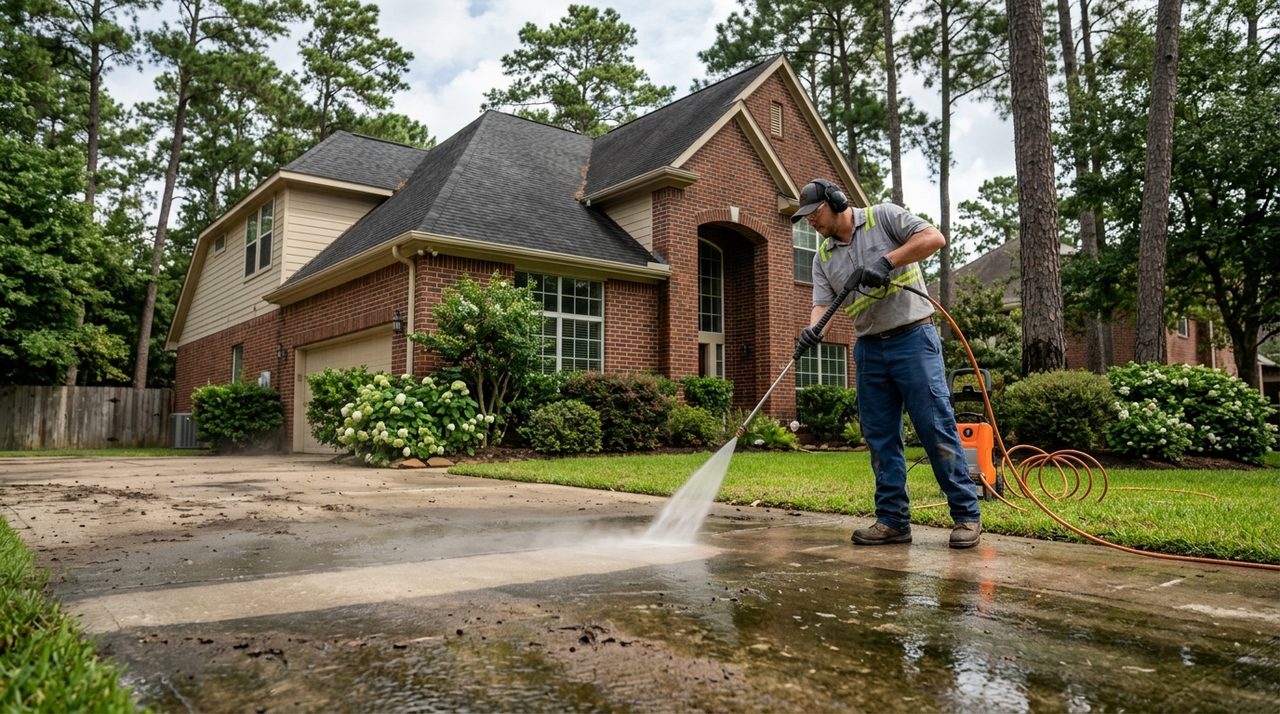
Homes built in the late 1990s and early 2000s in Tomball's first wave of master-planned subdivisions often retain their original concrete driveways — now 20-plus years old and bearing compounded vehicle oil, tire rubber oxidation, and surface spalling that accelerated after Winter Storm Uri (2021) introduced freeze-thaw stress to concrete that had never experienced it. Porous, aged concrete in Houston's UV-intense climate bakes oil into the surface matrix, turning gray slabs permanently dark without chemical intervention.
What a good pro does
Hot-water pressure washing combined with an alkaline degreaser pre-soak is the correct approach for baked-in oil staining — cold water alone will not emulsify the oil. Budget for a 20–40% premium over a standard driveway wash when significant oil staining or spalling is present. The operator should cap pressure at 2,500–3,000 PSI on plain concrete and reduce further on any surface showing active spall damage to avoid undercutting loose aggregate. Confirm the contractor carries general liability insurance; Texas does not license pressure washers as a standalone trade, so insurance is the primary homeowner protection.
Why it matters to you
Tomball's post-1990s production subdivisions are heavily landscaped with wood privacy fences — typically untreated southern yellow pine — that face Houston's full assault of 100°F summers, frequent heavy rain, and elevated humidity. By the time a fence is 8–12 years old in this climate, the boards have often greyed, developed surface mold, and begun to check (crack longitudinally), which means the fence needs cleaning before any stain or sealant will adhere properly. Many Tomball HOAs also cite greyed or mold-darkened fencing in the same violation notices as driveway algae.
What a good pro does
Weathered pine requires low-to-medium pressure (800–1,200 PSI maximum) and a dedicated wood brightener or oxalic acid rinse after washing to open the grain and restore pH balance before staining — skipping this step causes stain to peel within a season. The operator should fan-wash with the grain and keep the nozzle moving to avoid grain-raise, which splinters soft, weathered pine. Sequencing matters: wash and allow 48–72 hours of dry time before staining, and confirm with your HOA's ARC whether the fence stain color must match the originally approved shade before ordering product.
Sources: Local HOA / deed restrictions (see area profile), Texas Commission on Environmental Quality
Hiring pressure washing in Tomball? Tomball spans a wide range of housing stock, from older 1960s–1980s homes near the historic city core to newer master-planned subdivisions built from the late 1990s onward. Most HOA-governed neighborhoods feature production-builder brick veneer homes on slab-on-grade foundations, meaning foundation monitoring, HVAC maintenance, and roof upkeep are the primary service needs. Contractors should verify whether a property falls within the City of Tomball, an unincorporated Harris County area, or a specific HOA before beginning work.
Building era
Mixed: 1960s–1980s near Old Town Tomball; late 1990s–2010s in master-planned subdivisions.
Typical style
Production-builder Texas Traditional with brick veneer, hip/gable roofs, and attached garages; some older ranch-style homes near the city core.
Foundations
Predominantly slab-on-grade; pier-and-beam limited to pre-1960s or custom/rural construction.
Common systems
Newer subdivisions: central HVAC (often 15–25 years old in late-1990s builds), copper or PEX plumbing, 200-amp electrical panels. Older homes near Old Town: original HVAC systems likely replaced, possible galvanized or cast iron plumbing, older electrical panels that may need upgrading.
What that means for repairs
Older homes near Old Town Tomball see kitchen and bath remodels, re-piping from galvanized to PEX, and electrical panel upgrades. Newer master-planned homes are entering their first major replacement cycles for HVAC systems, water heaters, and roofing.
Permit jurisdiction
Mixed jurisdiction: properties within the City of Tomball require permits through the City of Tomball Building Department; unincorporated Harris County properties require permits through Harris County Engineering. Verify municipal boundaries before pulling permits.
HOA & deed restrictions
Mandatory HOAs/POAs are the norm in modern Tomball-area master-planned subdivisions (e.g., Villages of NorthPointe Community Association, Stone Lake Homeowners Association). Membership attaches to property ownership. Older pockets near Tomball city core may have no organized HOA or voluntary civic clubs. Confirm specific HOA status via Harris County deed records or TREC HOA Management Certificate database.
Historic districts
No City of Houston historic district designation confirmed. Old Town Tomball has some heritage character but no HAHC jurisdiction applies.
Contractor note
Many Tomball-area HOAs require architectural review committee (ARC) approval before exterior modifications. Contractors should confirm HOA approval requirements and verify whether the property is in the City of Tomball or unincorporated Harris County, as permitting processes differ significantly.
FEMA flood zone
FEMA Zone X (low flood risk) per official NFHL data. Some areas near Cypress Creek and local drainage channels may carry higher risk; always verify specific addresses against the Harris County Flood Control District floodplain viewer.
Hurricane Harvey impact
Some parts of the Tomball/North Harris County area experienced Harvey flooding, particularly near creeks and Cypress Creek, but flooding was very localized. Many newer master-planned subdivisions were designed with detention facilities and experienced less structural flooding than older bayou-adjacent areas. Specific street-level flood history should be verified through Harris County Flood Control District records, seller disclosures, and FEMA claim data.
Heat & humidity load
Sustained summer heat puts heavy demand on HVAC systems, especially in late-1990s to early-2000s homes where original units may be nearing end of life. Slab foundations on Houston's expansive clay soils benefit from consistent watering during drought periods to prevent differential settlement. Attic temperatures in single-story brick veneer homes can exceed 150°F, accelerating roofing material degradation.
Working with contractors here
HVAC replacement and maintenance is the most common service call in Tomball's master-planned subdivisions, as many late-1990s and 2000s-era systems are reaching or past their expected lifespan. Foundation repair and monitoring is also significant due to the expansive clay soils common across northwest Harris County. Roofing work is frequent, driven by both age-related wear and periodic hail events. In older Old Town Tomball homes, re-piping from galvanized to PEX and electrical panel upgrades are common jobs. Contractors should always check HOA ARC requirements for exterior work and confirm the correct permit jurisdiction before starting any project.
Local Tip
Always ask for a written estimate before work begins. Texas contractors are required to provide one on jobs over $1,000.
Tomball spans a wide range of housing stock, from older 1960s–1980s homes near the historic city core to newer master-planned subdivisions built from the late 1990s onward. Most HOA-governed neighborhoods feature production-builder brick veneer homes on slab-on-grade foundations, meaning foundation monitoring, HVAC maintenance, and roof upkeep are the primary service needs. Contractors should verify whether a property falls within the City of Tomball, an unincorporated Harris County area, or a specific HOA before beginning work.
Source: U.S. Census Bureau, ACS 5-Year 2023
Most of Tomball maps to FEMA Zone X (low mapped flood risk), but Houston's flash-flood reality means even low-risk blocks benefit from smart drainage and storm-hardened installs.
Source: FEMA National Flood Hazard Layer (NFHL). Flood zones vary by parcel — verify your individual FIRM panel.
Sources: City of Houston Permitting Center
Sources: Local HOA / deed restrictions (see area profile)