Open Now
709 Springwood Dr, Conroe, TX 77385
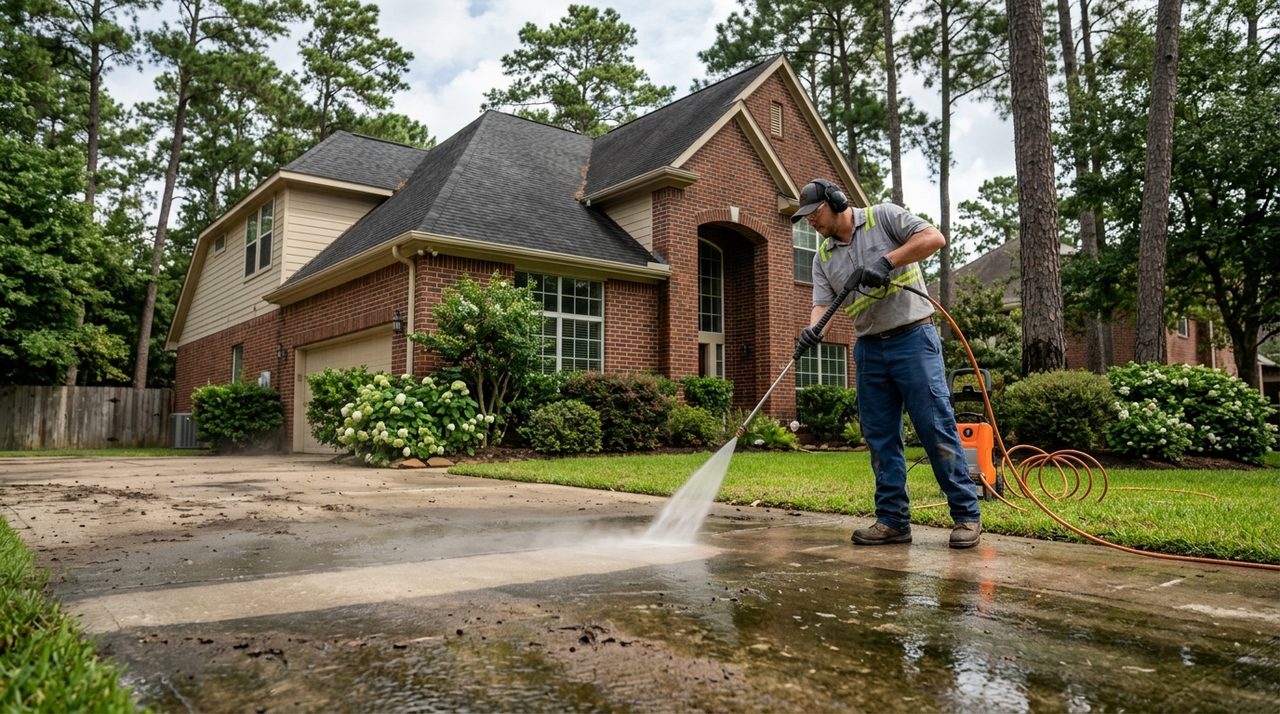
The Woodlands' defining characteristic — thousands of mature hardwoods and pines on heavily canopied lots across villages built between 1974 and the 2020s — creates relentless organic staining on every exterior surface, from 1970s-era brick on South Shore Harbour Drive to freshly poured concrete in newer Creekside Park driveways. The township's deed restrictions and village-level covenant enforcement actively monitor exterior appearance, meaning algae-streaked driveways and green-tinted siding are not just aesthetic problems — they can trigger formal written notices with cure deadlines. Understanding which surfaces need soft-wash chemistry versus direct pressure, and how Montgomery County's permitting framework (not the City of Houston's) applies to commercial wash operations here, is the difference between a clean result and a costly mistake.
Ranked by verified Google rating × review volume × verification tier. How we rank →
709 Springwood Dr, Conroe, TX 77385
22 Tender Violet Pl, The Woodlands, TX 77381
18567 Buddy Riley Blvd, Magnolia, TX 77354
18015 FM 1488 Ste B, Magnolia, TX 77354
24800 I-45 Ste 312, The Woodlands, TX 77386
28514 Ashlyn Ridge Ln, Spring, TX 77386
25700 Interstate 45 N #4300, The Woodlands, TX 77386
15105 Canyon Rapids Rd, Conroe, TX 77302
1611 Julia Park Dr, Spring, TX 77386
9595 Six Pines Dr Bldg 8, Suite 8210, The Woodlands, TX 77380
Why it matters to you
The forested lots that give The Woodlands its identity also keep siding, driveways, and fences in near-constant shade and moisture — exactly the conditions that accelerate Gloeocapsa magma (black algae) and green mold colonization. Homes in the older 1970s–1990s villages like Grogan's Mill and Panther Creek, many with original brick or T1-11 siding, see organic buildup return within 6–12 months of a basic rinse because surface porosity increases with age. Even newer Creekside Park homes are not immune — pine needle and oak leaf debris mats against fence boards and under overhangs, holding moisture that feeds mildew through every humid Houston summer.
What a good pro does
A thorough job here means applying a post-wash biocide (sodium hypochlorite-based soft-wash solution at appropriate dilution) to inhibit regrowth, not just rinsing off visible staining. Operators applying products classified as pesticides under the Texas Department of Agriculture definition must carry a TDA pesticide applicator license — ask to see it before any chemical treatment begins. For wood siding on older homes, pressure should be dialed down to 500–800 PSI and tip distance increased to avoid raising grain or forcing water behind clapboards.
Sources: Local HOA / deed restrictions (see area profile), Texas Commission on Environmental Quality
Why it matters to you
The Woodlands Township and individual village associations enforce deed restrictions on exterior appearance — algae-covered driveways, discolored fences, and roof black-streaking are among the most commonly cited violations in active master-planned communities like this one. Unlike older inner-loop Houston neighborhoods with minimal HOA presence, The Woodlands' architectural review and covenant compliance processes are well-funded and routine, and cure windows can be as short as 30 days from written notice. For homeowners in villages like Sterling Ridge or Cochran's Crossing, that timeline is tight enough that scheduling matters as much as technique.
What a good pro does
Before booking a wash, pull your specific village's covenant language — some deed restrictions explicitly prohibit high-pressure washing on certain roofing materials and painted masonry, requiring soft-wash methods instead. A compliant soft-wash on an asphalt shingle roof (under 500 PSI) satisfies both appearance requirements and manufacturer warranty conditions. Because The Woodlands is unincorporated Montgomery County, there is no City of Houston permit required for routine residential pressure washing, but operators should confirm any chemical disposal practices comply with TCEQ stormwater rules regardless.
Sources: Local HOA / deed restrictions (see area profile), Texas Commission on Environmental Quality, City of Houston Permitting Center
Why it matters to you
The Woodlands' median year-built of 2000 masks a wide range: villages like Alden Bridge and Indian Springs contain substantial 1980s and 1990s housing stock where 3-tab and early architectural shingles are now 25–35 years old and have already shed significant granules. Black Gloeocapsa magma streaks accumulate on these roofs within two to three Houston summers, but blasting them with a standard pressure wand above 500 PSI strips remaining granules, voids any residual manufacturer warranty, and accelerates leak risk — exactly the wrong outcome before a Gulf hurricane season. The combination of aging shingles and township appearance standards creates a narrow window where cleaning is necessary but technique is critical.
What a good pro does
The correct method is a dedicated roof soft-wash: a low-pressure (under 200 PSI) application of diluted sodium hypochlorite solution allowed to dwell and kill algae at the root, followed by a gentle rinse. No Montgomery County permit is required for this service on a residential roof, but if the operator uses a concentrated algaecide formulation that qualifies as a pesticide under Texas Department of Agriculture definitions, a TDA applicator license is required — not optional. Request proof of that credential and confirm the operator carries liability insurance specifically covering roof work before signing any contract.
Sources: Local HOA / deed restrictions (see area profile), International Residential Code (as adopted by City of Houston)
Why it matters to you
Post-1980s wood privacy fences are standard throughout The Woodlands' subdivisions, and the same tree canopy that creates curb appeal also keeps fence boards damp for extended periods after rain, accelerating gray weathering, surface mold, and wood-boring insect activity. Untreated pine fence boards in heavily shaded backyards of older Grogan's Mill or Cochran's Crossing lots can deteriorate to the point of visible black mold streaking and grain splitting within 18–24 months of installation without biennial maintenance washing and resealing. The Woodlands' deed restrictions treat fence appearance as a covenant matter, so a gray, visibly molded fence is both a structural risk and a compliance liability.
What a good pro does
Pressure washing weathered pine fence boards correctly means staying at or below 1,200 PSI with a fan-tip nozzle held at least 12 inches from the surface — over-pressuring aged wood splinters the grain and opens more pathways for moisture and insects. The wash should be followed within a week by a penetrating wood sealer or stain to lock out the moisture that drives regrowth; washing alone without sealing is a six-month fix at best in The Woodlands' climate. Estimates for fence washing in the Houston metro run roughly $0.35–$0.65 per linear foot, with staining quoted separately — confirm both line items before work begins.
Sources: Local HOA / deed restrictions (see area profile), Texas Commission on Environmental Quality
Hiring pressure washing in The Woodlands? The Woodlands is a large master-planned community in Montgomery County governed by The Woodlands Township rather than a traditional HOA, with deed restrictions and covenants on individual lots. Housing spans multiple decades since the community's 1974 founding, meaning contractors encounter a wide range of system ages and conditions. Permitting runs through Montgomery County rather than the City of Houston, which affects licensing and inspection requirements for all trades.
Building era
1970s through 2020s — phased development since 1974, with northern sections generally representing later phases.
Typical style
Not confirmed from available sources — likely a mix of traditional, transitional, and contemporary styles typical of Houston-area master-planned communities.
Foundations
Not confirmed — slab-on-grade is typical for the region but not source-verified for this specific area.
Common systems
Given the multi-decade build-out, expect a wide range: older homes may have R-22 HVAC systems and copper/galvanized plumbing, while newer construction features R-410A systems and PEX plumbing.
What that means for repairs
Older 1970s–1990s sections likely drive demand for HVAC upgrades, kitchen and bath remodels, and plumbing replacements. Deed restrictions and township architectural guidelines affect exterior modifications.
Permit jurisdiction
Montgomery County — The Woodlands is an unincorporated community and does not have its own city permit office. Permits are handled through Montgomery County engineering and development services.
HOA & deed restrictions
No traditional mandatory HOA for the overall community. The Woodlands Township, a special-purpose district, provides governance and services. Deed restrictions and covenants apply to individual lots. Some villages or sub-neighborhoods may have their own associations or architectural review processes — check specific lot records.
Historic districts
No City of Houston historic district designation — The Woodlands is in unincorporated Montgomery County, outside HAHC jurisdiction.
Contractor note
Contractors must follow Montgomery County permitting requirements, not City of Houston codes. Exterior modifications may also require approval through The Woodlands Township or village-level covenant enforcement processes, so confirm before starting work.
FEMA flood zone
FEMA Zone X (low flood risk) per official NFHL data. The Woodlands was designed with an integrated drainage system including retention ponds and natural waterways, though proximity to specific creeks or drainage channels may vary by lot.
Hurricane Harvey impact
Not verified from available sources for The Woodlands North specifically. Some areas of The Woodlands experienced flooding during Harvey in 2017, but neighborhood-specific impact and recurring flood streets could not be confirmed — check Montgomery County floodplain maps and FEMA claims data for parcel-level information.
Heat & humidity load
Houston-area summers with sustained high heat and humidity stress HVAC systems heavily, especially in older homes with less efficient insulation. The wooded setting of the community can contribute to moisture-related issues, mold risk, and increased pest pressure around foundations and attic spaces.
Working with contractors here
The Woodlands' multi-decade build-out means contractors encounter everything from 1970s-era homes needing full system overhauls to recently constructed properties still under builder warranty. HVAC replacement and efficiency upgrades are common in older sections, while newer homes may need cosmetic updates or smart home integrations. The township's deed restrictions and village-level architectural controls mean exterior work — roofing, fencing, painting — often requires pre-approval before starting. Contractors should confirm Montgomery County permit requirements rather than assuming City of Houston processes apply. The heavily wooded lots that define the community create recurring demand for tree-related services, gutter maintenance, and drainage work around foundations.
Local Tip
Always ask for a written estimate before work begins. Texas contractors are required to provide one on jobs over $1,000.
The Woodlands is a large master-planned community in Montgomery County governed by The Woodlands Township rather than a traditional HOA, with deed restrictions and covenants on individual lots. Housing spans multiple decades since the community's 1974 founding, meaning contractors encounter a wide range of system ages and conditions. Permitting runs through Montgomery County rather than the City of Houston, which affects licensing and inspection requirements for all trades.
Source: U.S. Census Bureau, ACS 5-Year 2023
Most of The Woodlands maps to FEMA Zone X (low mapped flood risk), but Houston's flash-flood reality means even low-risk blocks benefit from smart drainage and storm-hardened installs.
Source: FEMA National Flood Hazard Layer (NFHL). Flood zones vary by parcel — verify your individual FIRM panel.
Sources: Local HOA / deed restrictions (see area profile)