Closed
2613 Industrial Ln, Conroe, TX 77301
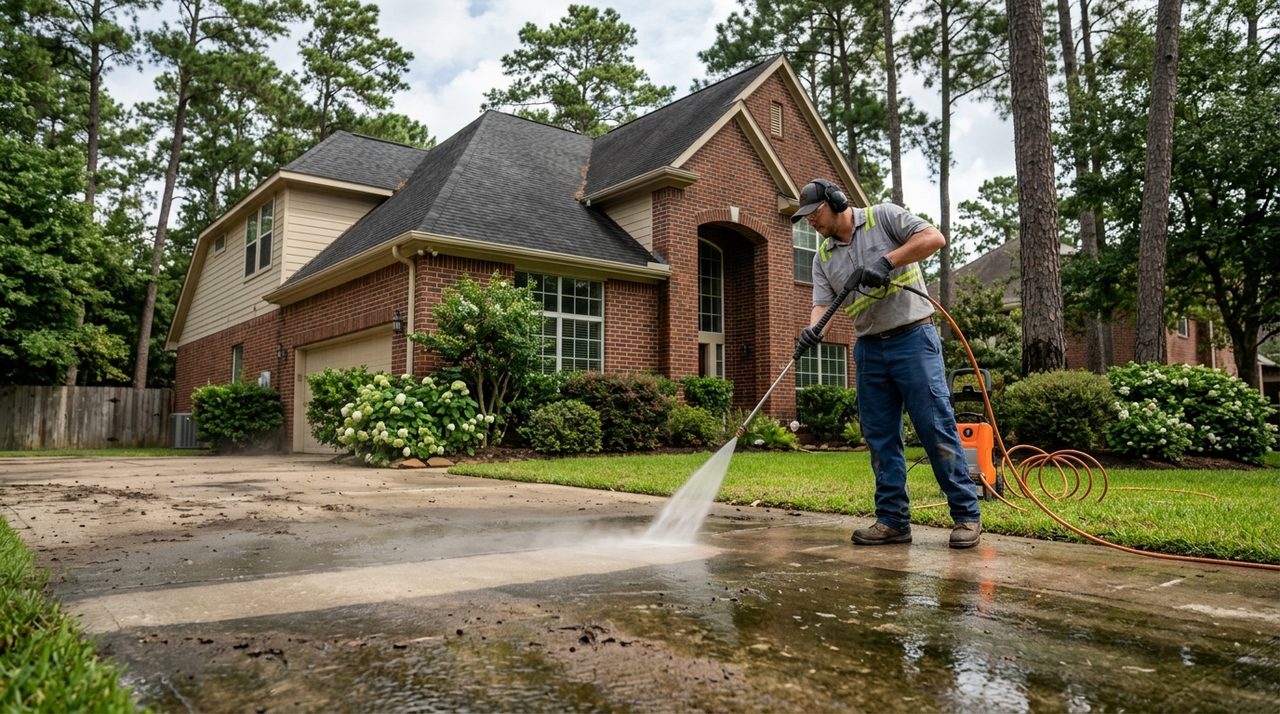
Conroe's housing stock spans six decades — from 1960s brick ranches in older in-town blocks to 2010s-era master-planned subdivisions — and every era brings its own pressure-washing headache: clay-heavy Montgomery County soils that wick mineral stains onto slab edges, Gulf-humidity mold that colonizes wood fences within a single wet season, and a patchwork of subdivision HOAs (some silent, some aggressive) that issue violation notices on a 30-day clock. Understanding which challenge applies to your specific block — and who has permit jurisdiction over your property — is what separates a one-season fix from lasting results.
Ranked by verified Google rating × review volume × verification tier. How we rank →
Some highly-rated pros serve Conroe from nearby and may not keep a Conroe street address. Those are listed under "Also serving Conroe" with their real city and distance, so you always know where each business is based.
2613 Industrial Ln, Conroe, TX 77301
103 S Delmont Dr W, Conroe, TX 77301
2210 N Frazier St Ste #200, Conroe, TX 77303
1516 S Frazier St, Conroe, TX 77301
358 Texoma Plains Dr, Conroe, TX 77304
Highly-rated pros based nearby who cover Conroe. Distance shown from the Conroe area.
Serving Conroe Based in The Woodlands · 9.4 mi away
Why it matters to you
Montgomery County's clay-heavy soils behave exactly like Houston's Beaumont Black clay — shrinking in summer drought and swelling after Gulf moisture events — and the median Conroe home was built around 2004, meaning most slab driveways are now old enough for the concrete's surface to have opened up and begun absorbing mineral salts wicked upward from the subgrade. The result is chalky white efflorescence along slab joints and rust-tinted red-clay mud staining that a standard garden-hose rinse, or even a basic cold-water pressure wash, will not touch.
What a good pro does
A competent operator pre-treats efflorescence with a dilute acid wash (muriatic or phosphoric acid, properly neutralized) and follows with 3,000–3,500 PSI flat-surface cleaning using a rotary surface cleaner to lift clay staining evenly without etching. No City of Conroe or Montgomery County permit is required for routine residential pressure washing, but operators using chemical degreasers or acid pre-treatments must keep wash water from entering storm-drain inlets per TCEQ stormwater rules — containment berms or wet-vac recovery are the practical tools on tighter subdivision lots.
Why it matters to you
Conroe has no single city-wide HOA, but dozens of individual subdivisions — including communities with recorded covenants like Kellyn Oaks — operate active Architectural Control Committees that issue written violation notices for algae-greened driveways, gray wood fences, and black-streaked roofs. Montgomery County's humidity means these surfaces can go from clean to visibly stained in a single wet season, and a 30-day cure window in an HOA notice does not leave much margin to shop around for a contractor.
What a good pro does
Homeowners in HOA-governed Conroe subdivisions should schedule a full-property wash — house soft-wash, driveway, and fence — at least once a year before the late-spring inspection cycle, typically April through June. Budget estimates for a full package (house exterior + driveway + wood fence) run $500–$900 for an average suburban home; that is an estimate and varies with surface condition and linear footage. Confirm with your ACC whether your CC&Rs specify soft-wash-only methods for roofing before hiring, as some covenants restrict high-pressure application on asphalt shingles.
Sources: Local HOA / deed restrictions (see area profile)
Why it matters to you
Post-1990s Conroe subdivisions rely almost universally on pine privacy fencing, and the combination of Gulf humidity that rarely drops below 75% annual average, frequent heavy rain, and shade from subdivision trees means untreated pine can gray and develop surface mold within 12–18 months of installation. Homes in the 2000s-era subdivision belts — where original builder-installed fences are now 15–20 years old — are at the heaviest-deterioration stage.
What a good pro does
The correct sequence is a low-pressure wash (800–1,200 PSI maximum on weathered pine — anything higher splinters the grain) with a sodium hypochlorite or oxygen-bleach solution to kill mold spores, followed immediately by a stain or sealant while the wood is still slightly open from cleaning. Operators applying sodium hypochlorite solutions at concentrations that qualify as pesticides under Texas Department of Agriculture definitions may need a TDA pesticide applicator credential — ask your contractor directly. Neither the City of Conroe Permits & Inspections Department nor Montgomery County Engineering requires a permit for fence washing, but confirm your HOA does not require an ACC submittal before any exterior surface treatment.
Sources: Local HOA / deed restrictions (see area profile), Texas Commission on Environmental Quality
Why it matters to you
Conroe's median home was built around 2004, which means a large share of the housing stock is now wearing its original or first-replacement asphalt shingle roof — roofs between 10 and 20 years old that are simultaneously the most susceptible to Gloeocapsa magma black-streak algae (Houston's humidity makes a 2–3 year reappearance cycle typical) and the most vulnerable to granule loss from high-pressure washing. Voiding a remaining shingle warranty through improper washing is a real financial risk on a roof that may be 5–8 years from replacement anyway.
What a good pro does
Roof cleaning in this situation requires low-pressure soft-wash at under 500 PSI using a sodium hypochlorite-based biocide solution — never a high-pressure lance pointed at the shingle surface. A post-treatment algaecide rinse extends the clean interval and reduces how often the job needs repeating. Estimates for a single-story soft-wash in the Conroe market run $300–$600; two-story homes or steep pitches carry an additional premium. No permit is required from the City of Conroe or Montgomery County for this work, but TDA pesticide applicator rules apply if the chemical formulation meets the pesticide threshold.
Sources: Local HOA / deed restrictions (see area profile), Texas Commission on Environmental Quality
Hiring pressure washing in Conroe? Conroe's housing stock ranges from 1960s-era in-town neighborhoods to modern master-planned communities, creating diverse home service needs across the area. Contractors must verify HOA and deed restriction status on a per-subdivision basis, as requirements vary widely. The mix of older and newer construction means service providers encounter everything from aging HVAC and galvanized plumbing to contemporary builder-grade systems.
Building era
Mixed: 1960s–1980s in older in-town areas; significant growth in 1990s–2010s suburban subdivisions; ongoing 2020s new construction.
Typical style
Texas Traditional brick ranch, contemporary two-story suburban homes, and some custom/farmhouse-influenced builds near rural and lake-adjacent areas.
Foundations
Predominantly slab-on-grade for post-1970 subdivision homes; pier-and-beam found in some older, custom, or flood-prone/lakefront properties.
Common systems
Older homes (1960s–1980s): original galvanized or copper plumbing, aging R-22 HVAC systems, and 100–150 amp electrical panels. Newer homes (2000s–2020s): PEX or CPVC plumbing, R-410A HVAC, and 200 amp electrical service. Central HVAC is standard across all eras.
What that means for repairs
Older in-town Conroe homes frequently need HVAC replacement, re-plumbing from galvanized to PEX, and electrical panel upgrades. Newer subdivision homes see cosmetic remodeling and builder-grade fixture upgrades within 10–15 years of construction.
Permit jurisdiction
City of Conroe Permits & Inspections Department for properties within city limits; Montgomery County Engineering for unincorporated areas.
HOA & deed restrictions
No single mandatory HOA covers all of Conroe. Individual subdivisions vary widely: many master-planned communities (e.g., Kellyn Oaks HOA) have mandatory HOAs with recorded covenants and assessments; other areas have no HOA or only voluntary associations. HOA status must be verified per subdivision.
Historic districts
No historic district designation confirmed for Conroe. Conroe is not within the City of Houston and would not have HAHC oversight.
Contractor note
Contractors must confirm whether a property is within Conroe city limits or unincorporated Montgomery County, as permit requirements and inspection processes differ. Many subdivisions require Architectural Control Committee approval for exterior work before a permit is even pulled.
FEMA flood zone
FEMA Zone X (low flood risk) per official NFHL data. However, Conroe includes areas near the San Jacinto River, Lake Conroe, and various creeks; properties closer to waterways may carry higher flood risk that should be verified on a parcel-by-parcel basis.
Hurricane Harvey impact
Not confirmed with specific Conroe-area damage data from research. Montgomery County experienced flooding during Harvey (2017), particularly in areas near the San Jacinto River and downstream of Lake Conroe dam releases. Specific impact to individual Conroe neighborhoods should be checked via Montgomery County Flood Control District records.
Heat & humidity load
Extended Houston-area summers with sustained 95°F+ temperatures and high humidity stress HVAC systems heavily. Older units in 1960s–1980s homes are particularly failure-prone during peak summer. Slab foundations in the expansive clay soils of Montgomery County are susceptible to movement during prolonged drought cycles, causing door/window alignment issues and potential plumbing stress.
Working with contractors here
Conroe's diverse housing stock means contractors frequently handle HVAC replacements and duct work in older homes, along with re-plumbing projects to replace deteriorating galvanized lines. In newer master-planned subdivisions, work tends toward warranty-era repairs, cosmetic upgrades, and fence/patio additions that require HOA architectural approval. Foundation repair is a recurring need across all eras due to Montgomery County's clay-heavy soils and seasonal moisture swings. Contractors should always confirm permit jurisdiction (City of Conroe vs. Montgomery County) and whether an ACC submission is required before scheduling exterior work. The geographic spread of the area means job scoping should account for potentially significant drive times between subdivisions.
Local Tip
Always ask for a written estimate before work begins. Texas contractors are required to provide one on jobs over $1,000.
Conroe's housing stock ranges from 1960s-era in-town neighborhoods to modern master-planned communities, creating diverse home service needs across the area. Contractors must verify HOA and deed restriction status on a per-subdivision basis, as requirements vary widely. The mix of older and newer construction means service providers encounter everything from aging HVAC and galvanized plumbing to contemporary builder-grade systems.
Source: U.S. Census Bureau, ACS 5-Year 2023
Most of Conroe maps to FEMA Zone X (low mapped flood risk), but Houston's flash-flood reality means even low-risk blocks benefit from smart drainage and storm-hardened installs; risk climbs sharply on blocks nearest the West Fork San Jacinto River and Lake Conroe, where it varies parcel to parcel.
Source: FEMA National Flood Hazard Layer (NFHL). Flood zones vary by parcel — verify your individual FIRM panel.
Sources: Texas Commission on Environmental QualityFEMA National Flood Hazard Layer (NFHL)
Sources: Local HOA / deed restrictions (see area profile)
Sources: Local HOA / deed restrictions (see area profile)