458 Cumberland Trail, Conroe, TX 77301
Best Pest Control in Conroe, TX
Conroe's housing stock spans six decades of construction — from 1960s in-town brick ranches with aging cast-iron plumbing to 2020s master-planned subdivisions still settling into Montgomery County's clay-heavy soils — and every era brings its own pest entry points and pressures. The area's median build year of 2004 means a large share of homes sit on slabs poured before modern termiticide pre-treatment became standard practice in this region, while seasonal moisture swings on the West Fork San Jacinto corridor keep conditions hospitable for Formosan and native subterranean termites year-round. Understanding which challenges are baked into your subdivision's vintage and soil profile is the fastest way to avoid reactive, one-size-fits-all treatments that never fully solve the problem.
Verified against Google Business data
Updated 2026
See the 10 Pest Control Serving Conroe 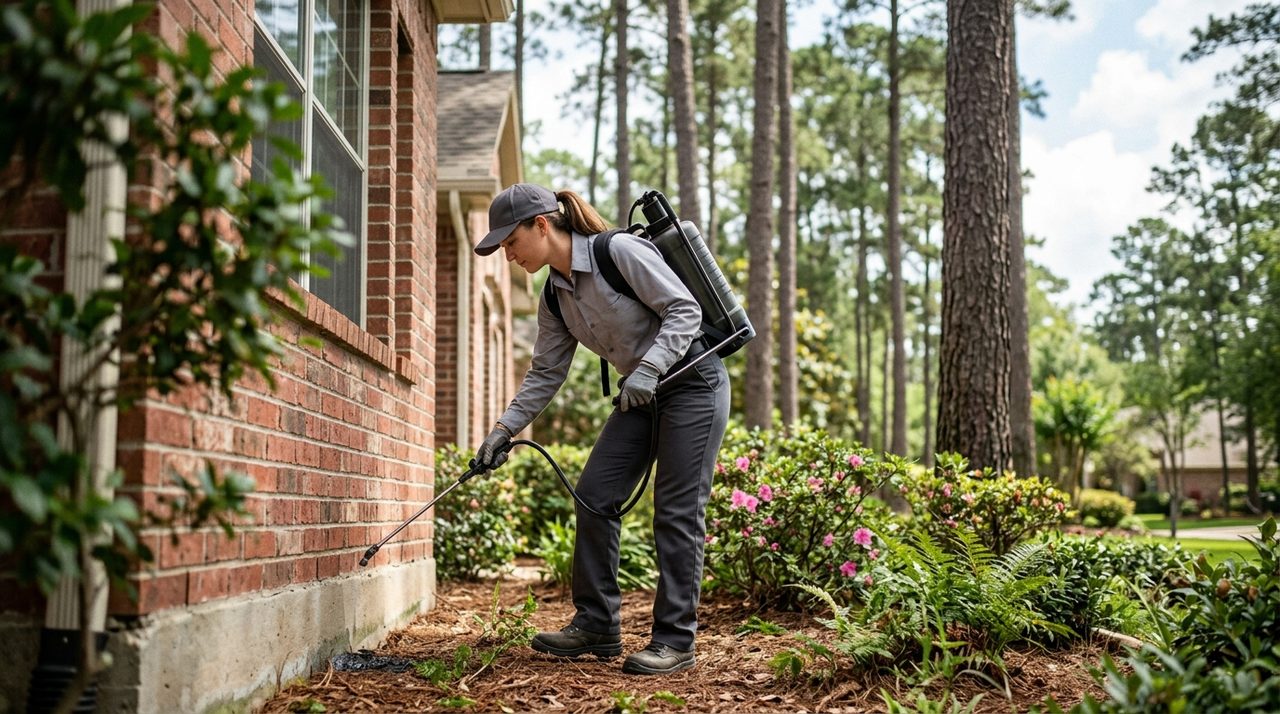
- Median home built
- 2004
- Median home value
- $283,100
- FEMA flood zone
- X (low)
- Typical pest control cost (est.)
- $150–$1,800+
- Most common local issue
- Subterranean termites exploiting slab plumbing penetrations in pre-2000 homes
Ranked by verified Google rating × review volume × verification tier. How we rank →
Some highly-rated pros serve Conroe from nearby and may not keep a Conroe street address. Those are listed under "Also serving Conroe" with their real city and distance, so you always know where each business is based.
Min rating:
10 resultsBased in Conroe
Closed
310 E Davis St Suite 127, Conroe, TX 77301
Closed
2042 Brookmont Dr, Conroe, TX 77301
Closed
336 1/2 N Main St, Conroe, TX 77304
Closed
3513 N Loop 336 W Bldg F, Conroe, TX 77304
Closed
108 Commercial Cir Suite 805, Conroe, TX 77304
2210 N Frazier St Ste #200, Conroe, TX 77303
Closed
2200 N Farm to Market 3083 Rd W, Conroe, TX 77304
Closed
310 E Davis St Suite 104, Conroe, TX 77301
Also serving Conroe
Highly-rated pros based nearby who cover Conroe. Distance shown from the Conroe area.
Closed
Serving Conroe Based in The Woodlands · 3.6 mi away
Pest Control in Conroe: What You Should Know
Termite Access Through Aging Slabs in Pre-2000 In-Town Homes
Why it matters to you
Conroe's older in-town neighborhoods — 1960s through 1980s brick ranches concentrated near downtown — were built on slabs without the liquid termiticide pre-treatments that became routine in the 1990s and 2000s. Houston's USDA Zone 5 termite pressure, the highest-rated zone in the continental U.S., means Formosan and Reticulitermes species are actively foraging year-round, and expansion joints, original galvanized plumbing penetrations, and decades of slab micro-movement on Montgomery County clay give them direct soil-to-wood highways with no crawlspace buffer in between.
What a good pro does
A TDLR-licensed Structural Pest Control operator (termite category endorsement required) should perform a full interior and exterior slab inspection, probing garage slabs, door thresholds, and plumbing walls where settlement gaps are most common. For active infestations, a liquid Termidor-type barrier treatment along the foundation perimeter — estimated $800–$1,800 for a typical slab home depending on linear footage — is the most common corrective approach; bait station programs (Sentricon-type, estimated $1,200–$2,000 installed plus $300–$500/year monitoring) suit homeowners who want ongoing activity tracking. Always ask to see the technician's TDLR license number and category endorsements before work begins.
Red Imported Fire Ants Targeting Irrigation and HVAC Junction Boxes in Suburban Subdivisions
Why it matters to you
Conroe's 1990s–2010s master-planned subdivisions were built on Montgomery County's clay-dominant soils with irrigated turf standard across most lots, and TAMU Extension classifies the entire Houston metro as high-density RIFA territory. Fire ant mounds concentrate predictably near irrigation heads and low-voltage electrical junction boxes — including HVAC disconnect boxes and exterior light pedestals — where soil stays moist and warm. Colonies that short out irrigation controllers or HVAC disconnects produce repair bills that quickly exceed the cost of a proper seasonal treatment program.
What a good pro does
Effective control in these subdivisions requires a two-step approach: a broadcast granular bait across the entire turf area (not just individual mound treatments, which drive colonies to relocate a few feet) followed by individual mound contact insecticide for immediate knockdown. Re-infestation from neighboring lots in HOA communities with shared greenspace is near-certain without quarterly perimeter treatments, so confirm whether your subdivision's HOA already contracts community-wide fire ant control — if so, coordinate with that program rather than duplicating effort. A TDLR-licensed operator can treat your property line independently if the community program does not cover private lots.
Sources: Texas Department of Licensing & Regulation, Local HOA / deed restrictions (see area profile)
Rodent Entry Through Slab Gaps and Utility Chases Reopened by Clay Soil Movement
Why it matters to you
Montgomery County's expansive Beaumont and Houston Black clay soils produce significant seasonal slab heave and settlement — USGS measurements in comparable Harris County clay soils document up to two inches of vertical differential — and that movement repeatedly opens gaps around plumbing penetrations, brick veneer weep holes, and garage door sweeps even in relatively new Conroe subdivision homes. Homes that had pipe repairs after Winter Storm Uri in 2021 are particularly exposed: rushed remediation frequently left utility chases improperly resealed, giving Rattus norvegicus and Mus musculus direct access to wall voids and attic spaces in homes that otherwise appear modern and tight.
What a good pro does
A thorough rodent exclusion job in Conroe starts with a crawl of the exterior at slab level, probing every plumbing and electrical penetration and every weep hole course for entry points, before any interior trapping begins. Gaps should be sealed with steel wool packed in hydraulic cement or metal flashing — materials that accommodate clay-driven slab movement better than caulk alone — and then monitored across at least two seasonal moisture cycles to confirm the seal holds. Full rodent exclusion plus interior treatment is estimated at $400–$900 in the Houston metro; in Conroe specifically, a quality operator will note whether any gap repair interacts with HOA architectural control requirements before patching visible brick or fascia areas.
Sources: Texas Department of Licensing & Regulation, Local HOA / deed restrictions (see area profile)
Post-Storm Wildlife Intrusion Into Attics After Derecho and Hurricane Wind Damage
Why it matters to you
The May 2024 derecho delivered 100-plus mph gusts across the North Houston metro, and many Conroe subdivisions with mature tree canopy saw soffit panels, ridge caps, and fascia boards stripped or cracked — openings that roof rats, opossums, and Mexican free-tailed bats exploit within days of a storm event. Conroe's mix of 1990s and 2000s wood-soffit construction is especially vulnerable because the soffit material degrades over time and fails at lower wind loads than newer fiber-cement or aluminum products. Texas Parks and Wildlife Department regulations require specific handling protocols for bats, meaning a pest control operator who discovers a bat colony during attic remediation must follow TPWD exclusion windows and cannot simply seal the opening mid-roost.
What a good pro does
After any significant wind event, a TDLR-licensed pest control operator with wildlife exclusion experience should inspect the full roofline before attic-access pests establish a permanent colony — early intervention is dramatically cheaper than full attic remediation. Expect a post-storm inspection and treatment scope to run $500–$1,500-plus if wildlife exclusion, guano removal, and insulation disturbance are involved; document everything photographically for a homeowner insurance claim. If your Conroe home carries TWIA wind coverage, confirm with your carrier whether wildlife exclusion work tied to storm-caused structural damage is eligible for reimbursement before authorizing the repair scope.
Sources: Texas Department of Licensing & Regulation, Texas Windstorm Insurance Association (TWIA), Local HOA / deed restrictions (see area profile)
Pest Control in Conroe: What You Should Know
Hiring pest control in Conroe? Conroe's housing stock ranges from 1960s-era in-town neighborhoods to modern master-planned communities, creating diverse home service needs across the area. Contractors must verify HOA and deed restriction status on a per-subdivision basis, as requirements vary widely. The mix of older and newer construction means service providers encounter everything from aging HVAC and galvanized plumbing to contemporary builder-grade systems.
- Housing era
- Mixed
- Foundation
- Predominantly slab-on-grade for post-1970 subdivision homes
- Flood zone
- FEMA Zone X (low flood risk) per official NFHL data
- Permits
- City of Conroe Permits & Inspections Department for properties within city limits
Housing stock & systems
Building era
Mixed: 1960s–1980s in older in-town areas; significant growth in 1990s–2010s suburban subdivisions; ongoing 2020s new construction.
Typical style
Texas Traditional brick ranch, contemporary two-story suburban homes, and some custom/farmhouse-influenced builds near rural and lake-adjacent areas.
Foundations
Predominantly slab-on-grade for post-1970 subdivision homes; pier-and-beam found in some older, custom, or flood-prone/lakefront properties.
Common systems
Older homes (1960s–1980s): original galvanized or copper plumbing, aging R-22 HVAC systems, and 100–150 amp electrical panels. Newer homes (2000s–2020s): PEX or CPVC plumbing, R-410A HVAC, and 200 amp electrical service. Central HVAC is standard across all eras.
What that means for repairs
Older in-town Conroe homes frequently need HVAC replacement, re-plumbing from galvanized to PEX, and electrical panel upgrades. Newer subdivision homes see cosmetic remodeling and builder-grade fixture upgrades within 10–15 years of construction.
Permits & restrictions
Permit jurisdiction
City of Conroe Permits & Inspections Department for properties within city limits; Montgomery County Engineering for unincorporated areas.
HOA & deed restrictions
No single mandatory HOA covers all of Conroe. Individual subdivisions vary widely: many master-planned communities (e.g., Kellyn Oaks HOA) have mandatory HOAs with recorded covenants and assessments; other areas have no HOA or only voluntary associations. HOA status must be verified per subdivision.
Historic districts
No historic district designation confirmed for Conroe. Conroe is not within the City of Houston and would not have HAHC oversight.
Contractor note
Contractors must confirm whether a property is within Conroe city limits or unincorporated Montgomery County, as permit requirements and inspection processes differ. Many subdivisions require Architectural Control Committee approval for exterior work before a permit is even pulled.
Flood & weather
FEMA flood zone
FEMA Zone X (low flood risk) per official NFHL data. However, Conroe includes areas near the San Jacinto River, Lake Conroe, and various creeks; properties closer to waterways may carry higher flood risk that should be verified on a parcel-by-parcel basis.
Hurricane Harvey impact
Not confirmed with specific Conroe-area damage data from research. Montgomery County experienced flooding during Harvey (2017), particularly in areas near the San Jacinto River and downstream of Lake Conroe dam releases. Specific impact to individual Conroe neighborhoods should be checked via Montgomery County Flood Control District records.
Heat & humidity load
Extended Houston-area summers with sustained 95°F+ temperatures and high humidity stress HVAC systems heavily. Older units in 1960s–1980s homes are particularly failure-prone during peak summer. Slab foundations in the expansive clay soils of Montgomery County are susceptible to movement during prolonged drought cycles, causing door/window alignment issues and potential plumbing stress.
Working with contractors here
Conroe's diverse housing stock means contractors frequently handle HVAC replacements and duct work in older homes, along with re-plumbing projects to replace deteriorating galvanized lines. In newer master-planned subdivisions, work tends toward warranty-era repairs, cosmetic upgrades, and fence/patio additions that require HOA architectural approval. Foundation repair is a recurring need across all eras due to Montgomery County's clay-heavy soils and seasonal moisture swings. Contractors should always confirm permit jurisdiction (City of Conroe vs. Montgomery County) and whether an ACC submission is required before scheduling exterior work. The geographic spread of the area means job scoping should account for potentially significant drive times between subdivisions.
Local Tip
Always ask for a written estimate before work begins. Texas contractors are required to provide one on jobs over $1,000.
About Conroe
Conroe's housing stock ranges from 1960s-era in-town neighborhoods to modern master-planned communities, creating diverse home service needs across the area. Contractors must verify HOA and deed restriction status on a per-subdivision basis, as requirements vary widely. The mix of older and newer construction means service providers encounter everything from aging HVAC and galvanized plumbing to contemporary builder-grade systems.
- Median year built
- 2004
- Median home value
- $283,100
- Owner-occupied
- 55.2%
- Population
- 96,976
- Housing units
- 40,219
- Median income
- $75,245
Source: U.S. Census Bureau, ACS 5-Year 2023
Flood & storm risk
FEMA Zone XLow flood riskMost of Conroe maps to FEMA Zone X (low mapped flood risk), but Houston's flash-flood reality means even low-risk blocks benefit from smart drainage and storm-hardened installs; risk climbs sharply on blocks nearest the West Fork San Jacinto River and Lake Conroe, where it varies parcel to parcel.
Source: FEMA National Flood Hazard Layer (NFHL). Flood zones vary by parcel — verify your individual FIRM panel.
Free Conroe Tools & Calculators
Houston-specific estimators to plan your project before you call a pro. All results are planning estimates — a licensed local pro confirms the details on site.
Houston Subtropical Pest Treatment Planner
Open full tool & FAQ →Your Houston treatment schedule
| Pest | Cadence | Active window |
|---|---|---|
Mosquito control A standard 4-week barrier treatment holds a typical suburban lot through Houston's core mosquito season. | Every 28 days | April – October |
Termite (subterranean) A once-a-year spring inspection is the baseline for a drier, sunnier Houston lot — catch mud tubes and swarmer wings before damage compounds. | Annual inspection | Spring |
General pest guard (roaches, ants, spiders) Houston's year-round warmth means general pests never fully die off — a quarterly perimeter treatment is the standard maintenance rhythm. | Quarterly | Mar · Jun · Sep · Dec |
This is a planning estimate only — actual requirements depend on an on-site assessment by a licensed Houston pro. Texas requires an SPCB-licensed applicator for chemical treatment — ask for the technician's license number.
Frequently Asked Questions
Do I need a permit from the City of Conroe or Montgomery County before a pest control company tents my house for fumigation?
Routine pest control treatments — sprays, bait stations, termite liquid barriers — require no municipal permit in Conroe. Fumigation (tent or whole-structure) is different: Texas regulations require the licensed operator to notify the local fire marshal, and whether that coordination runs through the City of Conroe Permits & Inspections Department or Montgomery County Engineering depends on whether your parcel sits inside city limits or in unincorporated Montgomery County — a distinction your operator should confirm before scheduling. Ask your pest control company to pull up your jurisdiction in advance and document the fire marshal notification in writing.
My Conroe subdivision has an HOA — do I need architectural approval before a pest control company installs termite bait stations around my foundation perimeter?
HOA status and rules vary widely across Conroe's subdivisions, so there's no single answer for the whole area. Communities with active Architectural Control Committees — like some of the master-planned subdivisions off Loop 336 — have deed restrictions that may regulate visible exterior bait stations, the timing of broadcast lawn treatments near shared greenspace, or mound treatments on common turf. Before your operator drives a Sentricon-type station into your lawn, pull your subdivision's recorded covenants or contact your ACC directly; some require written approval that can take two to four weeks.
Sources: Local HOA / deed restrictions (see area profile)
My home was built in the late 1990s near the West Fork San Jacinto River corridor — is it at higher termite risk than newer Conroe subdivisions, and what does treatment typically cost?
Yes, on two counts: homes built before roughly 2000 in this region generally predate the widespread adoption of modern termiticide soil pre-treatment at the slab pour, and parcels along the West Fork San Jacinto corridor — even those that map to FEMA Zone X on average — can hold soil moisture long enough after heavy rain to sustain active Formosan and native subterranean termite colonies close to your foundation. A liquid barrier treatment (Termidor-type) sized for a typical Conroe slab-on-grade home runs an estimated $800–$1,800 depending on linear footage; a bait-station system runs an estimated $1,200–$2,000 installed plus $300–$500 per year for required annual monitoring — both are estimates and vary by operator and home footprint.
When is mosquito pressure worst in the Conroe area, and does Harris County Mosquito Control District spray out here?
Peak mosquito pressure in Conroe typically runs May through October, with sharp spikes in the two to three weeks following any significant rainfall event that leaves water pooling in low-drainage clay-soil yards — a common occurrence in Montgomery County even during FEMA Zone X conditions. Conroe is in Montgomery County, not Harris County, so the Harris County Mosquito Control District does not operate here; Montgomery County has its own vector-control program, but like Harris County's, it focuses on public rights-of-way and does not treat private yards. A professional barrier spray program covering your property typically runs an estimated $75–$150 per monthly application during mosquito season.
Sources: Harris County Flood Control District
After the May 2024 derecho tore fascia off part of my Conroe home, something is living in my attic. Can a regular pest control company handle that, or do I need a separate wildlife removal contractor?
Many TDLR-licensed pest control operators in the Conroe area offer wildlife exclusion services, but Texas law (through TPWD regulations) requires specific handling protocols for bats and certain protected bird species — not every general pest control license covers that work. Before hiring, ask the company to confirm which wildlife categories are covered under their TDLR endorsements and whether they will also seal the storm-damaged entry points, since removal without exclusion nearly guarantees re-entry. If your homeowner's policy or TWIA coverage applies to the wind damage that opened the attic access, get a written scope from the pest operator before filing so you can document the pest remediation as part of the storm claim.
Sources: Texas Department of Licensing & RegulationTexas Windstorm Insurance Association (TWIA)
How do I verify that a pest control technician showing up at my Conroe home is actually licensed in Texas?
Texas requires every pest control technician to hold a TDLR Technician registration and to work under a Certified Applicator who holds a Structural Pest Control license with the appropriate category endorsements (termites, rodents, general household pests, etc.) — all issued by the Texas Department of Licensing and Regulation. You can verify any company's or individual's license status in real time at the TDLR online license search at tdlr.texas.gov; look up both the company's Structural Pest Control business license and the technician's individual registration before work begins. This is especially worth checking for post-storm or door-to-door solicitors that appear in Conroe neighborhoods after major wind events.