Closed
12415 Washington Wy, Tomball, TX 77375
Tomball's northwest Harris County clay soils rank among the most expansive in the metro, and the area's wide mix of housing — from 1960s–1980s ranch homes near Old Town to late-1990s and 2000s production-builder subdivisions in master-planned communities like Villages of NorthPointe — means foundation stress shows up in very different ways depending on which block you're on. Add a fragmented permit landscape split between the City of Tomball Building Department and Harris County Engineering, plus mandatory HOA architectural review requirements in most modern subdivisions, and a foundation repair project here requires more upfront homework than in many other parts of the metro. This page covers the specific soil, construction era, and jurisdictional realities that determine how a Tomball foundation repair job should be scoped, permitted, and documented.
Ranked by verified Google rating × review volume × verification tier. How we rank →
Some highly-rated pros serve Tomball from nearby and may not keep a Tomball street address. Those are listed under "Also serving Tomball" with their real city and distance, so you always know where each business is based.
12415 Washington Wy, Tomball, TX 77375
13315 Theis Ln, Tomball, TX 77375
11714 Boudreaux Rd Suite 220, Tomball, TX 77375
25410 Morgan Dr, Tomball, TX 77375
12022 Zion Rd, Tomball, TX 77375
12111 Spring Cypress Rd #302, Tomball, TX 77377
13900 Humble Rd, Tomball, TX 77375
12222 Windsor Bay Ct, Tomball, TX 77375
14090 Farm to Market 2920 G-170, Tomball, TX 77377
Highly-rated pros based nearby who cover Tomball. Distance shown from the Tomball area.
Serving Tomball Based in Porter · 1.2 mi away
Why it matters to you
The northwest Harris County Houston Black clay formation under Tomball's master-planned subdivisions swells with winter rains and contracts sharply during summer and La Niña drought years. Production-builder homes constructed from the late 1990s through the 2000s — now 20 to 30 years old and entering their first serious foundation cycle — commonly show stair-step cracks in brick veneer at corners, sticky interior doors, and hairline drywall cracks above window headers. These symptoms often reappear seasonally rather than progressing linearly, which homeowners sometimes misread as 'the house settling back down on its own.'
What a good pro does
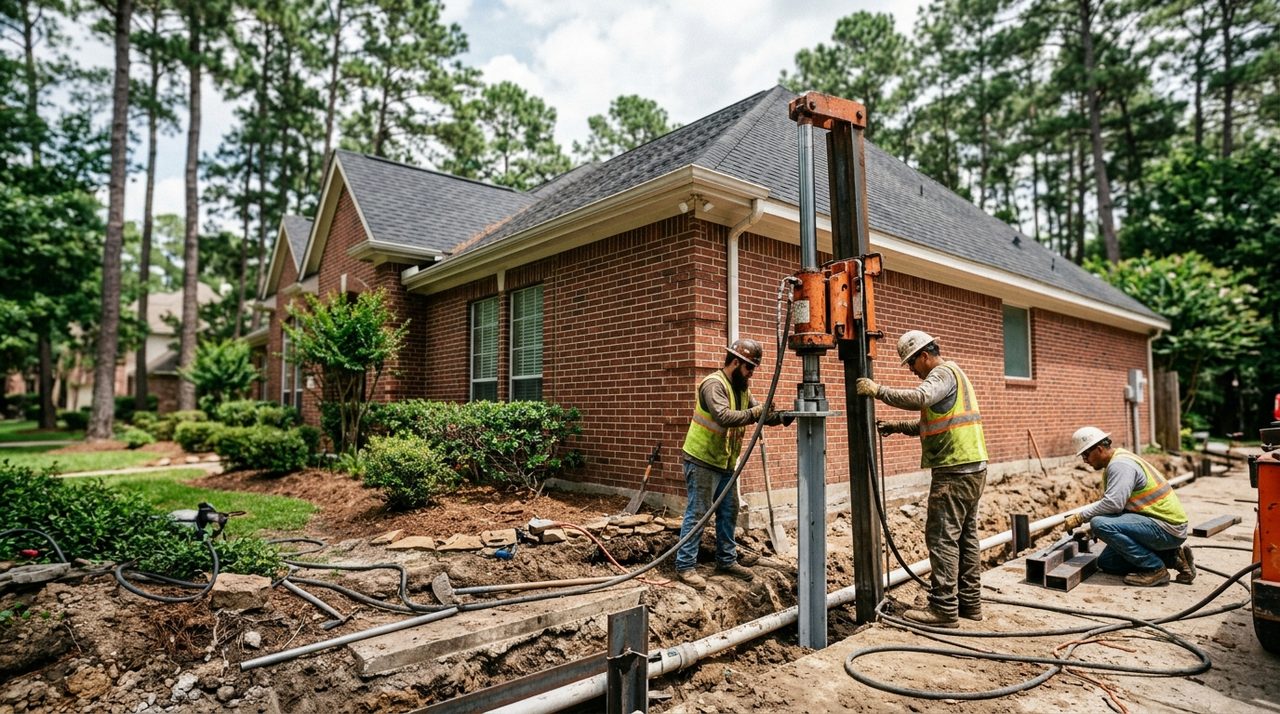
A qualified foundation contractor should document crack locations and measure differential elevation across the slab using a Zip-Level or optical level before recommending any underpinning. If movement is seasonal and within roughly half an inch, a structured soaker-hose perimeter irrigation program — run consistently during Tomball's dry months — is often the most cost-effective first step, costing far less than the estimated $10,000–$25,000 for a steel push-pier job. Contractors who skip the measurement step and jump straight to pier proposals on a late-1990s production-builder slab should be viewed skeptically.
Sources: Municipal permit office (see area profile), International Residential Code (as adopted by City of Houston)
Why it matters to you
Homes built in the 1960s through the 1980s near Tomball's historic city core were commonly plumbed with cast-iron under-slab drain lines. Winter Storm Uri in February 2021 cracked and displaced thousands of these pipes across Harris County; many Tomball homeowners patched visible interior damage but never addressed the pipe runs under the slab itself. Slow ongoing leaks from those lines saturate the clay directly beneath the foundation, causing localized heave followed by settlement as soil structure breaks down — a pattern that can mimic and be mistaken for purely soil-driven movement.
What a good pro does
Before signing any foundation repair contract on an Old Town Tomball home from this era, insist on a hydrostatic plumbing pressure test — a licensed plumber holding a TSBPE license must perform this scope. The test costs an estimated $250–$400 and identifies active under-slab leaks that, if left unaddressed, will undermine even a freshly piered foundation. A foundation contractor who quotes underpinning without recommending a plumbing test on a pre-1990 home with cast-iron lines is skipping a critical diagnostic step.
Sources: Texas State Board of Plumbing Examiners, Municipal permit office (see area profile)
Why it matters to you
Tomball is one of the more complicated permit jurisdictions in the northwest metro. Properties within the City of Tomball limits require foundation repair permits through the City of Tomball Building Department; properties in the surrounding unincorporated area — which includes many of the master-planned subdivisions that ring the city — permit through Harris County Engineering. These are separate offices with different inspection protocols, fee schedules, and inspection timing requirements. Contractors who routinely work inside the city limits may be unfamiliar with the county process, and vice versa; the result is unpermitted or improperly permitted work that surfaces as a liability on a TREC seller's disclosure form at resale.
What a good pro does
Confirm the property's municipal boundary before any contract is signed — not after. The Harris County Appraisal District property search and the City of Tomball GIS portal are the two fastest ways to establish which jurisdiction applies. Require your contractor to provide a copy of the issued permit and the final inspection sign-off in writing; do not accept verbal assurances that a permit was pulled. The median home value in Tomball is approximately $306,400 (U.S. Census Bureau, ACS 5-Year 2023), and an undisclosed unpermitted foundation repair can kill a sale or trigger renegotiation at closing.
Sources: Municipal permit office (see area profile), Local HOA / deed restrictions (see area profile)
Why it matters to you
In Tomball's modern master-planned communities — including Villages of NorthPointe and Stone Lake, among others — the HOA or POA architectural review committee typically must approve exterior work before it begins. Foundation repair involving perimeter trenching, pier installation access ports, or visible soil disturbance along the foundation line qualifies as an exterior modification under most ARC rules. Homeowners who skip ARC approval and let a contractor begin work risk stop-work notices, fines, and the cost of undoing completed work to satisfy HOA requirements.
What a good pro does
Before scheduling your foundation contractor's crew, pull your HOA's CC&Rs and submit an ARC request with the contractor's scope-of-work document and site diagram. Most Tomball-area HOAs respond to ARC submissions within 10 to 30 days; factor this into your project timeline, especially if moisture-driven movement is active. HOA approval documentation should be kept with your permit record and repair warranty because Texas TREC disclosure requirements mean you will need to produce this paperwork when the home is eventually sold.
Sources: Local HOA / deed restrictions (see area profile), Municipal permit office (see area profile)
Hiring foundation repair in Tomball? Tomball spans a wide range of housing stock, from older 1960s–1980s homes near the historic city core to newer master-planned subdivisions built from the late 1990s onward. Most HOA-governed neighborhoods feature production-builder brick veneer homes on slab-on-grade foundations, meaning foundation monitoring, HVAC maintenance, and roof upkeep are the primary service needs. Contractors should verify whether a property falls within the City of Tomball, an unincorporated Harris County area, or a specific HOA before beginning work.
Building era
Mixed: 1960s–1980s near Old Town Tomball; late 1990s–2010s in master-planned subdivisions.
Typical style
Production-builder Texas Traditional with brick veneer, hip/gable roofs, and attached garages; some older ranch-style homes near the city core.
Foundations
Predominantly slab-on-grade; pier-and-beam limited to pre-1960s or custom/rural construction.
Common systems
Newer subdivisions: central HVAC (often 15–25 years old in late-1990s builds), copper or PEX plumbing, 200-amp electrical panels. Older homes near Old Town: original HVAC systems likely replaced, possible galvanized or cast iron plumbing, older electrical panels that may need upgrading.
What that means for repairs
Older homes near Old Town Tomball see kitchen and bath remodels, re-piping from galvanized to PEX, and electrical panel upgrades. Newer master-planned homes are entering their first major replacement cycles for HVAC systems, water heaters, and roofing.
Permit jurisdiction
Mixed jurisdiction: properties within the City of Tomball require permits through the City of Tomball Building Department; unincorporated Harris County properties require permits through Harris County Engineering. Verify municipal boundaries before pulling permits.
HOA & deed restrictions
Mandatory HOAs/POAs are the norm in modern Tomball-area master-planned subdivisions (e.g., Villages of NorthPointe Community Association, Stone Lake Homeowners Association). Membership attaches to property ownership. Older pockets near Tomball city core may have no organized HOA or voluntary civic clubs. Confirm specific HOA status via Harris County deed records or TREC HOA Management Certificate database.
Historic districts
No City of Houston historic district designation confirmed. Old Town Tomball has some heritage character but no HAHC jurisdiction applies.
Contractor note
Many Tomball-area HOAs require architectural review committee (ARC) approval before exterior modifications. Contractors should confirm HOA approval requirements and verify whether the property is in the City of Tomball or unincorporated Harris County, as permitting processes differ significantly.
FEMA flood zone
FEMA Zone X (low flood risk) per official NFHL data. Some areas near Cypress Creek and local drainage channels may carry higher risk; always verify specific addresses against the Harris County Flood Control District floodplain viewer.
Hurricane Harvey impact
Some parts of the Tomball/North Harris County area experienced Harvey flooding, particularly near creeks and Cypress Creek, but flooding was very localized. Many newer master-planned subdivisions were designed with detention facilities and experienced less structural flooding than older bayou-adjacent areas. Specific street-level flood history should be verified through Harris County Flood Control District records, seller disclosures, and FEMA claim data.
Heat & humidity load
Sustained summer heat puts heavy demand on HVAC systems, especially in late-1990s to early-2000s homes where original units may be nearing end of life. Slab foundations on Houston's expansive clay soils benefit from consistent watering during drought periods to prevent differential settlement. Attic temperatures in single-story brick veneer homes can exceed 150°F, accelerating roofing material degradation.
Working with contractors here
HVAC replacement and maintenance is the most common service call in Tomball's master-planned subdivisions, as many late-1990s and 2000s-era systems are reaching or past their expected lifespan. Foundation repair and monitoring is also significant due to the expansive clay soils common across northwest Harris County. Roofing work is frequent, driven by both age-related wear and periodic hail events. In older Old Town Tomball homes, re-piping from galvanized to PEX and electrical panel upgrades are common jobs. Contractors should always check HOA ARC requirements for exterior work and confirm the correct permit jurisdiction before starting any project.
Local Tip
Always ask for a written estimate before work begins. Texas contractors are required to provide one on jobs over $1,000.
Tomball spans a wide range of housing stock, from older 1960s–1980s homes near the historic city core to newer master-planned subdivisions built from the late 1990s onward. Most HOA-governed neighborhoods feature production-builder brick veneer homes on slab-on-grade foundations, meaning foundation monitoring, HVAC maintenance, and roof upkeep are the primary service needs. Contractors should verify whether a property falls within the City of Tomball, an unincorporated Harris County area, or a specific HOA before beginning work.
Source: U.S. Census Bureau, ACS 5-Year 2023
Most of Tomball maps to FEMA Zone X (low mapped flood risk), but Houston's flash-flood reality means even low-risk blocks benefit from smart drainage and storm-hardened installs.
Source: FEMA National Flood Hazard Layer (NFHL). Flood zones vary by parcel — verify your individual FIRM panel.
Wind-driven rain during a hurricane can saturate soil on the windward side of your home while the leeward side stays dry, creating differential moisture conditions beneath your slab that show up as sticking doors weeks later in Tomball, TX. Schedule a Zip-Level elevation reading after any named storm passes so a foundation professional can distinguish normal seasonal movement from storm-induced settlement requiring pier work. Confirm the current FEMA panel for your Tomball parcel — the area maps to Zone X, but adjacent lots can differ.
The May 2024 derecho caused structural racking in thousands of Houston homes, and racking places diagonal tension on slab corners that can widen existing hairline cracks into visible gaps in Tomball, TX over the following weeks. Schedule a foundation survey within 30 days of any severe wind event to establish a post-storm baseline before summer drying compounds any movement. As a Harris County community, Tomball may follow county rather than City of Houston storm rebuild rules.
Winter Storm Uri's multi-day freeze caused Houston clay soils to go through freeze-thaw cycling not common in the region, and even low-flood-risk neighborhoods in Tomball, TX saw new door-sticking and brick-step cracking appear in the spring following the storm. A post-winter Zip-Level survey establishes whether that movement is seasonal and self-correcting or progressive and in need of pier work before summer drying amplifies the differential. As a Harris County community, Tomball may follow county rather than City of Houston storm rebuild rules.
Sources: FEMA National Flood Hazard Layer (NFHL), Ready.gov -- Hurricanes, CenterPoint Energy -- Storm Center, City of Houston -- Emergency Preparedness, Ready.gov -- Winter Weather, Harris County Flood Control District
Houston-specific estimators to plan your project before you call a pro. All results are planning estimates — a licensed local pro confirms the details on site.
Grouped by mature root aggression & water demand.
Trunk center to the nearest exterior wall.
The root zone likely reaches your foundation's soil during Houston's dry summers, when clay shrinks most. Watch for sticking doors and diagonal cracks, keep soil moisture even with a soaker hose during drought, and have a foundation pro evaluate if you see any movement.
Find a Houston foundation pro →This is a planning estimate only — actual requirements depend on an on-site assessment by a licensed Houston pro. Guidance is based on general species root behavior in expansive clay, not a soil test.
Disconnect & drain every outdoor hose bib
Remove hoses, drain the spigots, and cover each with an insulated faucet sock. Un-drained hose bibs are the #1 burst point in a Houston freeze.
Insulate exposed pipes in the attic & garage
Wrap any pipe in an unconditioned space (attic runs, garage walls) with foam sleeves. Houston homes rarely insulate these because they only matter a few nights a year — which is exactly why they burst.
Open cabinet doors & keep a pencil-width drip
On hard-freeze nights, open kitchen/bath cabinets so warm air reaches the pipes and let faucets on exterior walls drip to relieve pressure.
Protect the attic/garage water heater & its lines
An attic or garage tank sits in unconditioned space. Insulate the cold-inlet and hot-outlet lines and confirm the emergency drain pan is clear so a leak doesn't reach the ceiling.
This is a planning estimate only — actual requirements depend on an on-site assessment by a licensed Houston pro. If a pipe has already burst, shut off your main water supply and call a licensed Houston plumber immediately — freeze bursts flood fast.
Sources: Local HOA / deed restrictions (see area profile)
Sources: Municipal permit office (see area profile)
Sources: Municipal permit office (see area profile)
Sources: FEMA National Flood Hazard Layer (NFHL)Harris County Flood Control District