Closed
12714 New Cypress Dr, Cypress, TX 77429
Cypress is an unincorporated Harris County community built almost entirely on slab-on-grade foundations atop the same expansive Beaumont and Houston Black clay formations that destabilize slabs across northwest Houston — and with the bulk of its housing stock dating from the 1980s through the 2000s, many homes are now hitting the age window when those clay soils, decades of wet-dry cycling, and original builder-grade construction details converge into visible foundation movement. Permits for foundation underpinning here run through the Harris County Engineering Department, not the City of Houston, and nearly every subdivision's HOA requires architectural committee sign-off before any exterior trenching or repair work can begin. Understanding those layers — soil, system age, county permitting, and mandatory HOA process — is what separates a smooth repair from one that stalls at the permit counter or triggers a deed-restriction violation.
Ranked by verified Google rating × review volume × verification tier. How we rank →
Some highly-rated pros serve Cypress from nearby and may not keep a Cypress street address. Those are listed under "Also serving Cypress" with their real city and distance, so you always know where each business is based.
12714 New Cypress Dr, Cypress, TX 77429
17767 Grant Rd, Cypress, TX 77429
14555 Skinner Rd, Cypress, TX 77429
Highly-rated pros based nearby who cover Cypress. Distance shown from the Cypress area.
Serving Cypress Based in Tomball · 5.8 mi away
Serving Cypress Based in Champions Forest · 5.9 mi away
Serving Cypress Based in Tomball · 7.4 mi away
Serving Cypress Based in Tomball · 8.1 mi away
Serving Cypress Based in Jersey Village · 8.5 mi away
Serving Cypress Based in Jersey Village · 8.5 mi away
Serving Cypress Based in Tomball · 8.5 mi away
Why it matters to you
The 1980s–2000s production homes that dominate Cypress subdivisions like Lakewood Forest and Cypress Creek Crossing were built on Harris County's expansive clay without the deep-beam designs sometimes used in newer master-planned communities. After the 2022–2023 La Niña drought baked the soil, and again through the dry stretches following Hurricane Beryl in 2024, clay pulled away from slab perimeters across these neighborhoods, leaving voids that left the foundation edge unsupported. Homeowners in these subdivisions often first notice sticking interior doors or diagonal cracks running from door corners before they ever see daylight along the foundation edge.
What a good pro does
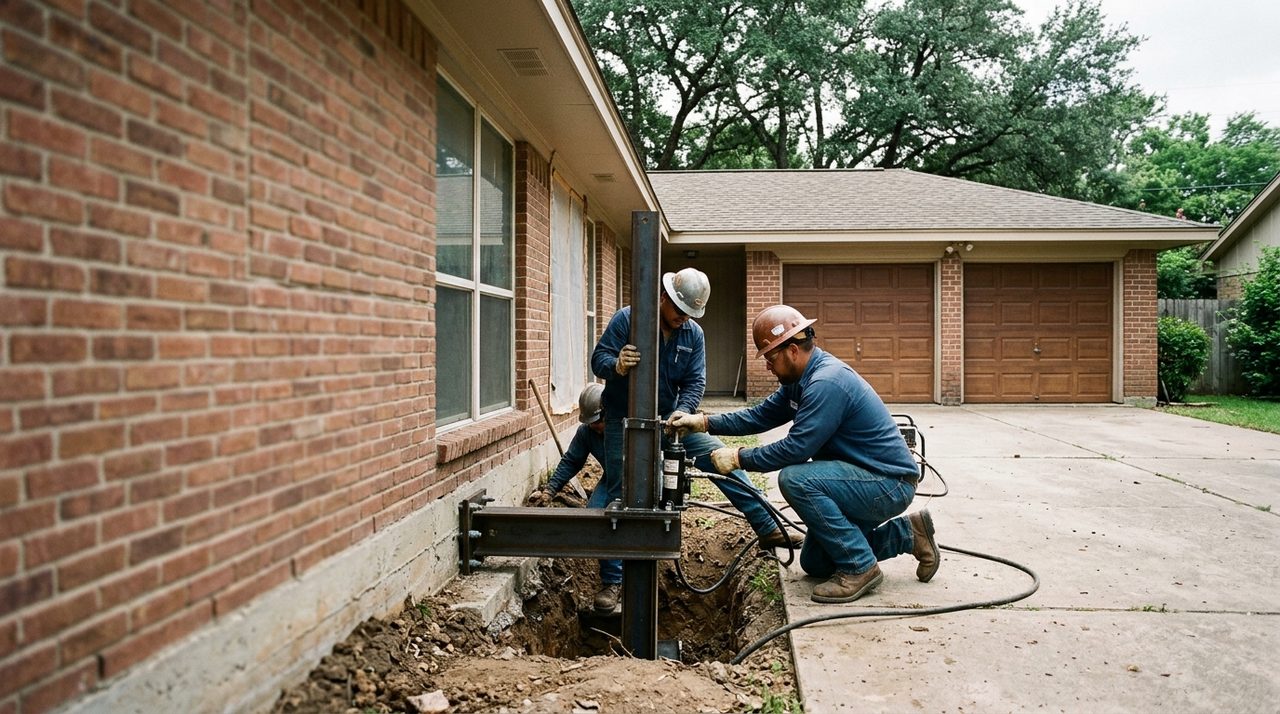
A qualified contractor will probe the perimeter for void depth before proposing any lifting method, and should provide a written pier count and target depth — not just a lump-sum price. Soaker-hose irrigation placed 18 inches from the foundation edge, run during dry months, is the primary prevention tool and costs almost nothing compared to underpinning. Harris County Engineering Department requires a permit for structural underpinning work, so confirm the contractor is pulling that permit — not asking you to owner-pull it — before signing.
Sources: Municipal permit office (see area profile), International Residential Code (as adopted by City of Houston)
Why it matters to you
Cypress homes built in the 1980s and early 1990s — a large share of the stock near FM 1960 and Huffmeister Road — were typically plumbed with cast-iron under-slab drain lines that are now 30–40 years old. Winter Storm Uri in February 2021 froze and cracked thousands of these lines across northwest Harris County; many owners patched interior walls but never tested whether the under-slab pipes themselves were compromised. A slow drain leak beneath the slab continuously saturates a localized zone of clay, causing that section to heave and then consolidate unevenly — a movement pattern that mimics drought settlement but won't be fixed by piers alone.
What a good pro does
Before accepting any foundation repair proposal on a pre-1995 Cypress home, insist on a hydrostatic plumbing test — a licensed Texas-registered plumber (licensed through TSBPE) pressurizes the drain system and checks for pressure loss. The test runs roughly $250–$400 (est.) and can prevent you from spending $15,000 on piers that won't stabilize a slab still being undermined by a leaking drain line. If a leak is found, the repair scope must include a licensed plumber, not just the foundation contractor.
Sources: Texas State Board of Plumbing Examiners, International Residential Code (as adopted by City of Houston)
Why it matters to you
Cypress subdivisions platted in the 1980s — including areas around Cypress Creek itself — now carry mature tree canopies of water oaks and invasive Chinese tallow trees whose root systems extend 20–40 feet from the trunk. On the expansive clay that underlies these lots, those roots aggressively extract soil moisture during dry months, creating a moisture gradient that drops one side of a slab while the opposite, unshaded side remains more stable. Many Cypress HOAs protect heritage trees through deed restrictions, limiting a homeowner's ability to remove the root source even when it is clearly driving differential foundation movement.
What a good pro does
A foundation pro working in established Cypress subdivisions should document where large trees are relative to the slab and include that context in the movement assessment — not just measure crack widths. Root barriers installed at 24–36 inch depth along the foundation-facing root zone can reduce moisture extraction without requiring tree removal. Before cutting any roots or installing barriers, check your subdivision's deed restrictions through your HOA; some Cypress HOAs require written approval for any soil disturbance within the drip line of trees above a certain caliper.
Sources: Local HOA / deed restrictions (see area profile), International Residential Code (as adopted by City of Houston)
Why it matters to you
Because Cypress is unincorporated Harris County — not within the City of Houston or any incorporated suburb — foundation repair permits route through the Harris County Engineering Department, which operates on a different fee schedule and inspection timeline than the City of Houston Development Services Department that most online guides reference. On top of that, virtually every platted Cypress subdivision requires the homeowner (not just the contractor) to submit an architectural review application to the HOA before any visible exterior work — including perimeter trenching for pier installation — can legally begin under the deed restrictions. Homeowners who skip HOA approval risk fines and mandatory restoration of the yard at their own expense.
What a good pro does
Ask your foundation contractor to confirm in writing that they are familiar with Harris County Engineering Department permit requirements and have pulled permits in unincorporated Harris County previously — not just within the City of Houston. Simultaneously, pull your subdivision's CC&Rs (available from your HOA or Harris County Appraisal District records) to identify the architectural review timeline, which commonly runs 10–30 days. Build that window into your project schedule before the first shovel goes in the ground.
Sources: Municipal permit office (see area profile), Local HOA / deed restrictions (see area profile)
Hiring foundation repair in Cypress? Cypress is an unincorporated area composed of dozens of separately platted subdivisions, each with its own HOA and deed restrictions. The housing stock spans from late-1970s ranch-style homes near FM 1960 to brand-new construction along the Grand Parkway, meaning contractors encounter a wide range of system ages and maintenance needs. Slab foundations, production-style builds, and HOA-regulated exteriors define the home services landscape here.
Building era
Late 1970s through 2020s, with concentrations in the 1980s–2000s era.
Typical style
Production suburban traditional and ranch-influenced one- and two-story homes; newer master-planned communities feature transitional and modern traditional facades with brick or brick-and-siding exteriors.
Foundations
Slab-on-grade (overwhelmingly dominant given post-1960s suburban construction; pier-and-beam is rare and limited to custom builds).
Common systems
Older 1980s–1990s homes: original builder-grade HVAC (10–15 SEER), copper or CPVC plumbing, and 100–200 amp electrical panels. 2000s–2010s homes: higher-efficiency HVAC, PEX plumbing, 200 amp panels. Homes from the 1970s–1980s may still have galvanized drain lines or polybutylene supply lines.
What that means for repairs
Kitchen and bath remodels are common in 1980s–1990s homes as original finishes age out. HVAC replacements are frequent in homes over 15 years old. Exterior updates often require HOA architectural review and approval before work begins.
Permit jurisdiction
Harris County Engineering Department (unincorporated area - not within City of Houston or any incorporated city limits).
HOA & deed restrictions
Mandatory HOAs are the norm in most platted subdivisions. Each subdivision operates independently (e.g., Lakewood Forest Fund, Cypress Creek Crossing HOA, Cypress Oaks North HOA, Villages of Cypress Lakes West). Older rural pockets and acreage tracts may have voluntary civic clubs or no organized association. Approximately 77% of Houston metro listings carry a mandatory HOA fee, and Cypress is explicitly cited as a high-HOA area.
Historic districts
No City of Houston historic district designation confirmed. Cypress is unincorporated Harris County with no known historic preservation overlays.
Contractor note
Contractors must pull permits through Harris County for structural, electrical, plumbing, and mechanical work. Nearly all subdivisions require HOA architectural committee approval for exterior modifications, fencing, roofing material changes, and paint colors before work begins.
FEMA flood zone
FEMA Zone X (low flood risk) per official NFHL data. Cypress Creek and its tributaries run through portions of the area, and specific parcels near waterways may carry higher flood designations — property-level FEMA lookups are recommended for homes near Cypress Creek, Faulkey Gully, or retention basins.
Hurricane Harvey impact
Not confirmed from provided research with subdivision-level specificity. Cypress Creek corridor flooding during Harvey (2017) impacted portions of the area, particularly homes in low-lying sections near creeks and bayous. Homeowners should check individual property flood claim history through FEMA and Harris County Flood Control District records.
Heat & humidity load
Prolonged 95°F+ heat and high humidity stress HVAC systems heavily; older 1980s–1990s units frequently fail during peak summer. Slab-on-grade foundations on expansive clay soils experience seasonal movement during summer drought cycles, leading to crack repair and foundation leveling demand. Exterior caulking and weatherproofing degrade quickly in UV and humidity.
Working with contractors here
Contractors in Cypress most commonly handle HVAC replacements and repairs, as the wide range of home ages means systems from the 1980s through the 2010s are cycling through end-of-life. Roof replacements are a major category, driven by storm damage and aging composition shingles, with HOA requirements often dictating material and color specifications. Plumbing repipes — especially replacing polybutylene or aging CPVC in 1980s–1990s homes — are a steady source of work. Foundation repair is common given the expansive clay soils and slab construction. Contractors should budget time for HOA architectural review submissions and Harris County permitting, as both processes can add lead time before work can commence.
Local Tip
Always ask for a written estimate before work begins. Texas contractors are required to provide one on jobs over $1,000.
Cypress is an unincorporated area composed of dozens of separately platted subdivisions, each with its own HOA and deed restrictions. The housing stock spans from late-1970s ranch-style homes near FM 1960 to brand-new construction along the Grand Parkway, meaning contractors encounter a wide range of system ages and maintenance needs. Slab foundations, production-style builds, and HOA-regulated exteriors define the home services landscape here.
Source: U.S. Census Bureau, ACS 5-Year 2023
Most of Cypress maps to FEMA Zone X (low mapped flood risk), but Houston's flash-flood reality means even low-risk blocks benefit from smart drainage and storm-hardened installs.
Source: FEMA National Flood Hazard Layer (NFHL). Flood zones vary by parcel — verify your individual FIRM panel.
Beryl 2024 reminded Houston homeowners that even neighborhoods with low FEMA flood designations experience localized ponding when storm-sewer inlets back up, and that standing water against a foundation for even 12 hours can trigger clay heave in Cypress, TX. Before the season, confirm your gutters discharge at least five feet from the foundation and that splash blocks direct water toward the street, keeping clay moisture content consistent beneath the slab. Confirm the current FEMA panel for your Cypress parcel — the area maps to Zone X, but adjacent lots can differ.
Hail itself does not crack a concrete foundation, but the insurance repair process — contractors dropping equipment, vibrating compactors near the structure — can disturb marginally stable piers in Cypress, TX. Coordinate a brief foundation check with a TDLR-licensed contractor before and after any major roof or exterior repair project that involves heavy equipment operating near your home. Confirm the current FEMA panel for your Cypress parcel — the area maps to Zone X, but adjacent lots can differ.
In Cypress, TX, where mapped flood risk is low, the primary post-freeze foundation threat is not surface water but slab-leak-driven soil saturation — Uri 2021 caused widespread pipe failures that fed water silently under slabs for days before homeowners noticed. After any hard freeze, have a plumber pressure-test your lines first, then schedule a foundation elevation check if any under-slab leak is confirmed. Confirm the current FEMA panel for your Cypress parcel — the area maps to Zone X, but adjacent lots can differ.
Sources: FEMA National Flood Hazard Layer (NFHL), Ready.gov -- Hurricanes, CenterPoint Energy -- Storm Center, City of Houston -- Emergency Preparedness, Ready.gov -- Winter Weather, Harris County Flood Control District
Houston-specific estimators to plan your project before you call a pro. All results are planning estimates — a licensed local pro confirms the details on site.
Grouped by mature root aggression & water demand.
Trunk center to the nearest exterior wall.
The root zone likely reaches your foundation's soil during Houston's dry summers, when clay shrinks most. Watch for sticking doors and diagonal cracks, keep soil moisture even with a soaker hose during drought, and have a foundation pro evaluate if you see any movement.
Find a Houston foundation pro →This is a planning estimate only — actual requirements depend on an on-site assessment by a licensed Houston pro. Guidance is based on general species root behavior in expansive clay, not a soil test.
Disconnect & drain every outdoor hose bib
Remove hoses, drain the spigots, and cover each with an insulated faucet sock. Un-drained hose bibs are the #1 burst point in a Houston freeze.
Insulate exposed pipes in the attic & garage
Wrap any pipe in an unconditioned space (attic runs, garage walls) with foam sleeves. Houston homes rarely insulate these because they only matter a few nights a year — which is exactly why they burst.
Open cabinet doors & keep a pencil-width drip
On hard-freeze nights, open kitchen/bath cabinets so warm air reaches the pipes and let faucets on exterior walls drip to relieve pressure.
Protect the attic/garage water heater & its lines
An attic or garage tank sits in unconditioned space. Insulate the cold-inlet and hot-outlet lines and confirm the emergency drain pan is clear so a leak doesn't reach the ceiling.
This is a planning estimate only — actual requirements depend on an on-site assessment by a licensed Houston pro. If a pipe has already burst, shut off your main water supply and call a licensed Houston plumber immediately — freeze bursts flood fast.
Sources: Municipal permit office (see area profile)Local HOA / deed restrictions (see area profile)
Sources: Local HOA / deed restrictions (see area profile)
Sources: FEMA National Flood Hazard Layer (NFHL)Harris County Flood Control District
Sources: Municipal permit office (see area profile)