Open Now
12808 W Airport Blvd #260C, Sugar Land, TX 77478
Sugar Land's 1980s–2000s brick-veneer slab homes on Fort Bend County's expansive clay soil face a specific water damage profile: flash flooding near the Brazos River and Oyster Creek, Uri-era pipe bursts in aging copper and CPVC supply lines, and subdivision HOAs that can slow emergency demo work even when hours matter. City of Sugar Land Development Services issues all trade permits here—not Harris County, not the City of Houston—so getting restoration work on the right permit track from day one keeps insurance claims moving and avoids costly re-inspections.
Ranked by verified Google rating × review volume × verification tier. How we rank →
Some highly-rated pros serve Sugar Land from nearby and may not keep a Sugar Land street address. Those are listed under "Also serving Sugar Land" with their real city and distance, so you always know where each business is based.
12808 W Airport Blvd #260C, Sugar Land, TX 77478
740 Industrial Blvd, Sugar Land, TX 77478
1502 Elmscott Dr, Sugar Land, TX 77498
12808 W Airport Blvd suite 463, Sugar Land, TX 77478
2245 Texas Dr, Sugar Land, TX 77479
56 Sugar Creek Center Blvd #160, Sugar Land, TX 77478
16535 Southwest Fwy #240, Sugar Land, TX 77479
14090 Southwest Fwy Suite 300 - #813, Sugar Land, TX 77478
Highly-rated pros based nearby who cover Sugar Land. Distance shown from the Sugar Land area.
Serving Sugar Land Based in Stafford · 2.7 mi away
Serving Sugar Land Based in Stafford · 2.9 mi away
Why it matters to you
Virtually every Sugar Land subdivision—from First Colony to New Territory to Telfair—has a mandatory HOA or POA with an architectural control committee that technically governs exterior modifications, including dumpster placement and any visible structural removal. IICRC S500 standards call for drying to begin within 24–48 hours of water intrusion; a Category 2 loss left unmitigated while waiting on HOA pre-approval paperwork can escalate to Category 3 (sewage-contaminated) territory, dramatically expanding the required demo scope and cost.
What a good pro does
A restoration contractor who works regularly in Sugar Land will know to notify the relevant HOA simultaneously with starting interior emergency extraction—not sequentially. They document that Category 3 conditions require immediate action under IICRC protocols and communicate that delay itself increases liability. For exterior work like dumpster placement or removing saturated brick-veneer sheathing, they submit the required HOA notification in writing on day one while proceeding with interior mitigation under the emergency provisions most deed restriction documents contain.
Sources: IICRC (water/mold restoration standards), Local HOA / deed restrictions (see area profile)
Why it matters to you
Sugar Land's post-1970 slab-on-grade homes sit directly on the same expansive Beaumont clay series that underlies much of Fort Bend County. When flash flooding—common near Oyster Creek and Brazos River-adjacent parcels even in FEMA Zone X—pushes water against the slab perimeter, the clay retains moisture against the foundation edge for weeks. That prolonged saturation wicks through the slab into bottom plates, baseboards, and drywall long after surface water has disappeared, and homeowners who dry what they can see often miss what the slab is still releasing.
What a good pro does
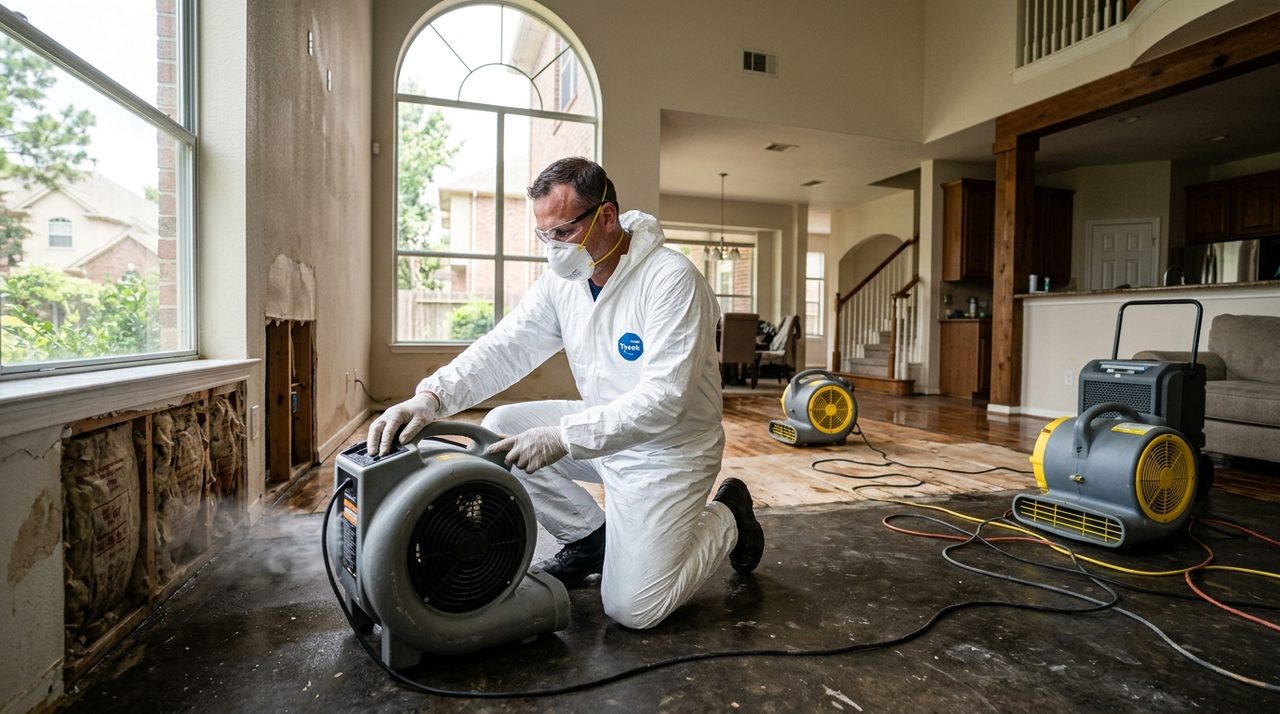
A qualified restoration crew uses calibrated moisture meters and thermal imaging cameras to map slab-edge and wall-cavity moisture in Sugar Land's brick homes, not just visible wet flooring. Structural drying timelines in this soil type routinely run 5–10 days longer than in sandier or pier-and-beam construction; a good contractor sets drying equipment accordingly and provides daily moisture logs—documentation your insurer will require to justify the extended equipment rental. All structural demo work requires a permit from City of Sugar Land Development Services.
Sources: IICRC (water/mold restoration standards), Municipal permit office (see area profile)
Why it matters to you
Sugar Land's median-year-built home dates to 1994, placing much of the housing stock squarely in the era of copper and CPVC supply lines run through unconditioned attic spaces—exactly the configuration that made Winter Storm Uri (February 2021) so destructive across Fort Bend County. Many homeowners replaced the burst section and repainted, but never thermally imaged the wall cavities or tested for residual moisture, leaving conditions ripe for Cladosporium and Aspergillus growth behind undisturbed drywall. A restoration call for a fresh leak or appliance failure routinely uncovers Uri-era mold that must be remediated before any new repairs can proceed.
What a good pro does
Before scoping any water damage repair in a Sugar Land home built between 1985 and 2002, a thorough restoration contractor should conduct a whole-home thermal imaging sweep to identify cold or damp wall sections that signal undiscovered moisture pockets. If mold is found, remediation must be performed by a TDLR-licensed Mold Remediation Contractor (MRC)—Texas Occupations Code Chapter 1958 prohibits unlicensed firms from performing this work. The City of Sugar Land Development Services permit office will require applicable trade permits for any plumbing work that gets exposed during the process.
Sources: Texas Department of Licensing & Regulation, Texas State Board of Plumbing Examiners, Municipal permit office (see area profile)
Why it matters to you
A large share of Sugar Land's original build-out homes from the 1980s and 1990s still have attic-mounted air handlers with fiberglass-wrapped flex duct that is at or past its service life. When even minor flooding or a significant roof leak from a storm like the May 2024 derecho allows moisture into the system, the insulation batts surrounding those ducts absorb water and hold it against the duct liner. Fort Bend County's summer ambient conditions—90°F-plus attic temps and 70-plus percent relative humidity—create mold growth within 48–72 hours, and the HVAC system then distributes spores throughout the home every time it cycles.
What a good pro does
Restoration contractors should scope an attic duct inspection as a standard line item on any Sugar Land water damage estimate where the home predates 2000 or where roof penetration is confirmed. If flex duct insulation tests moisture-positive or shows visible microbial growth, replacement—not drying in place—is the IICRC-recommended approach. HVAC duct work that touches the air handler or refrigerant lines requires a TDLR-licensed HVAC technician, and the City of Sugar Land Development Services requires a mechanical permit for system component replacement.
Sources: IICRC (water/mold restoration standards), Texas Department of Licensing & Regulation, Municipal permit office (see area profile)
Hiring water & flood restoration in Sugar Land? Sugar Land is composed of numerous master-planned communities, each governed by its own mandatory HOA or POA with actively enforced deed restrictions. The housing stock is predominantly 1980s–2000s suburban brick construction on slab-on-grade foundations, requiring contractors to navigate both city permitting and subdivision-level architectural review for most exterior projects. Proximity to the Brazos River and Oyster Creek creates localized flood risk despite generally favorable FEMA designations.
Building era
Primarily 1980s–2000s, with newer construction in communities like Telfair from the late 2000s–2010s and older sections dating to the 1970s.
Typical style
Traditional suburban brick homes (1- and 2-story) with brick veneer, composition shingle roofs, and attached garages; variants include Colonial-influenced, Mediterranean-influenced, and transitional brick/stone combinations.
Foundations
Slab-on-grade (standard for post-1970 Fort Bend County suburban construction).
Common systems
Central HVAC systems (many original units in 1980s–1990s homes nearing or past replacement age), copper or CPVC plumbing supply lines, cast iron or PVC drain lines depending on era, 200-amp electrical panels in most homes.
What that means for repairs
Kitchen and bathroom remodels are common in 1980s–1990s homes as original finishes age out. HVAC replacement is a major category given system lifespans. Many homeowners pursue exterior updates (stone accents, roof replacement, garage door upgrades) subject to HOA architectural review and approval.
Permit jurisdiction
City of Sugar Land Development Services (Sugar Land is an incorporated city with its own permitting office).
HOA & deed restrictions
HOA or POA membership is mandatory at the subdivision level across virtually all Sugar Land neighborhoods. Examples include Sugar Lakes POA, Ranch Country Association (POA), New Territory Residential Community Association, and First Colony community associations. Each subdivision enforces its own deed restrictions, architectural standards, and assessment schedules. No single city-wide HOA exists.
Historic districts
No historic district designation confirmed. Sugar Land is an incorporated city in Fort Bend County, outside City of Houston HAHC jurisdiction.
Contractor note
Contractors must obtain permits through the City of Sugar Land and should anticipate HOA architectural review requirements for exterior work. Many subdivisions require pre-approval from the HOA's architectural control committee before visible modifications can begin.
FEMA flood zone
FEMA Zone X (low flood risk) per official NFHL data. However, portions of Sugar Land near the Brazos River, Oyster Creek, and areas behind levee systems may carry higher risk designations at the parcel level. Property-specific FEMA lookups are recommended.
Hurricane Harvey impact
Sugar Land experienced significant flooding in some areas during Hurricane Harvey (2017), particularly in subdivisions near the Brazos River, Oyster Creek, and low-lying areas associated with levee districts. Not all subdivisions were equally affected — some experienced minimal impact while others saw substantial water intrusion. Specific subdivision-level Harvey damage records should be verified through Fort Bend County records.
Heat & humidity load
Extreme summer heat and humidity place heavy demand on HVAC systems, particularly in 1980s–1990s homes with aging equipment. Slab-on-grade foundations on expansive clay soils are susceptible to movement during drought-to-rain cycles, making foundation monitoring and proper drainage maintenance critical. Composition shingle roofs degrade faster under sustained UV exposure.
Working with contractors here
HVAC replacement and repair is among the most common contractor activities in Sugar Land, as many homes from the 1980s–1990s build-out are on their second or third system. Roof replacement is frequent given the age of the housing stock and storm exposure. Foundation repair is a recurring need due to expansive clay soils and seasonal moisture fluctuations. Contractors should budget extra time for HOA architectural review and approval processes, which vary by subdivision and can add weeks to project timelines. Exterior work — including paint colors, fencing, roofing materials, and landscaping — is tightly regulated by deed restrictions, so contractors must confirm approved materials and specifications with the relevant HOA before ordering supplies or beginning work.
Local Tip
Always ask for a written estimate before work begins. Texas contractors are required to provide one on jobs over $1,000.
Sugar Land is composed of numerous master-planned communities, each governed by its own mandatory HOA or POA with actively enforced deed restrictions. The housing stock is predominantly 1980s–2000s suburban brick construction on slab-on-grade foundations, requiring contractors to navigate both city permitting and subdivision-level architectural review for most exterior projects. Proximity to the Brazos River and Oyster Creek creates localized flood risk despite generally favorable FEMA designations.
Source: U.S. Census Bureau, ACS 5-Year 2023
Most of Sugar Land maps to FEMA Zone X (low mapped flood risk), but Houston's flash-flood reality means even low-risk blocks benefit from smart drainage and storm-hardened installs; risk climbs sharply on blocks nearest the Brazos River, where it varies parcel to parcel.
Source: FEMA National Flood Hazard Layer (NFHL). Flood zones vary by parcel — verify your individual FIRM panel.
Before hurricane season, commission a moisture baseline scan from an IICRC-certified restoration firm so any post-storm water intrusion in Sugar Land, TX can be quantified and documented for your insurer immediately. Beryl 2024 showed that even low-mapped-risk neighborhoods saw flash flooding that saturated flooring assemblies within hours of peak rainfall. Because Sugar Land drains toward the Brazos River, block-level runoff can differ sharply from the mapped zone.
Straight-line winds exceeding 80 mph, as recorded during the 2024 derecho, broke seals on sliding glass doors and drove water into flooring assemblies throughout Sugar Land, TX neighborhoods with no prior flood history. Contact a licensed Texas restoration firm — TDLR regulates their mold-assessment and remediation work — to inspect and dry any affected areas before summer humidity accelerates microbial growth. Confirm the current FEMA panel for your Sugar Land parcel — the area maps to Zone X, but adjacent lots can differ.
Homes in lower-flood-risk areas of Sugar Land, TX are not immune to the interior water losses Uri 2021 caused — burst attic supply lines and failed icemaker connections caused extensive drywall and flooring damage regardless of floodplain designation. A water-restoration contractor can extract standing water, remove wet flooring, and place structural drying equipment within the window that prevents a straightforward dryout from escalating to mold remediation. Confirm the current FEMA panel for your Sugar Land parcel — the area maps to Zone X, but adjacent lots can differ.
Sources: FEMA National Flood Hazard Layer (NFHL), Ready.gov -- Hurricanes, CenterPoint Energy -- Storm Center, City of Houston -- Emergency Preparedness, Ready.gov -- Winter Weather, Harris County Flood Control District
Houston-specific estimators to plan your project before you call a pro. All results are planning estimates — a licensed local pro confirms the details on site.
Disconnect & drain every outdoor hose bib
Remove hoses, drain the spigots, and cover each with an insulated faucet sock. Un-drained hose bibs are the #1 burst point in a Houston freeze.
Insulate exposed pipes in the attic & garage
Wrap any pipe in an unconditioned space (attic runs, garage walls) with foam sleeves. Houston homes rarely insulate these because they only matter a few nights a year — which is exactly why they burst.
Open cabinet doors & keep a pencil-width drip
On hard-freeze nights, open kitchen/bath cabinets so warm air reaches the pipes and let faucets on exterior walls drip to relieve pressure.
Protect the attic/garage water heater & its lines
An attic or garage tank sits in unconditioned space. Insulate the cold-inlet and hot-outlet lines and confirm the emergency drain pan is clear so a leak doesn't reach the ceiling.
This is a planning estimate only — actual requirements depend on an on-site assessment by a licensed Houston pro. If a pipe has already burst, shut off your main water supply and call a licensed Houston plumber immediately — freeze bursts flood fast.
Sources: Municipal permit office (see area profile)
Sources: FEMA National Flood Hazard Layer (NFHL)IICRC (water/mold restoration standards)
Sources: Texas Department of Licensing & RegulationIICRC (water/mold restoration standards)Municipal permit office (see area profile)