13003 Murphy Rd Ste H2, Stafford, TX 77477
Best Water & Flood Restoration in Stafford, TX
Stafford's housing stock — dominated by 1970s–1990s slab-on-grade brick veneer ranch homes built on Fort Bend County's expansive clay soils — creates a specific water damage profile that goes well beyond what FEMA Zone X status might suggest: clay soil holds floodwater against slab perimeters for days, galvanized drain lines in older builds are corrosion-prone, and the city's independent permitting authority means restoration scopes must route through the City of Stafford Permits Department, not Harris County or the City of Houston. Whether the trigger is a broken CPVC supply line, a washing-machine overflow, or wind-driven rain through aging brick veneer weep holes during a Gulf storm, the combination of older construction systems and moisture-retentive soil makes professional drying timelines here longer than they look on the surface.
Verified against Google Business data
Updated 2026
See the 10 Water & Flood Restoration Serving Stafford 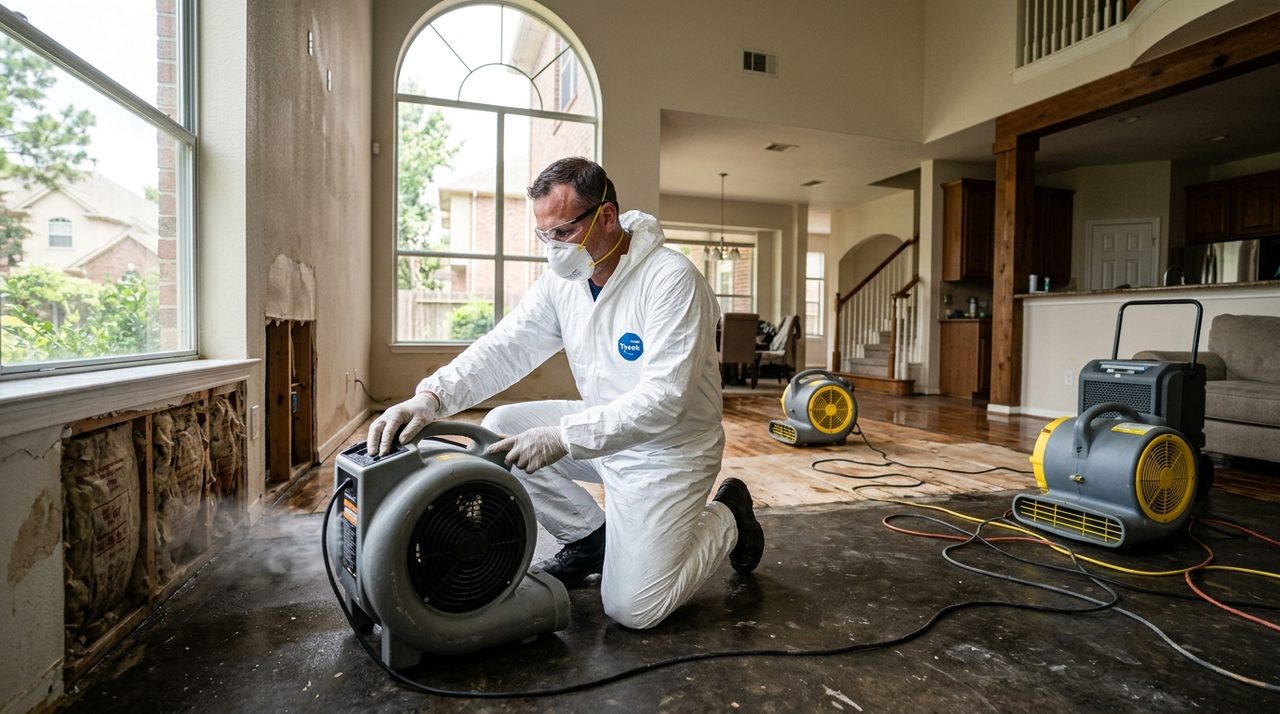
- Median home built
- 1992
- Median home value
- $247,900
- FEMA flood zone
- X (low)
- Typical mitigation cost (est.)
- $3,500–$40,000
- Most common local issue
- Extended slab-edge saturation on clay soil in 1970s–1990s ranch homes
Ranked by verified Google rating × review volume × verification tier. How we rank →
Min rating:
10 results13003 Southwest Fwy Suite 155, Stafford, TX 77477
13313 Redfish Ln Suite 104, Stafford, TX 77477
Open Now
13000 Murphy Rd # 130, Stafford, TX 77477
13003 Murphy Rd Ste: M5, Stafford, TX 77477
Open Now
12783 Capricorn St #100, Stafford, TX 77477
12700 Exchange Dr #559, Stafford, TX 77477
4185 Bluebonnet Dr, Stafford, TX 77477
13335 Murphy Rd # A, Stafford, TX 77477
Open Now
12999 Murphy Rd #13, Stafford, TX 77477
Water & Flood Restoration in Stafford: What You Should Know
Clay Soil Keeps Your 1970s–1990s Slab Wet Long After the Water Recedes
Why it matters to you
Stafford's Fort Bend County clay — the same expansive soil that moves foundations — acts like a sponge around slab perimeters after any significant water intrusion. For ranch homes built between 1972 and 1995 (the bulk of Stafford's owner-occupied stock, with a Census median year built of 1992), there is no crawl space buffer: water wicks directly into bottom plates, wall cavity insulation, and drywall from the saturated slab edge, often for two to three weeks after visible water is gone. Homeowners who stop drying equipment early because the floor 'looks dry' routinely discover mold behind baseboards six weeks later.
What a good pro does
A qualified restoration contractor will use calibrated moisture meters and thermal imaging cameras to map the actual drying front — not just visible surface conditions — before pulling equipment. IICRC S500 drying standards govern target moisture content for wood framing in slab homes, and in clay-soil environments like Stafford, drying validation readings should be taken at the slab-wall interface, not just the drywall face. Any mold remediation triggered by delayed or incomplete drying requires a TDLR-licensed Mold Remediation Contractor (MRC) before reconstruction begins.
Sources: IICRC (water/mold restoration standards), Texas Department of Licensing & Regulation, FEMA National Flood Hazard Layer (NFHL)
Aging Supply Lines and Galvanized Drains: Internal Flooding Risk in Pre-1990 Homes
Why it matters to you
Stafford's older subdivisions — including sections built in the 1970s and early 1980s — were commonly plumbed with copper supply lines and galvanized steel drain lines that are now 40–50 years old. Galvanized drains corrode from the inside out, restricting flow and eventually failing at joints; when a drain backs up or a corroded fitting lets go behind a wall, the resulting Category 2 water event can saturate wall cavities in a finished bathroom or kitchen for days before a homeowner notices staining. The census median home value of roughly $248,000 means repair-versus-remediation decisions matter financially.
What a good pro does
A restoration contractor scoping internal pipe-failure damage in a pre-1990 Stafford home should probe adjacent wall cavities with a moisture meter before limiting the scope to the visible wet zone, because galvanized line failures often seep slowly through multiple stud bays. Structural demo and reconstruction permits must be pulled through the City of Stafford Permits Department; any plumbing repair or repipe work requires a TSBPE-licensed plumber pulling their own trade permit through the same office. Estimating the mitigation phase for a single-story 1,500–2,000 sq ft affected area typically runs $3,500–$8,000 before reconstruction costs are added.
Sources: Texas State Board of Plumbing Examiners, Municipal permit office (see area profile), IICRC (water/mold restoration standards)
Wind-Driven Rain Into Brick Veneer: A Harvey-to-Beryl Pattern in Stafford Ranch Homes
Why it matters to you
Stafford's predominant one- and two-story brick veneer ranch homes are architecturally vulnerable to sustained Gulf-vector winds: weep holes at the base of the brick course are designed to drain moisture outward, but when wind forces water laterally through those openings during events like Harvey (2017) or Beryl (2024), water enters the cavity between the brick and the sheathing and travels downward to the bottom plate. Because there is no interior flooding trigger — no standing water, no roof leak — many Stafford homeowners don't discover the intrusion until drywall tape lifts or a musty odor develops weeks later.
What a good pro does
Post-storm inspection for brick veneer homes should include thermal imaging of exterior-facing walls from inside the home, ideally within 48–72 hours of the event when temperature differential makes wet cavities visible. IICRC S500 Category 1 and Category 2 classifications still apply to wind-driven rain intrusions, and drying scope must address the full vertical path of water travel — from the top of the affected cavity down to the bottom plate — not just the visible stain. Any structural demo exposing wall sheathing requires a demolition permit from the City of Stafford; if the sheathing or framing predates 1978, an EPA lead paint assessment is warranted given the housing era.
Sources: IICRC (water/mold restoration standards), EPA Lead Renovation, Repair and Painting (RRP) Rule, Municipal permit office (see area profile)
Subdivision HOA Rules That Can Slow Emergency Demo Timelines
Why it matters to you
Stafford has no city-wide HOA, but many of its individual subdivisions — including associations like Grove West Community Association — enforce architectural review requirements that technically cover exterior modifications, dumpster placement, and visible demolition work. Because IICRC S500 standards call for drying initiation within 24–48 hours to prevent Category 2 water from escalating to a Category 3 mold condition, any delay waiting on HOA committee approval for exterior work — removing saturated soffit material, placing a roll-off, or staging equipment in a common-area driveway — directly increases remediation scope and cost.
What a good pro does
Homeowners should pull their deed and confirm HOA status through Fort Bend County Clerk records before a water event occurs, not during one. A restoration contractor experienced in Stafford's subdivisions will contact the relevant HOA architectural review committee simultaneously with pulling the City of Stafford demolition permit, documenting the emergency timeline in writing to establish that the work was initiated as rapidly as code and IICRC standards require. This documentation also supports insurance scope defense if the insurer later challenges why exterior demo was performed.
Sources: Local HOA / deed restrictions (see area profile), IICRC (water/mold restoration standards), Municipal permit office (see area profile)
Water & Flood Restoration in Stafford: What You Should Know
Hiring water & flood restoration in Stafford? Stafford is an incorporated city in Fort Bend County composed of many individual subdivisions, each with its own HOA rules, deed restrictions, and housing characteristics. The housing stock spans from 1970s ranch homes to 2010s production builds, predominantly slab-on-grade construction on expansive clay soils. Homeowners should verify their specific subdivision's HOA requirements and flood status before scoping any exterior or structural project.
- Housing era
- 1970s–1990s (bulk of existing stock), with newer infill and subdivisions from the 2000s–2010s
- Foundation
- Slab-on-grade (overwhelmingly standard for the era and region
- Flood zone
- FEMA Zone X (low flood risk) per official NFHL data
- Permits
- City of Stafford Permits Department (Stafford is an incorporated city with its own permitting…
Housing stock & systems
Building era
1970s–1990s (bulk of existing stock), with newer infill and subdivisions from the 2000s–2010s.
Typical style
One- and two-story brick veneer ranch homes, traditional and neo-eclectic production builder homes, with some townhomes and garden homes in newer phases.
Foundations
Slab-on-grade (overwhelmingly standard for the era and region; pier-and-beam limited to rare older or custom structures).
Common systems
Central AC with gas furnace; copper or CPVC supply plumbing in older homes transitioning to PEX in newer builds; 1970s–1980s homes may have original galvanized drain lines; electrical panels range from 100-amp in older homes to 200-amp in newer construction.
What that means for repairs
Kitchen and bathroom remodels are common in the 1970s–1990s stock as homeowners update finishes and fixtures. Foundation repair due to expansive clay soil movement is a recurring need. HVAC system replacements are frequent in pre-2000 homes reaching end of equipment life.
Permits & restrictions
Permit jurisdiction
City of Stafford Permits Department (Stafford is an incorporated city with its own permitting authority).
HOA & deed restrictions
No city-wide HOA exists. Many individual subdivisions have mandatory HOAs/POAs (e.g., Grove West Community Association, Inc.) that enforce deed restrictions and architectural standards. Some properties may have no HOA or minimal deed restrictions. Must be confirmed per property via deed records and Fort Bend County Clerk.
Historic districts
No historic district designation confirmed for any area within Stafford.
Contractor note
Contractors must pull permits through the City of Stafford, not Harris County or the City of Houston. Subdivision-level HOA architectural review committees may require pre-approval for exterior modifications, so contractors should confirm HOA requirements before beginning work.
Flood & weather
FEMA flood zone
FEMA Zone X (low flood risk) per official NFHL data. While the broader Fort Bend County area includes Brazos River floodplain zones, the Stafford city center area generally falls outside high-risk flood designations. Property-level verification via FEMA FIRM panels and Fort Bend County floodplain GIS is recommended.
Hurricane Harvey impact
Stafford was not identified as one of the hardest-hit cities during Hurricane Harvey (2017). While Fort Bend County experienced substantial flooding along the Brazos River, the worst-documented impacts were south and southwest of Stafford in Missouri City, Sugar Land, and Richmond/Rosenberg. Specific Stafford streets or subdivisions with repetitive flood losses could not be confirmed from available public records. Buyers and contractors should still check NFIP claims history and seller flood disclosures for individual properties.
Heat & humidity load
Extended Houston-area heat and humidity stress HVAC systems in the aging 1970s–1990s housing stock, making seasonal tune-ups and refrigerant checks essential. Slab foundations on expansive clay soils are vulnerable to differential movement during summer drought cycles, requiring homeowners to maintain consistent watering around foundations. Attic temperatures in single-story ranch homes can exceed 150°F, accelerating roof underlayment and radiant barrier degradation.
Working with contractors here
Foundation monitoring and repair is among the most common contractor engagements in Stafford due to the expansive clay soils and the age of the 1970s–1990s slab-on-grade housing stock. HVAC replacement is a high-demand service as original equipment in older homes reaches 20–30 years of age. Whole-home repiping is increasingly needed in pre-1990s homes with galvanized drain lines or deteriorating copper supply lines. Contractors should note that Stafford is an independent city with its own permitting process, inspection schedules, and code enforcement — not governed by the City of Houston or Fort Bend County for permitting purposes. Job scoping for exterior work must account for subdivision-level HOA architectural standards, which vary significantly across the city.
Local Tip
Always ask for a written estimate before work begins. Texas contractors are required to provide one on jobs over $1,000.
About Stafford
Stafford is an incorporated city in Fort Bend County composed of many individual subdivisions, each with its own HOA rules, deed restrictions, and housing characteristics. The housing stock spans from 1970s ranch homes to 2010s production builds, predominantly slab-on-grade construction on expansive clay soils. Homeowners should verify their specific subdivision's HOA requirements and flood status before scoping any exterior or structural project.
- Median year built
- 1992
- Median home value
- $247,900
- Owner-occupied
- 43%
- Population
- 17,279
- Housing units
- 6,988
- Median income
- $85,910
Source: U.S. Census Bureau, ACS 5-Year 2023
Flood & storm risk
FEMA Zone XLow flood riskMost of Stafford maps to FEMA Zone X (low mapped flood risk), but Houston's flash-flood reality means even low-risk blocks benefit from smart drainage and storm-hardened installs.
Source: FEMA National Flood Hazard Layer (NFHL). Flood zones vary by parcel — verify your individual FIRM panel.
Houston Storm Readiness in Stafford
Hurricane & flooding
Before hurricane season, commission a moisture baseline scan from an IICRC-certified restoration firm so any post-storm water intrusion in Stafford, TX can be quantified and documented for your insurer immediately. Beryl 2024 showed that even low-mapped-risk neighborhoods saw flash flooding that saturated flooring assemblies within hours of peak rainfall. As a Fort Bend County community, Stafford may follow county rather than City of Houston storm rebuild rules.
Severe storms & hail
For homeowners in Stafford, TX: the May 2024 derecho caused widespread roof-deck separation across Houston, and the subsequent rainfall introduced water into attic insulation that retained moisture for weeks — a restoration contractor with desiccant drying equipment can address these attic assemblies that conventional fans cannot reach. Documenting the drying process with daily moisture logs also supports insurance claims for wind-and-water combined losses. Confirm the current FEMA panel for your Stafford parcel — the area maps to Zone X, but adjacent lots can differ.
Ice storms & freezes
A hard freeze in Stafford, TX can split a single supply line and deposit 50 or more gallons of water into a ceiling assembly before a homeowner locates the shutoff, and that volume requires more than fans and open windows to dry safely. Texas law under TDLR requires mold assessors and remediators to hold specific licenses, so verify your restoration contractor's credentials before you need them under emergency conditions. As a Fort Bend County community, Stafford may follow county rather than City of Houston storm rebuild rules.
Sources: FEMA National Flood Hazard Layer (NFHL), Ready.gov -- Hurricanes, CenterPoint Energy -- Storm Center, City of Houston -- Emergency Preparedness, Ready.gov -- Winter Weather, Harris County Flood Control District
Free Stafford Tools & Calculators
Houston-specific estimators to plan your project before you call a pro. All results are planning estimates — a licensed local pro confirms the details on site.
Houston Freeze Prep & Pipe Insulation Checklist
Open full tool & FAQ →Your freeze checklist — 4 tasks
- 1
Disconnect & drain every outdoor hose bib
Remove hoses, drain the spigots, and cover each with an insulated faucet sock. Un-drained hose bibs are the #1 burst point in a Houston freeze.
- 2
Insulate exposed pipes in the attic & garage
Wrap any pipe in an unconditioned space (attic runs, garage walls) with foam sleeves. Houston homes rarely insulate these because they only matter a few nights a year — which is exactly why they burst.
- 3
Open cabinet doors & keep a pencil-width drip
On hard-freeze nights, open kitchen/bath cabinets so warm air reaches the pipes and let faucets on exterior walls drip to relieve pressure.
- 4
Protect the attic/garage water heater & its lines
An attic or garage tank sits in unconditioned space. Insulate the cold-inlet and hot-outlet lines and confirm the emergency drain pan is clear so a leak doesn't reach the ceiling.
This is a planning estimate only — actual requirements depend on an on-site assessment by a licensed Houston pro. If a pipe has already burst, shut off your main water supply and call a licensed Houston plumber immediately — freeze bursts flood fast.
Frequently Asked Questions
Do I need a permit from the City of Stafford for flood demo work, or does Fort Bend County handle it?
Because Stafford is an incorporated city, all demolition, plumbing, and electrical permits for restoration work must be pulled through the City of Stafford Permits Department — not Fort Bend County or the City of Houston. Your restoration contractor should submit demo permits directly to Stafford's permit office and coordinate inspection scheduling there; using the wrong jurisdiction delays your Certificate of Completion, which insurers require to close the claim.
Sources: Municipal permit office (see area profile)
My Stafford home is in FEMA Zone X — does that mean I don't need to worry about mold after a plumbing leak?
Zone X only reflects mapped riverine flood risk, not interior water damage from burst pipes, appliance failures, or storm-driven intrusion — all common in Stafford's 1970s–1990s housing stock. IICRC S500 standards call for drying initiation within 24–48 hours regardless of flood zone; in Stafford's humid climate, a standing supply-line leak that sits over a weekend can generate mold growth requiring TDLR-licensed mold remediation on top of the original repair scope.
Sources: IICRC (water/mold restoration standards)Texas Department of Licensing & RegulationFEMA National Flood Hazard Layer (NFHL)
My subdivision in Stafford has a mandatory HOA — can I start emergency demo immediately or do I have to wait for architectural committee approval?
Life-safety and emergency mitigation work (extraction, structural drying, immediate demo of saturated drywall) generally cannot wait for an HOA architectural review cycle without risking a Category 2 water loss escalating to a more expensive Category 3 scope per IICRC S500 standards. The practical approach is to notify your HOA or POA in writing the same day demo begins, documenting the emergency basis; requirements vary by subdivision, so confirm your specific deed restrictions with Fort Bend County Clerk records rather than assuming all Stafford HOAs operate the same way.
Sources: IICRC (water/mold restoration standards)Local HOA / deed restrictions (see area profile)
How long does structural drying actually take in a 1980s Stafford slab home after a washing machine overflow?
Estimated drying timelines in Stafford's slab-on-grade homes run longer than national averages — typically 5 to 10 days of continuous equipment operation for a moderate Category 2 interior loss — because Fort Bend County's expansive clay soil retains ambient moisture against the slab edge, slowing evaporation even after the visible water is extracted. Restoration contractors should use daily moisture meter readings at slab level and wall cavities to confirm actual drying progress rather than pulling equipment on a fixed-day schedule.
Does Texas require the water restoration company I hire in Stafford to hold any state license for mold work?
Yes — if the scope includes mold assessment or mold remediation (common after extended drying delays in Stafford's older ranch homes), the firm must hold a TDLR-issued Mold Assessment Consultant (MAC) or Mold Remediation Contractor (MRC) license under Texas Occupations Code Chapter 1958. You can verify a company's MRC license directly on the TDLR public license search before signing a contract; an unlicensed firm performing mold remediation exposes you to potential liability and may void insurer reimbursement for that scope.
Stafford got hit hard by the May 2024 derecho — should I have a restoration contractor check wall cavities in my brick veneer ranch home even if I didn't see interior water?
Yes, and this is particularly worth doing in Stafford's 1970s–1980s brick veneer homes, where wind-driven rain from the derecho's sustained gusts commonly entered through soffit vents, older window flanges, and weep holes in the brick wythe without producing obvious interior staining. A qualified restoration contractor can use thermal imaging and calibrated moisture meters to trace intrusion paths from the roof deck down through wall sheathing — catching hidden saturation before it generates mold behind intact drywall, which would require a more invasive and costly remediation scope.