Open Now
Serving Manvel Based in Pearland · 6.7 mi away
Manvel sits squarely in FEMA Zone AO — a sheet-flow flood designation that means stormwater doesn't just rise from a nearby bayou, it moves across the land surface, soaking slab perimeters and garage floors across master-planned communities like Pomona, Valencia, and Sedona Lakes as well as older rural tracts near the original town center. Brazoria County's heavy black clay soil compounds the problem: once floodwater saturates the ground against a slab edge, it stays there for days or weeks, wicking moisture into wall cavities long after the street looks dry. If you own a home in Manvel — whether a 2015 production build with PEX plumbing or a 1980s rural tract house with aging galvanized lines — this page explains the specific restoration decisions that matter here, not generic flood advice written for a different city.
Ranked by verified Google rating × review volume × verification tier. How we rank →
Some highly-rated pros serve Manvel from nearby and may not keep a Manvel street address. Those are listed under "Also serving Manvel" with their real city and distance, so you always know where each business is based.
Highly-rated pros based nearby who cover Manvel. Distance shown from the Manvel area.
Serving Manvel Based in Pearland · 6.7 mi away
Serving Manvel Based in Pearland · 6.8 mi away
Serving Manvel Based in Pearland · 8.6 mi away
Serving Manvel Based in Pearland · 9.8 mi away
Why it matters to you
Unlike AE-zone homes that flood from a rising bayou, Manvel's FEMA Zone AO designation means stormwater flows across the surface and ponds against your foundation. Brazoria County's expansive black clay soil absorbs that water and holds it pressed against the concrete slab perimeter for days after the yard appears dry. In the 2000s–2020s production homes that dominate communities like Pomona and Sedona Lakes, this sustained perimeter saturation wicks through the slab edge into bottom plates, batt insulation, and drywall — damage that doesn't always show up until mold is already established behind intact-looking sheetrock.
What a good pro does
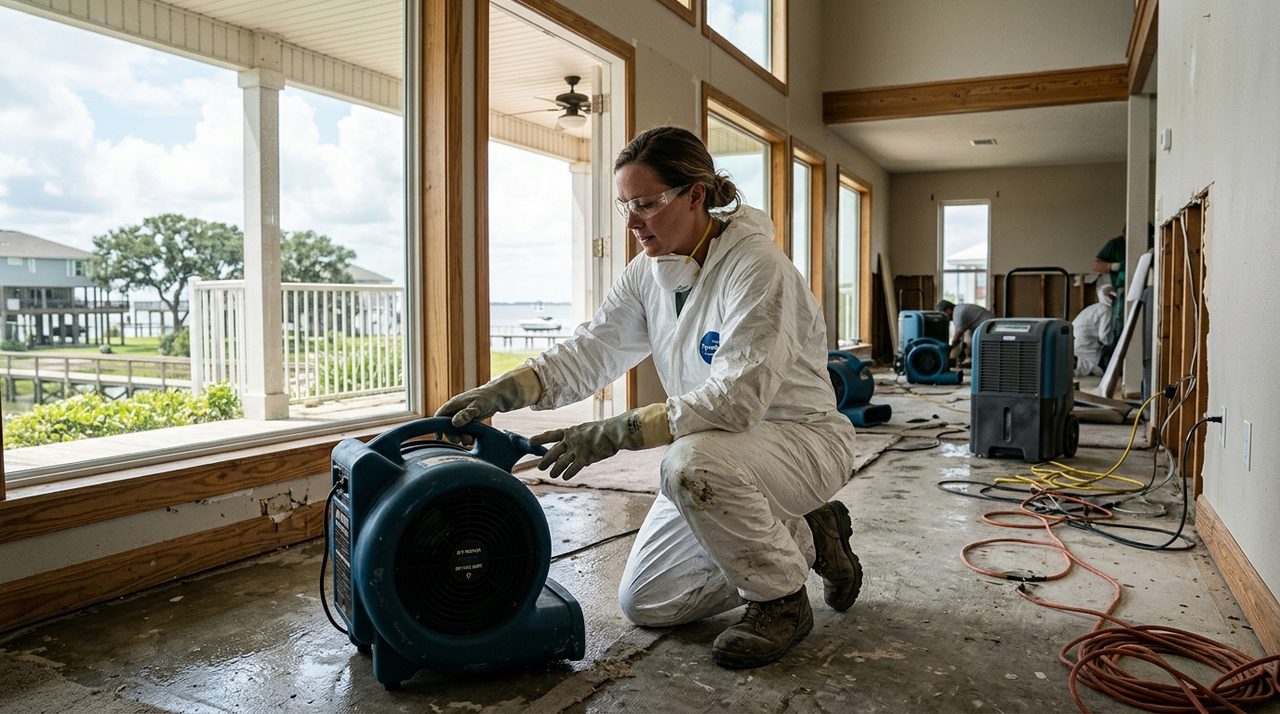
A qualified restoration contractor will deploy moisture meters and thermal imaging along every exterior wall's bottom 24 inches, not just in visibly wet rooms, before scoping the demo. Structural drying for a typical Manvel slab home under moderate AO inundation can take 3–5 days of continuous dehumidification even after extraction is complete; any contractor proposing to pack up equipment after 48 hours in this soil type is undersizing the drying phase. Mold assessment, if triggered, must be conducted by a TDLR-licensed Mold Assessment Consultant before remediation begins.
Sources: IICRC (water/mold restoration standards), FEMA National Flood Hazard Layer (NFHL), Texas Department of Licensing & Regulation
Why it matters to you
Manvel's position in Southeast Houston puts it in the Gulf wind vector for tropical systems, and the predominant one- and two-story brick-veneer production homes built between 2000 and 2020 have weep holes, window flanges, and soffit vents that can admit wind-driven rain under sustained storm conditions — including events like Hurricane Beryl in 2024 — without producing any obvious interior water entry. The result is moisture trapped in wall sheathing or behind brick that travels down to the bottom plate, creating conditions that look like a slab-moisture problem but actually originate at mid-wall.
What a good pro does
Restoration contractors working post-storm in Manvel should conduct a full building-envelope scan with a calibrated moisture meter and infrared camera before attributing all moisture readings to ground-level flooding. The intrusion path from wind-driven rain runs top-down through wall assemblies, which requires a different drying strategy — upper-wall injection drying rather than only floor-level equipment placement. Any structural sheathing repairs or re-cladding on brick-veneer exteriors in HOA communities like Valencia or Pomona require architectural review board approval before work begins, so the contractor must build that coordination into the schedule from day one.
Sources: IICRC (water/mold restoration standards), Local HOA / deed restrictions (see area profile), Municipal permit office (see area profile)
Why it matters to you
Three of Manvel's largest master-planned communities — Pomona, Valencia, and Sedona Lakes — have mandatory HOAs with active architectural control committees. IICRC S500 standards call for drying initiation within 24–48 hours of water intrusion to prevent a Category 2 gray-water loss from escalating to Category 3; but placing a roll-off dumpster, removing exterior stucco or brick veneer, or staging equipment on a driveway in these communities technically requires HOA pre-approval. Delays waiting on an architectural review board can push a manageable mitigation scope into a full Category 3 demo-and-gut project — roughly $15,000–$40,000 estimated — that could have been avoided.
What a good pro does
At the start of any emergency claim, contact your HOA management company immediately and in writing to request expedited emergency review — most HOA governing documents include a provision for emergency situations, even if it isn't prominently advertised. A restoration contractor experienced in Manvel's HOA communities will know to document the emergency timeline, keep dumpsters on the homeowner's driveway rather than street right-of-way, and submit a written scope to the management company concurrently with pulling the demolition permit from the City of Manvel or Brazoria County Engineering office, depending on which jurisdiction your lot falls in.
Sources: Local HOA / deed restrictions (see area profile), IICRC (water/mold restoration standards), Municipal permit office (see area profile)
Why it matters to you
Outside the newer master-planned communities, Manvel's original rural core has pockets of 1970s–1990s homes with galvanized water supply lines, 100–150 amp electrical panels, and attic-run plumbing that was never rerouted or insulated after Winter Storm Uri in February 2021. These homes are disproportionately likely to have residual moisture in wall cavities from Uri-era pipe bursts that received only surface repairs at the time. A restoration contractor called for flood work in one of these older tracts routinely finds two-year-old microbial growth behind drywall that was never properly dried — requiring mold remediation before any flood reconstruction can proceed.
What a good pro does
Before scoping flood restoration in any pre-2000 Manvel home, request that the contractor conduct a whole-home moisture scan, including attic plumbing chases and any wall cavity adjacent to supply lines. Mold remediation must be completed by a TDLR-licensed Mold Remediation Contractor, and if galvanized lines or sub-code electrical work is exposed during demo, a TSBPE-licensed plumber or TDLR-licensed electrician must pull their own trade permits through the City of Manvel or Brazoria County Engineering before that work proceeds. Estimated mold remediation costs in the Houston metro range from $2,500–$10,000 depending on affected square footage and whether HVAC duct replacement is required.
Sources: Texas Department of Licensing & Regulation, Texas State Board of Plumbing Examiners, Municipal permit office (see area profile)
Hiring water & flood restoration in Manvel? Manvel encompasses a wide range of housing from recent master-planned communities like Pomona, Valencia, and Sedona Lakes to older rural tracts near the original town center. Homeowners in newer subdivisions deal primarily with warranty-era maintenance and HOA compliance, while owners of older properties may face deferred maintenance on aging systems. The FEMA AO high-risk flood designation makes drainage, grading, and flood mitigation critical considerations for any home service project.
Building era
Mixed: 2000s–2020s dominant in master-planned communities; 1970s–1990s pockets near historic core and rural tracts.
Typical style
Contemporary suburban Texas production homes — primarily one- and two-story brick or brick-and-stone veneer detached houses with attached garages and composition shingle roofs.
Foundations
Predominantly concrete slab-on-grade in newer subdivisions; older or custom rural homes may include pier-and-beam, but slab is overwhelmingly standard.
Common systems
Newer homes: high-efficiency HVAC systems, PEX or CPVC plumbing, 200-amp electrical panels. Older homes (1970s–1990s): original builder-grade HVAC, possible galvanized or copper plumbing, 100–150 amp panels potentially needing upgrades.
What that means for repairs
Newer MPCs see outdoor living additions, patio covers, and fence upgrades subject to HOA architectural review. Older rural properties see full system replacements (HVAC, plumbing repiping, electrical panel upgrades) and foundation repairs due to expansive clay soils.
Permit jurisdiction
City of Manvel for properties within city limits; Brazoria County Engineering for unincorporated areas and ETJ tracts (some MPCs like Pomona are in Manvel's ETJ).
HOA & deed restrictions
Subdivision-by-subdivision: Pomona HOA, Valencia Residential Owners Association Inc., and Sedona Lakes Homeowners Association are mandatory HOAs with deed restriction enforcement and architectural control. Many other areas in Manvel, particularly older and rural tracts, have no HOA. No single citywide HOA or civic club identified.
Historic districts
No historic district designation confirmed. Manvel has no known HAHC or local historic overlay districts.
Contractor note
Contractors must verify whether a property falls within Manvel city limits or unincorporated Brazoria County, as permit requirements and inspection processes differ significantly. HOA-governed subdivisions require pre-approval for exterior modifications before permits are pulled.
FEMA flood zone
FEMA Zone AO (high flood risk) — source: fema_nfhl. Zone AO indicates shallow flooding with defined flood depths, typically from sheet flow on sloped terrain. Manvel's flat Brazoria County topography and proximity to Chocolate Bayou and Mustang Bayou tributaries contribute to drainage challenges.
Hurricane Harvey impact
Specific street-level Harvey flooding data for Manvel was not confirmed in available research. Brazoria County broadly experienced significant flooding during Harvey, and Manvel's low-lying terrain and AO flood zone designation suggest vulnerability. Homeowners should check individual property flood claims history through FEMA and the Brazoria County Floodplain Administrator for parcel-specific impact records.
Heat & humidity load
Extreme Houston-area summer heat and humidity drive heavy HVAC demand, especially in newer homes with large square footage and high-volume ductwork. Slab foundations on expansive clay soils are susceptible to movement during drought-to-rain cycles, making foundation monitoring and proper drainage grading essential seasonal maintenance tasks.
Working with contractors here
Contractors in Manvel most commonly handle HVAC installation and maintenance, fence and patio construction, and foundation monitoring — reflecting the area's newer production housing stock and challenging clay soils. In older rural tracts, full system replacements (plumbing repiping from galvanized, electrical panel upgrades, roof replacements) are frequent. The AO flood zone designation means drainage improvements, French drains, and grading work are high-demand services across all property types. Contractors working in HOA communities like Pomona, Valencia, and Sedona Lakes must coordinate exterior modification approvals with the respective management companies before beginning work. Job scoping should always account for MUD-related utility tap and connection requirements in newer developments.
Local Tip
Always ask for a written estimate before work begins. Texas contractors are required to provide one on jobs over $1,000.
Manvel encompasses a wide range of housing from recent master-planned communities like Pomona, Valencia, and Sedona Lakes to older rural tracts near the original town center. Homeowners in newer subdivisions deal primarily with warranty-era maintenance and HOA compliance, while owners of older properties may face deferred maintenance on aging systems. The FEMA AO high-risk flood designation makes drainage, grading, and flood mitigation critical considerations for any home service project.
Source: U.S. Census Bureau, ACS 5-Year 2023
Much of Manvel maps to FEMA Zone AO (high flood risk), so flood-resilient detailing -- elevated equipment, water-tolerant materials, and drainage-first thinking -- is essential here, not optional; as a Brazoria County coastal community, tropical surge and wind add a layer generic guidance misses.
Source: FEMA National Flood Hazard Layer (NFHL). Flood zones vary by parcel — verify your individual FIRM panel.
Harvey 2017 left coastal communities waiting weeks for restoration crews, so secure a priority-response contract with a licensed Manvel, TX water-restoration company before June and confirm they carry sufficient commercial drying equipment for surge-volume extraction. Documenting your structure's pre-storm moisture content with thermal imaging gives adjusters a defensible baseline when category-3 or saltwater losses are disputed. As a Brazoria County community, Manvel may follow county rather than City of Houston storm rebuild rules.
After the May 2024 derecho, coastal homeowners discovered that wind had forced water into attic ridge vents and behind exterior cladding that appeared undamaged, leading to hidden saturation discovered only months later. Scheduling a post-storm thermal imaging inspection with a water-restoration contractor in Manvel, TX is the most reliable way to rule out or remediate this type of concealed water intrusion. Confirm the current FEMA panel for your Manvel parcel — the area maps to Zone AO, but adjacent lots can differ.
Ice-storm water losses on barrier-island and bay-front properties in Manvel, TX can introduce moisture behind fiber-cement and stucco cladding systems that hold water far longer than wood-framed inland walls, requiring extended drying cycles and more frequent moisture monitoring. Engaging an IICRC-certified firm with coastal experience immediately after any freeze-related pipe failure ensures the drying plan accounts for cladding type and prevailing marine humidity. As a Brazoria County community, Manvel may follow county rather than City of Houston storm rebuild rules.
Sources: FEMA National Flood Hazard Layer (NFHL), Ready.gov -- Hurricanes, CenterPoint Energy -- Storm Center, City of Houston -- Emergency Preparedness, Ready.gov -- Winter Weather, Harris County Flood Control District
Houston-specific estimators to plan your project before you call a pro. All results are planning estimates — a licensed local pro confirms the details on site.
Disconnect & drain every outdoor hose bib
Remove hoses, drain the spigots, and cover each with an insulated faucet sock. Un-drained hose bibs are the #1 burst point in a Houston freeze.
Insulate exposed pipes in the attic & garage
Wrap any pipe in an unconditioned space (attic runs, garage walls) with foam sleeves. Houston homes rarely insulate these because they only matter a few nights a year — which is exactly why they burst.
Open cabinet doors & keep a pencil-width drip
On hard-freeze nights, open kitchen/bath cabinets so warm air reaches the pipes and let faucets on exterior walls drip to relieve pressure.
Protect the attic/garage water heater & its lines
An attic or garage tank sits in unconditioned space. Insulate the cold-inlet and hot-outlet lines and confirm the emergency drain pan is clear so a leak doesn't reach the ceiling.
This is a planning estimate only — actual requirements depend on an on-site assessment by a licensed Houston pro. If a pipe has already burst, shut off your main water supply and call a licensed Houston plumber immediately — freeze bursts flood fast.
Sources: Municipal permit office (see area profile)
Sources: IICRC (water/mold restoration standards)FEMA National Flood Hazard Layer (NFHL)
Sources: Texas State Board of Plumbing ExaminersMunicipal permit office (see area profile)