20351 Hwy 6 Suite D, Manvel, TX 77578
Best Pest Control in Manvel, TX
Manvel's FEMA Zone AO flood designation, its sprawling clay-heavy soils, and a housing stock that ranges from brand-new master-planned communities like Pomona and Sedona Lakes to 1970s–1980s rural tracts near the historic town core create a pest environment that shifts street by street — and flood event by flood event. When standing water lingers in low-lying Brazoria County yards for days after a named storm, and when seasonal slab movement opens new gaps around plumbing sleeves, routine pest control from a big-box package plan rarely keeps up. Understanding which pressures apply to your specific property type in Manvel — and which licensed operators are equipped for them — is what this page is about.
Verified against Google Business data
Updated 2026
See the 3 Pest Control Serving Manvel 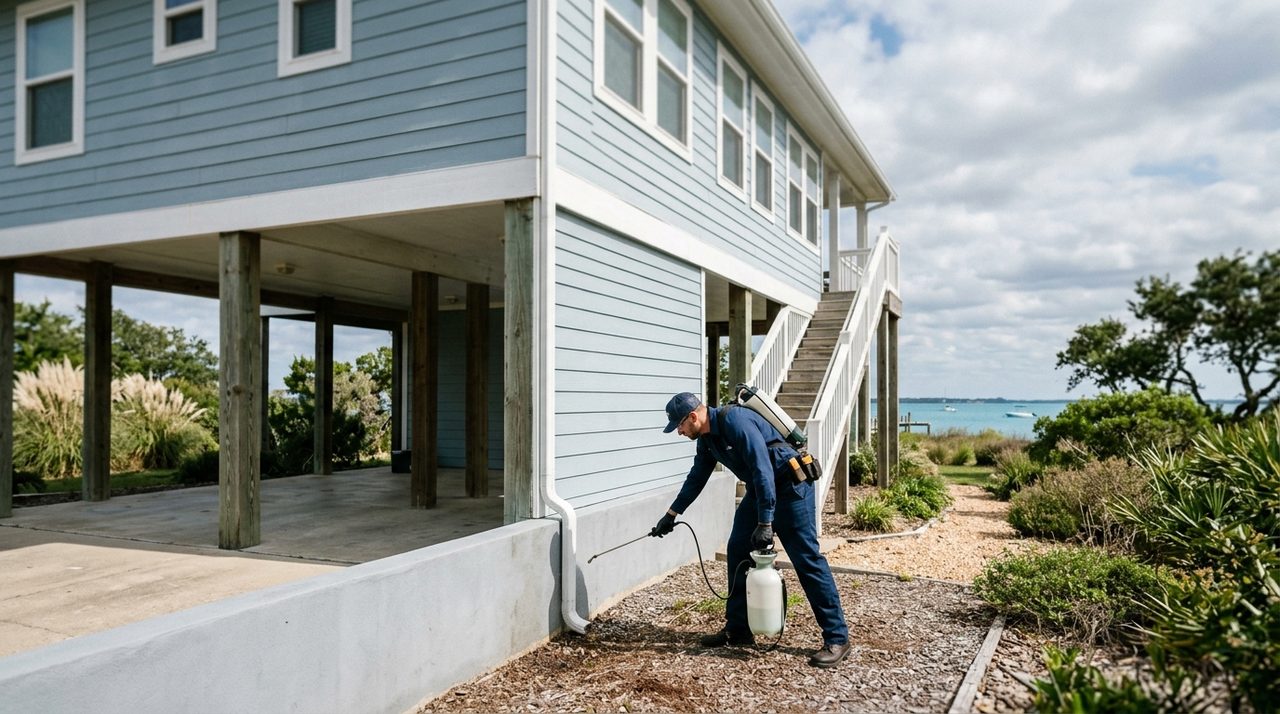
- Median home built
- 2010
- Median home value
- $321,600
- FEMA flood zone
- AO (high)
- Typical pest control cost (est.)
- $150–$300 one-time; $40–$70/visit on quarterly plan
- Most common local issue
- Post-flood mosquito surge & standing-water breeding in AO-zone yards
Ranked by verified Google rating × review volume × verification tier. How we rank →
Some highly-rated pros serve Manvel from nearby and may not keep a Manvel street address. Those are listed under "Also serving Manvel" with their real city and distance, so you always know where each business is based.
Min rating:
3 resultsBased in Manvel
Also serving Manvel
Highly-rated pros based nearby who cover Manvel. Distance shown from the Manvel area.
Serving Manvel Based in Alvin · 4.1 mi away
Closed
Serving Manvel Based in Alvin · 6.5 mi away
Pest Control in Manvel: What You Should Know
AO Flood Zone Mosquito Breeding After Every Major Rain Event
Why it matters to you
Manvel sits in FEMA Zone AO — a shallow-sheet-flow flood designation meaning water doesn't just pool in low spots after a storm, it spreads broadly across yards and around foundations for days. Brazoria County's heavy clay soil holds that moisture far longer than sandy coastal soils would, making Manvel's backyards and swales prime breeding habitat for Aedes aegypti and Culex quinquefasciatus mosquitoes from April through October. Harris County Mosquito Control aerial spraying does not cover Brazoria County, so there is no public-program backstop for private yards in Manvel — that gap falls entirely to homeowners and the pest control operators they hire.
What a good pro does
A qualified TDLR-licensed pest control operator working in Manvel should conduct a property-specific source-reduction walkthrough — identifying low spots, clogged gutters, and irrigation overrun areas where water stands 72+ hours — before recommending a larvicide-plus-barrier-spray program. Monthly barrier applications ($75–$150 per visit, estimated) during peak season are most effective when combined with BTI (Bacillus thuringiensis israelensis) larviciding of any standing water that can't be eliminated. Operators should hold a TDLR category endorsement for general pest control and document every application per Texas Structural Pest Control Act requirements.
Sources: FEMA National Flood Hazard Layer (NFHL), Texas Department of Licensing & Regulation, Harris County Flood Control District
Subterranean Termite Pressure on New-Construction Slabs in Pomona, Valencia, and Sedona Lakes
Why it matters to you
The majority of Manvel's master-planned community homes — built between the mid-2000s and today — sit on concrete slab-on-grade foundations over Brazoria County's expansive black clay soil. Houston's region ranks in USDA's highest termite pressure zone (Zone 5), and Formosan subterranean termites (Coptotermes formosanus) exploit expansion joints, post-tension cable sleeves, and plumbing penetrations as direct soil-to-wood pathways. Builder-applied pre-construction termiticide treatments have a limited effective life (typically 5–10 years depending on product and soil disturbance), meaning homes built in Pomona's earliest phases around 2010 are now approaching or past their original treatment window.
What a good pro does
Homeowners in Pomona, Valencia, and Sedona Lakes should obtain the original builder's termiticide treatment records — often required at closing — to determine which product was applied and when retreatment is due. A TDLR-licensed termite operator can perform a visual inspection and moisture probe assessment, then recommend either a liquid barrier renewal (Termidor-type, estimated $800–$1,800 based on linear foundation footage) or a bait station installation (Sentricon-type, estimated $1,200–$2,000 plus $300–$500/year monitoring). HOA communities in Manvel do not restrict termite treatment access to the foundation perimeter, but exterior bait station placement near common greenspace may require coordination with the respective HOA management company.
Sources: Texas Department of Licensing & Regulation, Local HOA / deed restrictions (see area profile), FEMA National Flood Hazard Layer (NFHL)
Red Imported Fire Ant Mound Pressure in Irrigated Suburban Yards
Why it matters to you
Brazoria County's clay-heavy soils and the irrigated turf standards enforced by Pomona, Valencia, and Sedona Lakes HOAs create near-ideal conditions for Solenopsis invicta (red imported fire ants). TAMU Extension classifies the entire Houston metro — including Brazoria County — as high-density RIFA territory, and Manvel's newer subdivisions, with their shared greenspaces, detention pond banks, and community amenities, provide essentially limitless adjacent mound-source pressure that means treating your yard alone produces only temporary relief. RIFA colonies also target HVAC disconnect boxes and irrigation controller junction boxes at foundation edges, causing equipment damage beyond the sting risk to children and pets.
What a good pro does
Effective RIFA management in HOA communities like Pomona requires a two-step approach: broadcast bait treatment across the entire turf area (not just visible mounds) followed by individual mound contact treatment. Because Pomona HOA and Valencia's Residential Owners Association maintain their own common-area pest programs, homeowners should ask whether those contracts include perimeter lot lines — and fill any gap with their own TDLR-licensed operator on a seasonal schedule (spring and fall treatments are most effective). Operators should apply broadcast baits when soil temperature is above 60°F and fire ants are actively foraging, typically March–May and September–October in Brazoria County.
Sources: Texas Department of Licensing & Regulation, Local HOA / deed restrictions (see area profile)
Rodent Entry Through Slab Gaps and Utility Chases in Older Rural Tracts
Why it matters to you
The older properties near Manvel's historic town center — many built in the 1970s through 1990s on brick-veneer slab construction — face compounding rodent entry risks that newer master-planned homes largely avoid. Brazoria County's expansive clay soil causes seasonal slab movement that repeatedly opens and closes gaps around plumbing penetrations and garage door sweeps; brick weep holes in older veneer walls are standard rodent entry points for Rattus norvegicus. Post-Uri pipe repairs (2021) on these older properties often involved cutting slab access and replumbing sections, and not all those penetrations were professionally resealed — leaving new pathways even in homes that were partially renovated.
What a good pro does
A thorough rodent exclusion job on an older Manvel rural-tract home starts with a perimeter inspection of every plumbing penetration, weep hole, and garage threshold — not just a bait station drop. TDLR-licensed operators offering rodent exclusion (a separate category endorsement under the Texas Structural Pest Control Act) should use copper mesh and foam-backer rod at slab penetrations, stainless steel weep hole covers rated for brick veneer, and door sweep upgrades before interior trapping begins. Exclusion plus interior treatment for an average Manvel rural-tract home typically runs $400–$900 estimated; homeowners should get itemized quotes that separate exclusion materials from treatment service.
Sources: Texas Department of Licensing & Regulation, FEMA National Flood Hazard Layer (NFHL)
Pest Control in Manvel: What You Should Know
Hiring pest control in Manvel? Manvel encompasses a wide range of housing from recent master-planned communities like Pomona, Valencia, and Sedona Lakes to older rural tracts near the original town center. Homeowners in newer subdivisions deal primarily with warranty-era maintenance and HOA compliance, while owners of older properties may face deferred maintenance on aging systems. The FEMA AO high-risk flood designation makes drainage, grading, and flood mitigation critical considerations for any home service project.
- Housing era
- Mixed
- Foundation
- Predominantly concrete slab-on-grade in newer subdivisions
- Flood zone
- FEMA Zone AO (high flood risk) — source
- Permits
- City of Manvel for properties within city limits
Housing stock & systems
Building era
Mixed: 2000s–2020s dominant in master-planned communities; 1970s–1990s pockets near historic core and rural tracts.
Typical style
Contemporary suburban Texas production homes — primarily one- and two-story brick or brick-and-stone veneer detached houses with attached garages and composition shingle roofs.
Foundations
Predominantly concrete slab-on-grade in newer subdivisions; older or custom rural homes may include pier-and-beam, but slab is overwhelmingly standard.
Common systems
Newer homes: high-efficiency HVAC systems, PEX or CPVC plumbing, 200-amp electrical panels. Older homes (1970s–1990s): original builder-grade HVAC, possible galvanized or copper plumbing, 100–150 amp panels potentially needing upgrades.
What that means for repairs
Newer MPCs see outdoor living additions, patio covers, and fence upgrades subject to HOA architectural review. Older rural properties see full system replacements (HVAC, plumbing repiping, electrical panel upgrades) and foundation repairs due to expansive clay soils.
Permits & restrictions
Permit jurisdiction
City of Manvel for properties within city limits; Brazoria County Engineering for unincorporated areas and ETJ tracts (some MPCs like Pomona are in Manvel's ETJ).
HOA & deed restrictions
Subdivision-by-subdivision: Pomona HOA, Valencia Residential Owners Association Inc., and Sedona Lakes Homeowners Association are mandatory HOAs with deed restriction enforcement and architectural control. Many other areas in Manvel, particularly older and rural tracts, have no HOA. No single citywide HOA or civic club identified.
Historic districts
No historic district designation confirmed. Manvel has no known HAHC or local historic overlay districts.
Contractor note
Contractors must verify whether a property falls within Manvel city limits or unincorporated Brazoria County, as permit requirements and inspection processes differ significantly. HOA-governed subdivisions require pre-approval for exterior modifications before permits are pulled.
Flood & weather
FEMA flood zone
FEMA Zone AO (high flood risk) — source: fema_nfhl. Zone AO indicates shallow flooding with defined flood depths, typically from sheet flow on sloped terrain. Manvel's flat Brazoria County topography and proximity to Chocolate Bayou and Mustang Bayou tributaries contribute to drainage challenges.
Hurricane Harvey impact
Specific street-level Harvey flooding data for Manvel was not confirmed in available research. Brazoria County broadly experienced significant flooding during Harvey, and Manvel's low-lying terrain and AO flood zone designation suggest vulnerability. Homeowners should check individual property flood claims history through FEMA and the Brazoria County Floodplain Administrator for parcel-specific impact records.
Heat & humidity load
Extreme Houston-area summer heat and humidity drive heavy HVAC demand, especially in newer homes with large square footage and high-volume ductwork. Slab foundations on expansive clay soils are susceptible to movement during drought-to-rain cycles, making foundation monitoring and proper drainage grading essential seasonal maintenance tasks.
Working with contractors here
Contractors in Manvel most commonly handle HVAC installation and maintenance, fence and patio construction, and foundation monitoring — reflecting the area's newer production housing stock and challenging clay soils. In older rural tracts, full system replacements (plumbing repiping from galvanized, electrical panel upgrades, roof replacements) are frequent. The AO flood zone designation means drainage improvements, French drains, and grading work are high-demand services across all property types. Contractors working in HOA communities like Pomona, Valencia, and Sedona Lakes must coordinate exterior modification approvals with the respective management companies before beginning work. Job scoping should always account for MUD-related utility tap and connection requirements in newer developments.
Local Tip
Always ask for a written estimate before work begins. Texas contractors are required to provide one on jobs over $1,000.
About Manvel
Manvel encompasses a wide range of housing from recent master-planned communities like Pomona, Valencia, and Sedona Lakes to older rural tracts near the original town center. Homeowners in newer subdivisions deal primarily with warranty-era maintenance and HOA compliance, while owners of older properties may face deferred maintenance on aging systems. The FEMA AO high-risk flood designation makes drainage, grading, and flood mitigation critical considerations for any home service project.
- Median year built
- 2010
- Median home value
- $321,600
- Owner-occupied
- 77.7%
- Population
- 12,873
- Housing units
- 4,829
- Median income
- $113,938
Source: U.S. Census Bureau, ACS 5-Year 2023
Flood & storm risk
FEMA Zone AOHigh flood riskMuch of Manvel maps to FEMA Zone AO (high flood risk), so flood-resilient detailing -- elevated equipment, water-tolerant materials, and drainage-first thinking -- is essential here, not optional; as a Brazoria County coastal community, tropical surge and wind add a layer generic guidance misses.
Source: FEMA National Flood Hazard Layer (NFHL). Flood zones vary by parcel — verify your individual FIRM panel.
Free Manvel Tools & Calculators
Houston-specific estimators to plan your project before you call a pro. All results are planning estimates — a licensed local pro confirms the details on site.
Houston Subtropical Pest Treatment Planner
Open full tool & FAQ →Your Houston treatment schedule
| Pest | Cadence | Active window |
|---|---|---|
Mosquito control A standard 4-week barrier treatment holds a typical suburban lot through Houston's core mosquito season. | Every 28 days | April – October |
Termite (subterranean) A once-a-year spring inspection is the baseline for a drier, sunnier Houston lot — catch mud tubes and swarmer wings before damage compounds. | Annual inspection | Spring |
General pest guard (roaches, ants, spiders) Houston's year-round warmth means general pests never fully die off — a quarterly perimeter treatment is the standard maintenance rhythm. | Quarterly | Mar · Jun · Sep · Dec |
This is a planning estimate only — actual requirements depend on an on-site assessment by a licensed Houston pro. Texas requires an SPCB-licensed applicator for chemical treatment — ask for the technician's license number.
Frequently Asked Questions
Do I need a permit from the City of Manvel or Brazoria County before a pest control company can tent-fumigate my home?
Routine interior and exterior pest control services require no municipal permit in Manvel — the pest control operator's TDLR Structural Pest Control license covers the work. However, full structure fumigation (tenting) requires the operator to notify the local fire marshal regardless of whether your property falls under City of Manvel jurisdiction or unincorporated Brazoria County's authority, so confirm which applies to your address before scheduling, since permit offices and contacts differ between the two jurisdictions.
My home in Pomona was built around 2015 — does the builder termiticide pre-treatment still protect me, or do I need a new barrier?
Most pre-construction termiticide treatments applied to Pomona-era slabs used liquid barriers with an effective window of roughly 5–10 years under ideal conditions, but Manvel's FEMA Zone AO flood cycling and the Brazoria County clay soil can accelerate product degradation by saturating and displacing treated soil around slab penetrations and expansion joints. A home built in 2015 is now at or approaching the edge of that protection window, so a licensed TDLR termite category operator should inspect your plumbing sleeves and expansion joints and advise whether a reapplication or a bait station monitoring system makes sense for your specific lot's drainage conditions.
Sources: Texas Department of Licensing & RegulationFEMA National Flood Hazard Layer (NFHL)
I'm in Sedona Lakes — can my pest control company put bait stations and do a yard broadcast treatment without HOA approval?
Sedona Lakes HOA enforces deed restrictions and architectural control review, so visible exterior installations like termite bait stations or fire ant bait dispensers along the perimeter may require pre-approval from the HOA management company before your pest operator places them. Interior treatments and services confined entirely inside your home generally don't trigger review, but to avoid a violation notice, ask your pest control provider to confirm with the Sedona Lakes Homeowners Association what exterior pest equipment is permitted and whether a maintenance service window applies near community amenity areas.
Sources: Local HOA / deed restrictions (see area profile)
After the next major rain floods my yard for a few days, how quickly do I need to call a mosquito service — and will Harris County Mosquito Control spray my property?
Aedes aegypti mosquitoes can complete a breeding cycle in standing water in as little as 7–10 days in Manvel's summer heat, so a larviciding or barrier spray service is most effective if scheduled within the first 3–5 days after floodwater recedes from your yard. Manvel falls under Brazoria County, not Harris County Mosquito Control District, so the Harris County aerial spraying program does not cover your property — Brazoria County has its own mosquito control operations focused on public rights-of-way, leaving private yard treatment entirely to licensed pest control operators you hire directly.
Sources: Harris County Flood Control DistrictFEMA National Flood Hazard Layer (NFHL)
My 1980s rural tract home near the Manvel historic core has a bad American cockroach problem every time it rains hard — is this a sewer issue or a pest control issue?
In older Manvel rural-tract homes, especially those built before 1985, heavy rain displaces American cockroaches from aging cast-iron or clay tile drain lines and storm sewer infrastructure, pushing them through slab plumbing penetrations and weep holes into living areas — so it's both a sewer adjacency issue and a pest control issue simultaneously. A TDLR-licensed general household pest and rodent operator should do an exterior exclusion audit around your foundation penetrations, weep holes, and any floor drains, and interior spraying alone will not stop re-entry without sealing those pathways first.
What's a realistic cost estimate and treatment timeline for getting fire ant mounds under control on a typical Manvel suburban lot, and will they come back from my neighbor's yard?
For an average irrigated suburban lot in a Manvel master-planned community, a professional broadcast baiting and perimeter mound treatment is typically estimated at $150–$300 for an initial visit, with quarterly retreatment plans running roughly $40–$70 per visit — these are estimates and actual pricing depends on lot size, mound density, and the operator. Re-infestation from adjacent properties is nearly certain given that red imported fire ants are endemic throughout Brazoria County and spread rapidly across shared turf and common areas, so a seasonal treatment schedule (at minimum spring and fall) is more realistic than a one-time fix, particularly in HOA communities where shared greenspace creates a constant pressure reservoir.