Serving Alvin Based in Friendswood · 6.8 mi away
Best Water & Flood Restoration in Alvin, TX
Alvin's housing stock — a median build year of 1984 across a mix of 1960s–1980s ranch homes and fast-growing 2020s production subdivisions on flat Brazoria County Black clay — creates a wide range of water and flood restoration challenges that generic Houston advice simply doesn't address. Even though most of Alvin maps to FEMA Zone X, Gulf-driven flash flooding, tropical surge, and clay soils that hold moisture against slab perimeters for weeks after a storm make restoration scoping here more demanding than the flood-zone designation suggests. All permits for demo, plumbing, and electrical work touched during restoration must run through the City of Alvin Permits & Inspections office — not Houston's permit portal — a distinction that directly affects how fast an insurance claim can close.
Verified against Google Business data
Updated 2026
See the 10 Water & Flood Restoration Serving Alvin 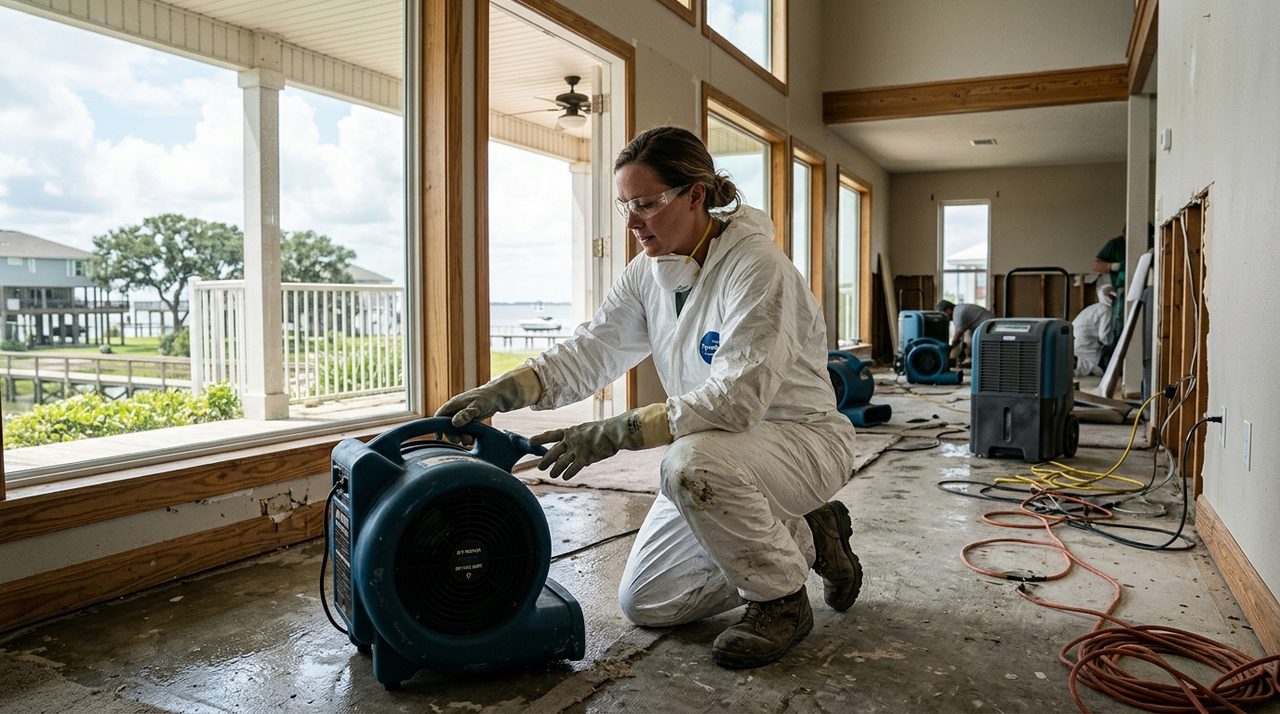
- Median home built
- 1984
- Median home value
- $212,500
- FEMA flood zone
- X (low)
- Typical mitigation cost (est.)
- $3,500–$40,000
- Most common local issue
- Clay-soil moisture wicking into older ranch slab edges after storms
Ranked by verified Google rating × review volume × verification tier. How we rank →
Some highly-rated pros serve Alvin from nearby and may not keep a Alvin street address. Those are listed under "Also serving Alvin" with their real city and distance, so you always know where each business is based.
Min rating:
10 resultsAlso serving Alvin
Highly-rated pros based nearby who cover Alvin. Distance shown from the Alvin area.
Open Now
Serving Alvin Based in Pearland · 7 mi away
Serving Alvin Based in League City · 7.3 mi away
Open Now
Serving Alvin Based in Friendswood · 7.8 mi away
Open Now
Serving Alvin Based in Friendswood · 8.1 mi away
Open Now
Serving Alvin Based in Friendswood · 8.3 mi away
Serving Alvin Based in Dickinson · 9.2 mi away
Open Now
Serving Alvin Based in League City · 9.4 mi away
Open Now
Serving Alvin Based in Webster · 9.6 mi away
Water & Flood Restoration in Alvin: What You Should Know
Brazoria Clay Keeps Slabs Saturated Long After Stormwater Recedes
Why it matters to you
Alvin sits on the same expansive Beaumont/Houston Black clay belt that causes foundation movement throughout Southeast Houston, and that same soil's low permeability means floodwater or heavy-rain intrusion doesn't drain away from your slab perimeter — it stays pressed against the concrete for weeks. For the city's large inventory of 1960s–1980s ranch slabs, that prolonged contact saturates bottom plates, wicks into drywall, and can trigger mold growth well after a homeowner thinks the house is dry. You won't see it from the surface, which is why so many Alvin homeowners discover the problem only when a musty smell develops months later.
What a good pro does
A qualified restoration contractor will use calibrated moisture meters and thermal imaging cameras to map slab-edge saturation before deploying desiccant dehumidifiers and directional air movers sized for the square footage — not just visible wet areas. IICRC S500 standards set the drying timeline and documentation requirements; the contractor should provide daily moisture logs so your insurer can't dispute that drying was completed properly. If mold has already taken hold, the remediation firm must hold a TDLR-issued Mold Remediation Contractor (MRC) license before touching affected materials.
Sources: IICRC (water/mold restoration standards), Texas Department of Licensing & Regulation
Aging Ranch-Home Flex Duct Becomes a Mold Incubator After Any Inundation
Why it matters to you
A significant portion of Alvin's pre-2000 ranch homes were built with attic-run flex duct systems, and that insulation-wrapped duct absorbs moisture during extended inundation or even prolonged high-humidity conditions that follow a tropical event. Brazoria County's Gulf Coast position means Alvin can see multi-day sustained humidity above 90% after a storm system stalls — exactly the conditions under which Cladosporium and Aspergillus colonize damp flex duct within 48–72 hours. Homeowners who restore flooring and drywall but leave saturated ductwork in place are essentially seeding spores back into living space every time the air handler runs.
What a good pro does
Restoration scope in any Alvin home built before 2000 should include a duct moisture inspection as a line item, not an afterthought. Contractors should use a borescope or duct probe alongside moisture readings at supply boots; duct sections reading above acceptable baselines per IICRC S500 should be replaced, not dried in place. Replacement duct work requires a mechanical permit pulled through the City of Alvin Permits & Inspections office, and the inspection must be scheduled and passed before insulation is replaced over the new runs.
Sources: IICRC (water/mold restoration standards), Municipal permit office (see area profile)
Wind-Driven Rain Through Newer Brick Veneer and Older Window Flanges
Why it matters to you
Alvin's newer DR Horton and comparable production homes feature brick veneer cladding, and the May 2024 derecho — which tracked through the Houston metro with sustained winds well above 70 mph — demonstrated that weep holes, improperly flashed window flanges, and soffit vents can admit enough wind-driven rain to saturate wall cavities without a drop of visible interior flooding. Older 1970s ranch homes with original single-pane aluminum windows are even more vulnerable; the window-to-framing interface on those installations was not designed for the lateral water pressure a Gulf-coast derecho delivers. In both cases, the water infiltration point is above grade, so it looks nothing like conventional flood damage.
What a good pro does
Post-storm inspections should include thermal imaging of all exterior walls, not just areas with visible staining, because the infiltration path typically runs from the soffit or window head down through wall sheathing to the bottom plate — and the thermal signature disappears once ambient temps equalize. Contractors must document the water source (wind-driven rain, not groundwater or sewer) because the IICRC S500 classification and the resulting demo scope differ significantly from a Category 3 bayou flood. Structural drying work and any window or sheathing replacement triggered by the investigation require permits from the City of Alvin.
Sources: IICRC (water/mold restoration standards), Municipal permit office (see area profile)
HOA Architectural Rules in Newer Subdivisions Can Slow Emergency Demo
Why it matters to you
Alvin's growing subdivisions — including Forest Heights (managed by Goodwin & Co.) and Watermark — carry mandatory HOA or POA covenants that typically govern exterior work, dumpster placement, and visible material removal. IICRC S500 calls for drying initiation within 24–48 hours of water intrusion to prevent a Category 2 loss from escalating to Category 3 (sewage-contaminated, requiring full demo of all porous materials). If an HOA architectural review requirement slows exterior demo or restricts where a roll-off container can sit, that clock keeps running and your remediation cost can jump substantially. Older in-town Alvin neighborhoods without an organized HOA face none of this friction, giving homeowners in those areas a meaningful head start on drying timelines.
What a good pro does
In HOA-governed subdivisions, confirm before signing any restoration contract that the firm has experience navigating the specific POA's emergency-work protocols — some allow expedited verbal approval for documented storm damage when followed by written submission within 72 hours. The contractor should pull demolition and any required trade permits from the City of Alvin concurrently with HOA notification rather than sequentially. Keep a written record of every HOA communication with timestamps; if an insurer later disputes the remediation scope or timeline, that paper trail substantiates why work began when it did.
Sources: Local HOA / deed restrictions (see area profile), IICRC (water/mold restoration standards), Municipal permit office (see area profile)
Water & Flood Restoration in Alvin: What You Should Know
Hiring water & flood restoration in Alvin? Alvin's housing stock spans decades, from 1960s–1980s ranch homes in established neighborhoods to 2020s production-builder subdivisions like Watermark and Forest Heights. Homeowners here navigate a patchwork of mandatory HOAs in newer plats and minimal restrictions in older areas, with all permitting handled through the City of Alvin rather than Houston. The flat Brazoria County clay soils and Gulf proximity make foundation maintenance, drainage management, and hurricane preparedness central to the home services picture.
- Housing era
- Mixed
- Foundation
- Predominantly slab-on-grade for post-1960 subdivisions and all new construction
- Flood zone
- FEMA Zone X (low flood risk) per official NFHL data
- Permits
- City of Alvin Permits & Inspections (Alvin is an incorporated city with its own…
Housing stock & systems
Building era
Mixed: significant 1960s–1980s older stock plus substantial 2000s–2020s new construction.
Typical style
Ranch-style suburban tract homes in older areas; contemporary traditional brick/stone veneer production homes (DR Horton and similar) in newer subdivisions; some rural custom and farmhouse-style homes on larger lots.
Foundations
Predominantly slab-on-grade for post-1960 subdivisions and all new construction; some pier-and-beam may exist in pre-1960 central-town homes, but percentage is not confirmed.
Common systems
Newer homes feature modern forced-air HVAC, PEX or CPVC plumbing, and 200-amp electrical panels. Older 1960s–1980s homes may have original galvanized or copper plumbing, R-22 refrigerant HVAC units approaching or past end-of-life, and 100–150 amp electrical panels. Ductwork in older slab homes typically runs through attic space.
What that means for repairs
Older ranch homes commonly undergo HVAC replacements, kitchen and bathroom remodels, and re-plumbing from galvanized to PEX. Foundation repair on slab homes is a recurring need due to expansive clay soils. Newer subdivisions see relatively little renovation activity but may require warranty-period punch-list work and landscape/drainage improvements.
Permits & restrictions
Permit jurisdiction
City of Alvin Permits & Inspections (Alvin is an incorporated city with its own permitting authority; unincorporated fringe areas fall under Brazoria County Engineering).
HOA & deed restrictions
Many newer subdivisions have mandatory HOAs/POAs (e.g., Forest Heights POA managed by Goodwin & Co., Watermark Residential Community, Inc.). Older in-town areas and rural lots may have only recorded deed restrictions or no organized HOA at all. There is no single citywide HOA. Specific HOA status must be verified at the parcel level via the Texas HOA registry or Brazoria County Clerk records.
Historic districts
No historic district designation confirmed. Alvin is an independent city and is not subject to Houston's HAHC historic preservation overlay.
Contractor note
Contractors must pull permits through the City of Alvin for work within city limits, which has its own inspection schedules and code enforcement separate from Houston. For properties in unincorporated Brazoria County near Alvin, verify jurisdiction before pulling permits.
Flood & weather
FEMA flood zone
FEMA Zone X (low flood risk) per official NFHL data. However, Alvin sits in flat Brazoria County terrain with proximity to Mustang Bayou and Chocolate Bayou watersheds; localized street flooding can occur during extreme rainfall events even in Zone X areas.
Hurricane Harvey impact
Brazoria County experienced significant Harvey-related flooding, particularly along the Brazos and San Bernard Rivers. Research did not confirm specific street-level inundation details for Alvin's residential subdivisions; however, the broader Brazoria County flooding context suggests some areas of Alvin likely experienced impacts. Homeowners should check individual property flood history through Brazoria County records and FEMA claims data for parcel-specific Harvey impact.
Heat & humidity load
Extreme heat and humidity drive heavy HVAC demand from May through October; older units in 1960s–1980s homes are particularly vulnerable to failure during peak summer. Attic-run ductwork in slab-on-grade homes can degrade insulation efficiency. High humidity also contributes to mold risk in poorly ventilated areas and accelerates exterior paint and siding deterioration.
Working with contractors here
Contractors in Alvin most commonly handle HVAC replacement and repair, foundation leveling on slab-on-grade homes affected by expansive clay soils, and re-plumbing of older galvanized systems. Roofing work is frequent due to Gulf Coast storm exposure, and newer subdivisions generate steady demand for fence installation, patio covers, and landscape drainage solutions. Job scoping should account for the wide variation in housing age—a 1970s ranch home will present very different electrical and plumbing conditions than a 2022 DR Horton build. Contractors should also verify whether a property falls within Alvin city limits or unincorporated Brazoria County, as permitting requirements differ significantly.
Local Tip
Always ask for a written estimate before work begins. Texas contractors are required to provide one on jobs over $1,000.
About Alvin
Alvin's housing stock spans decades, from 1960s–1980s ranch homes in established neighborhoods to 2020s production-builder subdivisions like Watermark and Forest Heights. Homeowners here navigate a patchwork of mandatory HOAs in newer plats and minimal restrictions in older areas, with all permitting handled through the City of Alvin rather than Houston. The flat Brazoria County clay soils and Gulf proximity make foundation maintenance, drainage management, and hurricane preparedness central to the home services picture.
- Median year built
- 1984
- Median home value
- $212,500
- Owner-occupied
- 57.8%
- Population
- 27,700
- Housing units
- 12,073
- Median income
- $68,769
Source: U.S. Census Bureau, ACS 5-Year 2023
Flood & storm risk
FEMA Zone XLow flood riskMost of Alvin maps to FEMA Zone X (low mapped flood risk), but Houston's flash-flood reality means even low-risk blocks benefit from smart drainage and storm-hardened installs; as a Brazoria County coastal community, tropical surge and wind add a layer generic guidance misses.
Source: FEMA National Flood Hazard Layer (NFHL). Flood zones vary by parcel — verify your individual FIRM panel.
Houston Storm Readiness in Alvin
Hurricane & flooding
Zone X mapping offers no guarantee in Houston's flat topography, so have a water-restoration contractor identify the fastest flood-entry paths into your Alvin, TX home — typically garage thresholds, HVAC closets, and exterior door sweeps — and pre-stage extraction equipment contacts. Acting in the first 24 hours after inundation is the difference between a dryout and a full mold remediation. As a Brazoria County community, Alvin may follow county rather than City of Houston storm rebuild rules.
Severe storms & hail
Straight-line winds exceeding 80 mph, as recorded during the 2024 derecho, broke seals on sliding glass doors and drove water into flooring assemblies throughout Alvin, TX neighborhoods with no prior flood history. Contact a licensed Texas restoration firm — TDLR regulates their mold-assessment and remediation work — to inspect and dry any affected areas before summer humidity accelerates microbial growth. As a Brazoria County community, Alvin may follow county rather than City of Houston storm rebuild rules.
Ice storms & freezes
A hard freeze in Alvin, TX can split a single supply line and deposit 50 or more gallons of water into a ceiling assembly before a homeowner locates the shutoff, and that volume requires more than fans and open windows to dry safely. Texas law under TDLR requires mold assessors and remediators to hold specific licenses, so verify your restoration contractor's credentials before you need them under emergency conditions. With a median build year of 1984, the older building stock here is more exposed to hard-freeze damage than newer construction. As a Brazoria County community, Alvin may follow county rather than City of Houston storm rebuild rules.
Sources: FEMA National Flood Hazard Layer (NFHL), Ready.gov -- Hurricanes, CenterPoint Energy -- Storm Center, City of Houston -- Emergency Preparedness, Ready.gov -- Winter Weather, Harris County Flood Control District
Free Alvin Tools & Calculators
Houston-specific estimators to plan your project before you call a pro. All results are planning estimates — a licensed local pro confirms the details on site.
Houston Freeze Prep & Pipe Insulation Checklist
Open full tool & FAQ →Your freeze checklist — 4 tasks
- 1
Disconnect & drain every outdoor hose bib
Remove hoses, drain the spigots, and cover each with an insulated faucet sock. Un-drained hose bibs are the #1 burst point in a Houston freeze.
- 2
Insulate exposed pipes in the attic & garage
Wrap any pipe in an unconditioned space (attic runs, garage walls) with foam sleeves. Houston homes rarely insulate these because they only matter a few nights a year — which is exactly why they burst.
- 3
Open cabinet doors & keep a pencil-width drip
On hard-freeze nights, open kitchen/bath cabinets so warm air reaches the pipes and let faucets on exterior walls drip to relieve pressure.
- 4
Protect the attic/garage water heater & its lines
An attic or garage tank sits in unconditioned space. Insulate the cold-inlet and hot-outlet lines and confirm the emergency drain pan is clear so a leak doesn't reach the ceiling.
This is a planning estimate only — actual requirements depend on an on-site assessment by a licensed Houston pro. If a pipe has already burst, shut off your main water supply and call a licensed Houston plumber immediately — freeze bursts flood fast.
Frequently Asked Questions
Do I need a permit from the City of Alvin to tear out flood-damaged drywall and flooring in my home?
Yes — structural demolition work after water damage requires a permit through the City of Alvin Permits & Inspections office, not the City of Houston or Brazoria County (unless your property sits in unincorporated county land just outside city limits, in which case Brazoria County Engineering is the authority). Your restoration contractor typically pulls the demo permit, while any licensed plumber or electrician working on exposed systems must pull their own trade permits separately. Skipping this step can delay the Certificate of Completion your insurance carrier needs to close the claim.
Sources: Municipal permit office (see area profile)Texas Department of Licensing & Regulation
My Alvin home was built in the 1970s and sits in FEMA Zone X — will my insurance company still cover a full restoration scope if it floods from a tropical storm?
FEMA Zone X indicates low mapped flood risk, but it does not limit what your homeowner's policy must cover for storm-driven water intrusion or pipe-related losses — those are separate policy questions entirely. The more important issue for a 1970s Alvin ranch home is how your insurer classifies the water source: bayou or street overflow is Category 3 (black water) under IICRC S500 standards, which requires full demo of porous materials to at least 12 inches above the flood line regardless of flood zone. Document the water source and have your contractor photograph the entry point to prevent the insurer from reclassifying the loss to a lower category with a smaller payout.
Sources: IICRC (water/mold restoration standards)FEMA National Flood Hazard Layer (NFHL)
How long does the structural drying phase realistically take for a 1980s slab-on-grade ranch home in Alvin after a major rainstorm?
For a typical 1,500–2,500 sq ft slab home on Brazoria County Black clay, budget 5–10 days of active drying as an estimate — longer than you might expect because the clay soil holds moisture against the slab perimeter and wicks it back into bottom plates even after surface water disappears. IICRC S500 standards call for drying equipment to be placed within 24–48 hours of water entry to prevent Category 2 loss from escalating to Category 3, so speed of mobilization matters as much as total runtime. Your contractor should use moisture meters and thermal imaging to confirm the slab edge and wall cavities reach drying goals before equipment is pulled.
My newer DR Horton home in a Forest Heights or Watermark subdivision has a POA — do I need architectural approval before a restoration crew can start tearing out water-damaged materials?
For interior demo work that isn't visible from the street, most POAs in Alvin's newer subdivisions won't require prior architectural approval, but exterior items — dumpster placement, removed siding or windows left exposed, temporary tarps — often do fall under review rules managed by groups like Goodwin & Co. Contact your POA management company the same day water damage occurs and ask specifically about emergency work provisions, which many governing documents include to allow faster action. Waiting on a standard review cycle can push a manageable Category 2 loss toward Category 3 territory within 48–72 hours.
Sources: Local HOA / deed restrictions (see area profile)
I suspect my 1970s Alvin ranch home still has galvanized pipe — what restoration issues come up if one of those lines bursts during a freeze or corrodes through?
Galvanized supply lines common in Alvin's pre-1980s housing stock are both corrosion-prone and slow to drain after a burst, meaning water can wick into wall cavities and attic framing for hours before anyone notices — especially in rarely opened utility spaces. Any plumber making the line repair must be licensed through TSBPE, and if the wall cavity is opened during demo, a TDLR-licensed mold assessment consultant should evaluate whether residual moisture from prior small leaks has already generated microbial growth before drywall is closed back up. Mold remediation costs for a localized pipe-burst scope in Alvin typically run $2,500–$6,000 as an estimate depending on how far moisture has traveled.
Sources: Texas State Board of Plumbing ExaminersTexas Department of Licensing & Regulation
When is the worst time of year to have a slow roof leak or hidden wall moisture go unaddressed in Alvin, and why does the season matter for restoration outcomes?
Late spring through early September is the highest-risk window: Alvin's Gulf Coast humidity regularly exceeds 74% and outdoor temps stay above 90°F, which means any hidden moisture in wall cavities or attic ductwork reaches mold-growth conditions (Cladosporium, Aspergillus) within 48–72 hours of initial saturation. That same period is also peak hurricane and tropical storm season for Brazoria County, so a slow leak discovered in July may be competing for contractor availability right when demand spikes after a named storm. Getting a TDLR-licensed mold assessment done promptly — rather than waiting to see if the issue dries on its own — is especially important from June through September in this climate.
Sources: Texas Department of Licensing & RegulationIICRC (water/mold restoration standards)