Open Now
2500 Yale St Suite B19, Houston, TX 77008
Lazybrook and Timbergrove's 1950s–1960s brick ranch homes sit within blocks of White Oak Bayou inside the 610 Loop, combining aging galvanized drain lines and early-generation flex ductwork with Houston's Black clay soil—a combination that turns even a moderate plumbing failure or wind-driven rain event into a weeks-long drying project. FEMA maps most of the neighborhood in Zone X, but that designation describes mapped flood plains, not the reality of clay soil that sheds surface water slowly and holds moisture against slab edges long after the rain stops. Understanding exactly what restoration work triggers City of Houston permits—and when the Timbergrove Manor Civic Club design review must happen first—is the difference between a clean insurance close-out and a stalled repair.
Ranked by verified Google rating × review volume × verification tier. How we rank →
Some highly-rated pros serve Lazybrook / Timbergrove from nearby and may not keep a Lazybrook / Timbergrove street address. Those are listed under "Also serving Lazybrook / Timbergrove" with their real city and distance, so you always know where each business is based.
2500 Yale St Suite B19, Houston, TX 77008
3434 Washington Ave D, Houston, TX 77007
Highly-rated pros based nearby who cover Lazybrook / Timbergrove. Distance shown from the Lazybrook / Timbergrove area.
Serving Lazybrook / Timbergrove Based in Spring Branch · 1.3 mi away
Serving Lazybrook / Timbergrove Based in Spring Branch · 2.5 mi away
Serving Lazybrook / Timbergrove Based in Galleria · 3.7 mi away
Serving Lazybrook / Timbergrove Based in Spring Branch · 3.8 mi away
Serving Lazybrook / Timbergrove Based in Acres Homes · 3.9 mi away
Serving Lazybrook / Timbergrove Based in Tanglewood · 3.9 mi away
Serving Lazybrook / Timbergrove Based in Acres Homes · 4.1 mi away
Serving Lazybrook / Timbergrove Based in Upper Kirby · 4.3 mi away
Why it matters to you
The ranch homes built throughout Lazybrook and Timbergrove in the 1950s and 1960s were plumbed with galvanized steel supply lines and cast-iron drain lines that are now 60-plus years old. When Winter Storm Uri (February 2021) swept through inside-the-Loop neighborhoods, uninsulated supply lines in unconditioned attic spaces and exterior wall chases burst, and many owners patched the visible break without fully drying the wall cavity behind it. A restoration contractor called today for any water event—a slab leak, a roof intrusion, a localized flood—routinely opens walls and finds Uri-era microbial growth that must be remediated before new materials can go in.
What a good pro does
A qualified restoration crew will use moisture meters and thermal imaging to scan wall cavities adjacent to any known or suspected pipe route before closing the scope, not just the area of visible damage. Mold assessment and remediation in Texas requires a TDLR-issued Mold Remediation Contractor license; plumbing line repairs or replacements exposed during demo require a TSBPE-licensed plumber who pulls a separate trade permit through the City of Houston Permitting Center. Scoping the full pipe condition—not just the failed section—during an active restoration project prevents a second mobilization six months later.
Sources: Texas Department of Licensing & Regulation, Texas State Board of Plumbing Examiners, City of Houston Permitting Center
Why it matters to you
Lazybrook and Timbergrove sit on Houston's expansive Beaumont Clay, and because 1950s–1960s construction in this corridor includes both slab-on-grade and pier-and-beam foundations—often mixed within the same block—the post-flood drying timeline differs dramatically by property. On slab homes, the dense clay retains moisture against the slab perimeter and wicks it into bottom plates and drywall for weeks after standing water is gone. On pier-and-beam homes, the crawl space itself can trap humidity that migrates upward into subfloor framing. Neither scenario is visible to the naked eye once the floor is dried and fans are running.
What a good pro does
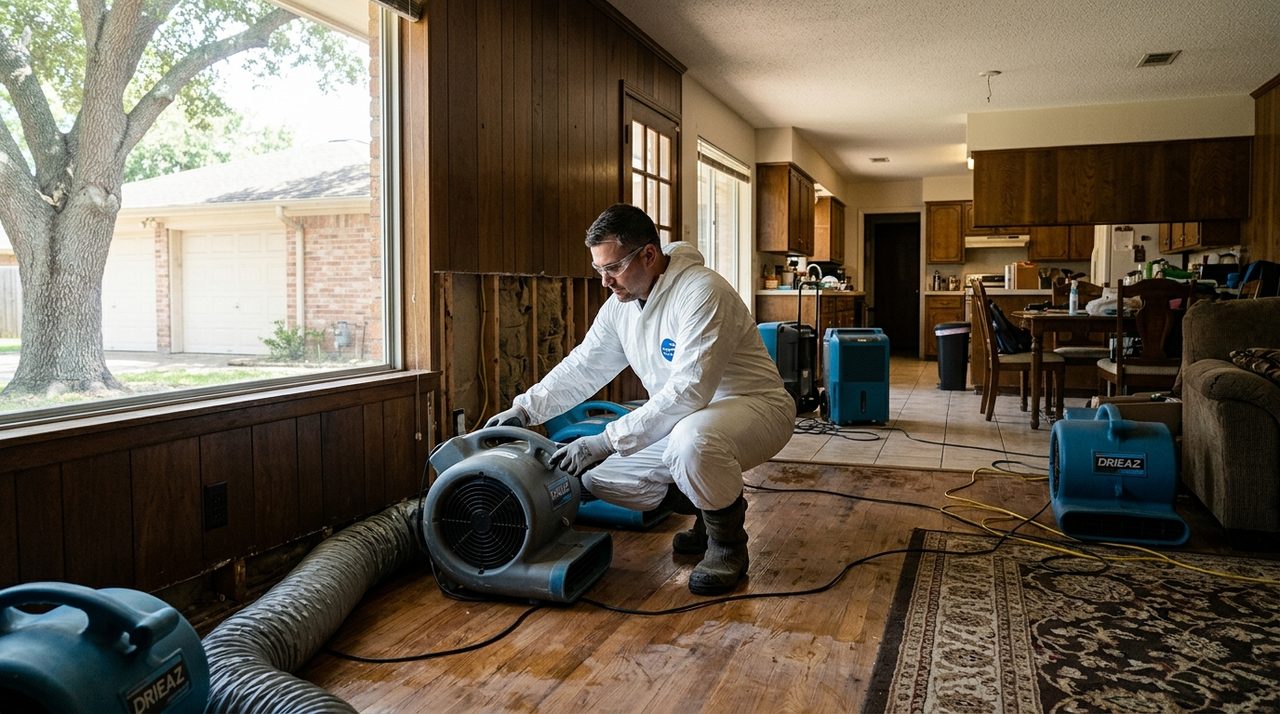
IICRC S500 standards require drying validation through measured moisture content in structural materials, not just surface readings or elapsed time. A restoration contractor should set calibrated drying equipment, map the moisture readings daily, and provide documentation of final readings at or below IICRC-specified reference values before any flooring or drywall is reinstalled. This documentation also supports the insurance claim and protects the homeowner from a future mold dispute. Verify which foundation type is present at the specific address before scoping equipment placement.
Sources: IICRC (water/mold restoration standards), Harris County Flood Control District
Why it matters to you
Original ranch homes in Lazybrook and Timbergrove that have not had full HVAC replacements are likely to have flex duct systems installed in the 1980s or 1990s—ductwork whose fiberglass batt insulation absorbs and retains moisture from a single flood or pipe event. Houston's average relative humidity of 74 percent and summer temperatures above 90°F mean that any moisture held inside a duct lining creates conditions where Cladosporium and Aspergillus can establish within 48 to 72 hours of the initial exposure. If the air handler was running during or immediately after water entry, spores circulate throughout the living area.
What a good pro does
A thorough restoration scope for any Lazybrook or Timbergrove home with pre-2000 flex duct includes a duct inspection—opening return and supply connections at the air handler—and moisture testing inside the duct lining, not just a visual pass. If the insulation batting tests above acceptable moisture content, full duct replacement is the code-consistent and IICRC-aligned answer; surface drying the exterior of a saturated flex duct does not restore the interior batting. Any mold remediation inside ductwork must be performed by a TDLR-licensed Mold Remediation Contractor, and the duct replacement itself should be permitted through the City of Houston as a mechanical trade permit.
Sources: IICRC (water/mold restoration standards), Texas Department of Licensing & Regulation, City of Houston Permitting Center
Why it matters to you
When a water event in Timbergrove requires exterior demo—removing damaged brick veneer sections, replacing a breached soffit, pulling out rotted window framing after wind-driven rain intrusion—the Timbergrove Manor Civic Club requires design review approval before the City of Houston will issue permits for new construction or major exterior modifications. IICRC S500 calls for drying initiation within 24 to 48 hours of water entry to prevent Category 2 conditions from escalating; delays waiting on an approval cycle can push a manageable loss into a deeper remediation scope. This is not a theoretical concern—the TMCC actively enforces deed restrictions on exterior work in the neighborhood.
What a good pro does
Experienced restoration contractors working in Timbergrove build civic club notification into their day-one emergency response rather than treating it as an afterthought. For interior mitigation that does not touch exterior surfaces, City of Houston permits can often proceed without TMCC review, allowing structural drying to begin immediately. Exterior scope—material replacement, cladding, window units—should be separated into a second permit package that moves through the TMCC design review in parallel with interior drying, so reconstruction can start without interruption once the structure is dry and the permit is in hand.
Sources: Local HOA / deed restrictions (see area profile), City of Houston Permitting Center, IICRC (water/mold restoration standards)
Hiring water & flood restoration in Lazybrook / Timbergrove? Lazybrook/Timbergrove is defined by 1950s–1960s ranch-style brick homes inside the 610 Loop, many of which are now reaching the age where major systems need replacement or full renovation. Proximity to White Oak Bayou introduces flood-risk considerations for any ground-level work, and the Timbergrove Manor Civic Club requires design review approval before permitting for new construction and renovations, adding a step contractors must plan for.
Building era
1950s–1960s, with ongoing infill and teardown rebuilds.
Typical style
One-story, mid-century ranch-style brick homes; newer two-story infill construction is increasing.
Foundations
Not confirmed from available sources - both slab-on-grade and pier-and-beam are common in 1950s–1960s Houston construction. Verify on a per-property basis.
Common systems
Original homes likely have galvanized or cast-iron drain lines, copper supply lines, older electrical panels (60–100 amp), and aging central HVAC systems. Many have undergone partial updates over the decades.
What that means for repairs
Teardowns and full rebuilds are common as land values inside the Loop have risen. Whole-home remodels of original ranches are also frequent, including kitchen and bath modernizations, re-plumbing, and electrical panel upgrades. Timbergrove Manor Civic Club requires design review before City of Houston permitting for new construction and major renovations.
Permit jurisdiction
City of Houston Permitting Center (neighborhood is within Houston city limits, inside the 610 Loop).
HOA & deed restrictions
No mandatory master HOA. Governance is through civic clubs: Timbergrove Manor Civic Club (TMCC, 501(c)(4)) and Lazybrook Civic Club. Deed restrictions are enforced at the subdivision level and vary by section. Whether civic club dues are legally mandatory varies by section and is not definitively documented in public-facing materials.
Historic districts
No City of Houston historic district designation confirmed. HAHC Certificates of Appropriateness are not required for exterior work based on available research.
Contractor note
Contractors working in Timbergrove must obtain civic club design review approval before applying for City of Houston permits for new construction and major renovations. Deed restrictions vary by section, so scope of work and exterior modifications should be verified against the specific lot's recorded restrictions.
FEMA flood zone
FEMA Zone X (low flood risk) per official NFHL data. However, the neighborhood borders White Oak Bayou, and properties closer to the bayou may carry higher effective flood risk. Individual properties should be checked against HCFCD inundation maps and may require elevation certificates.
Hurricane Harvey impact
Specific Harvey 2017 impact data for Lazybrook/Timbergrove is not available from the sources reviewed. The neighborhood's adjacency to White Oak Bayou suggests some homes near the bayou likely experienced flooding, but street-level or block-level inundation data was not confirmed. Check HCFCD Harvey inundation maps and Harris County Repetitive Loss/Severe Repetitive Loss lists for property-specific history.
Heat & humidity load
Original 1950s–1960s homes with aging HVAC systems face heavy summer cooling loads. Older ductwork in attics or crawlspaces may be poorly insulated, driving up energy costs. Pier-and-beam homes (where present) may see moisture-related issues under the house during Houston's humid summers. Bayou-adjacent lots may experience increased mosquito pressure and standing water concerns.
Working with contractors here
The dominant work in Lazybrook/Timbergrove involves either full teardown-and-rebuild projects or deep renovations of 60–70-year-old ranch homes. Re-plumbing (replacing galvanized or cast-iron lines), electrical panel upgrades, and HVAC replacement are among the most common system jobs. Foundation evaluation is important given the age of the housing stock, though the predominant foundation type is not uniformly documented. Contractors should budget time for Timbergrove Manor Civic Club design review when scoping exterior-facing or new construction work, as this approval is required before the City of Houston will issue permits. Flood risk near White Oak Bayou should be assessed before any ground-level or below-grade scope, including foundation work and landscaping drainage.
Local Tip
Always ask for a written estimate before work begins. Texas contractors are required to provide one on jobs over $1,000.
Lazybrook/Timbergrove is defined by 1950s–1960s ranch-style brick homes inside the 610 Loop, many of which are now reaching the age where major systems need replacement or full renovation. Proximity to White Oak Bayou introduces flood-risk considerations for any ground-level work, and the Timbergrove Manor Civic Club requires design review approval before permitting for new construction and renovations, adding a step contractors must plan for.
Source: U.S. Census Bureau, ACS 5-Year 2023
Most of Lazybrook / Timbergrove maps to FEMA Zone X (low mapped flood risk), but Houston's flash-flood reality means even low-risk blocks benefit from smart drainage and storm-hardened installs.
Source: FEMA National Flood Hazard Layer (NFHL). Flood zones vary by parcel — verify your individual FIRM panel.
Water-restoration companies serving Lazybrook / Timbergrove can install or recommend backflow prevention add-ons on floor drains and advise on contents-elevation strategies that limit category-2 water contact during a tropical event. The May 2024 derecho reminded Houston homeowners that extreme rain is not exclusive to named hurricanes, making year-round readiness essential. In-city Lazybrook / Timbergrove work falls under City of Houston floodplain and permitting rules.
For homeowners in Lazybrook / Timbergrove: the May 2024 derecho caused widespread roof-deck separation across Houston, and the subsequent rainfall introduced water into attic insulation that retained moisture for weeks — a restoration contractor with desiccant drying equipment can address these attic assemblies that conventional fans cannot reach. Documenting the drying process with daily moisture logs also supports insurance claims for wind-and-water combined losses. In-city Lazybrook / Timbergrove work falls under City of Houston floodplain and permitting rules.
Ice accumulation on exterior pipe chases and uninsulated attic runs caused widespread freeze-and-burst events across Lazybrook / Timbergrove during Uri 2021, and the resulting water losses required IICRC-trained technicians with commercial dehumidifiers to dry out wall and ceiling cavities that building materials alone could not off-gas. Confirming you have a preferred restoration contractor's number before a freeze forecast arrives eliminates critical delays when crews are in high demand across the metro. In-city Lazybrook / Timbergrove work falls under City of Houston floodplain and permitting rules.
Sources: FEMA National Flood Hazard Layer (NFHL), Ready.gov -- Hurricanes, CenterPoint Energy -- Storm Center, City of Houston -- Emergency Preparedness, Ready.gov -- Winter Weather, Harris County Flood Control District
Houston-specific estimators to plan your project before you call a pro. All results are planning estimates — a licensed local pro confirms the details on site.
Disconnect & drain every outdoor hose bib
Remove hoses, drain the spigots, and cover each with an insulated faucet sock. Un-drained hose bibs are the #1 burst point in a Houston freeze.
Insulate exposed pipes in the attic & garage
Wrap any pipe in an unconditioned space (attic runs, garage walls) with foam sleeves. Houston homes rarely insulate these because they only matter a few nights a year — which is exactly why they burst.
Open cabinet doors & keep a pencil-width drip
On hard-freeze nights, open kitchen/bath cabinets so warm air reaches the pipes and let faucets on exterior walls drip to relieve pressure.
Protect the attic/garage water heater & its lines
An attic or garage tank sits in unconditioned space. Insulate the cold-inlet and hot-outlet lines and confirm the emergency drain pan is clear so a leak doesn't reach the ceiling.
This is a planning estimate only — actual requirements depend on an on-site assessment by a licensed Houston pro. If a pipe has already burst, shut off your main water supply and call a licensed Houston plumber immediately — freeze bursts flood fast.
Sources: City of Houston Permitting CenterFEMA National Flood Hazard Layer (NFHL)
Sources: Local HOA / deed restrictions (see area profile)City of Houston Permitting Center